Executive Summary
Let’s be clear on background before discussing the article itself.
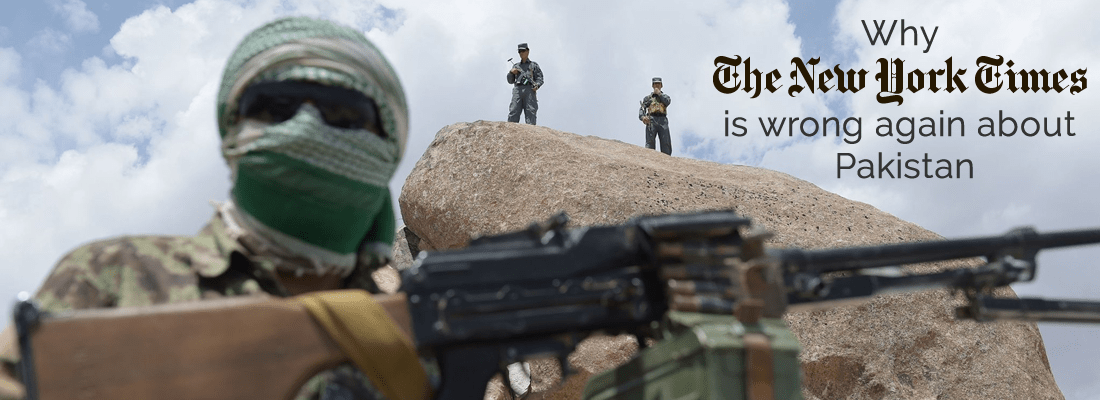
The New York Times has long considered itself an expert on Afghanistan and Pakistan, based on the sheer number of articles and books that have been published by staffers.
Having said that, let’s also be clear that these same staffers have no influence on the editorial board, who have written nothing of substance on the same topics. Everything has been opinion, colored with manipulations of facts.
Let’s look at some articles and editorials on Pakistan from this newspaper of record:
October 2015: Is Pakistan Worth America’s Investment
Nov 2015: Pakistan Military Expands Its Power, and is Thanked For Doing So
Nov 2015: The Pakistan Nuclear Nightmare
Feb 2016: Pakistan’s Hand in the Rise of International Jihad
Apr 2016: Afghan President Demands Pakistan Take Military Action Against Taliban
Let’s also understand that repeated under democratically elected governments, journalists from The New York Times have been declared persona non-grata and asked to leave the country. Many on the desks of the NYT will say that it was Pakistan’s “powerful army and intelligence services” that have forced them out, but that’s just not the case.
Readers will recall the international outcry when the front page of Pakistan’s Express Tribune published a blank page where Carlotta Gall’s book, The Wrong Enemy, excerpt was to appear. Pakistan’s premier intelligence service was again blamed for attempting to control journalistic freedom of speech.
Let’s not forget the fact that this same newspaper ran a story a few months prior to Carlotta Gall’s book release that pointed the finger right at Kabul and Karzai for the Tehrik-e-Taliban Pakistan (TTP), responsible for over 80,000 deaths in Pakistan. When Latif Mehsud, a senior commander of the TTP, was arrested in Afghanistan by ISAF forces, it was Kabul that went crazy, not Islamabad.
Mehsud was later handed over to Pakistan.
Here’s how that story started:
“A bungled attempt by the Afghan government to cultivate a shadowy alliance with Islamist militants escalated into the latest flash point in the troubled relationship between Afghanistan and the United States, according to new accounts by officials from both countries.
The disrupted plan involved Afghan intelligence trying to work with the Pakistan Taliban (Tehrik-e-Taliban Pakistan), allies of Al Qaeda, in order to find a trump card in a baroque regional power game that is likely to intensify after the American withdrawal next year, the officials said. And what started the hard feelings was that the Americans caught them red-handed.
Tipped off to the plan, United States Special Forces raided an Afghan convoy that was ushering a senior Pakistan Taliban militant, Latif Mehsud, to Kabul for secret talks last month, and now have Mr. Mehsud in custody.
Publicly, the Afghan government has described Mr. Mehsud as an insurgent peace emissary. But according to Afghan officials, the ultimate plan was to take revenge on the Pakistani military.”
Seems that the editorial board doesn’t read their own newspaper.