3 Key Takeaways
- Accelerated State Collapse: The March–April 2026 war has deepened the collapse of Lebanon’s public administration, displacing 18% of the population and overwhelming local services.
- Marginalization of the LAF: The national army’s decision to remain neutral during the conflict highlights the state’s lack of military authority and its inability to control its own territory.
- Disruption of Parallel Finance: Target strikes on Al-Qard al-Hassan have disrupted Hezbollah’s parallel financial system, reducing local liquidity and increasing financial pressure on civilian populations.
Executive Summary
The state of Lebanon is undergoing a severe process of institutional liquefaction. This long-standing economic and political crisis escalated sharply following the outbreak of a major military conflict between Israel and Hezbollah on March 2, 2026. Triggered by regional escalations, this war resulted in over 3,500 Israeli strikes targeting Hezbollah’s infrastructure, command networks, and financial offices across the country.
By the time a fragile 10-day ceasefire took effect on April 16, 2026, the conflict had displaced over 1.2 million Lebanese citizens,representing roughly 18% of the country’s population. This sudden movement of people put immense pressure on a state infrastructure that was already suffering from years of neglect, corruption, and financial default.
This dossier analyzes the breakdown of Lebanon’s official governance structures, the marginalization of the Lebanese Armed Forces (LAF), the impact of the war on Hezbollah’s parallel financial institutions, and the growing humanitarian crisis.
The March–April 2026 Conflict: Catalyst for Collapse
The brief but high-intensity conflict between Israel and Hezbollah shattered the remaining capacity of Lebanon’s state institutions.
Displacement and Municipal Strain
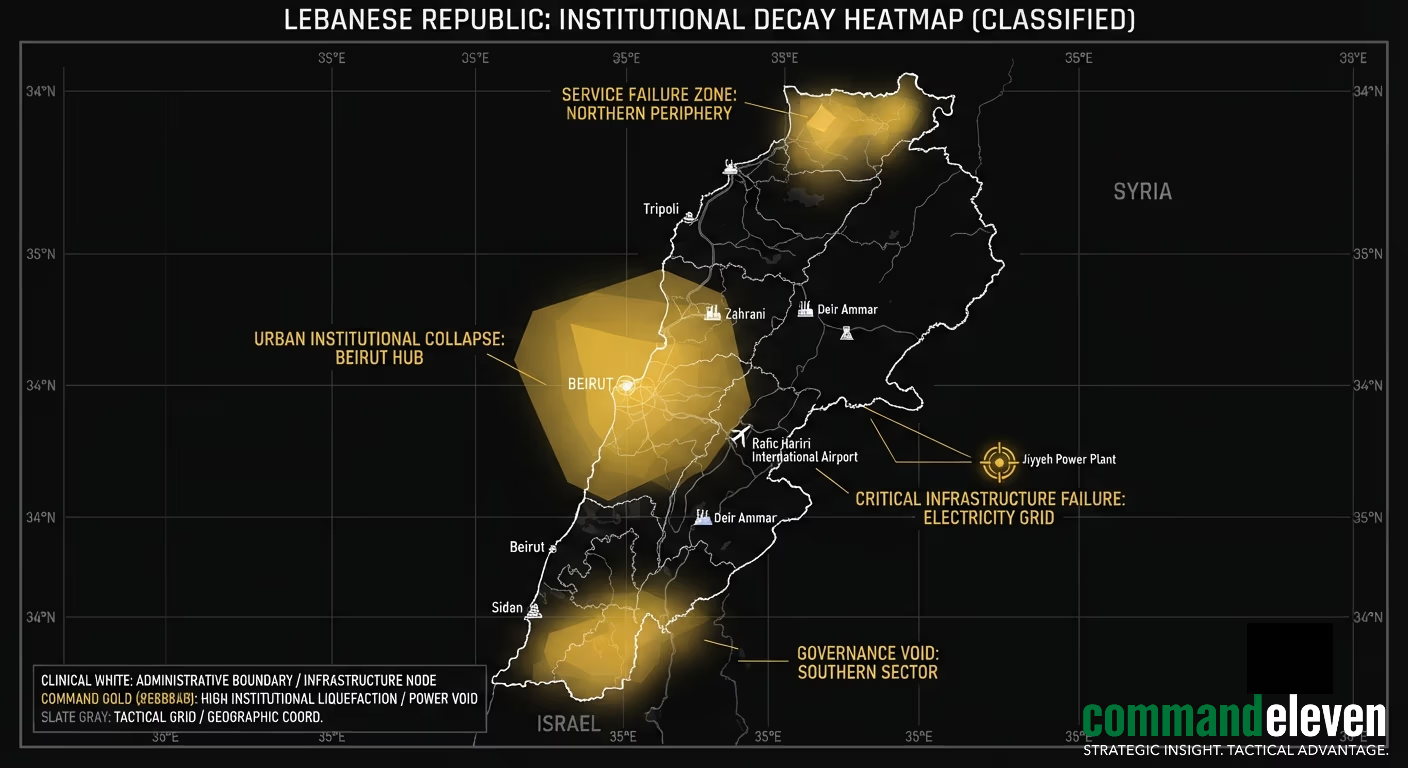
The rapid displacement of 1.2 million people from southern Lebanon, the Beqaa Valley, and Beirut’s southern suburbs (Dahiyeh) quickly overwhelmed local municipalities. Public schools converted into temporary shelters faced immediate shortages of clean water, electricity, and basic sanitation.
Without state-coordinated logistics, the responsibility for managing these displaced populations fell to local municipalities, tribal networks, and sectarian organizations. This shift has further weakened the central government’s authority and reinforced sectarian divisions.
Physical Destruction of Infrastructure
In addition to targeting military sites, the military campaign damaged critical civilian infrastructure, including bridges, roadways, and electricity grids. These losses have severely limited the Ministry of Energy and Water’s ability to supply basic power, leaving much of the country dependent on private, unregulated diesel generator networks.
The Irrelevance of the State Security Apparatus: The LAF
During the six weeks of active fighting, the Lebanese Armed Forces (LAF) remained entirely on the sidelines. This passivity highlights the state’s lack of military authority and its inability to enforce security decisions within its own borders.
- Operational Neutrality: As Israeli ground forces entered southern Lebanon and airstrikes targeted Hezbollah sites nationwide, the LAF withdrew its units from forward observation points along the Blue Line to avoid direct engagement. This move confirmed that the state military has no practical role in defending national territory against external actions or managing domestic non-state actors.
- Severe Financial Weakness: The LAF remains heavily dependent on foreign aid, primarily from the United States and Qatar, to cover basic food rations, fuel supplies, and soldier salaries. This financial dependence limits the military’s operational readiness and makes it vulnerable to external political pressures.
- Internal Fragmentation Risks: The LAF is one of the few national institutions that cuts across sectarian lines. However, the pressure of the 2026 conflict, combined with the displacement of soldiers’ families, has raised concerns about desertion and internal divisions along sectarian lines, should the military be ordered to actively disarm domestic factions.
Hezbollah’s Parallel Economy and the Targeting of AQAH
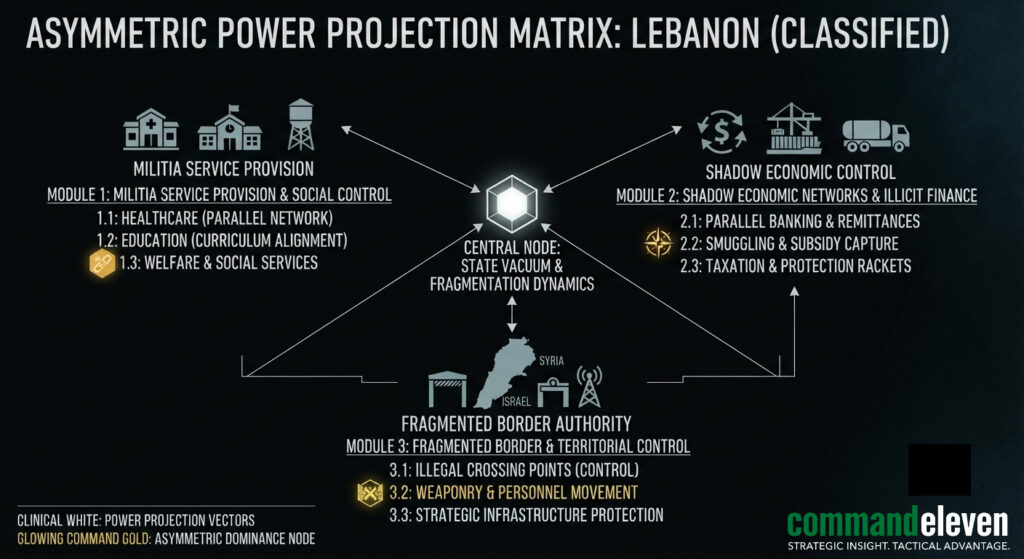
For decades, Hezbollah has operated a parallel state within Lebanon, supported by its own social services, security zones, and financial systems. The primary pillar of this parallel economy is Al-Qard al-Hassan (AQAH), a non-profit, sharia-compliant micro-finance institution.
Kinetic Strikes on Financial Infrastructure
During the March 2026 campaign, the Israeli Air Force targeted AQAH branches across Lebanon. These strikes aimed to disrupt Hezbollah’s cash flow and damage its support among the civilian population.
The physical destruction of these branches destroyed safe boxes, cash reserves, and gold collateral held by ordinary Lebanese citizens who used the institution as a safe alternative to the collapsed formal commercial banking sector.
Impact on Hezbollah’s Social Support
By damaging AQAH, the military campaign directly impacted Hezbollah’s ability to pay salaries, distribute aid, and fund reconstruction efforts. While this has strained Hezbollah’s financial operations, it has also widened the financial crisis for the broader population, leaving hundreds of thousands of families without access to their savings or credit lines.
Socio-Economic and Demographic Realities (Mid-2026)
| Socio-Economic Metric | Pre-2026 Conflict Status | Post-April 2026 Ceasefire Baseline | Primary Structural Cause |
| Sovereign Currency Depreciation | Stable at ~89,000 LBP per USD | In excess of 150,000 LBP per USD | Panic buying of hard currencies, lack of central bank reserves, and war-induced capital flight |
| Internal Displacement Density | Negligible (domestic) | 1.2 million citizens displaced | Destruction of residential sectors in South Lebanon and Dahiyeh |
| Refugee Burden Ratio | 1.4 million Syrian refugees | 1.4 million refugees alongside 1.2 million displaced citizens | Concurrent regional conflicts and complete lack of border management systems |
| Public Utility Availability | 2 to 4 hours of state electricity daily | 0 to 1 hours of state electricity daily | Direct targeting of fuel transit routes and municipal infrastructure damage |
Tactical Intelligence Assessment & Outlook
CommandEleven Intelligence assesses Lebanon is entering a period of deep institutional collapse. The formal Lebanese state now exists largely on paper, unable to provide security, manage its borders, or deliver basic public services. The vacuum left by the central government is being filled by sectarian organizations, local security groups, and municipal coalitions.
Over the next 12 months, the fragile April 16 ceasefire is unlikely to lead to long-term stability. The state lacks the power to disarm non-state actors or enforce border security, the risk of renewed conflict remains high.
The destruction of Hezbollah’s parallel financial networks has damaged the country’s informal economy, which could fuel social unrest. Without major structural reforms, a resolution to the banking crisis, and a coordinated international response, Lebanon is highly likely to continue fracturing into self-governing, sectarian enclaves, ending any prospect of a unified national government.