The plot that failed by pure luck. Originally published March 15, 2026. Case details have been checked against the US Justice Department record for this edition.
Executive Summary
The 2011 Arbabsiar plot is the most important single data point for understanding the realistic potential for an Iranian-directed terrorist attack in the United States. It matters not because it succeeded, but because it failed for one reason: the Mexican cartel contact that Manssor Arbabsiar recruited to carry out the operation was a DEA informant. Remove that one contingency and the plan proceeds.
In that version, Saudi Arabia’s ambassador to the United States is killed by a bomb in a crowded Washington, DC restaurant during lunch. American civilians die. And the organization responsible is the Islamic Revolutionary Guard Corps Quds Force, acting through a Texas-based Iranian-American asset and a cartel it believed it was paying $1.5 million.
That is not a theoretical threat scenario. It is a documented conspiracy that reached an advanced stage before law enforcement stopped it.
This assessment sets out how the plot was built, why it failed, and why the conditions that made it possible in 2011 are more favorable to Iranian planners in 2026, not less.
The Plot
Origins and Recruitment
The plot began in 2011, when Manssor Arbabsiar, a naturalized US citizen of Iranian origin living in Corpus Christi, Texas, and running a series of failing small businesses, was approached through a cousin in Iran. Arbabsiar later described the cousin as a “big general” and a senior member of the Quds Force who asked him to find someone to kill the ambassador. Through the cousin he was put in contact with Gholam Shakuri, a Quds Force member who became his handler.
The idea was audacious: hire a Mexican drug cartel to assassinate Saudi Arabia’s ambassador to the United States, Adel al-Jubeir, on American soil. The target was chosen for what he represented. Al-Jubeir was one of the most prominent faces of the Saudi-American relationship that Tehran saw as the main obstacle to its regional ambitions. Killing him in Washington would humiliate the United States on its own territory, frighten the Gulf diplomatic community, and strike at the Saudi government at a moment of intense Iranian-Saudi rivalry after the Arab Spring.
The choice of a cartel was just as deliberate. The Quds Force did not have the infrastructure inside the United States to carry out a high-profile killing without being traced. A Mexican trafficking organization with reach into the United States could, in theory, be hired for cash. The logic was simple: buy the capability through a deniable commercial transaction. If the operation succeeded, it would look like a cartel killing. If it failed, proving Iran’s role would take an investigation that might not finish before the political damage was done.
The Network
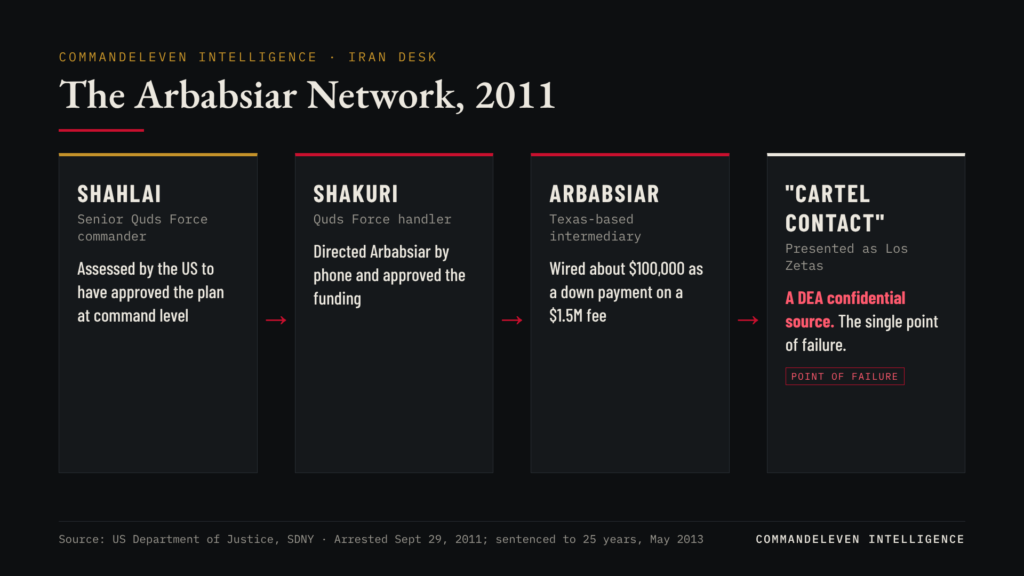
Manssor Arbabsiar was the intermediary. His job was not to carry out the killing but to connect the Quds Force handlers in Iran with the cartel contact in Mexico, using his US passport and his ability to travel between the United States, Iran and Mexico.
Gholam Shakuri was his handler. He directed Arbabsiar by phone, approved the funding and urged him on as the plot developed. In one call monitored by US authorities, he told Arbabsiar to “just do it quickly.”
Brigadier General Abdul Reza Shahlai, a senior Quds Force commander, is assessed by the US government to have approved the plan at the command level. The US Treasury designated him in October 2011, and the State Department later offered a reward of up to $15 million for information on him. The decision to attempt a cartel-facilitated assassination in the United States was not a field improvisation. It had senior backing.
The cartel contact, presented to Arbabsiar as an associate of the Los Zetas cartel, was in fact a DEA confidential source. That single fact is the reason the plot failed. It was not stopped by signals intelligence or by surveillance of Iranian networks. It was stopped by an informant who happened to be in place when Arbabsiar made his approach.
The Target and the Restaurant
The plan discussed with the informant was to kill al-Jubeir with a bomb at a Washington restaurant he was known to frequent. When the informant raised the likelihood that other diners could be killed, Arbabsiar dismissed it as “no big deal.” Recorded on tape, he said: “They want that guy done, if the hundred go with him f**k ’em.”
The point is worth holding. The plotters accepted a mass-casualty attack on a restaurant in the American capital in order to kill one Saudi diplomat. The constraint on the operation was not moral. It was logistical and financial.
The Money
The informant asked for $1.5 million to carry out the killing. Arbabsiar arranged a down payment of about $100,000, wired from overseas in two transfers on August 1 and August 9, 2011, into what turned out to be an FBI undercover account.
For the strategic effect it was meant to produce, the plot was extraordinarily cheap. The Quds Force was trying to buy a capability, criminal reach inside the United States, that it could not build itself, at a fraction of the cost of the strategic effect it sought.
Arrest and Prosecution
Arbabsiar was arrested at John F. Kennedy International Airport in New York on September 29, 2011, a day after he was refused entry to Mexico. He confessed and cooperated with investigators. That alone is telling: he was not a trained intelligence officer but a civilian with family connections to the IRGC, recruited for one operation, with no preparation for interrogation.
On October 17, 2012, he pleaded guilty to murder-for-hire, conspiracy to commit murder-for-hire, and conspiracy to commit an act of terrorism transcending national boundaries. In May 2013 he was sentenced to 25 years in federal prison. Shakuri was charged and remains at large in Iran. Shahlai has never faced trial.
The plot failed on its one attempt. But the failure was not a failure of capability. It was the luck of an informant being in the right place.
What Failed, What Didn’t, and Why It Matters
The Arbabsiar plot is often described as amateurish. That is accurate about the operative and misleading about the plan.
Arbabsiar was a poor operative: disorganized, careless and badly wrong about his cartel contact. But the concept behind him was coherent. It used a deniable civilian to bridge the gap between the IRGC and a criminal organization capable of violence inside the United States, it paid through intermediaries that obscured the state sponsor, and it accepted mass casualties as a byproduct. The failure was in the person chosen to carry it out, not in the design.
What Tehran did not do was abandon the concept. The record since then shows the same model at work: Iranian services hiring criminals and other intermediaries to carry out plots against dissidents, Jewish communities, Israeli targets and US officials, from the plot against former national security adviser John Bolton charged in 2022 to the cases MI5 and Australian intelligence have described since. The method has matured. The intent has not changed.
The 2026 Environment
The conditions in March 2026 are different from those of 2011, and the differences cut toward greater risk. Four stand out.
1. Command decentralization. Strikes on Iranian command centers during the US-Iran war have, by CommandEleven Intelligence’s assessment, pushed the IRGC toward a more decentralized structure, with regional commanders operating with less day-to-day direction from Tehran. In 2011 the plot needed approval from the top of the Quds Force, and that chain acted as a brake. Weaker central control means more actors with resources, motive and less accountability. [ASSESSED]
2. The activation threshold. Iran had warned that direct US military action would bring retaliation beyond the battlefield. That action is no longer a threat; it is under way. Whatever Iran’s doctrine says about using its networks abroad in wartime, the condition it was waiting for has been met. [ASSESSED]
3. Deeper criminal ties. Iranian-linked intermediaries have built commercial relationships with Mexican trafficking organizations, including through the chemical and financial networks behind the fentanyl trade. A commercial relationship is not an operational alliance, but it creates contacts and trust that did not exist in 2011. Mexican cartels’ presence inside the United States has also grown. [ASSESSED]
4. Better tradecraft elsewhere. The plots documented in Europe since 2022 show a level of planning well above Arbabsiar’s. MI5 has said it tracked more than 20 potentially lethal Iran-backed plots in a single year. [CONFIRMED on the MI5 figure]
Taken together, these changes support one conclusion: Iran has the motive, the precedent, the criminal relationships and the experience to attempt an attack inside the United States, and the 2026 conflict has made that attempt more likely than at any time since 2011. [ASSESSED]
Hezbollah’s long-standing presence in the United States adds to the risk. The FBI has told Congress it has active investigations into Hezbollah-linked individuals, and federal prosecutions over the past decade have described Hezbollah operatives conducting surveillance in American cities. How many such individuals exist outside current investigations is, by definition, unknown. [ASSESSED]
CommandEleven Intelligence does not publish attack scenarios, target lists or operational sequences in public reporting. That material is provided to government and law enforcement clients only.
What Defenders Should Watch
- Payments that look criminal but are not. Transfers through cryptocurrency brokers, money service businesses or trade invoices that connect to Iranian-linked intermediaries.
- Approaches to criminal groups. Informant reporting of foreigners seeking to hire violence from cartels, gangs or online “gig” networks for political targets.
- Surveillance of symbolic targets. Pre-attack surveillance of diplomats, Jewish and Israeli sites, dissidents and US officials, which has preceded most of the Iranian plots exposed in Europe.
- Diaspora recruitment. Approaches to Iranian-Americans or other dual nationals through family connections in Iran, the route used to recruit Arbabsiar.
- Escalation triggers. Major US or Israeli strikes on senior Iranian figures, which have historically raised the risk of retaliation abroad.
Assessment and Conclusions
The Arbabsiar plot is not a historical curiosity. It is a precedent.
It shows that the Quds Force, at a senior level, approved an attempt at a mass-casualty attack in the United States using cartel help. It shows that money could be moved toward the operation. It shows that Iranian-Americans with family ties to the IRGC are a recruitment pool. And it shows that the plot’s single point of failure was an informant who happened to be in place.
In 2026, the conditions that made the plot attractive to Iranian planners are sharper. The United States is in direct conflict with Iran. The IRGC’s command is more dispersed. Criminal partners are more capable and more present inside the United States. Iran’s services have spent a decade refining the use of criminal proxies abroad.
The threat is real, and US law enforcement and intelligence agencies have been tracking it. The lesson of 2011 is that luck is not a defense.
Sources
- US Department of Justice, Manssor Arbabsiar sentenced in Manhattan federal court to 25 years in prison for conspiring with Iranian military officials to assassinate the Saudi Arabian ambassador to the United States
- The National, Iranian threat to UK ramps up with 20 plots uncovered last year
- NPR, Australia accuses Iran of organizing antisemitic attacks and expels ambassador