
Automated targeting architectures rely on deep neural networks (DNNs) that assume data integrity across the training, testing, and deployment phases. This assumption represents a critical operational vulnerability. By manipulating the physical or digital inputs fed into these systems, an adversary can predictably induce targeting failures, false positives, or complete system blindness.
This appendix isolates the technical mechanics of data poisoning and adversarial manipulation directed against computerized target classification engines.
Poisoning Vectors in the Training Pipeline
Data poisoning injects corrupted telemetry into the machine learning pipeline before model deployment. If an intelligence architecture collects open-source data, captured adversary files, or unencrypted commercial sensor feeds to retrain its models, it exposes itself to clean-label poisoning attacks.
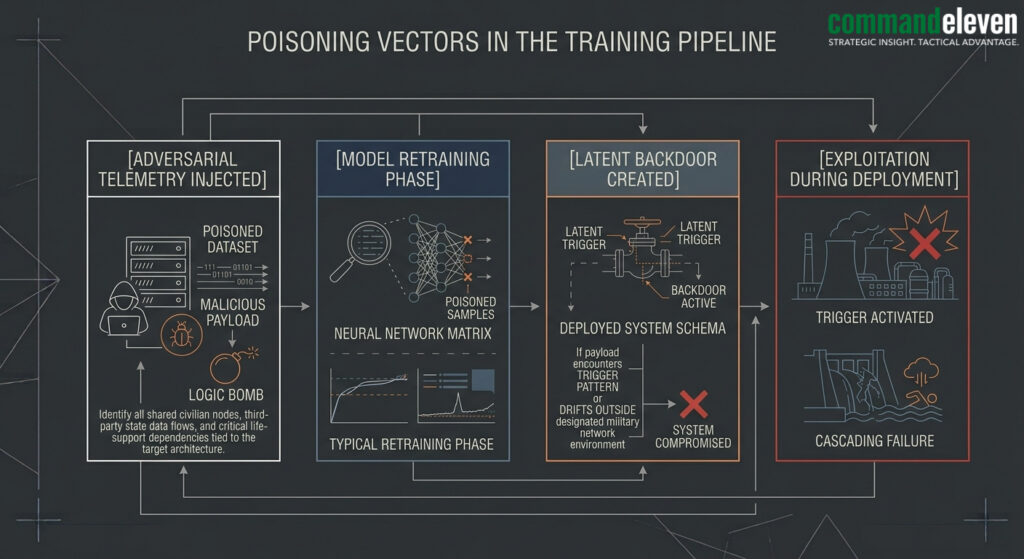
Clean-Label Poisoning Mechanics
An adversary does not need to alter target labels (e.g., changing “Civilian Truck” to “Tank” in the metadata). Instead, they introduce mathematically manipulated images of civilian assets into the training pool that contain subtle pixel perturbations. To a human analyst, the image looks like an ordinary civilian transport. To the neural network, the loss function identifies a mathematical pattern that binds specific civilian shapes to military target profiles.
Latent Backdoors and Triggers
Poisoning often implants a latent backdoor within the targeting engine. The system functions with 99% accuracy during routine validation tests. However, the adversary has trained the model to associate a specific, highly localized trigger,such as a precise geometric pattern on a vehicle hood or a unique transponder emission frequency,with a completely different classification.
When the trigger is physically deployed on the battlefield, the target classification engine misclassifies a high-value threat as a non-combatant, effectively blinding the strike loop.
Invalidation at the Edge: Evasion and Physical Perturbations
Evasion attacks occur during live deployment. They do not alter the model’s internal weights; instead, they exploit the mathematical blind spots of the neural network’s decision boundaries.
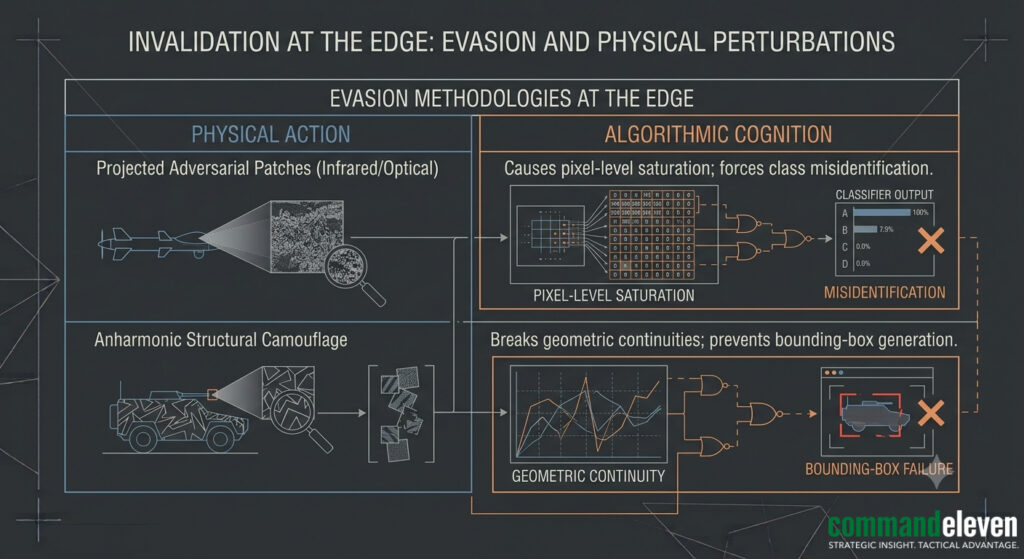
Projected Adversarial Patches
Adversaries print precise, non-intuitive geometric shapes onto vinyl sheets or apply them as thermal paint onto combat vehicles. These patterns are generated using Fast Gradient Sign Methods (FGSM) to maximize the classification error of specific military models.
When an optical or thermal reconnaissance drone sweeps the area, the pixel arrangement on the patch causes an immediate internal saturation within the convolutional layers. The vehicle is not hidden; rather, the algorithm is forced to misidentify a mobile artillery piece as a harmless agricultural tractor with high statistical confidence.
Anharmonic Structural Camouflage
Traditional camouflage conceals an asset from human sight. Adversarial camouflage disrupts the feature-extraction layers of computerized vision. By applying irregular, high-contrast grid patterns that break the expected geometric continuities of a vehicle’s edges, the adversary prevents the model’s region-proposal networks (RPN) from generating a bounding box.
If the algorithm cannot bound the object, the sensor-to-shoot pipeline treats the asset as background noise, excluding it from automated strike queues.
Analytical Countermeasures and Validation Metrics
Defending an automated targeting loop against adversarial machine learning requires continuous technical verification at the analyst level.
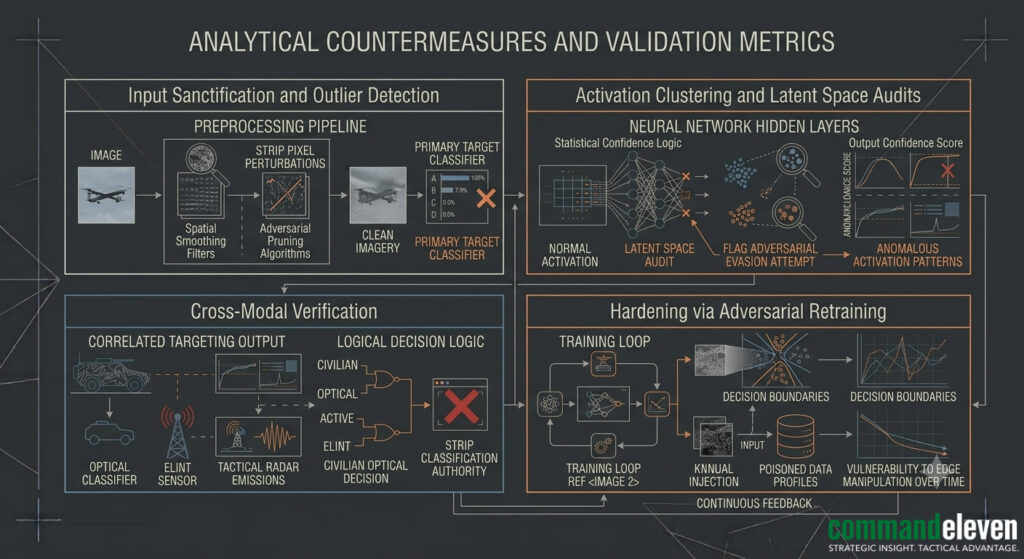
Operational Directive: If an analyst suspects an adversarial manipulation vector is active within a specific geographic sector, all automated target signatures from that sector must be decoupled from the strike pipeline. Targeting metrics must immediately revert to manual positive identification protocols.