
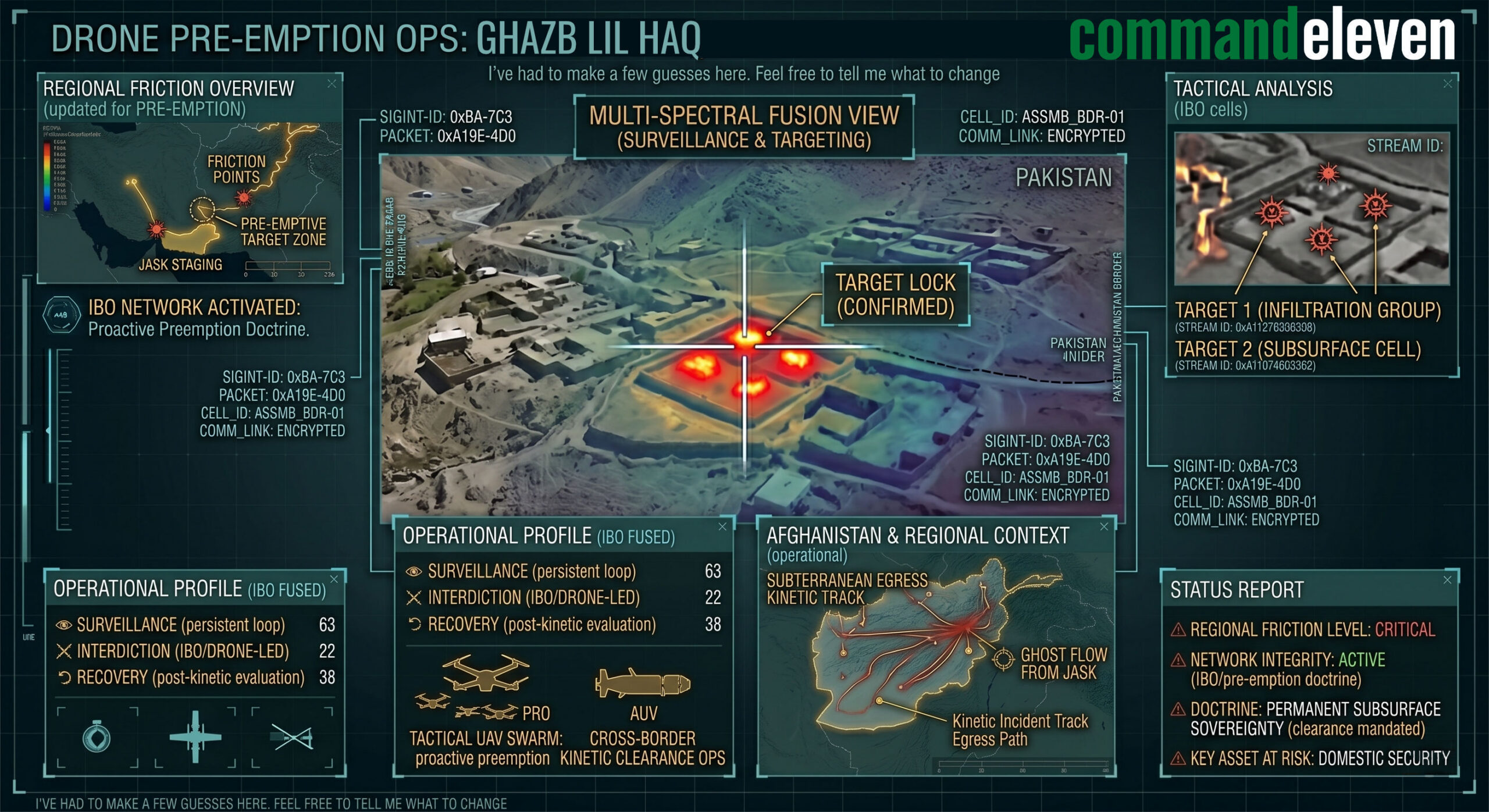
Executive Summary
Operation Ghazb lil Haq represents a fundamental pivot in Pakistan’s counter-terrorism doctrine, transitioning from the static defense of the Hardened Border to a posture of Proactive Pre-emption. Launched to neutralize the “Technological Parity Crisis” following the 2021 US withdrawal from Afghanistan, the operation utilizes indigenous UAV technology and SIGINT-Kinetic fusion to dismantle insurgent nodes during the assembly phase. By restoring the state’s qualitative edge through persistent stare surveillance and specialized sniper cadres, Ghazb lil Haq bridges the Sanitization Gap and ensures that domestic kinetic gains are not eroded by a technologically empowered TTP.
3 Key Takeaways
- Neutralization of Hardware Parity: The operation successfully counters the TTP’s acquisition of NATO-grade thermal and night-vision optics by utilizing indigenous drones with superior multi-spectral imaging ranges.
- The Pre-emptive Logic: Strategic success is now defined by the destruction of guerrilla nodes during the Assembly and Transit phases, preventing the adversary from ever initiating high-lethality nighttime engagements.
- SIGINT-Kinetic Fusion: The integration of electronic warfare assets to intercept NATO-standard RF emissions allows for meter-level target geolocating, turning the adversary’s acquired technology into a tracking liability.
The Strategic Mandate: Restoration of Dominance
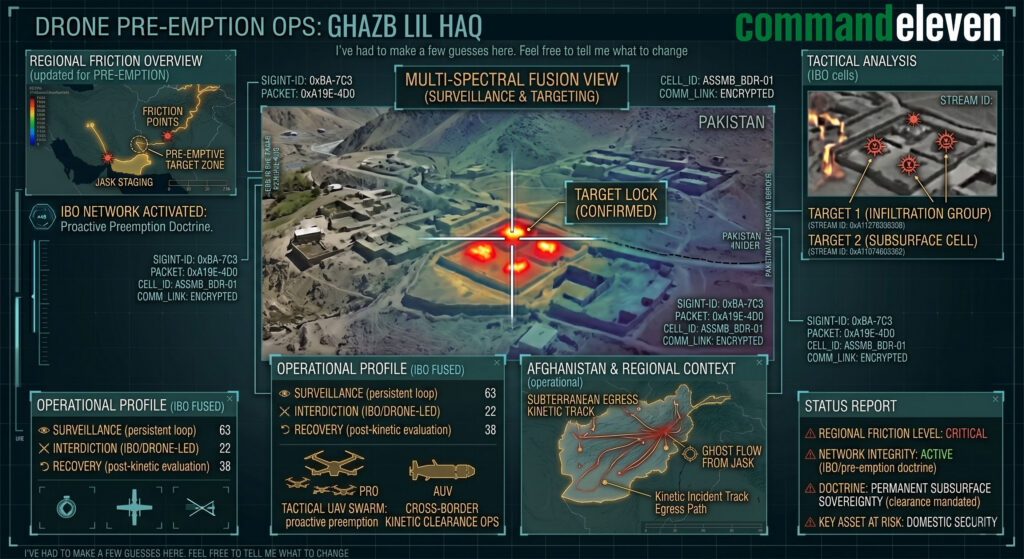
The August 2021 US withdrawal from Afghanistan did more than create a geopolitical vacuum; it fundamentally altered the tactical physics of the “Long War.” For the first time in twenty-five years, state forces faced an adversary equipped with NATO-grade thermal optics, night-vision goggles (NVGs), and high-precision small arms. This “Hardware Catastrophe” effectively neutralized the military’s traditional monopoly on the night, leading to a spike in localized nighttime ambushes and cross-border incursions.
Operation Ghazb lil Haq (Wrath of Truth), initiated in late 2025, is the clinical response to this parity. The mandate is clear: the state can no longer wait for the adversary to initiate contact at a time and place of their choosing. Sovereignty now depends on Persistent Stare Surveillance and Proactive Neutralization. The operation moves the frontline from the checkpost to the assembly point, utilizing technology to out-range and out-pace the technologically empowered TTP.
Technical Mechanics: The SIGINT-Kinetic Fusion
The core of Ghazb lil Haq is the seamless integration of Signal Intelligence (SIGINT) with immediate kinetic response. This is not a “bombing campaign” in the traditional sense; it is a high-fidelity hunting operation.
Neutralizing Thermal Parity
The TTP’s acquisition of thermal scopes allowed them to engage checkposts from the “dark zones” outside traditional visual range. Operation Ghazb lil Haq counters this by deploying indigenous UAVs equipped with superior-range, multi-spectral imaging. These platforms identify the heat signatures of guerrilla nodes at altitudes and distances that render the insurgents’ acquired optics useless. The drone doesn’t just see the militant; it sees the “thermal footprint” of the assembly long before the militant is in a position to fire.
Electronic Interception and Packet IDs
A critical vulnerability of the NATO-grade hardware used by the TTP is the digital signature of the communication devices paired with them. SIGINT assets involved in the operation actively intercept encrypted bursts and radio-frequency (RF) emissions from acquired hardware. These “Packet IDs” allow fusion centers to geolocate active cells with meter-level accuracy. Once a signature is verified against the Biometric Threat Matrix, a “Target Lock” is handed off to the nearest aerial asset.
Operational Assets: The Drone-Sniper Synergy
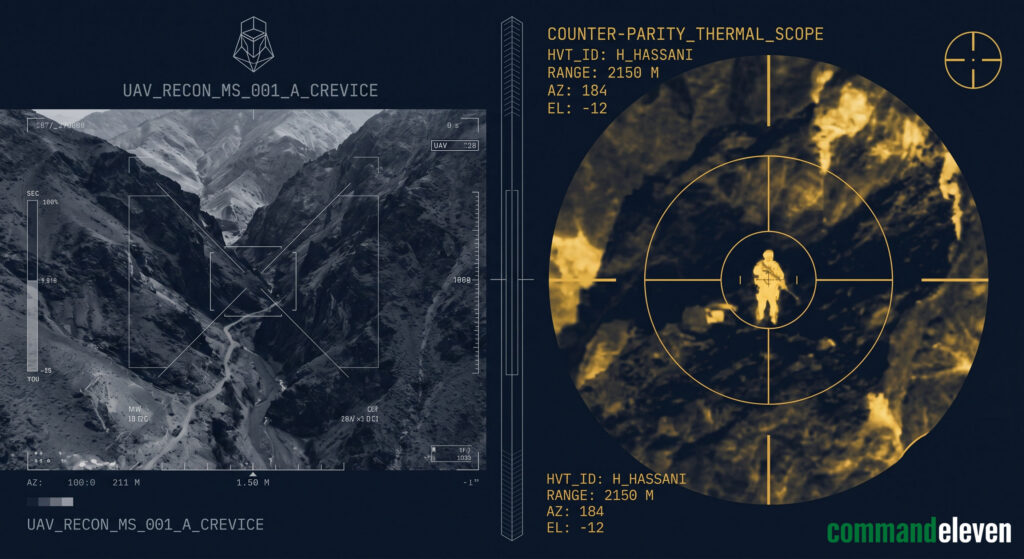
The operation utilizes a specialized “High-Low” asset mix to ensure that no target escapes due to terrain masking or subterranean hardening.
- Indigenous UAV Platforms: Locally developed drones provide the “Persistent Stare.” Unlike manned aircraft, these assets can loiter over suspected transit corridors for 24+ hours, identifying the stigmergic patterns of militant movement.
- Specialized SSG Sniper Cadres: In areas where high-altitude strikes risk collateral damage or where deep mountain crevices provide cover, the operation deploys specialized SSG (Special Service Group) sniper teams. These units are equipped with “Counter-Parity” optics – custom-built thermal systems that out-range NATO surplus gear – ensuring that in a “Sniper vs. Sniper” engagement, the state maintains the first-shot advantage.
- Pre-emptive Strike Logic: The focus remains on the Assembly Phase. By targeting militants while they are grouping for a mission or conducting a logistical handoff, the military disrupts the “New Manifesto” of Noor Wali Mehsud before it can manifest as a kinetic event.
Psychological Impact and the “Zero-Trust” Border
Beyond the physical destruction of guerrilla nodes, Operation Ghazb lil Haq serves a critical psychological function. The persistent, invisible presence of drones creates a “Panopticon Effect” within the militant ranks.
- Survival over Operations: When an insurgency knows it is being watched by an asset it cannot see or out-range, it is forced to prioritize concealment and survival over operational planning. This slows the tempo of attacks and forces the TTP back into a reactive posture.
- Restoring the “Writ of the State”: The operation signals to the local population that the border is no longer porous. The fence (The Hardened Border) is now protected by an active, technological “Overwatch” that can reach out and strike with clinical precision.
The Future of Persistence
Operation Ghazb lil Haq is the physical manifestation of the Border Pivot. It proves that in the modern asymmetric theater, territorial integrity is not maintained by a line of soldiers, but by a web of sensors and pre-emptive strike capabilities. By neutralizing the Technological Parity Crisis at its source, the state is bridging the Sanitization Gap and ensuring that the hard-won gains of the last quarter-century are not eroded by a technologically empowered adversary.