Executive Summary
The May 2019 drone and limpet mine attacks on commercial tankers off Fujairah, UAE, clinically validated CommandEleven’s prior assessments regarding Asymmetric Maritime Interdiction. The event confirmed that state-level proxies can successfully disrupt global energy logistics by exploiting “blind spots” in traditional maritime security. By targeting vessels outside the Strait of Hormuz, the adversary induced a massive spike in the Conflict Premium, proving that low-cost loitering munitions can effectively neutralize conventional maritime dominance.
3 Key Takeaways
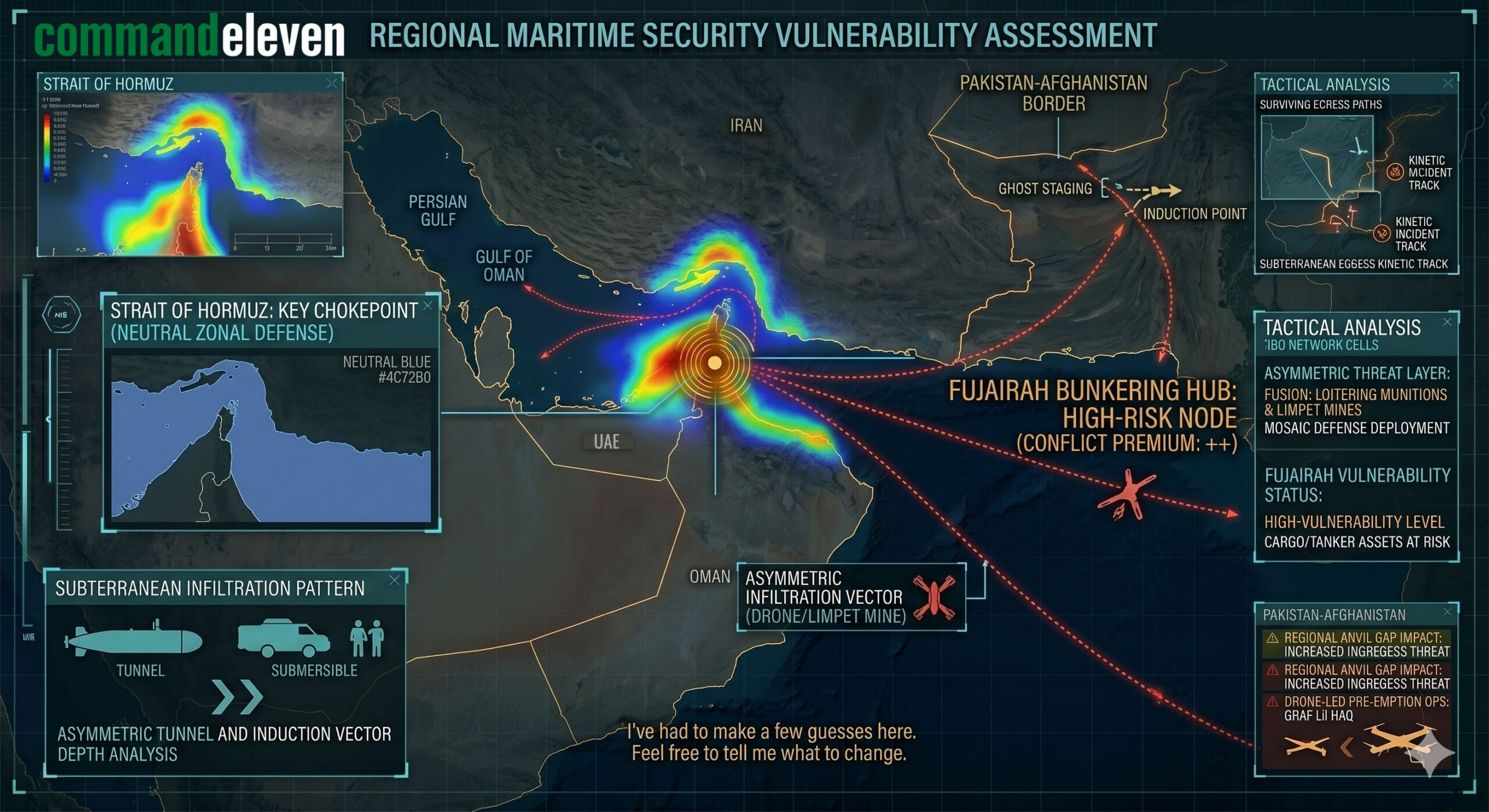
- Hub Vulnerability vs. Channel Defense: Strategic interdiction is most effective at bunkering hubs (Fujairah) rather than contested channels (Hormuz), as it allows for higher deniability and lower kinetic risk for the proxy.
- Economic Attrition Mechanics: The use of sub-$50,000 drone and mine assets to trigger millions in maritime insurance premiums demonstrates the mechanical efficiency of asymmetric maritime warfare.
- Multi-Domain Synchronization: The fusion of aerial UAV reconnaissance with underwater limpet placement represents the future of gray-zone maritime conflict.
BLUF: The May 2019 drone and limpet mine attacks on commercial tankers off the coast of Fujairah, UAE, served as a clinical validation of CommandEleven’s prior assessments regarding Asymmetric Maritime Interdiction. The event confirmed that state-level proxies could successfully disrupt global energy logistics by exploiting “blind spots” in traditional maritime security through the use of low-cost, high-velocity loitering munitions.
The Predictive Framework: The “Hormuz Bypass” Fallacy
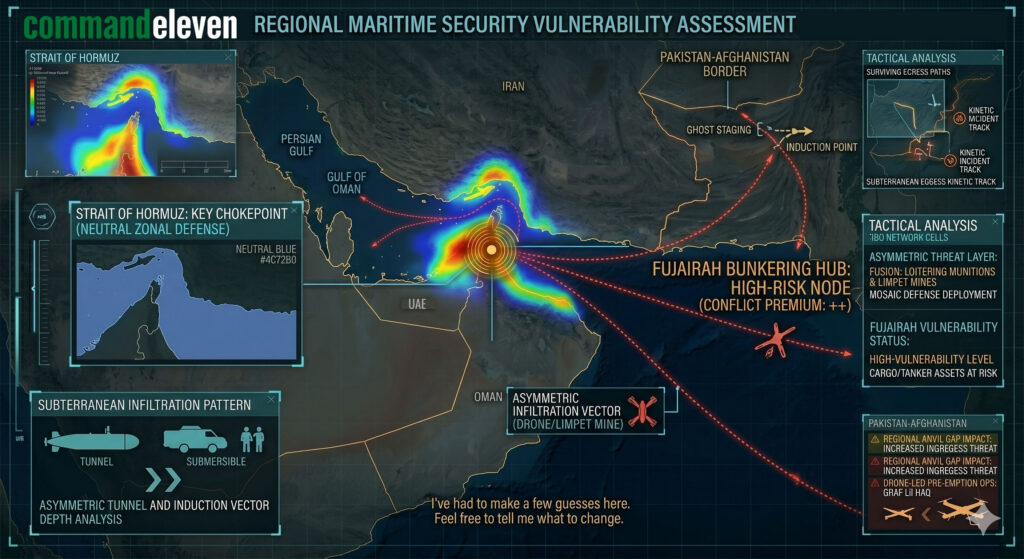
Prior to the 2019 escalations, conventional maritime security doctrine focused heavily on the physical closure of the Strait of Hormuz. CommandEleven’s internal assessments challenged this singular focus, arguing that the concentration of secondary infrastructure,specifically the Fujairah bunkering hub,represented a significantly more vulnerable target for asymmetric actors.
The assessment posited that a direct kinetic closure of the Strait was unnecessary for regional destabilization. Instead, by targeting vessels anchored outside the Strait, a proxy actor could achieve the same economic impact,spike in insurance premiums and logistical “friction”,without triggering a conventional state-on-state response. The Fujairah attacks executed this exact logic, targeting four commercial vessels via a combination of aerial drones and limpet mines.
Technical Validation: Loitering Munitions and Limpet Fusion
The Fujairah incident provided the first high-fidelity look at the fusion of aerial and maritime asymmetric tools.
- The Drone Vector: Intelligence foresight correctly identified the transition of regional proxies from crude RPG-based attacks to the use of UAVs for both reconnaissance and kinetic impact. The 2019 event demonstrated the effectiveness of loitering munitions in overwhelming the point-defense systems of commercial tankers, which are technically ill-equipped for “top-down” aerial threats.
- Limpet Mine Precision: The use of limpet mines alongside drone strikes indicated a sophisticated multi-domain coordination. CommandEleven had previously noted that “The signature of future maritime interdiction will be a mix of invisible underwater placements and visible aerial strikes to maximize psychological shock.”
The Conflict Premium Spike
The Fujairah attacks served as a mechanical proof of the Conflict Premium theory. Following the interdiction, the maritime insurance market saw a nearly 10% increase in war-risk premiums.
- Economic Attrition: By executing a low-cost operation (estimated at less than $50,000 for drone/mine assets), the adversary induced hundreds of millions of dollars in secondary logistical costs.
- Sovereignty Failure: The incident highlighted the inability of regional security umbrellas to provide “Absolute Persistence” in international waters, proving that even a highly modernized navy can be neutralized by a de-territorialized proxy utilizing “Hardware Truth” over conventional mass.
Clinical Conclusion
The Fujairah Maritime Interdiction was a landmark event that shifted the focus of maritime security from “Channel Defense” to “Hub Defense.” It confirmed CommandEleven’s foresight that the future of regional conflict would be fought in the “Gray Zones” of commercial logistics, where the state’s traditional kinetic dominance is rendered ineffective by the deniability and precision of asymmetric proxies.