EXECUTIVE SUMMARY
FindFace, a convolutional neural network (CNN) biometric identification system developed by NtechLab (est. 2015), has transitioned from a consumer-grade curiosity to a critical asset within the Russian state military-industrial complex. Following a majority stake acquisition by Rostec in 2018, the platform was integrated into Moscow’s “Safe City” network ($170,000$+ cameras) and subsequently weaponized for export to authoritarian regimes.
Primary Finding: Investigation #EyesOfIran (published March 2026) confirms the clandestine 2019 acquisition of FindFace by the Islamic Republic of Iran through a front company, Rasadco. This transfer bypassed international sanctions and provided the Iranian apparatus with a “counter-revolutionary infrastructure.” The lack of a popular uprising against the Islamic Republic is not a failure of will, but a structural consequence of FindFace; by eliminating public anonymity, the system has effectively neutralized the conditions necessary for spontaneous mass mobilization.
TECHNICAL SPECIFICATIONS & ALGORITHMIC PIPELINE
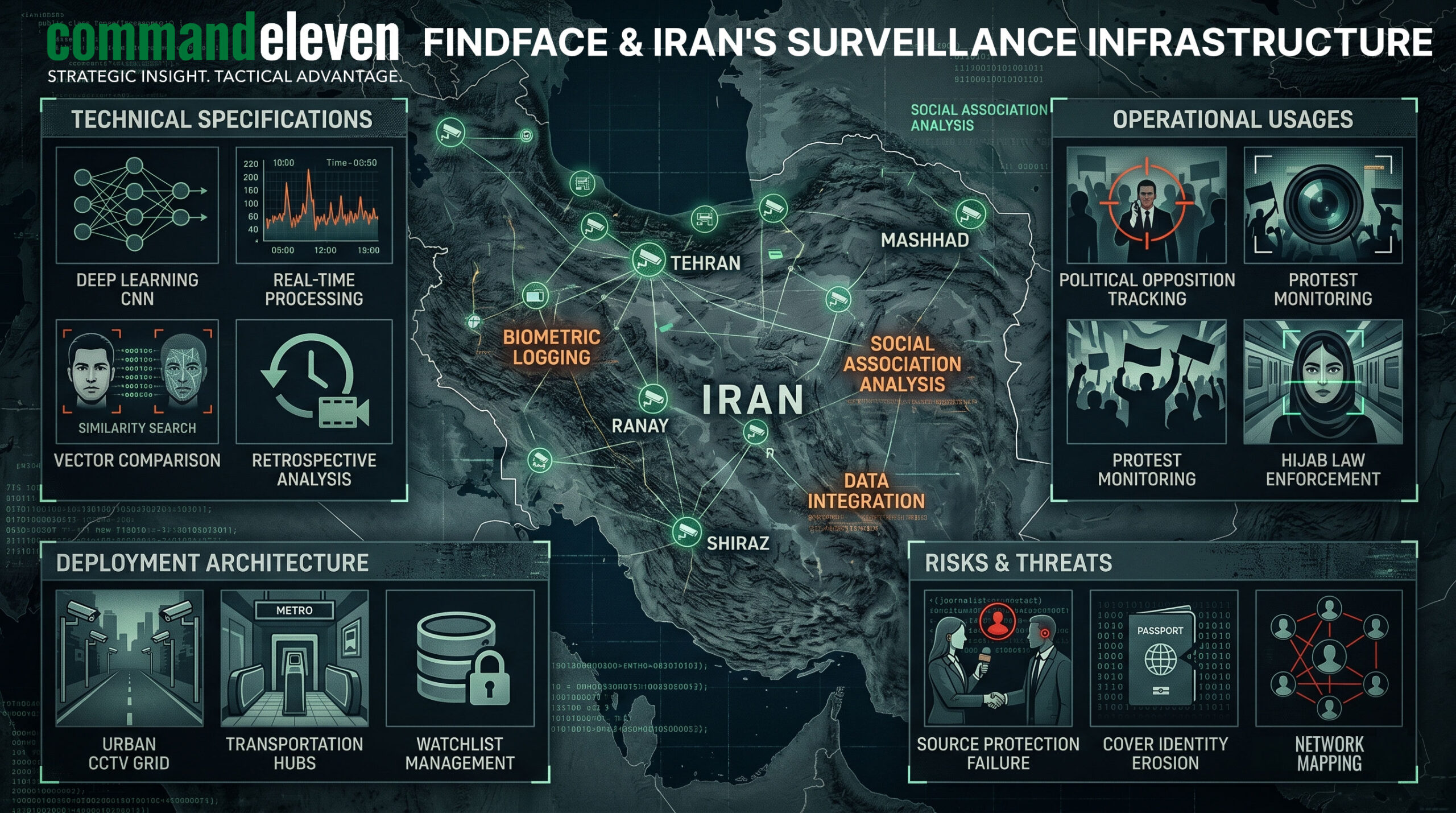
The system utilizes a deep learning architecture optimized for high-throughput, real-time urban environments.
Operational Workflow
- Face Detection: Deep learning models isolate facial regions within video frames, accounting for partial occlusion, motion blur, and sub-optimal lighting.
- Alignment: Mathematical normalization of the detected face to a standard coordinate system, compensating for pitch, yaw, and roll.
- Embedding Generation: The aligned face is processed through a proprietary neural network to produce a high-dimensional mathematical vector (face embedding).
- Vector Comparison: Similarity search against databases using approximate nearest-neighbor algorithms.
Performance Benchmarks
- Identification Latency: $0.3$ seconds per query.
- Throughput: Minimum $4.4$ requests per second (RPS) per processing node.
- Reported Accuracy: Up to $99\%$ under controlled parameters (NIST FRTE tier performance).
- Hardware Efficiency: Capable of processing 720p/25 FPS streams on standard dual-core architecture ($>2.5$ GHz).
IRANIAN OPERATIONAL DEPLOYMENT
Tehran’s deployment of FindFace (FindFace Multi) follows a multi-layered suppression strategy.
Urban Chokepoints
The system is integrated into existing CCTV networks in Tehran and Mashhad. Deployment in the Mashhad metro (documented Dec 2023) utilized real-time scanning for hijab law enforcement, involving public shaming via terminal screens and subsequent security intervention.
Network Mapping & Retrospective Analysis
FindFace Multi’s “Analytics” layer identifies “physical co-presence.” By logging individuals who consistently appear in the same frame over time, the system reconstructs social and organizational networks without requiring digital intercepts. Retrospective Search allows operators to retroactively track an individual’s movement through months of archived footage, eliminating the safety of “blending in” during past events.
Counter-Intelligence (CI) Threat
FindFace poses a systemic risk to Western HUMINT operations:
- Cover Erosion: Biometric profiles bypass documentation-based identities (NOC).
- SDR Compromise: Traditional Surveillance Detection Routes (SDR) are rendered obsolete by passive logging; there is no physical surveillance team to “burn.”
- Asset Association: Identifying one asset allows for the automatic identification of their entire contact network via historical co-presence logs.
COMPARATIVE GEOPOLITICAL ANALYSIS
FindFace occupies a specific niche between Western commercial platforms and Chinese state-monolith systems.
| System | Origin | Primary Database | State Integration |
| FindFace | Russia | CCTV + Social Media (VK) | High (Rostec/FSB) |
| SenseTime | China | National Infrastructure | Total (Xinjiang Model) |
| Clearview AI | USA | Scraped Public Web | Private/LEO Access |
| NEC | Japan | Civil/Commercial | High (Verification-centric) |
RISK ASSESSMENT & STRATEGIC OUTLOOK
The proliferation of FindFace creates an “authoritarian surveillance commons.” The Iranian case study demonstrates that post-hoc sanctions (EU 2023, US 2024) are insufficient to mitigate damage once technology transfer occurs.
Strategic Implications
- Protest Neutralization: The “chilling effect” of permanent, retrospective identifiability makes the cost of protest participation effectively certain rather than probabilistic.
- Sanctions Evasion: The use of Rasadco as a “cutout” highlights a critical gap in international export controls for dual-use AI.
- Operational Necessity: Future field doctrine must prioritize “biometric hygiene” and “camera-dark” route planning.
Conclusion
FindFace has fundamentally altered the landscape of domestic control and international espionage. In the current theater of conflict, the Iranian regime’s stability is structurally tied to this Russian-derived biometric grid. Any strategy for internal destabilization must first address the technological elimination of anonymity.