CURRENT STATE OF DEPLOYMENT
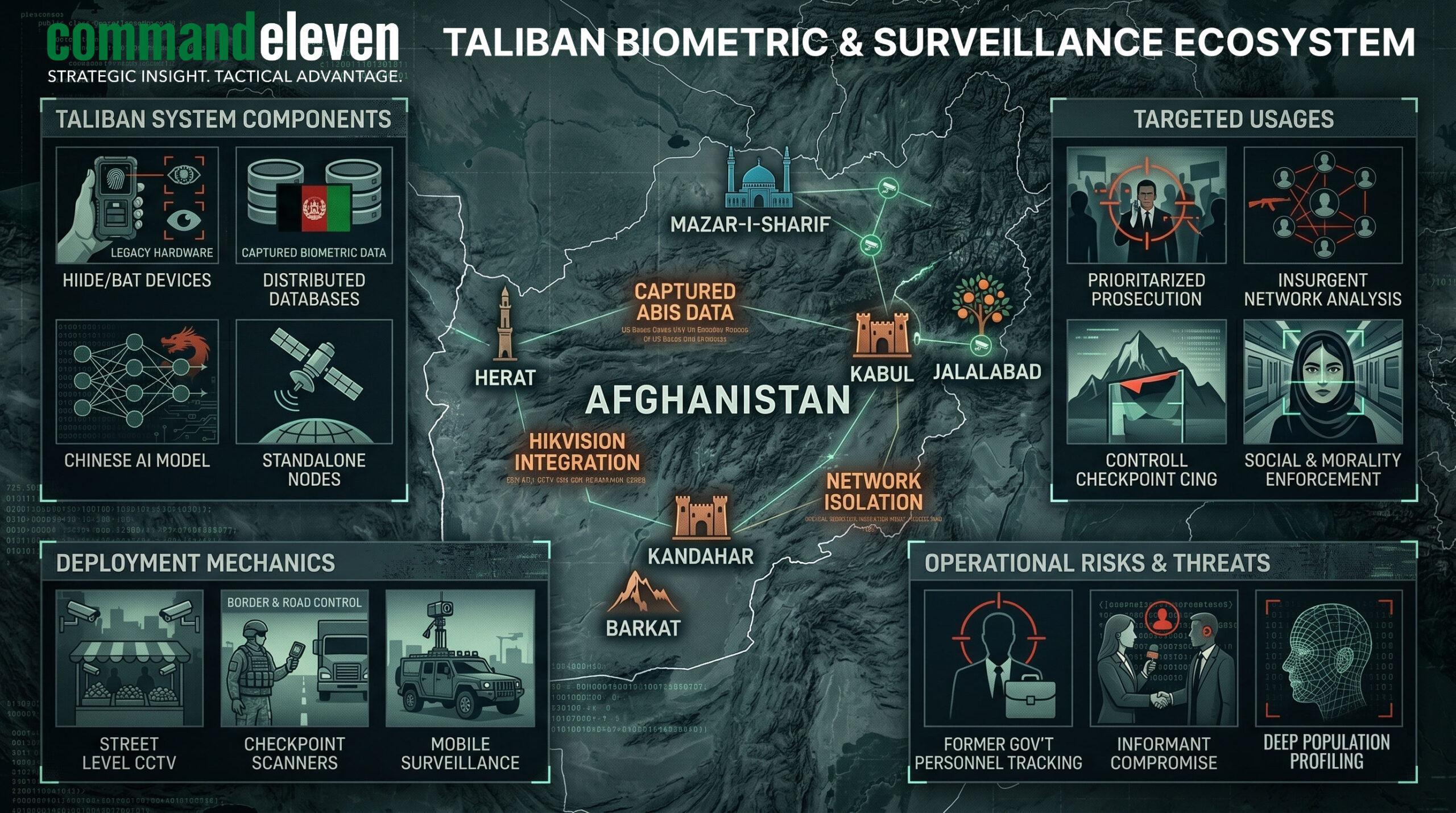
Unlike the centralized, state-integrated Russian/Iranian FindFace model, the Taliban’s facial recognition capability is a hybrid of captured Western assets and modern Chinese infrastructure.
Captured Western Biometric Infrastructure
Following the August 2021 withdrawal, the Taliban seized a massive repository of sensitive biometric hardware and data.
- HIIDE & BAT Devices: Handheld Interagency Identity Detection Equipment (HIIDE) and Biometric Automated Toolsets (BAT). These devices store iris scans, fingerprints, and high-resolution facial images.
- APIS & ABIS Databases: The Taliban reportedly secured access to the Afghan Personnel Identification System (APIS) and elements of the Automated Biometric Identification System (ABIS), which contain profiles of approximately 80% of the Afghan population, including former military, police, and coalition partners.
- Operational Usage: These systems are currently used at checkpoints and border crossings to “whitelist” and “blacklist” individuals against legacy coalition datasets.
The “Safe City” Expansion (Chinese Integration)
As of early 2026, the Taliban has aggressively pivoted toward a unified urban surveillance grid modeled after the Chinese “Sharp Eyes” program.
- Hardware Providers: Reporting indicates the widespread installation of Dahua and Hikvision cameras. In late 2023, the Ministry of Interior confirmed a partnership with Huawei to install a comprehensive CCTV network across all provinces.
- Infrastructure Scale: Kabul currently hosts an estimated 90,000+ cameras. While initially sold as a counter-terrorism measure against ISIS-K, the backend is optimized for individual tracking and social control.
- Software Origin: While the specific algorithmic brand (e.g., SenseTime vs. Megvii) is not publicly disclosed, the architecture is designed to integrate with Chinese facial recognition APIs, allowing for real-time identification within the urban grid.
STRATEGIC ALIGNMENT: THE CHINA-TALIBAN PARTNERSHIP
The deployment of facial recognition in Afghanistan serves mutual strategic interests:
- Taliban Intent: Consolidation of power, suppression of the National Resistance Front (NRF), and enforcement of morality laws (similar to the Mashhad metro deployment).
- Chinese Intent: Profiling of ETIM (East Turkistan Islamic Movement) personnel and securing a “stability corridor” for BRI (Belt and Road Initiative) investments. By managing the surveillance grid, Beijing gains secondary access to a biometric data stream covering regional militant actors.
OPERATIONAL IMPLICATIONS FOR HUMINT
The threat to intelligence assets in Afghanistan mirrors the Iranian theater but with increased unpredictability due to the “legacy” data:
- Biometric Identification: Any individual who previously worked with the US or UN and is in the ABIS database is “biometrically burned.” There is no document-based cover that can defeat a handheld HIIDE scan.
- Urban Ubiquity: The 90,000-camera grid in Kabul makes “anonymity in transit” impossible. Tradecraft must shift to remote communication or “blind” handoffs.
- Cross-Database Syncing: There is an ongoing risk that captured Western datasets are being merged with modern Chinese algorithmic alignment, creating a “Super-Profile” of Afghan citizens.
COMPARATIVE ASSESSMENT
| Feature | Iran (FindFace) | Afghanistan (Hybrid Model) |
| Primary Tech | Russian (NtechLab) | Chinese (Huawei/Dahua) + Captured US |
| Data Source | Live CCTV + Social Media | Legacy Military Databases + New Urban Grid |
| Primary Goal | Suppress Uprising/Morality | Target “Collaborators”/Counter-ISIS |
| Maturity | Highly Integrated | Expanding/Fragmented |
Given the Taliban’s possession of legacy US biometric data, how can field agents effectively mask their biometric signatures during high-stakes urban transits?