
Executive Summary
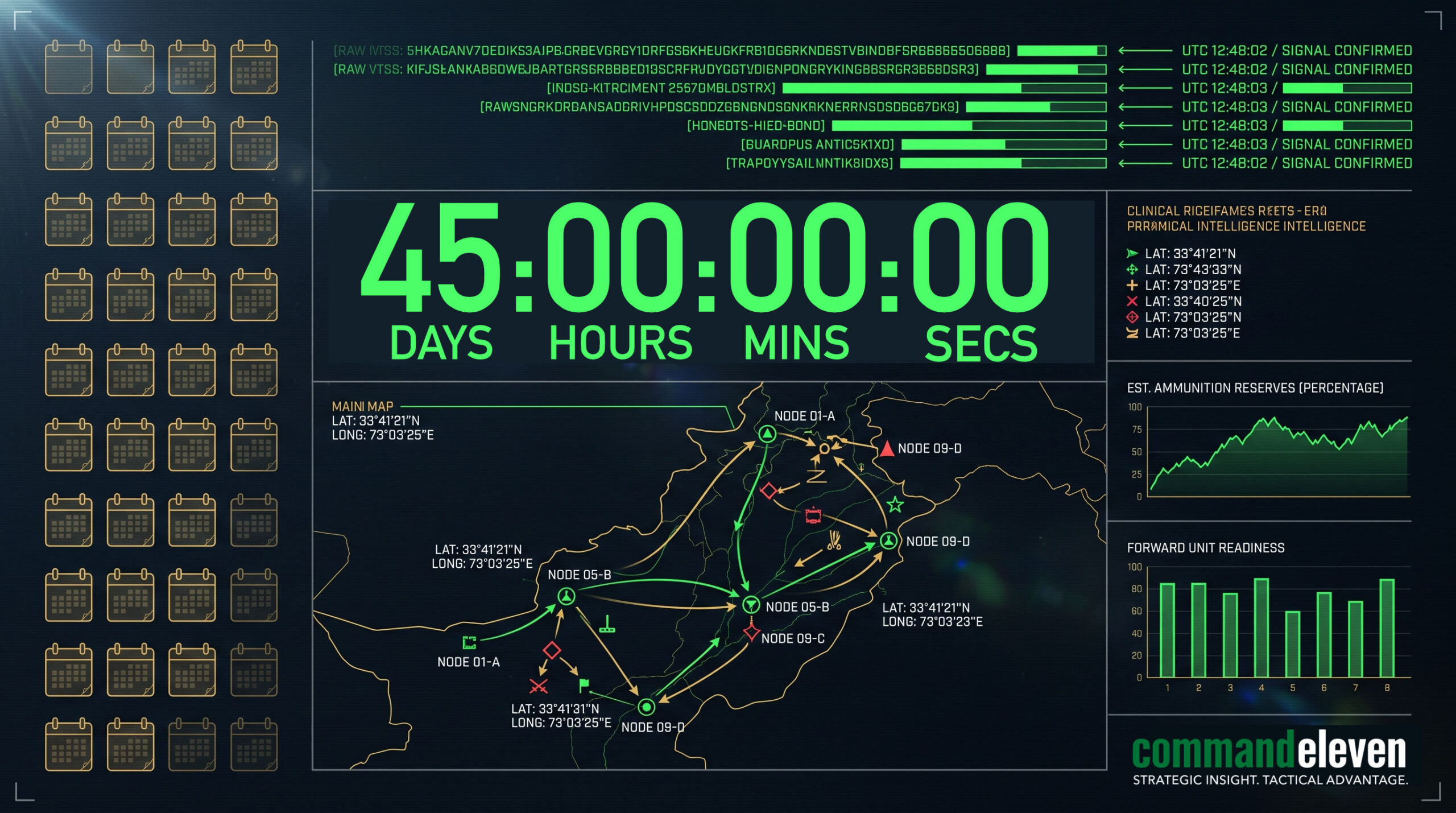
The 45-Day Terminal Window identifies a critical temporal phase in geopolitical and kinetic escalation where traditional diplomacy yields to operational inevitability. This window represents the final interval during which a state or non-state actor transitions from posturing and mobilization to the execution of a primary objective. Within this period, intelligence indicators shift from strategic intent to tactical certainty, as logistics, personnel positioning, and secondary support structures reach a state of readiness that becomes financially and politically unsustainable to maintain without action. Monitoring this window requires a granular analysis of “hard truth” indicators, including forward-deployment of specialized munitions, the activation of localized command-and-control nodes, and the finalization of maritime or border-crossing logistics.
3 Key Takeaways
- Logistical Irreversibility: Once an actor enters the 45-day window, the “sunk cost” of mobilization,comprising personnel deployment and resource expenditure – reaches a threshold where de-escalation results in significant loss of domestic and international credibility.
- Indicator Saturation: The transition from the 90-day to the 45-day mark is defined by a shift from signals intelligence (SIGINT) to human intelligence (HUMINT) and geospatial intelligence (GEOINT) confirmation of “first-strike” hardware positioning.
- Tactical Compression: As the terminal window narrows, the timeframe for external intervention or counter-measures decreases exponentially, forcing a shift from proactive deterrence to reactive containment or defensive posture.
Operational Guidelines: The 45-Day Terminal Window
The 45-Day Terminal Window is the clinical interval between the initiation of an extremist “Software Update” and the recruit’s final transition through the Kinetic Gate. Within the Mosaic Defense, this window represents the primary opportunity for Tile Guardians to interdict human capital through administrative utility rather than kinetic force.
Phase 1: Detection (Days 1–15)
- The Acquisition Signal: Identifying individuals who have begun to disengage from state-vetted social structures. This is often preceded by a loss of Logistical Oxygen (unemployment, lack of healthcare, or academic failure).
- Cognitive Indicators: Monitoring for the early resonance of the “Silent Echo” – the adoption of sanitized extremist narratives disguised as local grievances.
- Tile Guardian Action: Deploying localized HUMINT to verify if the individual is being funneled into the Madrassa Pipeline’s acquisition stage.
Phase 2: Processing & Narrative Conflict (Days 16–35)
- The Software Update: During this phase, the recruit undergoes intensive narrative indoctrination. This is the period of maximum cognitive plasticity.
- Utility Spoofing: Adversaries provide shadow services to cement the recruit’s loyalty.
- Tile Guardian Action: Initiating a Utility Interjection. The Tile must provide a superior, tangible alternative to the pipeline’s social support. This is not “counter-propaganda,” but the physical delivery of state-backed opportunity (vocational placement, medical intervention, or administrative inclusion).
Phase 3: The Terminal Threshold (Days 36–45)
- The Kinetic Gate: The final transition where cognitive indoctrination translates into physical facilitation (transporting IED components, logistics, or tactical training).
- Institutional Rupture: Once an individual crosses Day 45, the state’s administrative utility loses its leverage, and the subject moves into the kinetic interdiction domain.
- Tile Guardian Action: Last-mile administrative intervention. If the “Hardware Truth” of state utility fails to resonate by Day 45, the Tile Guardian must hand over the file to the security apparatus, as the Sanitization Gap has successfully closed.