SOURCING AND CONFIDENCE TIERS
This dossier applies CommandEleven’s standard confidence-tiering to every substantive claim.
- [CONFIRMED] denotes claims corroborated by primary government or institutional documentation (Treasury, State Department, UN Security Council, or equivalent)
- [ASSESSED] denotes analytical judgments drawn from convergent open-source reporting where primary confirmation is unavailable or reporting is contested
- [SPECULATIVE] denotes forward-looking judgment beyond the current evidentiary record, offered for planning purposes only
- [DATA DEFICIT] flags points where authoritative data does not exist or cannot currently be independently verified.
Note on scope: this dossier addresses sanctions policy, economic effect, and diplomatic alignment at the strategic and organizational level only. It does not address military targeting, interdiction tactics, or any operational conduct of the ongoing conflict.
KEY JUDGEMENTS
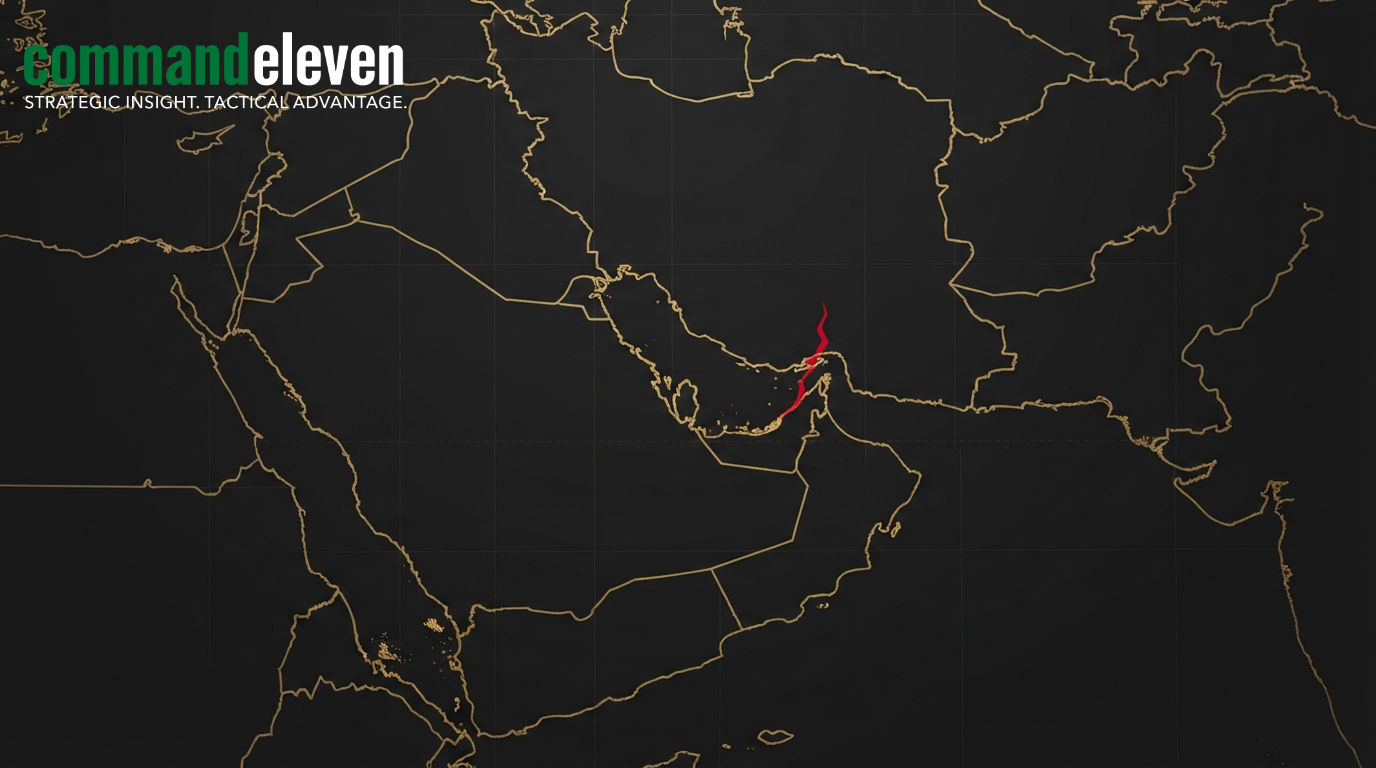
[CONFIRMED] Iran’s sanctions posture has shifted qualitatively since February 2026, from an administrative “maximum pressure” campaign of designations and export targets into an integrated war-and-blockade posture that combines Treasury sanctions with a physical US naval blockade of the Strait of Hormuz.
[CONFIRMED] United Nations sanctions on Iran, suspended under the 2015 nuclear deal, were formally reimposed on 27 September 2025 after the United Kingdom, France, and Germany (the E3) triggered the JCPOA’s snapback mechanism, restoring the pre-2015 arms embargo, asset freezes, and proliferation-related restrictions.
[ASSESSED] The Trump administration’s Treasury-based toolkit is approaching the limits of its marginal utility. Weekly-to-biweekly rounds of Office of Foreign Assets Control designations under the “Economic Fury” campaign continue, but the naval blockade – a war-powers instrument, not a sanctions instrument in the technical sense – is now doing the majority of the economic damage to Iran’s export revenue.
[ASSESSED] China’s formal invocation of its Blocking Statute against US sanctions on five independent refineries in May 2026 marks a break from the tacit-evasion pattern that characterized Chinese conduct through 2018–2025. It signals a state-level decision to treat Iranian crude access as a sovereign energy-security prerogative rather than a compliance risk to be quietly managed.
[ASSESSED] Iran’s demonstrated endurance of sanctions since 1979 is a weak predictor of resilience to the current phase. Prior sanctions regimes coexisted with a shadow-fleet export architecture that kept 1.5–2.1 million barrels per day flowing even at the height of “maximum pressure.” The 2026 blockade physically interdicts that architecture rather than merely penalizing it financially, producing an export collapse no prior sanctions round achieved.
[SPECULATIVE] Absent a negotiated settlement on the nuclear file and Strait of Hormuz access, sustained combined pressure raises the probability of further domestic unrest and elite friction inside Iran through the remainder of 2026, though the regime’s demonstrated repressive capacity makes any forecast of institutional collapse unwarranted.
[DATA DEFICIT] Iran has not published official GDP data since 2024, and a sustained domestic internet blackout limits independent verification of on-the-ground conditions. Economic judgments in this dossier rely on IMF and World Bank modeling, shipping and tanker-tracking data, and parallel-market currency indicators rather than official Iranian statistics.
FROM EMBASSY SEIZURE TO SNAPBACK: THE SANCTIONS ARCHITECTURE, 1979-2025
Iran has operated under some form of US economic restriction continuously since November 1979, making it one of the most sustained sanctions relationships in modern statecraft. Understanding the current phase requires distinguishing three eras: the foundational unilateral embargo (1979–2006), the multilateral nuclear-proliferation regime built through the UN Security Council and the EU (2006–2015), and the post-JCPOA cycle of relief, withdrawal, and reimposition that has defined the past decade.
The secondary-sanctions model that now dominates US Iran policy – penalizing third-country firms and banks for dealing with sanctioned Iranian entities, rather than only restricting direct US trade – dates to the mid-1990s and was the mechanism that eventually brought Iran to the JCPOA negotiating table in 2013–15. The 2015 deal represented the high-water mark of sanctions relief: a coordinated UN, EU, and US rollback in exchange for verified enrichment limits. Its unraveling began with the 2018 US withdrawal and accelerated through 2025, when Iran’s accumulating JCPOA breaches and restrictions on IAEA monitoring gave the E3 legal grounds to trigger the snapback mechanism embedded in UNSCR 2231 before that mechanism’s October 2025 expiry.
| Period | Development |
| 1979–80 | Seizure of the US embassy in Tehran triggers the first US sanctions program against Iran: asset freezes and a trade embargo under the International Emergency Economic Powers Act. |
| 1984 | State Department designates Iran a State Sponsor of Terrorism, layering export and arms-transfer restrictions atop the existing embargo , a designation that remains in force. |
| 1995–96 | Clinton-era executive orders and the Iran-Libya Sanctions Act extend restrictions to foreign firms investing in Iran’s energy sector , the origin of the secondary-sanctions model still in use today. |
| 2006–10 | UN Security Council Resolutions 1696, 1737, 1747, 1803, 1835, and 1929 impose multilateral sanctions over Iran’s uranium enrichment; the EU adds a full oil embargo in 2012. |
| 2015 | Iran, the P5+1, and the EU conclude the Joint Comprehensive Plan of Action (JCPOA). UNSCR 2231 endorses the deal and lifts nuclear-related UN, EU, and US sanctions in exchange for enrichment caps and IAEA verification. |
| 2018 | The first Trump administration withdraws the United States from the JCPOA and reimposes unilateral sanctions under a “maximum pressure” strategy aimed at driving Iranian oil exports to zero. |
| 2019–24 | Iran progressively breaches JCPOA enrichment limits; a first US snapback attempt at the UN fails for lack of standing. The Biden administration maintains sanctions but limits new escalation; Vienna talks on JCPOA revival stall repeatedly. |
| Feb 2025 | The second Trump administration issues a National Security Presidential Memorandum restoring maximum pressure, directing Treasury to maximize sanctions and State to pursue zero Iranian oil exports. |
| Aug–Sep 2025 | Citing Iranian noncompliance and restricted IAEA access, the E3 (UK, France, Germany) trigger the JCPOA’s snapback mechanism on 28 August; UN sanctions formally return on 27 September. The G7 issues a joint statement of support on 2 October. |
| Feb 2026 | The 2026 Iran war begins with US–Israeli strikes on Iranian nuclear and military sites; Iran closes the Strait of Hormuz, triggering a global energy shock. |
| Apr–Aug 2026 | A cycle of ceasefires, a June memorandum of understanding, and collapses follows. The United States imposes and reimposes a naval blockade of Iranian ports; a 17 August 2026 deadline for a final deal expires without resolution. |
[CONFIRMED] China, Iran, and Russia formally disputed the E3’s legal standing to invoke snapback in an 18 October 2025 letter to the Security Council, arguing the E3 had itself ceased performing its own JCPOA commitments and had not exhausted the deal’s dispute-resolution procedures. The Security Council’s presidency did not accept this objection, and the reimposed resolutions took effect regardless – a dispute that remains procedurally live but has not altered the sanctions’ practical reinstatement.
The significance for the current dossier is this: by the time the 2026 war began, Iran was already operating under a fully reimposed multilateral sanctions architecture – UN, EU, UK, and US measures simultaneously in force – for the first time since 2015. The war and blockade that followed in February 2026 did not open a new sanctions front so much as add a kinetic and maritime-interdiction layer on top of an already-restored economic one.
THE TOOLKIT AVAILABLE TO THE TRUMP ADMINISTRATION
Washington’s Iran-sanctions authority rests on a stack of statutory and executive tools accumulated since the 1990s: the International Emergency Economic Powers Act, the Iran Sanctions Act lineage, the Countering America’s Adversaries Through Sanctions Act framework, and a series of terrorism- and proliferation-linked executive orders (13224, 13382, 13599 among them). What has changed in 2025–26 is not the legal architecture but the operational tempo and the addition of a war-powers instrument that sits outside the sanctions system proper.
| Instrument | Current Application |
| OFAC SDN designations (IEEPA, E.O. 13382, E.O. 13224) | Rolling weekly-to-biweekly designations under the Treasury’s “Economic Fury” campaign, targeting individuals, shipping firms, and vessels tied to oil, shadow-fleet logistics, and weapons procurement. |
| Shadow-fleet and shipping sanctions | Tanker-specific SDN listings (crude, LPG, and chemical carriers) intended to restrict vessels’ ability to obtain insurance, flag registration, and port access internationally. |
| Refinery-level secondary sanctions | Direct designation of Chinese independent (“teapot”) refineries – most notably Hengli Petrochemical in April 2026 – for processing sanctioned Iranian crude, an escalation beyond the shipping-and-trading-company targeting of prior years. |
| Financial and shadow-banking sanctions | Measures against banking networks and, as of 7 August 2026, digital-asset exchanges used to move Iranian oil proceeds outside conventional correspondent-banking channels. |
| Reimposed UN measures (snapback) | Arms embargo, ballistic-missile technology restrictions, and asset freezes restored via UNSCR mechanisms since 27 September 2025, binding on all UN member states independent of US unilateral action. |
| Naval blockade of Iranian ports | A war-powers instrument, not a Treasury sanction: physical interception, redirection, and boarding of tankers transiting to or from Iranian ports, in force intermittently since 13 April 2026 and reimposed after the July ceasefire collapse. |
[ASSESSED] The single most consequential escalation in the current toolkit is the direct designation of Chinese refineries rather than only the intermediary trading and shipping companies that moved Iranian crude to them. Targeting Hengli – reported by Treasury as one of the largest purchasers of Iranian oil and a processor of shadow-fleet cargoes since at least 2023 – signals a willingness to accept direct friction with Beijing that earlier administrations avoided.
[ASSESSED] Remaining headroom in the toolkit is narrower than headline designation counts suggest. Treasury has largely exhausted the population of shipping and trading intermediaries it can plausibly designate without directly sanctioning Chinese state-owned banks or major refiners – a step that would carry systemic financial-markets implications and has so far been avoided. The blockade, not further OFAC listings, is the marginal source of additional pressure.
[SPECULATIVE] Should negotiations remain stalled, the most likely next escalatory step is expanded interdiction enforcement under blockade authority – more vessels boarded or redirected – rather than a qualitatively new sanctions category. A secondary possibility, carrying materially higher risk of direct US–China confrontation, is the designation of a major Chinese state bank for USD-clearing activity connected to Iranian oil proceeds.
MULTILATERAL ALIGNMENT: WHO FOLLOWS WASHINGTON’S SIGNAL
The reimposition of UN sanctions via snapback gives the current campaign a multilateral legal foundation the 2018–2020 “maximum pressure” campaign never had – that earlier effort relied on US unilateral and secondary sanctions alone, since the US had already exited the JCPOA and lacked standing to trigger snapback itself. The 2025 snapback was executed by the E3 acting as continuing JCPOA participants, and the G7’s prompt joint endorsement extended formal alignment across the transatlantic bloc plus Japan and Canada.
| Actor | Posture | Basis |
| G7 (Canada, France, Germany, Italy, Japan, UK, US) + EU | Aligned | Joint statement of 2 October 2025 explicitly endorsed the E3 snapback and committed to swift reimplementation of restored UN measures. |
| European Union | Aligned | Council decisions and implementing regulations reimposing sanctions adopted 29 September 2025, matching the UN snapback. |
| Israel | Aligned / co-belligerent | Direct military participant in the 2026 war; fullest alignment of any regional actor. |
| Gulf states (Saudi Arabia, UAE, Qatar) | De-escalatory, not sanctioning | Not sanctions-imposing states; have instead pressed Washington toward restraint at points (e.g., May 2026 request that contributed to a pause in strike planning) given direct exposure to Hormuz disruption and regional spillover. |
| Pakistan | Mediator, non-aligned | Organized the April 2026 ceasefire and continues mediation; not a party to the sanctions regime. |
| Russia | Opposed | Joined China and Iran in disputing the E3’s legal standing to trigger snapback; provides diplomatic cover but limited substantive economic relief given its own sanctions exposure. |
| China | Opposed / active defiance | Invoked its 2021 Blocking Statute for the first time against US sanctions in May 2026, formally ordering domestic firms not to comply. |
| India | Hedging | Historically pragmatic; reduced Iranian purchases under 2018-era pressure but is simultaneously resisting US and EU secondary-sanctions pressure over Russian oil, limiting its appetite for a second front. |
| Turkey | Hedging | Mixed compliance record; formal trade curtailed while informal cross-border flows with Iran persist. |
| Yemen’s Houthi movement | Iranian proxy, active escalation | Declared a maritime blockade of Saudi Arabia on 20 July 2026 and has struck Saudi Aramco facilities at Jizan and Yanbu, a tanker near Yanbu, Najran airport, and multiple Red Sea vessels – collapsing the 2022 Saudi-Houthi truce and opening a second regional front separate from the direct US-Iran confrontation. |
[ASSESSED] Alignment among Gulf states is best characterized as de-escalatory rather than sanctions-supportive. Saudi Arabia, the UAE, and Qatar have not imposed independent measures against Iran; their interventions have generally sought to limit escalation given their direct exposure to Strait of Hormuz disruption and the risk of Iranian retaliation against regional infrastructure and shipping.
[ASSESSED] India represents the most consequential swing case. New Delhi is concurrently managing US and EU pressure over Russian crude purchases – which reached roughly half of its import bill by value in mid-2026 – and is unlikely to accept simultaneous confrontation over Iranian oil absent a specific and binding compliance deadline. Its posture is best read as calculated hedging rather than either alignment or defiance.
EFFECTIVENESS: DOES FOUR DECADES OF SANCTIONS EXPOSURE BLUNT NEW PRESSURE?
A reasonable starting assumption is that a state which has operated under sanctions in some form for 47 years should have built substantial adaptive capacity, and that additional measures therefore carry diminishing marginal effect. That assumption holds for the 2018–2025 sanctions period but is a poor guide to the phase that began in February 2026, for a structural reason: prior sanctions rounds, however aggressive, operated within a financial-deterrence model that Iran learned to route around.
Between 2018 and early 2026, Iran built and continuously refined a shadow-fleet export system – reportedly several hundred tankers using ship-to-ship transfers off Malaysia, Singapore, and the Sea of Oman to obscure cargo origin – that kept meaningful export volumes flowing to Chinese independent refiners even at the rhetorical peak of “maximum pressure.” Secondary-sanctions threats raised the cost of this trade (discounts to Brent widened from roughly $8/barrel in 2023 to $14–17/barrel by 2026) but did not stop it. This is the core reason Iran’s economy, while badly strained, avoided outright collapse through the first Trump term’s sanctions campaign and the initial months of its 2025 revival.
| Indicator | Reported Value / Trend |
| Crude oil exports, pre-war baseline (Feb 2026) | Approximately 2.1 million barrels per day. |
| Crude oil exports, May 2026 | Effectively zero, per open-source tanker-tracking analysis , the sharpest export collapse of any sanctions phase since 1979. |
| Estimated daily blockade-related economic cost | Approximately $435 million per day (FDD estimate); Oxford Economics separately estimated the blockade could remove up to 70% of Iran’s export income. |
| Rial exchange rate (parallel market) | Fell to a record low of roughly 1.9 million rial per US dollar by late April 2026, easing only slightly thereafter. |
| Annualized inflation | Estimated in the high-50s to high-60s percent range through mid-2026 (IMF projects 68.9% for 2026); food inflation has run higher still. |
| GDP | IMF projects a 6.1% contraction for 2026; Iran has not published official GDP figures since 2024. |
| Fiscal break-even oil price vs. realized price | IMF estimates a fiscal break-even near $124/barrel for 2026, against realized Iranian export prices tracking closer to $56/barrel after shadow-fleet discounts and logistics costs , a financing gap covered through central-bank advances and monetary expansion. |
| Oil exports, June 2026 (post-MoU relief window) | Rebounded to roughly 1.75 million barrels per day under OFAC’s temporary General License X, generating an estimated $4.49 billion for the month (UANI tanker-tracking). |
| Oil exports, July 2026 (post-collapse) | Fell to roughly 967,000 barrels per day (about $2.44 billion) after the 7 July revocation of General License X and blockade reinstatement. |
[ASSESSED] The naval blockade removes the specific mechanism , physical, deniable maritime transshipment , that sustained Iranian export resilience through the prior sanctions decade. Financial secondary sanctions penalize a transaction after the fact; a blockade prevents the underlying tanker movement from occurring at all. This is a difference in kind, not degree, and explains why oil exports collapsed to effectively zero in May 2026 in a way that no prior OFAC campaign achieved even at its most aggressive.
The June Revenue Window: Sanctions Relief as a Negotiating Instrument
The export collapse of May 2026 was not sustained through the following two months, and the reason is instructive rather than contradictory. The 17 June MoU between Washington and Tehran was accompanied five days later by OFAC’s General License X, a temporary authorization permitting the sale of previously sanctioned Iranian crude, petroleum products, and petrochemicals – a deliberate US concession intended to incentivize compliance with the 60-day negotiating window. Iranian exports responded immediately: independent tanker-tracking by United Against Nuclear Iran recorded a rebound to roughly 1.75 million barrels per day in June, generating an estimated $4.49 billion that month alone, with parliament speaker Mohammad Bagher Ghalibaf publicly citing more than 40 million barrels exported at prices roughly 20% above pre-war levels.
Iranian state media (Fars News, citing the Ministry of Petroleum) reported approximately $7.5 billion in oil revenue transferred to the Central Bank of Iran over the four months following the outbreak of war – a figure roughly consistent with, if somewhat lower than, UANI’s independently tracked total of $21.82 billion across the full first seven months of 2026 once the pre-war and blockade months are weighted in. The apparent tension between “Iran sold billions during the height of the war” and “the blockade cut exports to near zero” dissolves once the timeline is disaggregated: the revenue was earned predominantly during the ceasefire and MoU window, not during active blockade, and a meaningful share of it flowed under a license Washington itself issued as a negotiating incentive rather than despite US enforcement.
That window closed on 7 July, when renewed IRGC attacks on commercial shipping prompted Treasury to revoke General License X and the US to reinstate the blockade; UANI recorded exports falling to roughly 967,000 barrels per day in July (about $2.44 billion), with some cushion still provided by an estimated 50 million barrels of Iranian crude that had accumulated at a Malaysian offshore anchorage during the June recovery.
[ASSESSED] Social and institutional resilience is a separate question from export resilience, and here Iran’s track record is a somewhat better predictor. Provincial protest activity beginning 28 December 2025 – reportedly spanning all 31 provinces, including areas typically considered loyal to the state – indicates that four decades of sanctions endurance has not eliminated the regime’s exposure to economic-grievance unrest. The government’s demonstrated capacity for domestic repression, however, makes any forecast of unrest translating into policy change or institutional instability speculative rather than assessed.
[DATA DEFICIT] Independent verification of on-the-ground Iranian conditions is constrained by the absence of official GDP publication since 2024 and a sustained domestic internet blackout. The indicators in the table above are drawn from IMF and World Bank modeling, tanker-tracking firms, and parallel-market currency data rather than Iranian government statistics, and should be read with that caveat.
IMPACT ON TRADING NATIONS: COMPLIANCE, DEFIANCE, AND HEDGING
China: Formal Defiance as Strategic Choice
China purchased more than 80% of Iran’s seaborne crude exports in 2025 and remains, by a wide margin, Iran’s most important economic lifeline. Beijing’s May 2026 invocation of its Blocking Statute – the first use of that instrument since its 2021 creation – represents a qualitative escalation beyond the tacit, deniable evasion that characterized Chinese conduct through the first Trump term. Rather than allowing independent “teapot” refiners to quietly absorb sanctions risk, China’s Ministry of Commerce formally instructed domestic entities to disregard the US designations entirely, framing the sanctions as a violation of international law and a threat to Chinese energy security.
[ASSESSED] China’s calculation reflects the scale of exposure rather than ideological solidarity with Tehran: independent refiners process the majority of Iran’s discounted crude, and Chinese officials have publicly characterized continued US escalation – direct refinery targeting, expanding vessel designations – as a threat to national energy-supply stability. This is a sovereignty and energy-security argument, not primarily a foreign-policy alignment with Iran, and it parallels Beijing’s simultaneous resistance to US and EU pressure over Russian crude purchases.
India and Turkey: Calibrated Hedging
Neither India nor Turkey has followed China’s path of formal, state-level defiance, but neither has fully complied either. India’s refining sector – anchored by large private and state operators – has periodically curtailed Iranian purchases under direct US pressure, as it did ahead of the 2018 sanctions deadline, while resisting analogous pressure over Russian oil, where Russian-origin crude reportedly reached roughly half of India’s import bill by value in mid-2026. Turkey shows a similarly mixed record: reduced formal trade alongside persistent informal cross-border flows with Iran.
[ASSESSED] India is the most consequential hedging case because it faces simultaneous secondary-sanctions exposure on two fronts – Russian oil and, potentially, Iranian oil – at a moment when its broader strategic relationship with Washington carries substantial weight. New Delhi’s posture is likely to remain calibrated avoidance: reducing exposure enough to limit designation risk without publicly conceding to US demands, absent a specific and binding compliance deadline analogous to the November 2018 precedent.
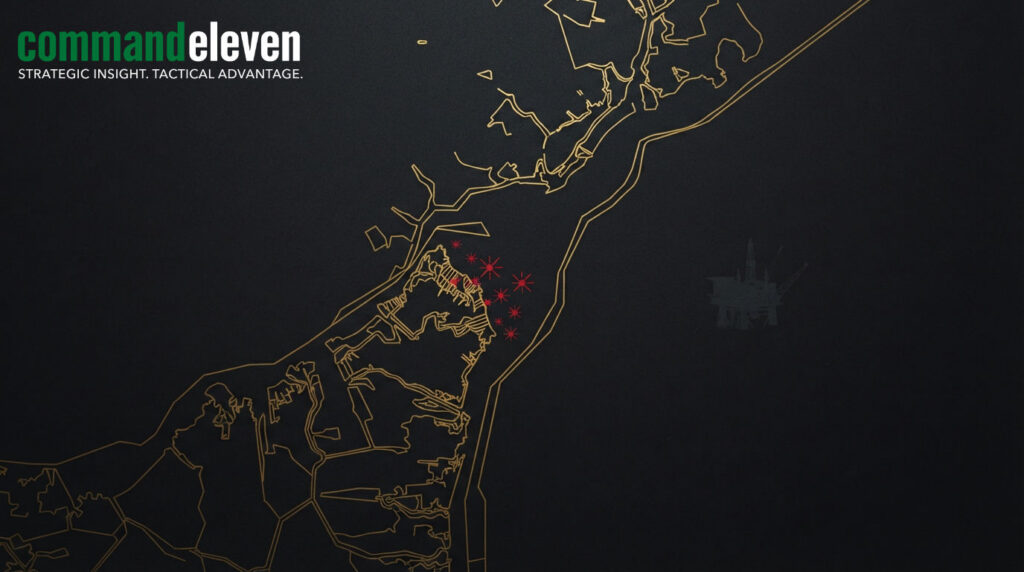
The Houthi Front: Pressure Redirected, Not Relieved
As direct US military and economic pressure on Iran has settled into a lower-intensity standoff since the 17 August expiry of the MoU negotiating window – continued but sporadic strikes rather than the sustained campaigns of February–April – Iran’s most consequential remaining proxy has escalated in its place. The Houthi movement’s “siege for a siege” campaign against Saudi Arabia, opened 20 July 2026, has struck Aramco’s Jizan and Yanbu facilities, a tanker near Yanbu, Najran airport, and multiple Red Sea vessels, killing at least 17 civilians per UN reporting and collapsing the 2022 Saudi-Houthi truce that had held for four years.
[ASSESSED] This front carries direct economic-pressure implications beyond the immediate Yemen-Saudi conflict. Saudi Arabia’s East-West Pipeline, which routes crude to Red Sea terminals, had partially insulated the kingdom from Iran’s earlier closure of the Strait of Hormuz. A sustained Houthi threat to Red Sea shipping and the Yanbu/Jizan export infrastructure – roughly 4 million barrels per day of capacity – would remove that insulation, giving Iran indirect leverage over regional energy flows even while its own direct war with the United States remains at a standstill.
[SPECULATIVE] Riyadh is reportedly evaluating military options, including a Yemeni-led ground operation, while simultaneously exploring Oman-mediated talks with the Houthis, though it denies the latter publicly. Whether this escalates into renewed large-scale conflict in Yemen or is contained through mediation remains genuinely uncertain and should not be treated as a foregone trajectory in either direction.
Compliant Nations: Limited Marginal Cost
For the G7, EU member states, and other aligned economies, formal compliance with the reimposed sanctions carries comparatively low marginal economic cost, since most of these economies had already curtailed direct Iran trade following the 2018 US withdrawal from the JCPOA. Their cost is primarily diplomatic and administrative – coordinating designations, updating compliance regimes, and absorbing modest energy-market volatility from Gulf disruption – rather than a loss of an existing trade relationship.
Downstream Effect: Rising Compliance Burden for Global Business
The expansion of US secondary sanctions into refinery-level and digital-asset-exchange targeting materially raises due-diligence burdens for multinational corporates operating in energy, shipping, insurance, and financial services across the Gulf and Central Asian corridors. Counterparty risk from shadow-fleet exposure – vessels with obscured ownership, falsified AIS transponder data, or ship-to-ship transfer histories – is no longer a niche compliance concern but a mainstream one for any firm with Gulf-adjacent maritime or trade-finance exposure.
PROJECTIONS
The floor under Iran’s economy is structural, not incidental
China alone has taken upwards of 80% of Iran’s seaborne crude at points. In May, China did something more consequential than quiet evasion – it formally invoked its Blocking Statute and told domestic refiners to ignore US sanctions outright. That’s a state-level decision, not a compliance gap. Pair that with India hedging, already fighting the US over Russian oil and has no appetite for a second front, and Russia providing diplomatic cover at the UN, and three of the world’s largest economies functioning as guaranteed buyers of last resort. No sanctions regime forces capitulation while that floor exists, because the regime always has somewhere to sell and someone to borrow from.
Latin America is the piece most sanctions coverage undersells
CommandEleven Intelligence has already published significant analysis in the IRGC series – the Quds Force’s Business Affairs Component, the Venezuela oil-and-drone barter arrangements, the Tri-Border Area logistics, Hezbollah’s Unit 910 footprint. The Latin America corridor matters specifically because it’s largely outside the maritime-interdiction and OFAC-banking toolkit that’s driving the current campaign. The US can blockade the Strait of Hormuz, but can’t blockade a barter arrangement with Caracas or an informal financial network running through cartel logistics. It’s a much smaller flow than the China oil trade, but it’s also nearly unstoppable by the instruments Washington is actually using, which makes it disproportionately important as a pressure-relief valve.
Where sanctions genuinely are working: capability constraint, not behavior change
The rial collapse, the 57-69% inflation, the protests spanning all 31 provinces since December – are real and not manufactured. Less money means less to spend on missiles, proxy funding, and reconstituting what the war degraded. That’s a meaningful outcome. It’s just not the outcome “sanctions will force Iran to the table on maximalist terms” implies. A regime can absorb enormous internal economic pain – Cuba, North Korea, Venezuela, Russia since 2022 – without changing core strategic behavior, especially one with Iran’s demonstrated repression capacity and no electoral accountability forcing the issue.
The blockade is the interesting exception, and Washington’s own conduct undercuts it
The blockade is the one instrument that actually bypasses the evasion architecture rather than just penalizing it – which is why exports hit zero in May in a way nothing since 1979 achieved. But the US traded it away in June for negotiating leverage (General License X), watched exports rebound to 1.75M bpd almost overnight, then had to reimpose it in July when Iran read that as weakness rather than good faith. That’s not an instrument being wielded with total conviction – it’s being used as a bargaining chip, which tells Tehran it’s reversible and therefore something to be waited out rather than capitulated to.
Net assessment
Sanctions plus blockade are extracting a real and rising economic price, but they are not going to produce capitulation on the nuclear file or proxy network as long as China, Russia, and India remain willing to absorb the trade and the Latin America corridor remains open below the sanctions radar. The theory of victory here would require either sanctioning China’s financial system directly – which risks a genuinely global confrontation Washington hasn’t shown appetite for – or waiting for internal collapse to do what external pressure can’t, which is a bet on Iranian domestic politics, not a sanctions outcome per se.
OUTLOOK AND FORECAST CONFIDENCE
[CONFIRMED] As of 21 August 2026, the direct US-Iran confrontation has settled into a lower-intensity standoff since the 17 August expiry of the MoU’s 60-day negotiating window: sporadic strikes and posturing (Trump’s threat against Oman, a social-media claim of the Strait of Hormuz as “New US Territory,” a reported Iranian bounty on US personnel, a UAE-reported missile threat) rather than a return to sustained offensive operations. Pressure has not relaxed so much as redirected – most visibly through the Houthi escalation against Saudi Arabia described above.
[ASSESSED] Absent a negotiated settlement on both the nuclear file and Strait of Hormuz transit arrangements, expect continued high-tempo OFAC designations targeting shipping, banking, and digital-asset intermediaries, with declining marginal deterrent effect relative to the blockade’s physical impact.
[ASSESSED] US–China friction over secondary-sanctions enforcement on Iranian oil will likely remain entangled with the broader US–China trade relationship, particularly given parallel tension over Russian energy purchases and existing tariff disputes – meaning Iran policy is no longer separable from great-power trade competition.
[SPECULATIVE] A plausible further escalation path involves direct designation of a major Chinese state-owned bank for USD-clearing activity linked to Iranian oil proceeds. This would represent a materially larger step than refinery-level targeting and carries meaningful risk of broader financial-market disruption; it has not occurred as of this writing and should be treated as a contingency rather than a prediction.
[SPECULATIVE] Continued economic deterioration combined with wartime disruption raises the probability of further domestic unrest in Iran through the remainder of 2026. Whether this translates into any change in regime posture on the nuclear program or Hormuz access remains highly uncertain and should not be assumed.
This dossier will be revisited as the situation develops; given the pace of designations and the fluidity of the ceasefire-negotiation cycle, readers requiring current-week detail should consult CommandEleven’s Intelligence Hub or primary Treasury/State Department releases directly.