Every post-attack review follows the same script.
Governments convene. Agencies brief. Committees demand answers. Journalists construct timelines. And somewhere in the proceedings, someone points to a piece of information that was already in the system and asks the question that haunts every major intelligence failure:
“Why didn’t we see this coming?”
The honest answer is rarely that the information wasn’t available. In most significant cases, substantial portions of the preparatory intelligence existed. The financing changes were observable. The rhetoric shifts had occurred. The organizational signals were in the record.
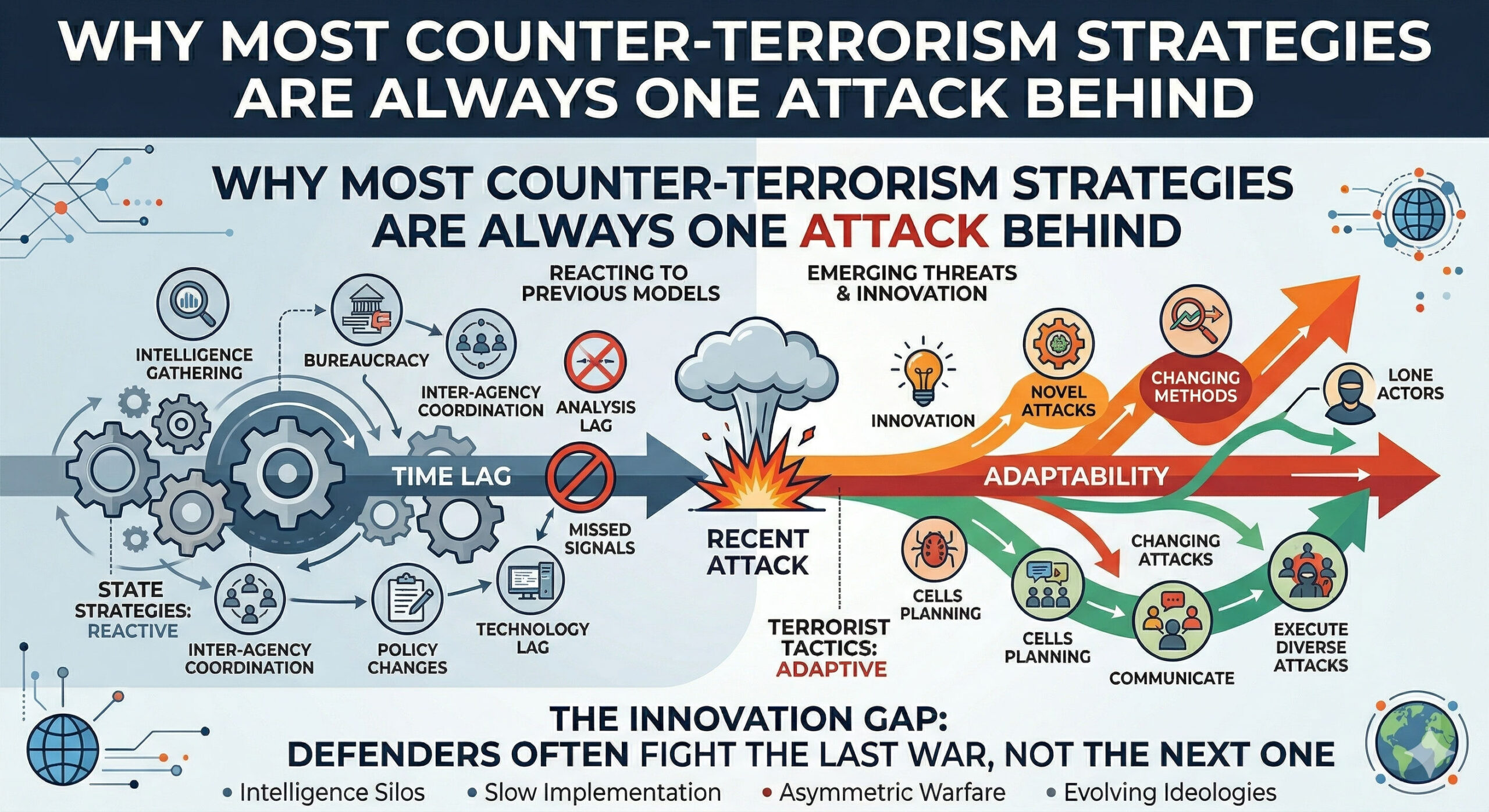
The answer is more uncomfortable: the analytical architecture was not designed to find them in time, because it was built for a different purpose — not to anticipate the next threat, but to explain the last one.
Most counter-terrorism strategies are, structurally, one attack behind.
How the Reactive Default Gets Built
Event-triggered resourcing. Most organizations allocate analytical attention in proportion to perceived threat salience. When a major event occurs, resources surge. But threat salience, by definition, peaks after events — when the threat has already materialized.
Post-event frameworks. The conceptual categories used to analyze terrorism tend to be built from the last generation of significant events. Analytical frameworks are systematically better at recognizing threats that look like the last threat than threats that look like the next one.
Confirmation dynamics. When a movement changes direction — adapts its tactics, shifts its geographic focus, restructures its organizational form — the early signals of that change often don’t fit the existing model well enough to trigger the reassessment they warrant.
What Proactive Intelligence Actually Requires
The conditions, not the events. Before a group conducts an operation, several observable things happen: recruitment language shifts, financial messaging evolves, communications migrate, geographic targeting rhetoric narrows.
Longitudinal coverage over surge capacity. The signals that precede attacks are detectable against a baseline — they’re departures from the pattern of a specific group’s normal communications.
Primary source monitoring. Most counter-terrorism strategies are built on analysis that is several degrees removed from the primary source environment. Proactive intelligence requires going back to the primary source.
The Quarterly Review Problem
Extremist movements don’t operate on quarterly cycles. They respond to conditions in real time. A group that makes a significant operational pivot in January doesn’t appear in most organizational threat assessments until the April quarterly review — if it appears at all.
Three months is a long time when operational preparation is underway.
The Pattern Recognition Gap
The teams that consistently get ahead of threats are not the ones with the most resources. They’re the ones with the deepest longitudinal engagement with specific threat actors — the analysts who have been reading the same groups for years, who know what normal looks like and can recognize abnormal when it appears.
What Changes When You Shift
Organizations that make the shift from reactive to proactive intelligence don’t just respond faster. They make fundamentally different decisions.
They de-prioritize threats earlier. They allocate resources to emerging threats before they peak. They brief decision-makers on what’s developing — not just what happened. They build organizational resilience against threats that haven’t yet materialized.
The threat landscape doesn’t wait for the next quarterly review.
The question for any organization with meaningful exposure isn’t whether it can afford to build proactive intelligence capacity. It’s whether it can afford not to.
The Structural Fix
Continuous monitoring as the default, not the exception. Intelligence functions that activate in response to events will always be behind the threat cycle.
Primary source coverage with linguistic depth. The most predictive signals are in the primary source communications — the actual output of the groups being analyzed, in their original languages.
Analytical frameworks oriented toward conditions, not events. What conditions, if present, increase the probability of operational activity?
Lead-time metrics as the measure of success. Organizations that measure how much lead time their intelligence provides before events are optimizing for the right outcome.
The attack is the last data point. The organizations that understand this build their analytical infrastructure around everything that precedes it.