
Why This Series, Why Now
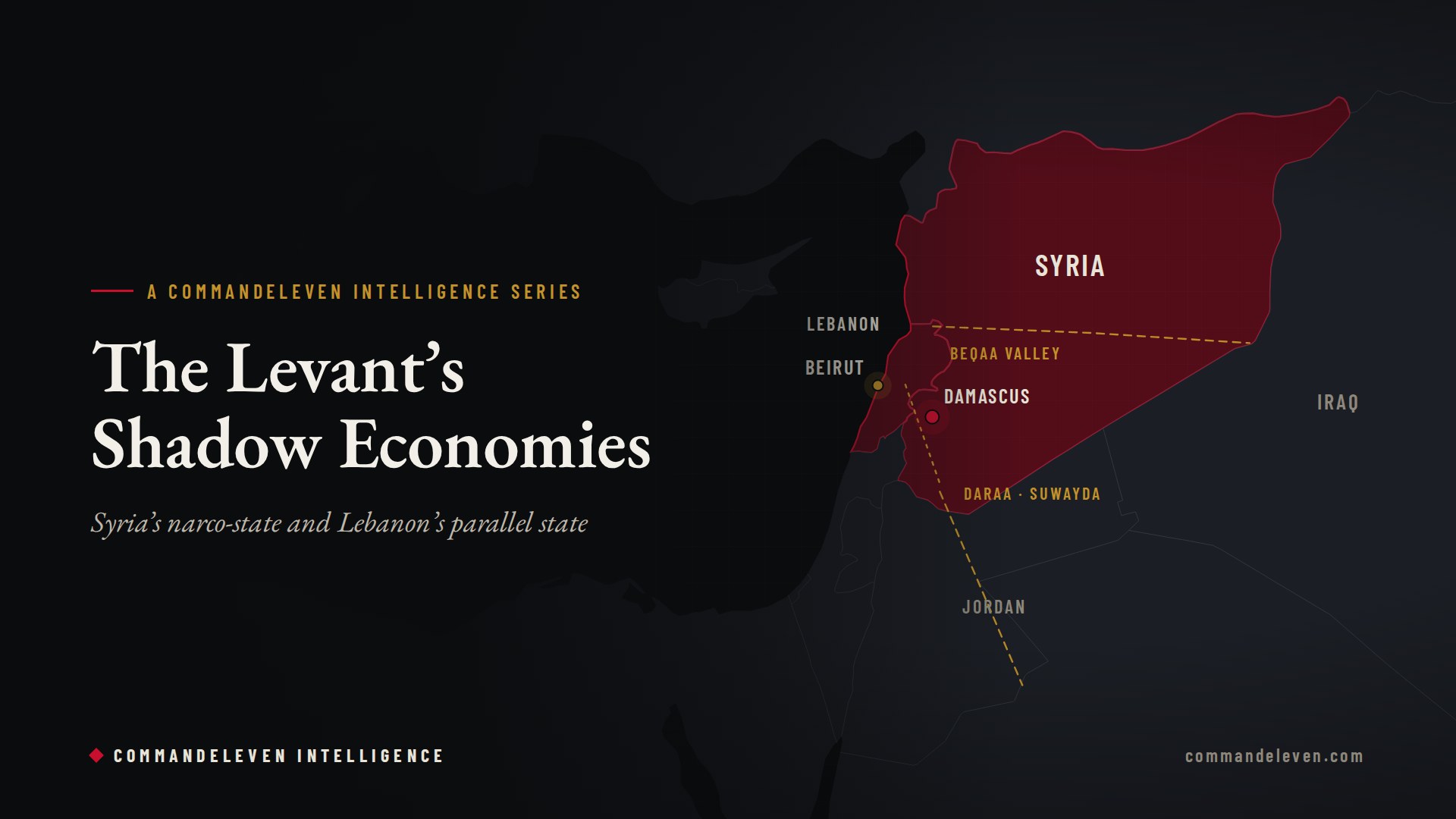
The Levant’s two most important economies are not on any official balance sheet. In Syria, the industrial Captagon trade once run by the 4th Armored Division did not end when the Assad regime fell in December 2024. Open-source reporting describes it as having fragmented into a decentralized network of regime remnants, militias and criminal syndicates. CommandEleven Intelligence’s own sources in Syria and Afghanistan go further: [CONFIRMED – CommandEleven field sources] the Jolani-led state is itself running a very large Captagon production network. In Lebanon, Hezbollah’s parallel financial, retail and logistics system has outlasted the 2019 collapse, the war that followed and a new government’s attempts at reform.
The two systems share routes, partners and a border, and each helps explain why formal state power in the Levant keeps failing to reassert itself. This series examines them side by side. A consolidated Captagon dossier, bringing CommandEleven Intelligence’s field reporting together with the open-source record, is in preparation and will join the series.
What This Series Covers
- Part 1: The Syrian Narco-State: Captagon’s Political Economy – from Assad-era state monopoly to the post-transition network, its financial architecture, and its continued use as leverage against the Gulf states.
- Part 2: Levantine Narco-Corridor and Captagon Dynamics – mobile production and the smuggling corridors through southern Syria, the Beqaa Valley and the Iraqi border.
- Part 3: The Syrian Narco-State: North African Production Networks – how production, transit and laundering moved into North Africa to evade Eastern Mediterranean interdiction.
- Part 4: Lebanese Institutional Decay and State Capture – Lebanon’s dollarized, non-structural recovery, Hezbollah’s Al-Qard al-Hassan financial network, captured ports and borders, and a security sector split between the state and a non-state force.
A Note on Method
Claims are confidence-tiered as CONFIRMED, ASSESSED or SPECULATIVE. Estimates of the Captagon trade’s value and of Lebanon’s war damage vary widely by source and method, and the series gives ranges rather than single figures where the evidence demands it. The analysis stays at the strategic and policy level and does not describe production methods.

