Technical Takeaways
- Administrative Subversion Circumvents Kinetic Radar Surveillance: Armed proxies have transitioned from external cargo smuggling to internal terminal co-optation. By embedding personnel within cranes, safety units, and harbor master offices, proxies manipulate automated scheduling and cargo data to isolate illicit arrivals from routine state inspection cycles entirely.
- Shadow Infrastructure Exploits Commercial Mass: Colonized port complexes allow armed networks to establish covert manufacturing, modification, and siphoning nodes inside legitimate shipping infrastructure. This tactical integration masks the physical footprint of weapons assembly and fuel extraction, protecting illicit cargo pools from aerial and satellite surveillance.
- Cyber and Electronic Shielding Induces Command Vacuum: Proxy electronic warfare cells utilize database penetration and directional signal suppression arrays to blind state authorities during active offloading operations. By executing automated radar track deletion scripts and jamming localized communication frequencies, proxies disrupt real-time coordination, allowing smuggling fleets to clear port perimeters before state assets can deploy.
Executive Summary
The operational convergence between non-state armed proxies and corrupted maritime port infrastructure establishes a critical threat to global supply chain integrity and state sovereignty. Irregular militant networks execute systematic infiltration operations to colonize strategic port terminals within weak sovereign enclaves or disputed littoral zones. This colonization process converts legitimate commercial transport hubs into specialized logistical sanctuaries for the unmonitored movement of illicit payloads. By co-opting local maritime administrative bodies, terminal operators, and customs verification systems, these syndicates generate significant, self-sustaining parallel economies. Legitimate shipping channels become primary vectors for the transport of heavy weapons systems, contraband, and specialized military technology. Traditional state naval interdiction forces and regional law enforcement regimes struggle to disrupt these embedded networks due to the legal complexities of commercial port domains and the sophisticated digital counter-measures deployed by proxies. Reclaiming sovereign control over these critical littoral chokepoints demands an aggressive, technology-led pre-emptive strategy that integrates comprehensive data analytics with tactical maritime law enforcement operations. This dossier evaluates the specific hardware mechanics, network infiltration tactics, and structural subversion methodologies that enable armed groups to project parallel authority through port colonization. Without targeted structural intervention, the continuous expansion of these proxy enclaves will permanently compromise international maritime security.
Infiltration Vectors and Port Terminal Subversion
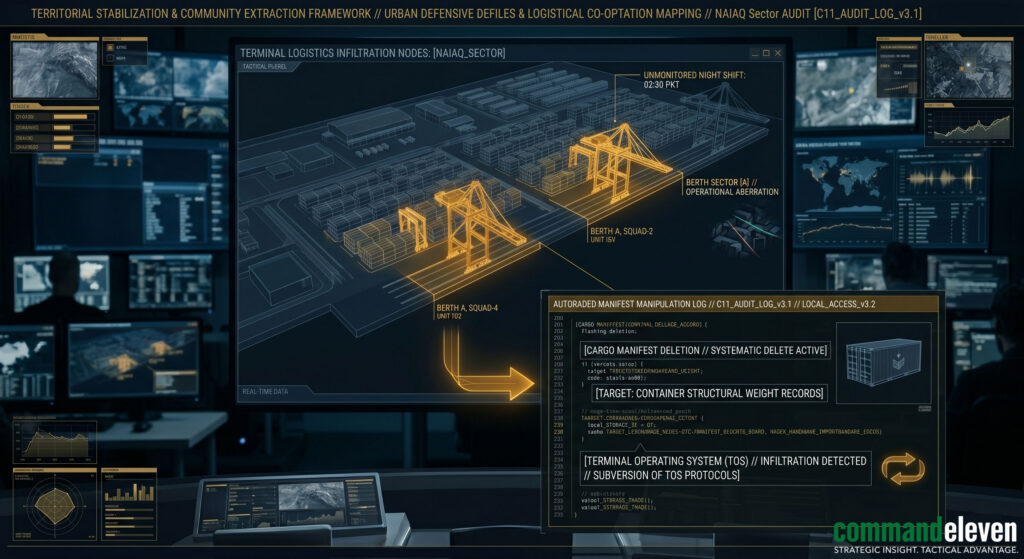
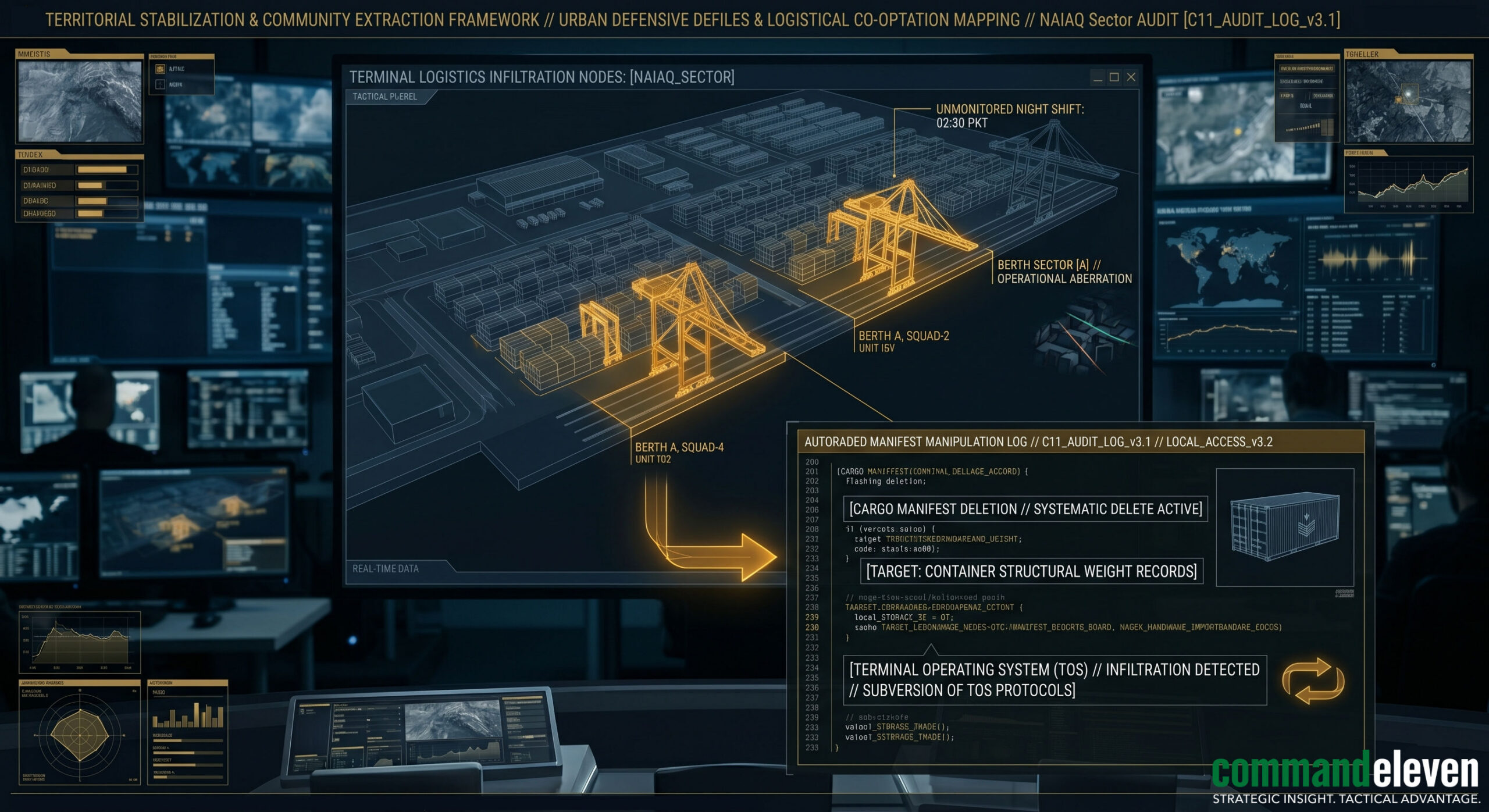
Armed proxies exploit institutional fragmentation within weak states to embed operational cells inside major commercial port complexes. These networks target specific maritime hubs where regulatory enforcement is compromised or underfunded. The infiltration teams secure employment or administrative placement within terminal operations sectors under the guise of legitimate logistics personnel, labor unions, or port security entities. This calculated positioning allows the proxies to access secure customs databases, container manifests, and berth allocation schedules without alerting national intelligence services. Once inside the port framework, these cells initiate the subversion of terminal offloading protocols.
- Corrupted crane operator teams execute unmonitored cargo transfers during low-visibility nighttime operational windows to bypass standard container inspection areas.
- Infiltrated terminal security guards manipulate physical access control points, allowing unauthorized vehicular traffic into restricted container storage yards.
- Compromised customs verification officers apply counterfeit or stolen digital administrative stamps to high-risk manifests, granting automated clearance to illicit shipments.
- Subverted harbor master staff alter berth assignment logs to position proxy-controlled cargo ships away from primary state observation towers.
This administrative subversion directly compromises the integrity of physical terminal boundaries. Concurrently, operational data shows that proxies coordinate these internal placements with external cyber exploitation campaigns. The physical manipulation of cargo flows remains dependent on the network’s capacity to alter electronic customs records permanently. Once the specialized personnel secure their target sectors, the port transitions from a standard public transport asset to a localized proxy transit vector. This institutional corruption provides the baseline logistical support needed to absorb large-scale illicit materials.
The proxies leverage their internal access to systematically alter the automated scheduling of container vessels entering the colonized terminal. By generating false scheduling anomalies or synthetic delays, the cells isolate specific arrivals from routine state inspection cycles. This logistical manipulation creates a predictable, unmonitored window where proxy-controlled vessels can offload illicit payloads directly into the domestic supply chain. These operations occur within the highest-volume sectors of the port, using commercial mass to dilute the signatures of specific contraband movements.
- Automated scheduling manipulation interfaces adjust terminal docking timelines remotely, creating artificial delays that push target container ships into unmonitored night shifts.
- Falsified crane manifest logs delete structural weight records of specific heavy equipment containers to hide the importation of military hardware.
- Subverted terminal tracking modules scrub specific container identification numbers from local storage yard inventory software, rendering the units invisible to port audits.
- Corrupted gate pass generators issue valid electronic transit documentation to unauthorized transport vehicles, facilitating immediate egress from the terminal perimeter.
The falsification of terminal tracking logistics ensures that incoming illicit materials bypass regional customs inspection barriers completely. This operational insulation allows the cargo to exit the port gate and enter secondary overland transit loops without triggering automated national law enforcement alerts. Once the payloads clear the immediate port boundary, the proxies move the assets to secure interior distribution hubs. This localized distribution network bridges the gap between maritime entry points and active conflict zones.
Parallel Port Governance and Shadow Infrastructure
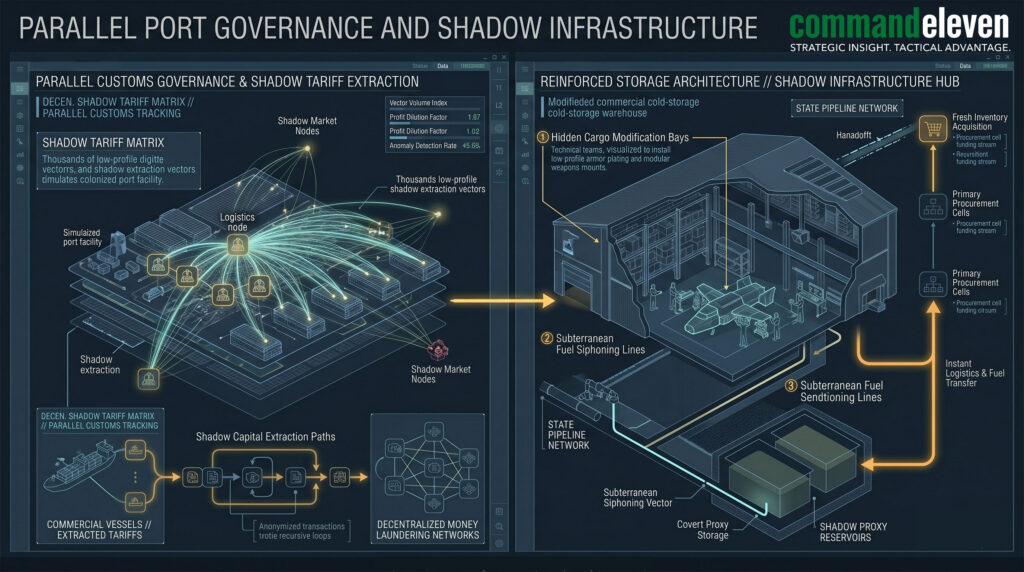
The colonization of port infrastructure allows armed proxies to establish parallel administrative governance frameworks over the surrounding maritime communities. The syndicates replace weak state regulatory agencies by executing direct taxation regimes on all commercial entities operating within the terminal zone. This extortion framework is institutionalized through proxy-managed business associations and co-opted labor unions. The revenue generated from these shadow tariffs provides the continuous liquidity required to fund expansionist insurgent campaigns and purchase advanced military hardware on the black market.
- Shadow customs tariff matrices impose parallel financial levies on all incoming commercial cargo vessels, forcing compliance through threats of terminal labor strikes.
- Co-opted port labor unions enforce total operational compliance among dock workers, effectively shutting down terminals if state authorities attempt inspections.
- Front shipping agency networks manage the legal documentation for proxy-controlled vessels, presenting a compliant corporate profile to international maritime bodies.
- Parallel dispute resolution sectors handle commercial conflicts within the port zone, completely bypassing the statutory authority of state courts.
This parallel administrative structure effectively insulates the proxy enclave from national regulatory intervention. Concurrently, financial intelligence reveals that the capital extracted through these shadow tariffs is immediately diverted into decentralized money laundering networks. The speed of this extraction ensures that the proxy network maintains constant funding to sustain its local operations. The colonized port serves as the economic engine for the broader insurgency, providing self-sustaining liquidity independent of foreign state sponsorship.
The proxies construct specialized shadow infrastructure inside the colonized port perimeters to facilitate the covert storage and modification of illicit assets. These hidden facilities are integrated into existing commercial warehouses, fuel depots, and repair bays to evade detection by aerial and satellite surveillance. The networks use these enclaves to unpack, assemble, and distribute incoming heavy weapons systems and specialized military tech components. The proximity of these storage nodes to the water allows for rapid deployment to active maritime or terrestrial combat zones.
- Modified commercial cold-storage facilities conceal the thermal signatures of stored electronics and guided missile guidance components from airborne infrared sensors.
- Subterranean fuel siphoning systems divert petroleum products from state-managed pipelines directly into hidden proxy distribution reservoirs.
- Reinforced cargo modification bays allow technical teams to install heavy weapon mounts and low-profile armor plating on standard civilian transport craft.
- Encrypted local area networks link all shadow storage nodes via secure fiber-optic lines, avoiding vulnerable public wireless communication systems.
The deployment of localized shadow infrastructure converts the commercial port terminal into a hardened military staging ground. This material processing capability ensures that incoming components are rapidly transformed into operational tactical assets. The proxies maintain control over these nodes through strict compartmentalization, ensuring that a state raid on one sector does not compromise the broader logistical grid. This structural resilience allows the network to withstand persistent security pressure without suffering a systemic breakdown.
High Velocity Maritime Smuggling Mechanics
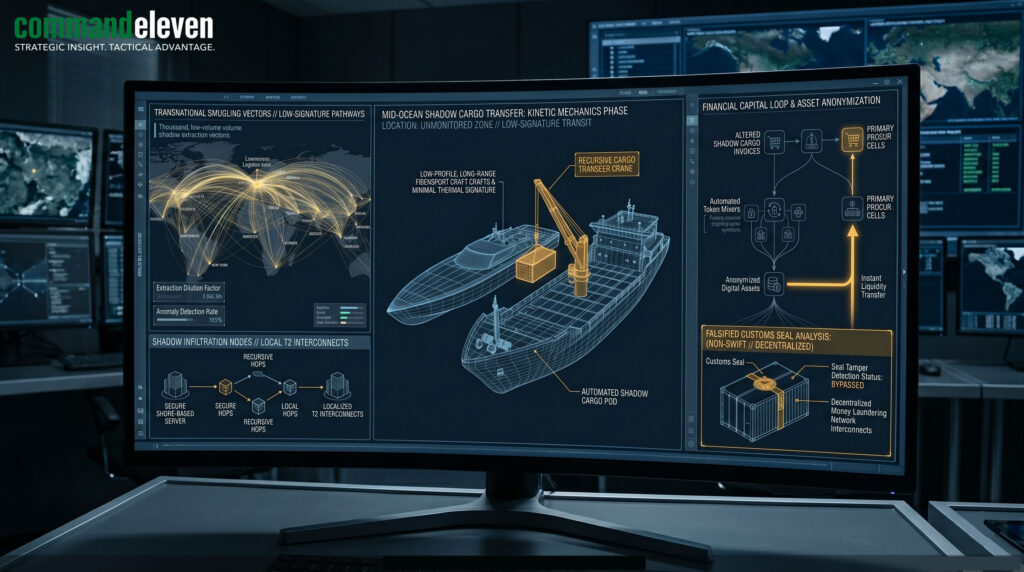
Armed proxies utilize their colonized port enclaves to execute high-velocity maritime smuggling operations across critical maritime transit corridors. The networks deploy specialized low-profile watercraft and modified commercial fishing vessels to move weaponry, explosives, and technical components between regional logistics nodes. These smuggling fleets operate under the cover of legitimate local maritime commerce, exploiting high-traffic fishing grounds to blend their movements into normal regional traffic profiles. This operational integration makes visual and radar identification exceptionally difficult for state coastal patrol forces.
- Low-profile fiberglass transport craft feature minimized radar cross-sections and dual outboard engines to execute rapid night runs across narrow maritime straits.
- Modified commercial dhows hide large weapons caches beneath layers of legitimate agricultural or frozen fish cargo to defeat basic visual inspections.
- Automated towable cargo pods submerge completely beneath the surface, carrying heavy payloads behind civilian vessels to evade airborne visual observation.
- Encrypted maritime transponder arrays broadcast the tracking signatures of legally registered fishing vessels, cloaking the smuggling craft within coastal registries.
This specialized maritime fleet directly facilitates the unhindered flow of military hardware into active theater zones. Concurrently, tracking data reveals that the proxies coordinate these maritime transits using real-time information feeds from their port intelligence cells. The smuggling craft adjust their launch windows and transit routes dynamically based on the observed patrol schedules of national naval assets. This tactical agility minimizes the probability of open-ocean interception by state security forces.
The smuggling networks employ advanced maritime concealment protocols to defeat international interdiction efforts on the high seas. When operating outside their colonized port sanctuaries, proxy vessels execute complex ship-to-ship transfer sequences with larger commercial bulk carriers. These transfers occur at designated coordinates outside the coverage zones of land-based coastal radar arrays, leveraging international maritime tracking blind spots. The cargo is rapidly restacked and integrated into legitimate international supply lines, effectively neutralizing the original tracking history of the military components.
- Hydraulic cargo transfer cranes facilitate the rapid movement of heavy containers between vessels during mid-ocean ship-to-ship rendezvous sequences.
- Acoustic release cargo anchors secure submerged payload pods to the seafloor, allowing smuggling craft to drop and retrieve cargo dynamically based on threat levels.
- Variable-frequency satellite communication suites transmit real-time intercept coordination updates between mother ships and localized distribution craft via secure servers.
- Falsified international customs seals are applied to containers immediately after ship-to-ship transfers to mimic the documentation of compliant global shipping lines.
The execution of mid-ocean cargo transfers creates a deep tracking gap that confounds international maritime intelligence units. By the time a container reaches its final destination port, its original connection to the proxy network is completely obscured. This operational laundering process permits the continuous influx of advanced components into regional distribution networks, fueling localized instability. The state cannot counter this high-velocity smuggling mechanic through legacy coastal defense paradigms alone.
Port Cyber Penetration and Electronic Shielding
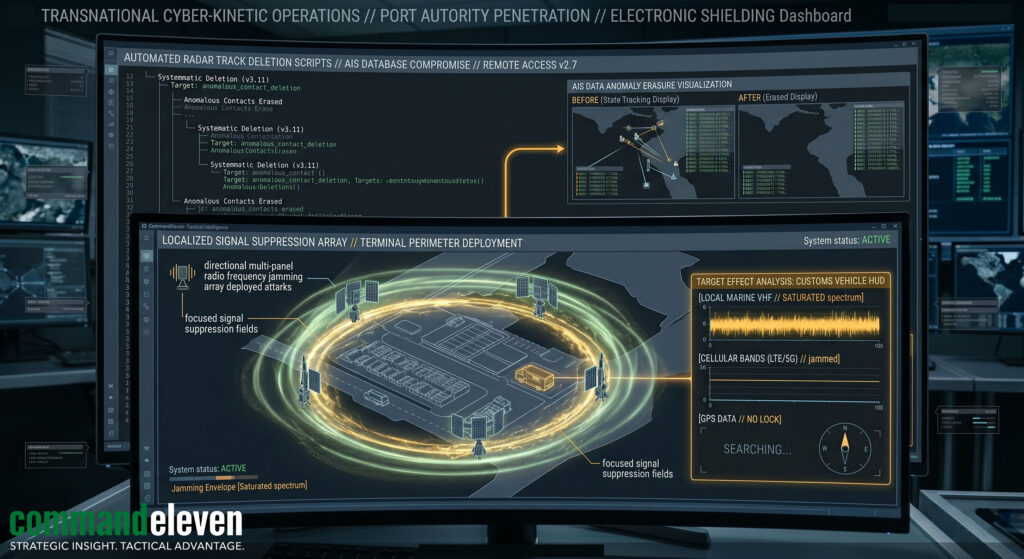
The expansion of parallel port operations requires the continuous deployment of advanced cyber exploitation tools to compromise national maritime safety networks. Armed proxies build dedicated electronic warfare cells tasked with penetrating the Automated Identification System databases managed by regional maritime authorities. By securing unauthorized access to these networks, the proxies inject false tracking coordinates, clone legitimate vessel profiles, and erase anomalous radar contacts from state monitoring screens. This digital dominance establishes an electronic shield over the colonized terminal zones.
- Custom software exploit packages target known vulnerabilities in regional port authority networks, granting administrative access to container clearance databases.
- Cloned maritime identification transponders replicate the digital profiles of legally compliant commercial vessels, masking proxy ships within tracking networks.
- Automated radar track deletion scripts remove specific maritime contacts from coastal surveillance displays, creating localized digital blindness for national security forces.
- Encrypted database exfiltration tools extract real-time coast guard patrol vectors, allowing proxy command cells to plan safe passage routes.
The compromise of regional maritime tracking networks creates a profound structural vulnerability that threatens international shipping security. By manipulating tracking databases, the proxies ensure that their smuggling fleets can navigate high-risk chokepoints with minimal threat of interception. This digital manipulation converts state-managed security infrastructure into an un-witting facilitator of the illicit proxy trade pipeline. The state’s failure to secure its maritime networks directly subsidizes the expansion of parallel port authority.
The electronic warfare cells deploy localized signal suppression arrays around the colonized port perimeter to neutralize state tracking initiatives. These arrays emit high-power directional jamming energy designed to disrupt the communications links of visiting state customs inspectors and law enforcement units. The jamming operations are tightly synchronized with the offloading schedules of high-value proxy cargo vessels, preventing real-time reporting of anomalies. This localized electronic block creates a command and control vacuum that isolates the terminal from national oversight.
- Directional radio frequency jammers saturate localized communication bands, preventing visiting customs personnel from contacting national command centers.
- GPS signal spoofing generators broadcast altered positioning data to port security vehicles, disrupting navigation inside complex terminal layouts.
- Cellular network isolation modules sever mobile data communication within specific warehouse zones, preventing the digital transmission of cargo manifests.
- Acoustic sensor disruption fields generate localized underwater noise to blind sonar arrays deployed along the port’s approach channels.
The deployment of localized signal suppression arrays forces state security agencies to operate without real-time coordination during port inspections. This communication barrier increases the operational friction encountered by law enforcement teams, rendering tactical intervention highly dangerous. By the time a security unit can re-establish communication with national command elements, the proxy cells have typically shifted the target cargo to secure interior storage nodes. This electronic insulation ensures the long-term survival of the colonized port infrastructure.
Territorial Stabilization and Community Extraction Frameworks
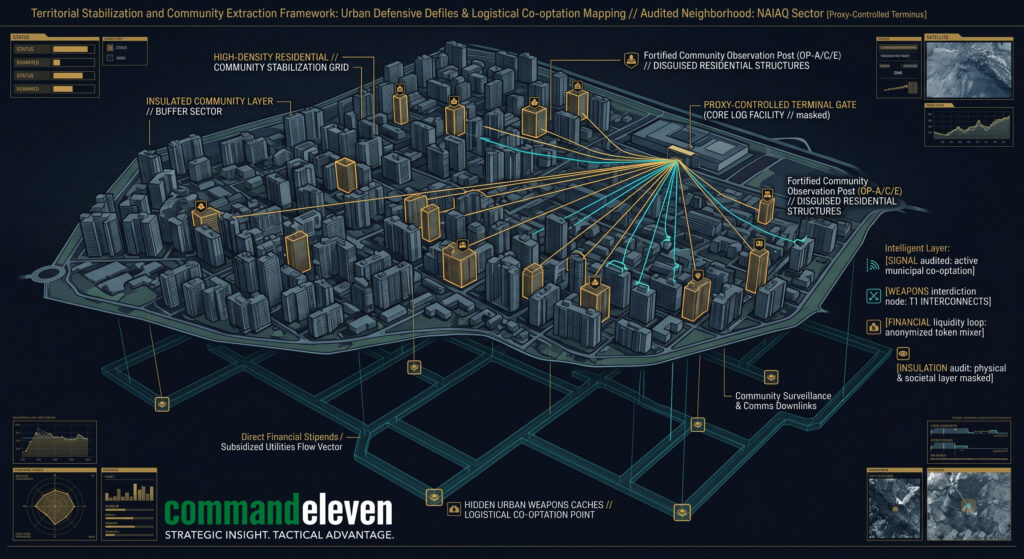
The long-term durability of the colonized port enclave depends on the proxy network’s ability to co-opt the local coastal population. The syndicates build sophisticated community extraction frameworks that deliver basic utility services, employment, and protection to populations abandoned by weak state governance. By funding local infrastructure and managing micro-economic distribution networks, the proxies replace the state as the primary provider of logistical oxygen. This social integration builds a human intelligence buffer that shields the proxy network from state kinetic actions.
- Subsidized local utility networks provide electricity and clean water to coastal communities, creating a deep economic dependency on parallel port governance.
- Localized employment distribution nodes allocate lucrative terminal labor jobs exclusively to families that cooperate with proxy intelligence requirements.
- Community protection militia units secure local neighborhoods from petty criminality, establishing a parallel judicial authority that replaces state law enforcement.
- Direct financial assistance programs distribute monthly cash stipends to influential tribal and community leaders to lock in institutional loyalty.
This deep societal co-optation converts the surrounding coastal community into an active extension of the proxy’s security infrastructure. Concurrently, human intelligence data indicates that the population serves as an early warning network for the port cells. Any movement of state military forces, intelligence officers, or foreign security advisors is immediately logged and transmitted to proxy command elements. This total situational awareness makes tactical surprise impossible for state interdiction forces attempting to reclaim the port.
The proxies integrate their human intelligence buffer with physical defensive networks embedded within the local urban sprawl. The neighborhoods surrounding the colonized port are transformed into dense tactical defiles, characterized by fortified observation posts and hidden weapons depots. The networks use these civilian zones to launch asymmetric counter-attacks against any state forces attempting to execute a land-based approach to the terminal. This urban militarization forces the state to face catastrophic political and material costs if it chooses to deploy conventional kinetic mass.
- Fortified community observation posts disguised as standard residential buildings monitor all land-based approach paths to the terminal gates.
- Hidden urban weapons caches store anti-tank guided missiles and heavy machine guns inside civilian structures to support sudden defensive mobilizations.
- Subterranean movement trenches cut through local neighborhoods, allowing proxy fighters to shift positions during active engagements without exposing themselves to aerial fire.
- Civilian human shield protocols position high-density residential developments adjacent to key proxy storage warehouses to deter state airstrikes.
The stabilization of these land-based defensive grids grants the proxy network total operational independence within the port enclave. The state cannot regain control of the terminal through isolated naval actions, as the landward side remains anchored in a hostile, co-opted urban population. This integration of maritime logistics and urban asymmetric warfare creates a resilient threat matrix that resists traditional counter-terrorism strategies. Reclaiming sovereignty requires a comprehensive doctrine that addresses the economic, digital, and military structures of the proxy colony simultaneously.
Integrated Maritime Interdiction and Supply Chain Reclamation
The systematic colonization of commercial port infrastructure by armed proxies demands an immediate, structural re-evaluation of national maritime defense doctrine. Traditional security models that rely on periodic cargo inspections and reactive naval patrols are entirely insufficient to dismantle an adversary operating with parallel administrative structures, electronic shielding, and population co-optation. To achieve strategic containment, the state must implement a unified, technology-led pre-emptive framework that targets the proxy’s digital infrastructure and financial extraction networks simultaneously. The institutionalization of the #72/48 Protocol is mandatory to protect national maritime tracking networks from the cyber-penetration and data manipulation executed by proxy electronic warfare cells. Furthermore, states must eliminate the structural vulnerabilities within port authority databases by enforcing strict, automated verification protocols for container logistics. Reclaiming sovereign authority requires replacing reactive enforcement postures with persistent, data-driven pre-emptive operations across both the maritime transit lanes and the adjacent coastal enclaves. This conflict represents a critical structural competition for control over global commercial logistics and the preservation of institutional integrity. Victory requires the uncompromising application of hardware truth to permanently dismantle the parallel economic and tactical ecosystem sustaining armed proxy port colonization.