Technical Takeaways
- Logistical Control Supersedes Kinetic Footprints: The survival of irregular insurgent syndicates remains entirely dependent on their capacity to supply parallel logistical oxygen to local populations. Reclaiming sovereign dominance requires transitioning from temporary military clearance operations to persistent, land-based administrative governance that permanently replaces shadow utility structures.
- Infrastructure Starvation Cascades Into Tactical Failures: Executing automated grid diagnostics and physical utility interdiction breaks the industrial baseline required to sustain interior processing nodes. By cutting illegal electricity taps and restricting dual-use industrial hardware components, the state forces the syndicate to divert financial resources away from weapons procurement to manage infrastructure deficits.
- Decentralized Tiles Eliminate Single-Trigger Vulnerabilities: Implementing the Mosaic Defense model hardens fragile border sectors by establishing autonomous administrative nodes managed by local Tile Guardians. This structural decentralization ensures that localized cyber-attacks or sensory ruptures do not compromise the macro-surveillance grid, preserving state persistence during high-velocity asymmetric crises.
Executive Summary
The stabilization of hybrid insurgent networks depends entirely on their capacity to build sovereign shadow systems that supply parallel logistical oxygen to local populations. Transnational syndicates systematically exploit institutional governance vacuums to distribute essential utilities, parallel judicial services, and alternative financial infrastructure within compromised border territories. This structural co-optation replaces the state’s administrative authority, embedding the irregular network deep inside the daily survival mechanics of the civilian population. Traditional kinetic operations fail to neutralize this threat because conventional military clearance does not dismantle the underlying shadow administrative grid. To achieve permanent territorial reclamation, the state must transition to an active interdiction posture that executes comprehensive utility starvation and parallel ledger disruption. Reclaiming sovereign dominance requires the systematic deployment of sensor-fused monitoring arrays and automated administrative platforms that replace shadow infrastructure with state-backed administrative permanence. This dossier evaluates the technical protocols of shadow governance, electronic network tracking, and physical utility interdiction required to collapse these parallel sovereign networks. Failing to execute targeted financial and resource starvation will allow these self-funding syndicates to permanently colonize fragile border zones. The state must treat parallel logistical oxygen as the primary tactical center of gravity in modern asymmetric warfare operations.
Shadow Governance Mechanisms and Population Co-optation
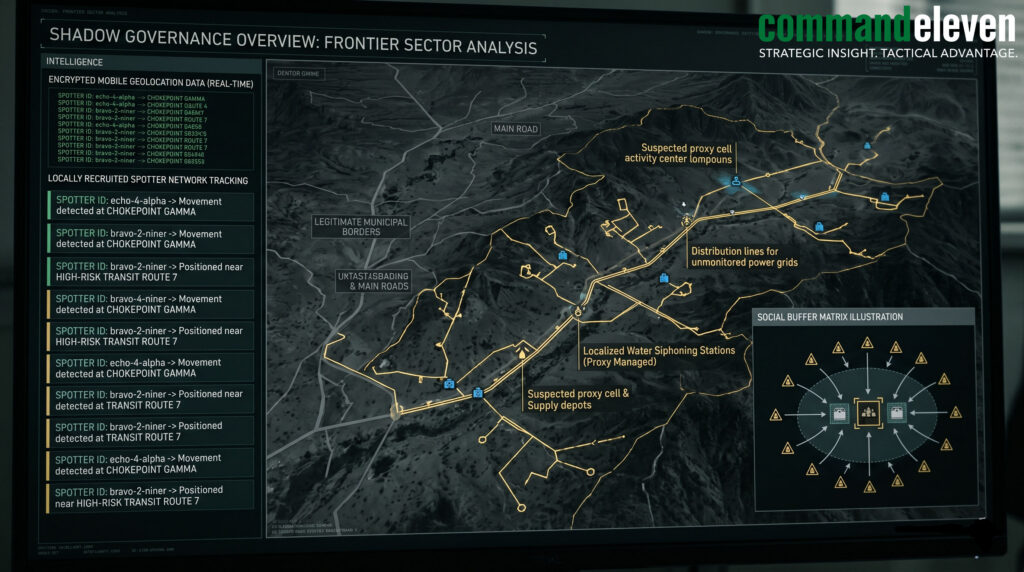
Transnational networks build parallel administrative systems within ungoverned border corridors to establish long-term population co-optation. These syndicates target peripheral territories where state utility distribution and judicial enforcement are absent or fragmented. The operational cells insert themselves into local municipal structures under the guise of private service providers, tribal councils, or charitable bodies. This strategic placement allows the networks to control the distribution of essential commodities, including water, electrical power, and basic medical access. By regularizing these vital lifelines, the proxy networks establish deep administrative dependencies that replace state authority.
- Parallel judicial arbitration tribunals resolve complex tribal property conflicts and commercial contractual arguments, completely bypassing the statutory courts of the state.
- Subsidized power distribution grids tap into national electrical infrastructure to supply localized border villages with cheap, unmonitored energy resources.
- Informal taxation collection units impose structured levies on all local mercantile activities, generating continuous liquidity to fund administrative expansion.
- Water resource distribution centers control the mechanical pumping stations at localized aquifers, rationing irrigation flows based on community compliance metrics.
This administrative subversion directly secures the active cooperation of the local coastal and border populations. Concurrently, operational data reveals that syndicates coordinate these land-based municipal systems with advanced digital management applications. The physical distribution of parallel utilities remains dependent on the network’s capacity to maintain a clean database of compliant local households. Once the shadow administrative grid achieves structural stability, the target territory transitions into a fully operational sovereign evasion hub. This transition shields the network’s physical military assets behind a compliant civilian human buffer.
The proxy cells leverage this community compliance to build an un-witting human intelligence network that monitors state security movements. Local populations dependent on shadow utilities provide real-time alerts regarding imminent police deployments, customs audits, or military mobilizations. This human buffer transmits tactical data through encrypted mobile messaging platforms, granting the syndicate absolute situational awareness along the immediate frontier. This defensive intelligence layer completely neutralizes the state’s capacity to execute unexpected tactical raids against hidden processing enclaves.
- Localized spotter network groups position lookouts at critical geographical choke points to report the physical movement of state security convoys.
- Encrypted mobile tracking applications log cellular geolocation data of border patrol units, transmitting immediate alert signals to proxy command cells.
- Civilian vehicle monitoring loops log the registration numbers of unfamiliar transit vehicles entering the administrative zone to detect undercover reconnaissance.
- Community alert siren networks install low-power acoustic indicators inside border villages to signal the physical approach of state law enforcement.
The integration of the civilian population into the syndicate’s security apparatus builds a resilient defensive shield around illicit logistics centers. This intelligence buffer ensures that the physical smuggling craft, clandestine laboratories, and heavy weapons depots can rotate locations prior to the arrival of state interdiction forces. The state cannot disrupt this defensive loop through traditional kinetic maneuvers alone. Reclaiming the territory requires the implementation of an aggressive utility starvation framework that permanently cuts the network’s parallel logistical oxygen.
Industrial Utility Interdiction and Resource Starvation
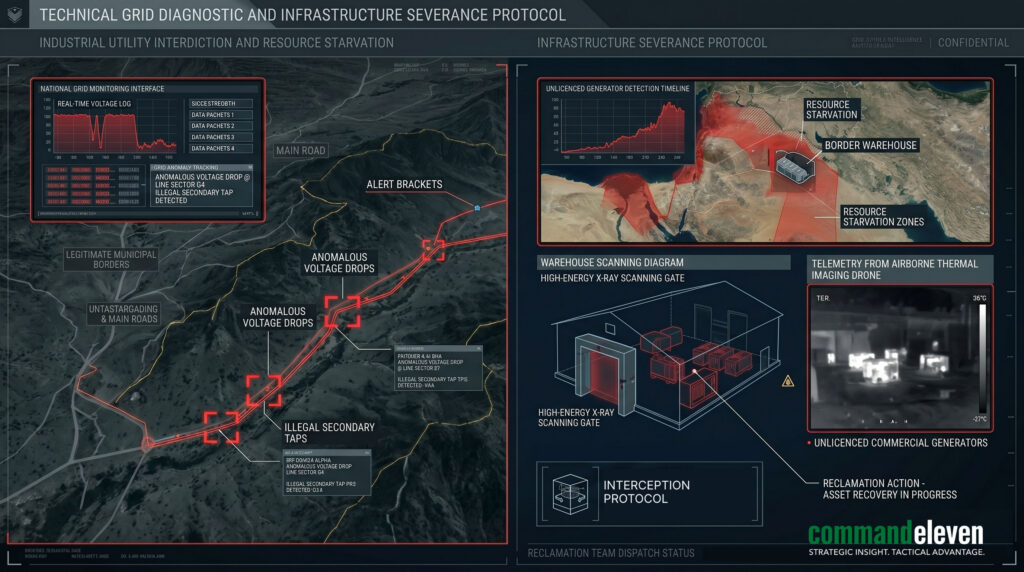
The state must deploy specialized engineering units to execute comprehensive physical interdiction against the syndicate’s parallel utility networks. This operational phase focuses on identifying and disabling illegal electrical taps, unmonitored water siphons, and shadow fuel pipelines. By executing targeted resource starvation, the state systematically dismantles the material baseline that anchors the population to parallel governance structures. These interdiction operations are executed under the cover of militarized perimeter security grids to prevent armed proxy interference.
- Automated grid diagnostic sensors monitor real-time phase imbalances and localized voltage drops along national power lines to locate illicit taps.
- High-mobility line isolation units deploy remote-controlled mechanical cutters to sever illegal secondary power connections inside hostile border sectors.
- Subterranean fluid tracking arrays inject microscopic chemical tracers into state water mains to detect unmonitored siphoning loops along regional aquifers.
- Acoustic pipe inspection drones traverse deep infrastructure lines to pinpoint the exact coordinates of hidden proxy fuel siphoning valves.
The physical disconnection of shadow utilities directly collapses the economic framework of parallel governance. Concurrently, tracking data reveals that resource starvation operations immediately degrade the operational capacity of the syndicate’s interior manufacturing hubs. Without unmonitored electrical power and water access, clandestine processing laboratories and cargo modification bays cannot sustain industrial-scale output. The disruption of the utility supply chain forces the cartel to divert precious liquidity away from weapons procurement to rebuild damaged infrastructure.
The state reinforces this physical resource starvation by implementing strict regulatory controls over the import and domestic movement of dual-use industrial equipment. Security agencies establish automated checkpoint verification systems along all primary transit corridors leading to the frontier zones. These checkpoints utilize advanced scanning hardware to inspect commercial freight cargo for unauthorized generator components, commercial water pumps, and bulk electrical switchgear. This defensive perimeter prevents the syndicate from sourcing the technical components required to repair their severed shadow grids.
- High-energy x-ray scanning gates analyze the internal structural configurations of commercial freight trucks to detect hidden industrial processing equipment.
- Automated serial number registries cross-reference the manufacturer tracking data of all incoming commercial generators against valid state utility licenses.
- Localized electromagnetic pulse units neutralize the internal control circuits of unmonitored power generation systems operating inside forbidden zones.
- Thermal imaging drone swarms execute continuous airborne sweeps of border warehouses to locate active, unlicenced industrial machinery clusters.
The systematic restriction of industrial hardware components traps the syndicate inside a compounding resource deficit. This technical blockage ensures that once a shadow utility node is physically dismantled, it remains permanently non-operational. The accumulation of these infrastructure failures erodes the community’s trust in the parallel administration’s capacity to provide basic logistical sustenance. As the shadow systems fail, the state inserts its own administrative platforms to reclaim sovereign authority over the hollowed-out proxy enclave.
Parallel Financial Ledger Disruption and Asset Liquidation
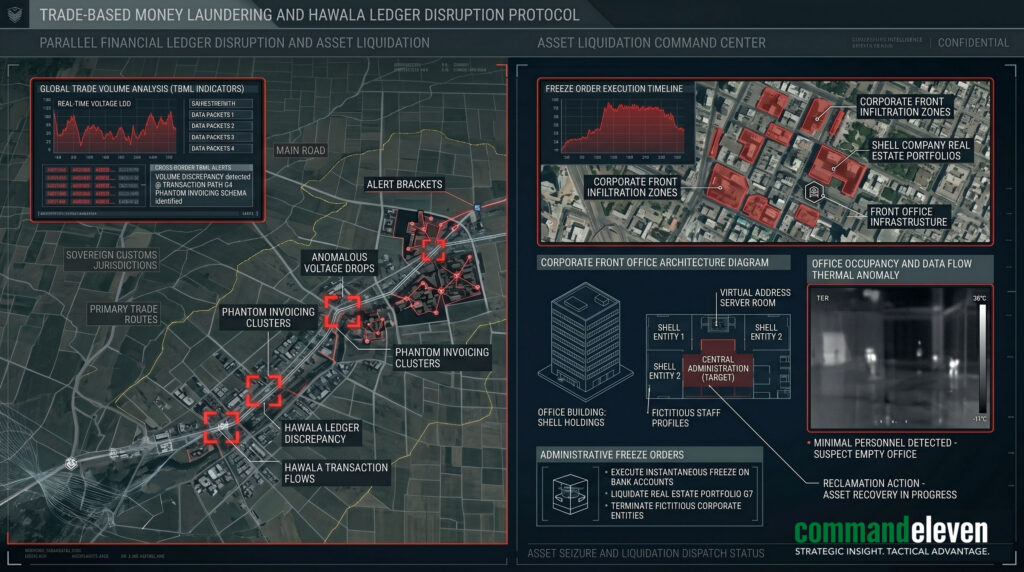
Disrupting the parallel financial networks that fund shadow administrations requires an aggressive, data-driven offensive against informal money laundering nodes. The state builds specialized financial intelligence units tasked with penetrating the decentralized Hawala networks operating in major port and border cities. By tracing the physical trade commodities used to balance parallel ledgers, state agencies expose the ultimate beneficial owners of cartel front operations. This financial interdiction focuses on freezing liquidity before it can be converted into physical tactical hardware.
- Trade-commodity matching software monitors international import-export customs registries to identify inflated or phantom invoicing schemes used to balance ledgers.
- Automated micro-structuring detection engines flag suspicious patterns of high-velocity, low-value cash deposits across fragmented personal banking accounts.
- Decentralized token tracing protocols map the transactions of automated cryptocurrency mixers used by syndicates to anonymize narcotics proceeds.
- Forensic accounting audit arrays cross-examine corporate tax filings of retail distribution fronts to isolate unverified parallel cash streams.
The execution of automated ledger disruption completely isolates the shadow administration from its global financial pipelines. Concurrently, operational data reveals that freezing these corporate assets forces a sudden contraction in the syndicate’s local procurement loops. Without continuous liquidity, field commanders cannot settle invoices for fresh precursor chemical shipments or pay stipends to co-opted community leaders. The financial starvation directly triggers the internal fragmentation of the hybrid criminal-terror nexus.
The state accelerates this financial collapse by executing synchronized asset liquidation raids against known corporate front headquarters inside urban commercial centers. These operations target the physical clearing offices, real estate holdings, and shell company repositories used to wash illicit wealth. Law enforcement units seize physical ledgers, digital storage arrays, and hard currency reserves, permanently removing transactional liquidity from the cartel’s internal ecosystem. The assets are absorbed into state sovereignty reclamation funds to finance border infrastructure development.
- Hardened data extraction platforms bypass local server encryption layers to harvest active debt-credit ledgers during physical office seizures.
- Automated bank account locks execute instant freeze commands across national banking networks upon verification of shell company front profiles.
- Seized property liquidation protocols transfer the ownership of cartel real estate holdings to state administrative authorities for public use.
- Biometric account audit modules verify the identities of all high-value corporate access holders to eliminate the use of synthetic aliases.
The systematic dismantling of the urban corporate interface permanently compromises the syndicate’s long-term economic durability. By removing the corporate wrappers that protect illicit wealth, the state exposes the core leadership to international legal tracking and asset seizure regimes. This financial exposure breaks the self-funding loop that allows the criminal-terror nexus to resist standard kinetic containment. Once the financial engine is disabled, the parallel administrative structure collapses under its own operational weight.
Cyber-Kinetic Port Integration and Manifest Reclamation
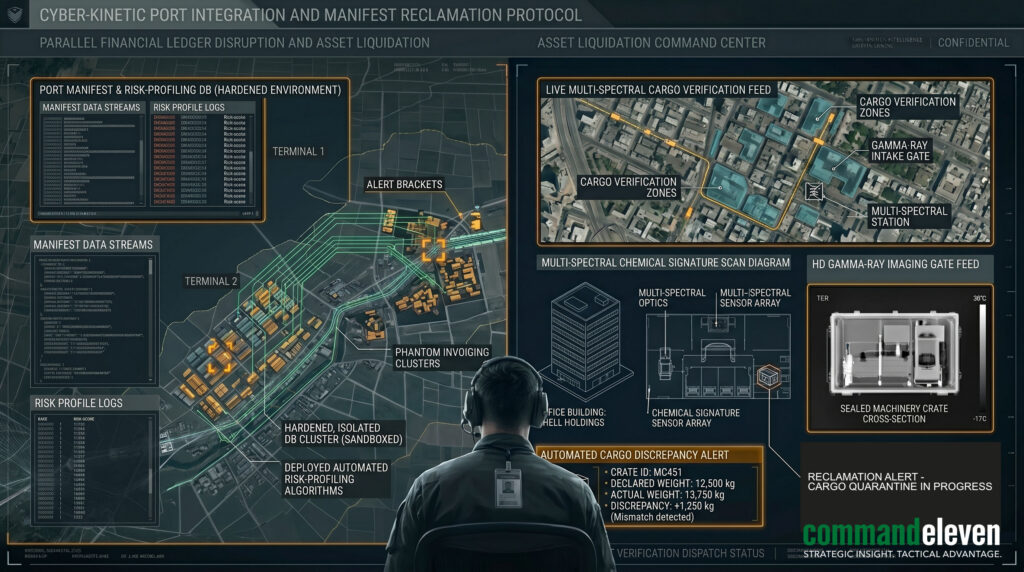
The reclamation of sovereign control over compromised maritime corridors requires the deployment of advanced cyber exploitation tools to secure port databases. The state establishes dedicated cyber-kinetic task forces tasked with neutralizing the automated manifest tampering scripts deployed by syndicates. By reclaiming administrative dominance over customs tracking networks, security forces eliminate the digital blindness exploited by cartels to smuggle weaponized materials. This digital hardening transforms vulnerable commercial transport sectors into proactive barriers against illicit trade.
- SQL injection patch suites eliminate known software vulnerabilities within port authority databases, preventing unauthorized remote access by cartel hackers.
- Automated risk-profiling algorithms scan international shipping manifests in real time, flagging containers that exhibit anomalous routing histories.
- Encrypted data verification tunnels isolate customs tracking data from public networks, preventing the remote alteration of vessel compliance histories.
- Biometric administrative access layers require dual-factor physical verification for all modifications made to automated container shipping logs.
The digital reclamation of customs databases closes the persistent tracking gap exploited by transnational smuggling fleets. Concurrently, operational analysis indicates that this cyber hardening directly enhances the effectiveness of physical naval interdiction units on the high seas. With real-time access to uncorrupted container manifest data, coast guard patrol craft can execute precise, high-probability boardings against suspect vessels. This synchronization of cyber-kinetic assets stops the influx of illicit compounds before they reach coastal zones.
The state pairs digital manifest reclamation with the deployment of specialized container inspection hardware at all major maritime cargo terminals. These physical verification systems utilize multi-spectral scanning arrays to analyze the internal chemical signatures of sealed industrial containers. This automated inspection protocol allows port authorities to identify hidden precursor chemicals, explosives, and heavy weapons components without causing logistical bottlenecks in legitimate commercial trade flows. Containers failing the automated verification check are immediately isolated by tactical response cells.
- Multi-spectral chemical signature scanners read the molecular profiles of sealed liquid cargo containers to detect unscheduled aniline derivatives.
- High-definition gamma-ray imaging gates generate clear internal visual reconstructions of packed machinery crates to locate hidden weapon mounts.
- Automated weight-differential sensor platforms compare the physical weight of incoming containers against the digital metrics logged in the customs database.
- Remote-controlled cargo isolation rovers extract high-risk containers from shipping yards, moving them to secure explosive containment bays.
The implementation of automated physical and digital verification protocols converts commercial maritime ports into unbreachable bottlenecks for the syndicate’s supply chain. This structural defensive grid blocks the importation of the raw materials required to sustain interior laboratory synthesis and weapon manufacturing operations. By choking the supply lines at the port of entry, the state starves the parallel sovereign systems of their material inputs. This logistics disruption forces the syndicate’s land-based networks to operate out of diminishing domestic stockpiles.
Decentralized Tile Sovereignty and Permanent Border Hardening
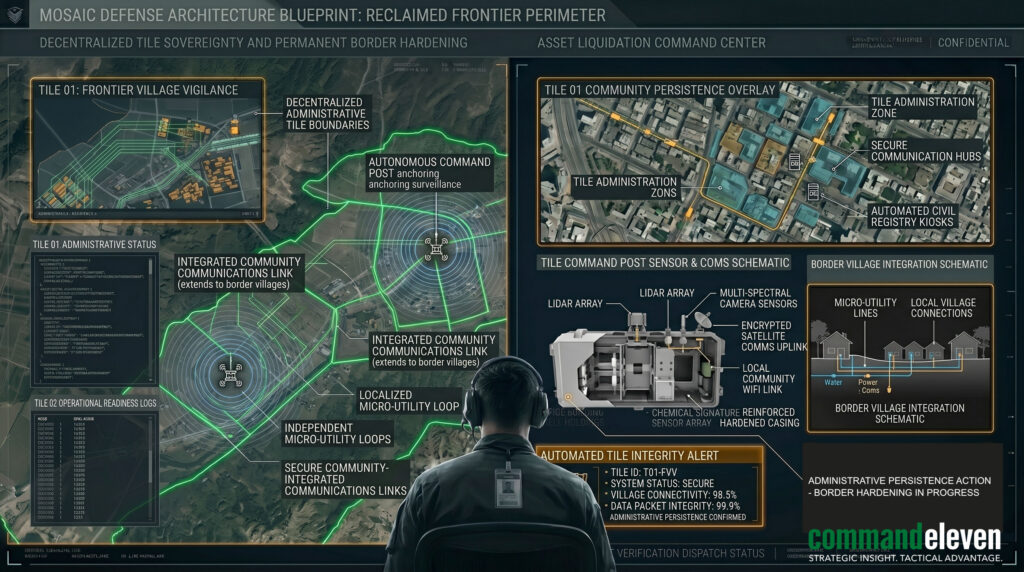
The final stabilization of reclaimed border zones requires the deployment of the CommandEleven Intelligence Mosaic Defense architecture to establish permanent administrative presence. The state replaces weak, centralized governance footprints with a dense network of autonomous administrative tiles along the entire frontier perimeter. Each tile functions as a self-contained administrative and security node, managed by an authorized Tile Guardian equipped with fused sensing arrays. This structural decentralization ensures that the local population receives superior logistical oxygen exclusively from the legitimate state apparatus.
- Autonomous sensor-fused command posts integrate real-time radar data, thermal tracking, and seismic sensors into a unified local surveillance feed.
- Localized micro-utility infrastructure loops distribute independent solar power and water filtration services directly to border village households.
- Automated civil registry kiosks issue digital sovereignty tokens and biometric identity documents to local populations to regularize administrative records.
- Mobile tactical intervention cells execute high-velocity pre-emptive strikes against any irregular assembly within the tile boundary.
The deployment of autonomous administrative tiles permanently hardens the frontier against the re-emergence of shadow governance systems. Concurrently, structural analysis reveals that this decentralized model eliminates the single-trigger threat vector that historically crippled centralized border defense grids. If a proxy cell executes a localized cyber-attack or sensory rupture against one tile, the adjacent nodes remain fully operational. This systemic insulation ensures that the state maintains permanent administrative persistence across the frontier during high-velocity asymmetric crises.
The Tile Guardians use their localized utility networks to permanently sever the economic dependency that bound the population to the liquid cartels. By providing superior logistical oxygen,including functional justice, secure trade velocity, and stable utility access,the state renders the syndicate’s parallel social support structures obsolete. The population transitions from a passive facilitator of irregular militancy into an active component of the state’s sovereign defensive matrix. This societal realignment seals the border zone, preventing the re-infiltration of transnational criminal elements.
- State-backed agricultural trade exchanges guarantee local farmers secure access to domestic markets, bypassing cartel extortion rings.
- Biometric employment verification registries link local infrastructure development jobs directly to verified compliance with national security frameworks.
- Localized dispute resolution councils deliver fast, transparent mediation services based on statutory law, replacing informal proxy tribunals.
- Community-integrated communications networks provide secure, direct digital links between village elders and the local Tile Guardian command center.
The stabilization of these decentralized administrative and economic frameworks cements the state’s victory over parallel sovereign systems. The territory is no longer an ungoverned evasion hub; it is a highly integrated, self-defending segment of the national grid. By combining physical border hardening with superior utility delivery, the state achieves long-term structural persistence along its frontier. This comprehensive reclamation doctrine permanently neutralizes the capacity of transnational syndicates to monetize instability and compromise national sovereignty.
Doctrinal Synthesis and the Preservation of Administrative Persistence
The successful neutralization of parallel sovereign shadow systems demands an uncompromising shift from legacy counter-insurgency doctrines to a unified model of administrative persistence. Traditional military operations that prioritize temporary kinetic clearance fail to address the core center of gravity in asymmetric conflicts, which is the control over population survival logistics. To secure permanent territorial reclamation, the state must treat the delivery of utilities, parallel justice, and informal finance as direct challenges to national sovereignty. Implementing the #72/48 Protocol is mandatory to shield national monitoring engines from the digital manipulation and sensory ruptures executed by proxy electronic warfare cells. Furthermore, the state must aggressively deploy the Mosaic Defense architecture to replace fragile, centralized border frameworks with autonomous administrative tiles that provide superior logistical oxygen. Victory requires the systematic weaponization of hardware truth to permanently dismantle the parallel economic and technical ecosystems that sustain irregular syndicates. By merging cyber-kinetic port interdiction with land-based resource starvation, the state permanently isolates the adversary from its material and financial lifelines. This comprehensive doctrine ensures that reclaimed territories are permanently insulated from transnational criminal exploitation, preserving the long-term sovereign integrity of the republic.