In contemporary geopolitics, the critical vulnerability of the state is not spatial, but temporal. It is the widening chasm between the emergence of a hostile tactic and its formal recognition, categorization, and counter-protocol formulation within a state bureaucracy.
At CommandEleven, this phenomenon is identified as The Sanitization Gap.
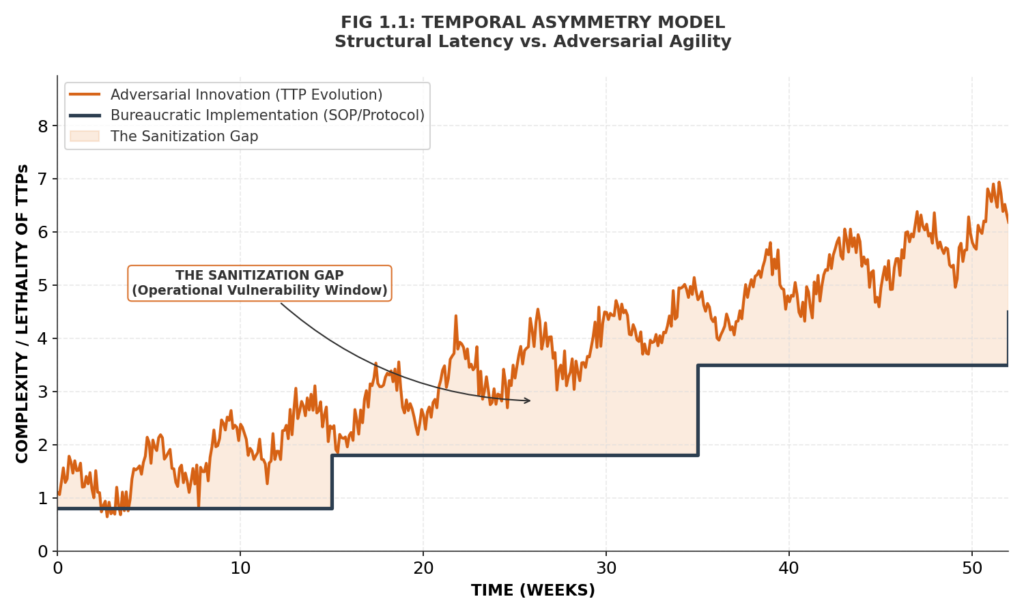
This “Gray Zone” allows adversaries to operate with relative impunity by outpacing administrative cycles. While tactical operatives identify threats in real-time, the “sanitization” process – comprising intelligence scrubbing, legal review, and policy codification – often spans months. Consequently, by the time a Standard Operating Procedure (SOP) is finalized, the adversary has already transitioned to a new operational phase.
Structural Analysis: Agility vs. Hierarchy
The Sanitization Gap is a byproduct of divergent organizational architectures.
Adversarial entities, including state-aligned syndicates such as Syndicate-Delta or decentralized groups like ISKP, utilize horizontal, decentralized structures. They operate via a “fail-fast” methodology, iterating Tactics, Techniques, and Procedures (TTPs) within hours of detection or failure. Their TTPs function as dynamic, evolving systems.
In contrast, Western institutional frameworks are vertical, hierarchical, and optimized for risk mitigation rather than velocity.
- Tactical Recognition: An operative identifies a novel encryption method or delivery mechanism.
- Bureaucratic Processing: The observation is subjected to “source protection” vetting, legal compliance audits, and inter-agency jurisdictional debates.
The resulting “Official Guidance” is frequently obsolete upon delivery, targeting a threat profile that has already been abandoned by the adversary.
The Sanitization Bottleneck: Latency in the 2026 Threat Landscape
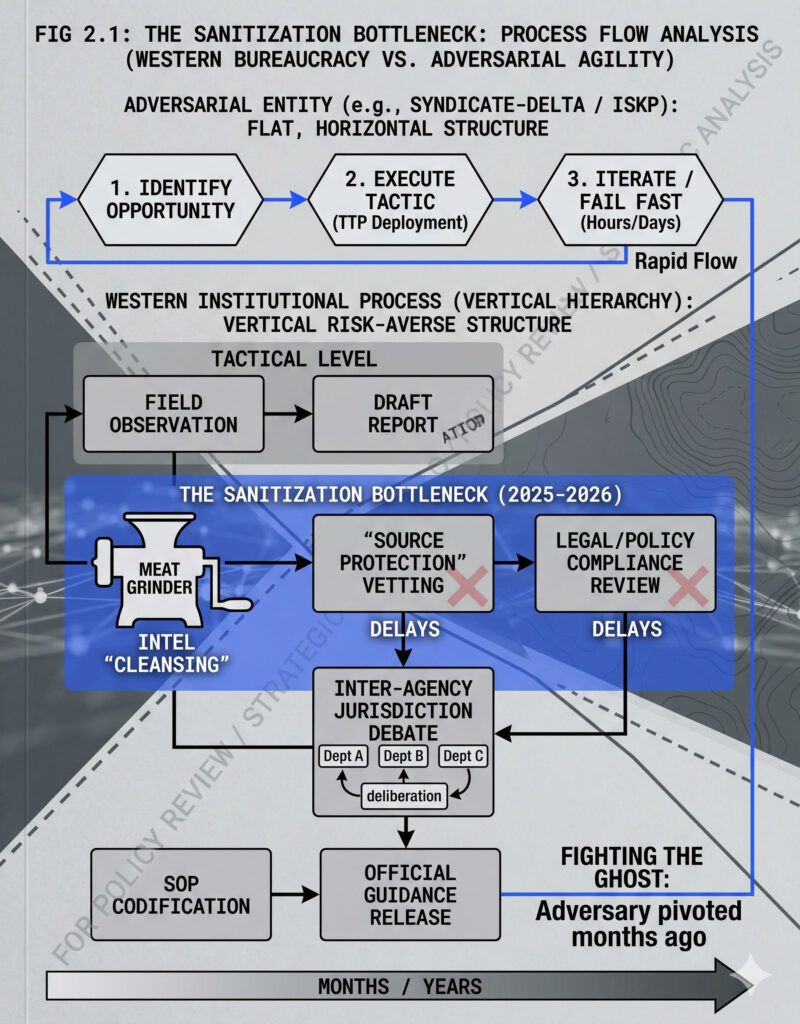
“Sanitization”,the process of converting raw intelligence into actionable data without compromising sensitive sources,has become the primary drag factor in the 2025–2026 defense environment. In an era defined by Cyber-Kinetic Loops, where digital compromise yields immediate physical consequences, traditional three-month sanitization cycles are untenable.
- The Over-Classification Trap: Persistent defaults toward secrecy result in the over-classification of adversary TTPs. This prevents the private sector and non-government allies from implementing defenses, effectively prioritizing the “source” over the protection of the “target.”
- Legal and Regulatory Paralysis: Every counter-TTP must navigate complex international and domestic legal frameworks. Adversaries leverage this through Lawfare, utilizing the West’s commitment to the rule of law to artificially widen the Sanitization Gap.
Case Study: Small Unmanned Aerial Systems (sUAS) Proliferation
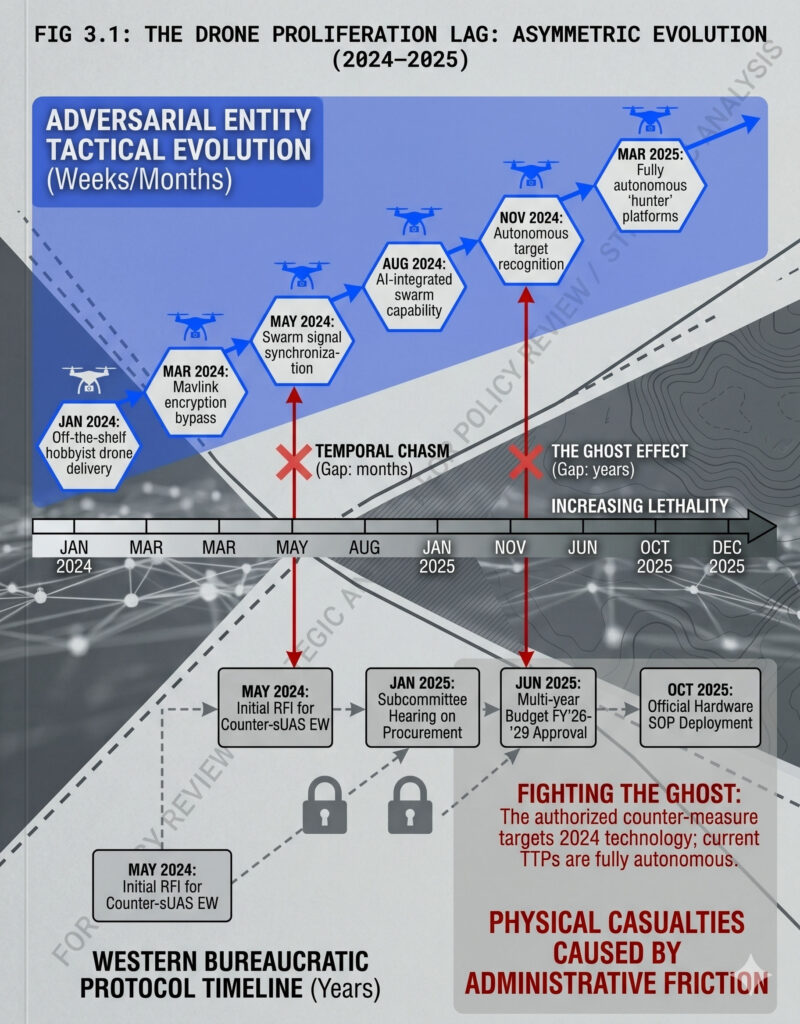
The evolution of sUAS technology illustrates the lethal consequences of administrative friction. Between 2024 and 2025, adversaries transitioned from off-the-shelf platforms to AI-integrated swarms featuring autonomous target recognition.
While tactical shifts occurred every six weeks, bureaucratic Electronic Warfare (EW) protocols remained tethered to multi-year procurement cycles and fiscal year budget authorizations. This discrepancy forced field personnel to rely on unauthorized, ad-hoc solutions while official counter-measures remained stalled in legislative or administrative subcommittees.
Mitigating the Gap: Strategic Recommendations
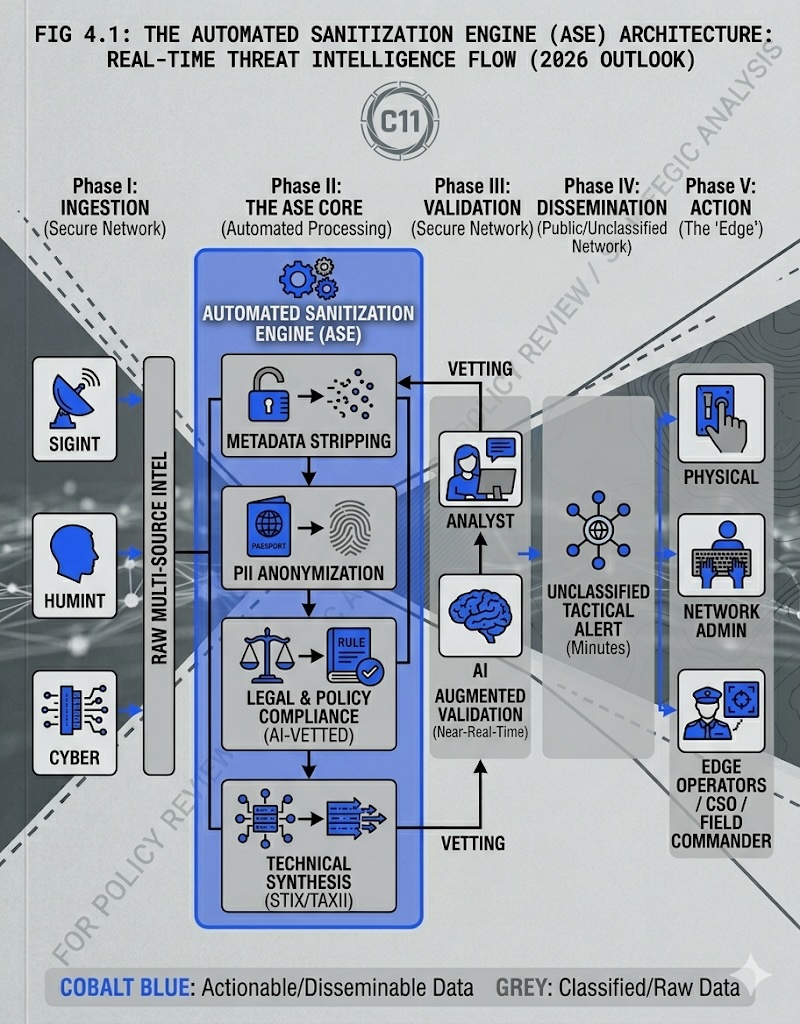
To counter the velocity of modern adversaries, the intelligence community must prioritize networked dissemination over bureaucratic centralism.
- Shift from “Need to Know” to “Need to Share”: The dissemination of functional intelligence must take precedence over the protection of pedigree. Technical signatures (e.g., malware hashes) targeting critical infrastructure require immediate distribution, bypassing multi-week vetting cycles.
- Automated Sanitization Protocols: We advocate for the deployment of AI-driven Sanitization Engines. These systems can autonomously strip sensitive metadata from raw data, generating unclassified, actionable alerts in minutes.
- Empowering the Tactical Edge: Tactical response must be decoupled from strategic policy. Field commanders and Chief Security Officers (CSOs) require the delegated authority to adapt TTPs locally without awaiting top-down validation from disconnected central authorities.
2026 Outlook: Prioritizing Resilience over Perfection
The Sanitization Gap cannot be entirely eliminated; however, it must be minimized to maintain strategic relevance. In a landscape where state-aligned syndicates modify the rules of engagement weekly, a multi-month delay is a systemic failure.
The objective for 2026 is Strategic Agility. This requires an institutional willingness to accept marginal “imperfection” in intelligence products in exchange for operational speed. Effective defense requires moving the pieces while the adversary is still active, rather than finalizing the rulebook after the engagement has concluded.