Executive Summary
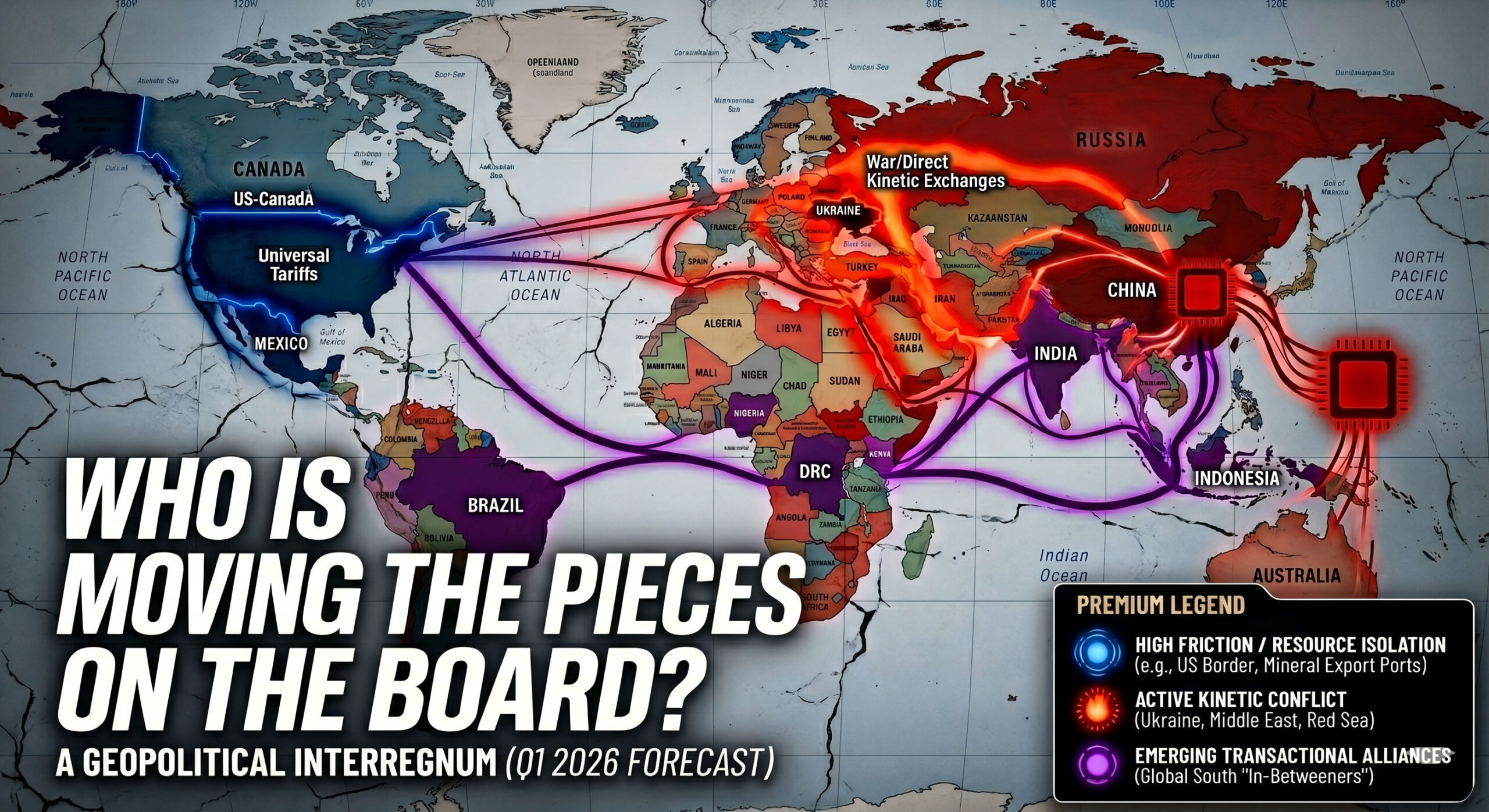
History doesn’t always move in a straight line; sometimes, it leaps. If 2024 was a year of bracing for impact, 2025 was the year the floor fell out. As we navigate the first quarter of 2026, the “Global Board” has been entirely remapped. The old rules—those neoliberal, multilateral guardrails we leaned on for eighty years—haven’t just been ignored; they’ve been archived.
To understand where we are, we have to look at the players. We are no longer in a unipolar world, nor a clean bipolar one. We are in a “Geopolitical Interregnum”—a period of high-velocity friction where the old order is dying, and the new one is struggling to be born.
Washington’s New Playbook: How ‘Private Equity’ Diplomacy Replaced the Rules-Based Order
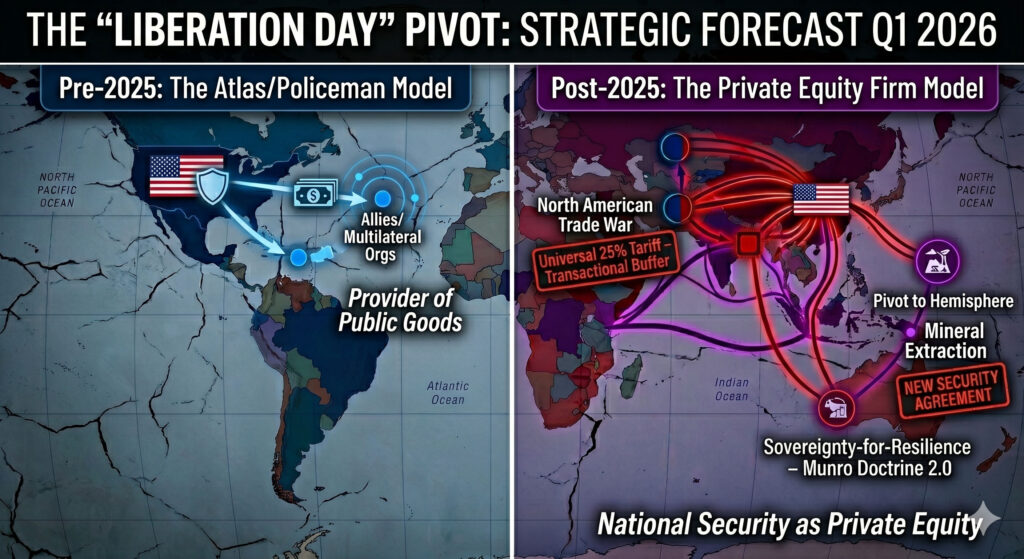
For decades, the United States acted as the “Atlas” of the world order, propping up global trade and security at its own expense (or so the current administration argues). That era ended on January 20, 2025.
The second Trump presidency has replaced the “Liberal Internationalist” doctrine with a muscular, transactional Economic Nationalism. Under the new National Security Strategy, the “Rules-Based Order” is now referred to as the “So-Called Rules-Based Order.” Washington has pivoted from being the world’s policeman to being its most aggressive private equity firm.
The ‘Liberation Day’ Shocks: Universal Tariffs and the Monroe Doctrine 2.0
On April 2, 2025, the world felt the weight of this shift with the declaration of “Liberation Day” tariffs. The administration moved to decouple the U.S. economy from perceived “freeloaders” and adversaries alike:
- The North American Trade War: Universal 25% tariffs on Mexico and Canada (later tempered by USMCA exemptions) redefined our closest relationships as transactional battlegrounds.
- The Pivot to the Hemisphere: Washington has essentially signaled a retreat from European and Central Asian “entanglements” to focus on the Western Hemisphere. The capture of Nicolás Maduro in 2025 and direct strikes against criminal cartels in Mexico signify a new, unilateral “Monroe Doctrine 2.0.”
The message to allies is clear: You are on your own, unless you pay.
The Mineral Iron Curtain: Why China’s Monopoly on Rare Earths is a Strategic Blockade
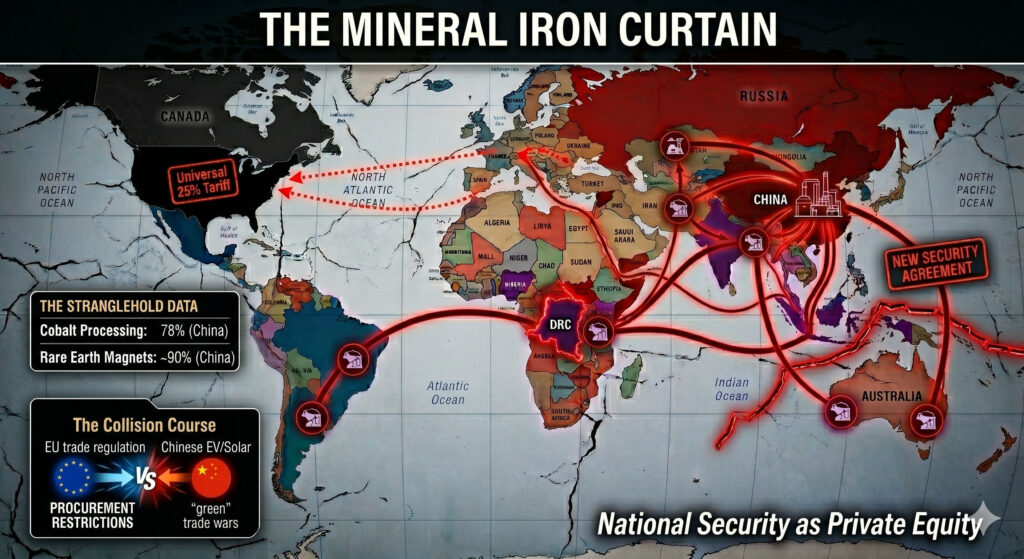
Beijing is not merely reacting to Washington; it is attempting to leapfrog it. As the U.S. turns inward, Xi Jinping has doubled down on “Total Electrification” as a tool of statecraft.
Total Electrification as Statecraft: Beijing’s Leverage over the EU
In late 2025, China weaponized its dominance over rare earth elements and magnets, rolling out an export control regime that targeted Western high-tech industries. By controlling 78% of the world’s cobalt processing and nearly all rare earth magnet production, China has created a “Mineral Iron Curtain.”
However, China faces its own internal rot. Overcapacity in EVs and solar panels has led to a “Collision Course” with the EU. Europe, once the “middle ground,” is finally arming itself—not just with tanks, but with trade barriers. In 2026, we are seeing the EU-China relationship devolve into a series of procurement restrictions and “green” trade wars.
Thawing Frozen Conflicts: The Pivot to Direct State-on-State Kinetic Exchanges
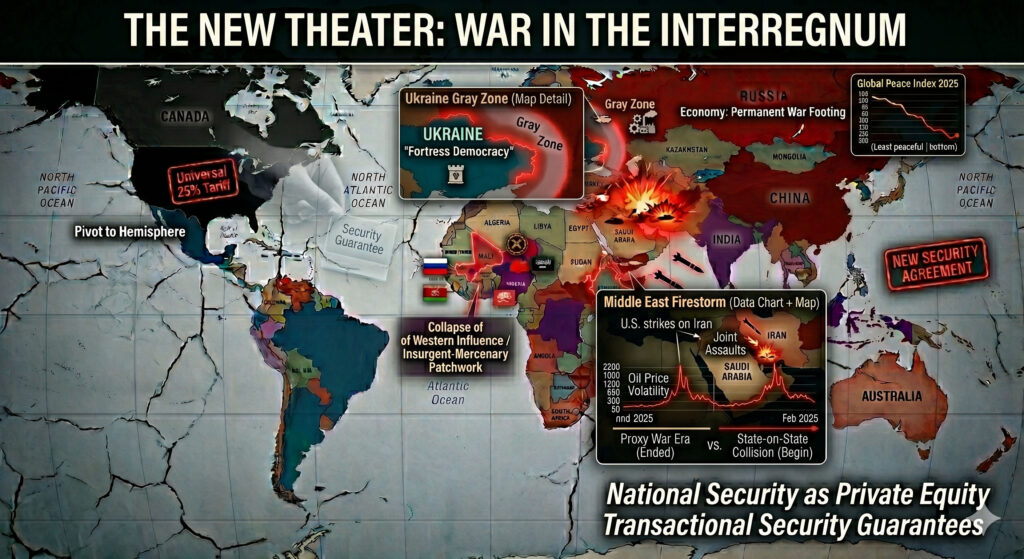
If you look at the map today, the “frozen” conflicts of the 2020s have thawed into a messy, multi-front reality.
The Ukraine Gray Zone: Life After the August 2025 Settlement
President Trump’s push for a ceasefire by August 8, 2025, has created a precarious “Gray Zone” in Eastern Europe. While the high-intensity shelling has slowed, Putin remains “empowered but isolated.” Russia has become the least peaceful country on the 2025 Global Peace Index, shifting its economy entirely to a permanent war footing. Ukraine, meanwhile, is being forced to transition from a frontline state to a “Fortress Democracy,” arming itself as U.S. security guarantees soften.
The Middle East Firestorm: Mapping Energy Volatility to Kinetic Strikes
The most dangerous flashpoint of 2026 isn’t a border dispute, but a regional conflagration. The U.S. conducted direct strikes on Iran in mid-2025, a prelude to the joint assaults seen in February 2026. This has thrown energy markets into chaos. We are no longer watching “proxy wars”; we are watching direct state-on-state kinetic exchanges.
The Forgotten Fronts
- Ethiopia-Eritrea: A new war is brewing in the Horn of Africa as Addis Ababa pushes for Red Sea access.
- The Sahel: A total collapse of Western influence has allowed a patchwork of Russian mercenaries and Islamist insurgents to carve up Mali and Burkina Faso.
Strategic Hedging: Why Middle Powers are Refusing to Pick Sides in 2026
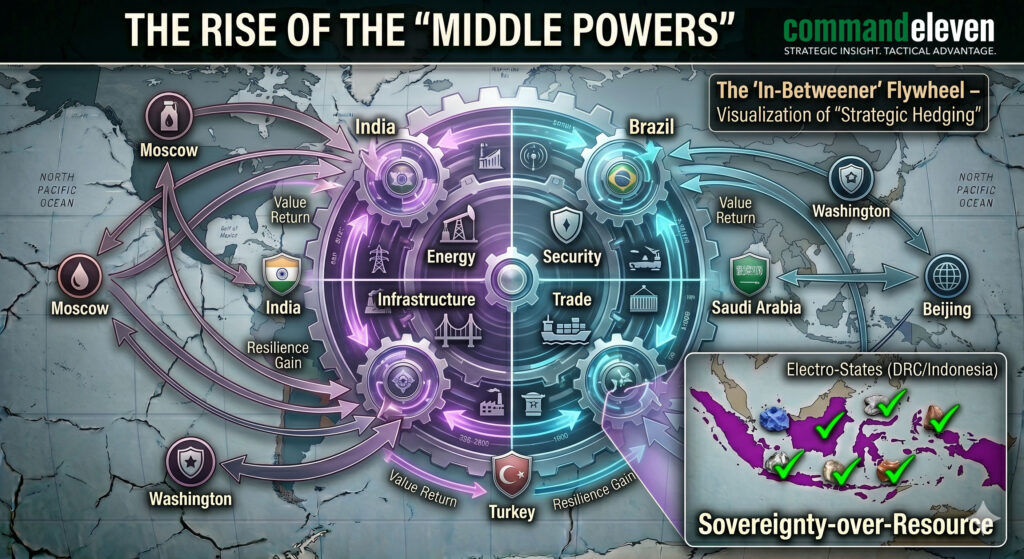
Perhaps the most fascinating shift on the board is the agency of the “In-Betweeners.” Countries like Brazil, India, Turkey, and Saudi Arabia are no longer picking sides. They are “Strategic Hedgers.”
At Davos 2026, the sentiment was clear: Sovereignty is now defined as resilience.
- India is emerging as the ultimate swing state, benefiting from “China Plus One” manufacturing shifts while maintaining a transactional bridge to both Moscow and Washington.
- The “Electro-States” (like Indonesia and the DRC) are leveraging their mineral wealth to force better deals, refusing to be mere resource colonies for the Great Powers.
India and the ‘China Plus One’ Advantage
India has emerged as the ultimate swing state of the interregnum. New Delhi is no longer content with being a junior partner in Western security architectures; instead, it has positioned itself as the indispensable alternative to the Chinese manufacturing monolith. By leveraging the “China Plus One” strategy of multinational corporations, India is absorbing the high-value supply chains fleeing the Pearl River Delta. However, Prime Minister Modi’s administration is playing a sophisticated double game: utilizing Western capital to build a domestic industrial base while maintaining a transactional bridge to Moscow for discounted energy and defense components. In 2026, India’s power is defined by its refusal to be an ally, opting instead to be a sovereign clearinghouse for global interests.
The Rise of Electro-States: Indonesia and the DRC’s Resource Sovereignty
The map of the 20th century was drawn by “Petro-States”; the map of 2026 is being redrawn by “Electro-States.” Nations like Indonesia and the Democratic Republic of Congo (DRC) have weaponized their geological endowments to force a fundamental shift in global trade. These are no longer mere resource colonies. Indonesia’s ban on raw nickel exports and the DRC’s aggressive renegotiation of cobalt concessions prove that sovereignty is now tied to the battery stack. These states are demanding “Value-Add” investment—insisting that refineries and precursor plants be built on their soil—effectively holding the transition to green energy hostage until their terms of developmental autonomy are met.
The Technological Fracture: Will the ‘Splinternet’ Force a Global Ecosystem Divorce?
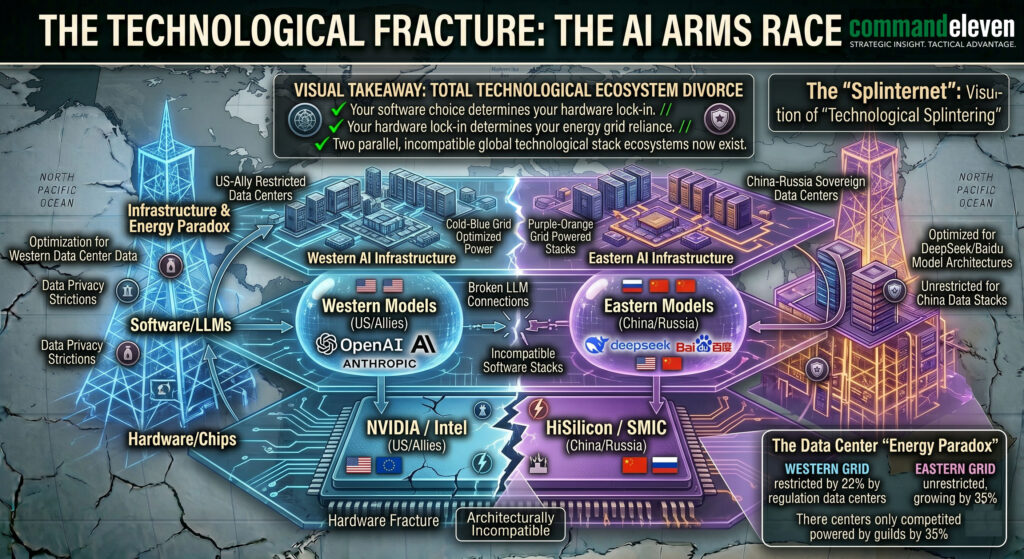
We cannot discuss the board without discussing the pieces themselves. AI is no longer a “tech trend”; it is the new nuclear physics.
The DeepSeek phenomenon of 2025 proved that the U.S. does not have a monopoly on generative intelligence. By 2026, the world has split into two technological ecosystems. If you use Western chips and U.S.-aligned LLMs, you are increasingly locked out of the Chinese and Russian digital stacks.
This is the “Splinternet” made manifest—not just in software, but in the very hardware and energy grids (the data center “Energy Paradox”) that power our civilization.
The Energy Paradox: Why AI Hardware determines your National Grid Reliance
The “Splinternet” is not just a software divide; it is a physical, energy-intensive divorce. We are witnessing the birth of the “Energy Paradox”: the more sophisticated a nation’s generative intelligence becomes, the more it cannibalizes its own national grid. By Q1 2026, your choice of technological stack—Western chips (NVIDIA/Intel) versus the Eastern stack (HiSilicon/SMIC)—dictates your infrastructure requirements.
Western AI clusters are increasingly optimized for high-efficiency, liquid-cooled environments that require a specific, stable frequency of power often restricted by new “Green” data regulations. Conversely, the Eastern stack has pivoted toward “Resilient Compute,” utilizing older, higher-draw architectures that demand massive, unrestricted coal and nuclear baseloads. If you buy the hardware, you are buying the grid reliance of the hegemon that produced it. There is no longer such a thing as “neutral” compute; your silicon choice is a lifelong commitment to a specific energy ecosystem.
Playing the Long Game
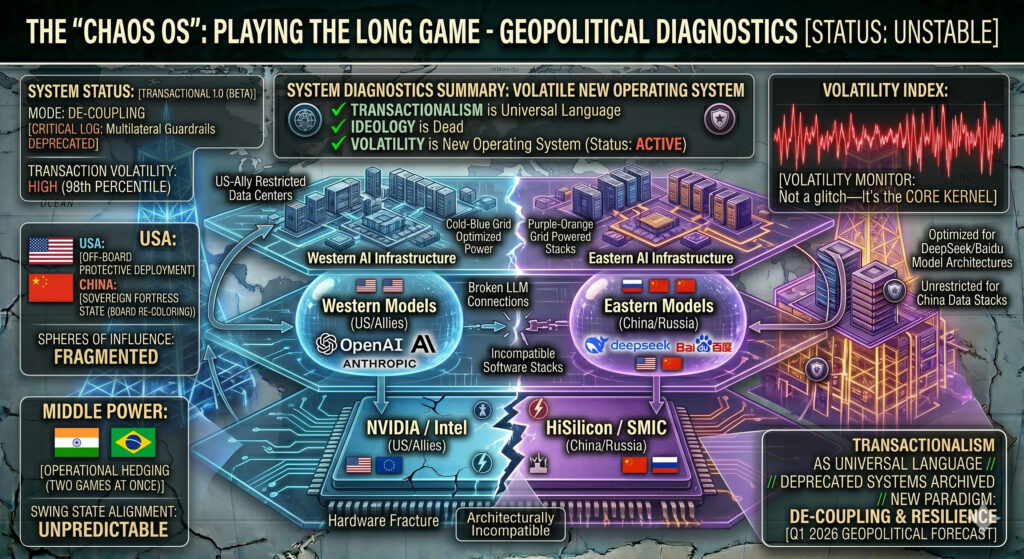
Who is moving the pieces? In 2026, the answer is “everyone and no one.” The U.S. is moving its pieces off the board to protect its “Home Base”; China is trying to change the color of the squares; and the Middle Powers are trying to play two games at once.
We are entering a period where transactionalism is the only universal language. Ideology is dead; interest is everything. For our quarterly subscribers, the takeaway is this: the volatility we see today isn’t a “glitch”—it’s the new operating system.