

Executive Summary
The Madrassa Frontier represents a non-geographic, cognitive domain where state sovereignty is contested through the occupation of the collective mind. This White Paper defines Administrative Persistence as the state’s functional capacity to maintain narrative primacy and institutional utility despite high-velocity cognitive maneuvers and the “Silent Echo” of extremist rhetoric. By deconstructing the Bamako Blueprint, this doctrine identifies how shadow networks induce Administrative Friction to hollow out the state’s core. To counter this, the state must transition from centralized command to a Mosaic Defense model, utilizing autonomous Administrative Tiles and the 72/48 Resilience Protocol. The objective is to anchor governance in Hardware Truth – the physics-based verification of utility – ensuring that the N-5 corridor and border sectors remain impervious to institutional rupture.
3 Key Takeaways
- Sovereignty as a Function of Utility: In the Multi-Domain Battlespace, sovereignty is no longer purely territorial; it is the ability of the state to project Hardware Truth and provide superior Logistical Oxygen to its citizens, thereby neutralizing the vacuum occupied by extremist pipelines.
- Decentralization via Mosaic Defense: To survive Single-Trigger Threats and “Flash-Dark” events, the state must restructure its frontier into autonomous Administrative Tiles that maintain functional persistence even when centralized command and control is compromised.
- Operational Resilience through 72/48: The 72/48 Resilience Protocol provides a clinical framework for local administrators to harden their sectors against narrative spoofing for 72 hours and maintain Analog Persistence for 48 hours using physical resource sovereignty.
The Cognitive Frontier as a Sovereign Domain

The traditional definition of a frontier is rooted in physical geography – the demarcation of territorial limits and the kinetic defense of the Pakistan-Afghanistan border. However, in the 2026 Multi-Domain Battlespace (MDB), the primary theater of conflict has shifted to the Madrassa Frontier. This is a non-geographic, cognitive domain where state sovereignty is contested not through the seizure of land, but through the occupation of the collective mind.
The Paradigm Shift in Sovereignty
State sovereignty is increasingly defined by Administrative Persistence – the ability of an institution to maintain functional utility and narrative primacy despite high-velocity cognitive maneuvers. The Madrassa Frontier represents a direct challenge to this persistence. It is a space where adversaries utilize the “Silent Echo” of extremist rhetoric to fill the vacuum left by administrative neglect. When a state fails to provide the intellectual and social “Logistical Oxygen” required by its citizens, the frontier expands, hollowing out the state’s authority from within.
The Doctrine of Necessity
Conventional kinetic solutions are insufficient to neutralize a threat that operates primarily in the cognitive and social dimensions. A military interdiction may seize a physical building, but it cannot interdict a laundered ideology or a “Software Update” disseminated through a decentralized network. Therefore, the state must adopt a doctrine of resilience that prioritizes Hardware Truth – the physics-based verification of reality and utility – over the battle for digital consensus or “hearts and minds”.
The Anatomy of Institutional Rupture
Institutional Rupture occurs when the cumulative weight of narrative friction and administrative failure renders a state entity incapable of performing its sovereign duties. In the context of the Madrassa Frontier, this rupture is the terminal objective of the Bamako Blueprint.
The Bamako Blueprint in Education
The Bamako Blueprint is a strategic template for the intentional induction of institutional paralysis. When applied to the educational sector:
- Shadow Governance: Decentralized madrassa networks establish their own judicial and social frameworks, rendering state laws irrelevant in the eyes of the local population.
- Utility Spoofing: By providing essential services that the state fails to deliver, these networks “spoof” the social sensors of the community, appearing as the primary provider of stability.
- Administrative Ghosting: As the pipeline’s authority grows, state officials become “ghosts” in their own provinces – physically present but functionally powerless.
Induced Administrative Friction
The insertion of extremist narratives creates permanent bottlenecks in provincial governance, a phenomenon known as Administrative Friction.
- Narrative Primacy vs. Technical Merit: Policy decisions are increasingly dictated by the need to appease radicalized segments of the population rather than technical or economic necessity.
- The Checkpoint Paradox: In an attempt to reassert control, the state often increases physical security hardening. This inadvertently raises the Conflict Premium, stalling the flow of legitimate commerce and further alienating the populace.
The Flash-Dark Vulnerability
Centralized command and control (C2) structures are inherently vulnerable to Single-Trigger Threats – singular events designed to trigger a systemic collapse.
- Information Overload: During a cognitive surge, centralized hubs are flooded with synthetic signals and “Digital Mirages,” leading to a state of paralysis.
- Flash-Dark Events: A sudden severance of digital or narrative links can cause a centralized administration to “go dark,” losing its ability to coordinate with provincial sectors.
- The Requirement for Mosaic Resilience: To survive such events, the state must move away from monolithic C2 and toward a Mosaic Defense, where autonomous Administrative Tiles maintain persistence even when the central hub is compromised.
Mapping the Madrassa Pipeline Logistics
The Madrassa Pipeline must be audited as a high-velocity human capital supply chain that leverages both digital and analog domains to maintain Logistical Oxygen. This section deconstructs the movement of recruits and resources within the Madrassa Frontier.
The Human Capital Supply Chain
The pipeline operates as a linear progression of cognitive and physical states:
- The Acquisition Phase: Adversaries exploit the “Psychological Terrain” created by state administrative absence, positioning the madrassa as the primary provider of social utility.
- The “Software Update”: Recruits undergo a mechanical indoctrination process that systematically replaces national identity with a “Global Security Mandate”.
- Tactical Distribution: Once the “Sanitization Gap” is bridged, processed recruits are funneled through the Pakistan-Afghanistan border to support kinetic operations for transnational threat actors like the TTP or ISKP.
Analog Liquidity and Persistence
Unlike centralized state systems, the pipeline is designed for Analog Liquidity – the ability to persist using physical resource sovereignty.
- Resource Sovereignty: The pipeline utilizes informal, decentralized funding and supply networks that are impervious to digital financial severance.
- Persistence During Flash-Dark Events: During periods of state-imposed digital network severance, the pipeline continues to operate via pre-positioned analog assets and local community ties.
- The Buffer Zone: This analog resilience ensures that the network maintains its Logistical Oxygen even when the state attempts to interdict its digital presence.
Sanitization Gap Interdiction
Interdiction requires identifying the specific intervals where radicalization is “cleaned”.
- Laundering Directives: Kinetic instructions are laundered into pedagogical veneers, making the transition from student to facilitator invisible to external sensors.
- Information Filtering: Local proxies act as the final filter, ensuring that the Digital Mirage of extremist ideology is anchored in the physical reality of the community.
The Mosaic Defense in the Cognitive Domain
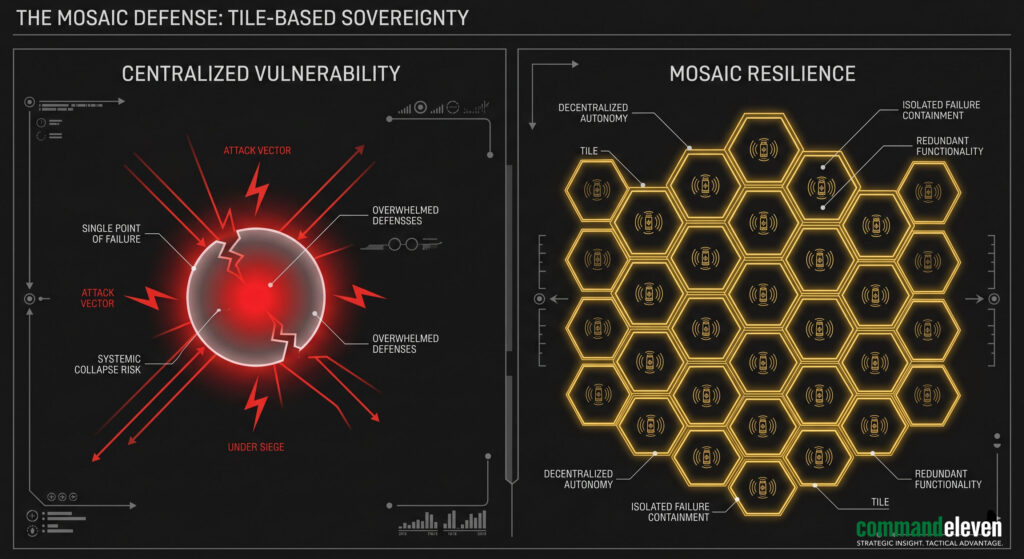
The Mosaic Defense is the doctrinal response to the hollowing out of state authority. It replaces monolithic, centralized command with a network of autonomous, hardened units called Administrative Tiles.
Transition to Autonomous Administrative Tiles
To achieve Administrative Persistence, the state must decentralize its authority:
- The Tile Concept: An Administrative Tile is a localized unit (border sector, logistical hub, or educational district) empowered to govern and verify its own domain independently.
- Resilience via Autonomy: If the central hub suffers from Institutional Rupture or a Single-Trigger Threat, the individual Tiles continue to provide state utility and maintain order.
- Hardened Perimeters: Each Tile is secured by a “Triple Lock” of verification, ensuring it remains immune to external cognitive maneuvers.
The Hardware Truth Mandate
In a domain flooded with Digital Mirages, the state must anchor its legitimacy in Hardware Truth.
- Physics-Based Verification: Tiles reject digital consensus and laundered signals in favor of physical audits, manual ledgers, and direct human intelligence.
- Utility as Defense: The most effective counter to radicalization is the physical delivery of superior social services – the state’s own Logistical Oxygen.
- Reclaiming Narrative Primacy: By demonstrating unwavering physical utility and transparency, the Tile shatters the “Silent Echo” of the adversary.
Stigmergy as a Counter-Strategy
Stigmergy refers to a system where independent actors coordinate through physical indicators rather than direct communication.
- Decentralized Coordination: State Tiles coordinate by observing the “Hardware Truth” of neighboring sectors, ensuring a synchronized response to threats without relying on a vulnerable centralized C2.
- The Resilient Network: This model creates a state presence that is as decentralized and persistent as the pipeline it seeks to neutralize.
Operational Framework: The 72/48 Resilience Protocol
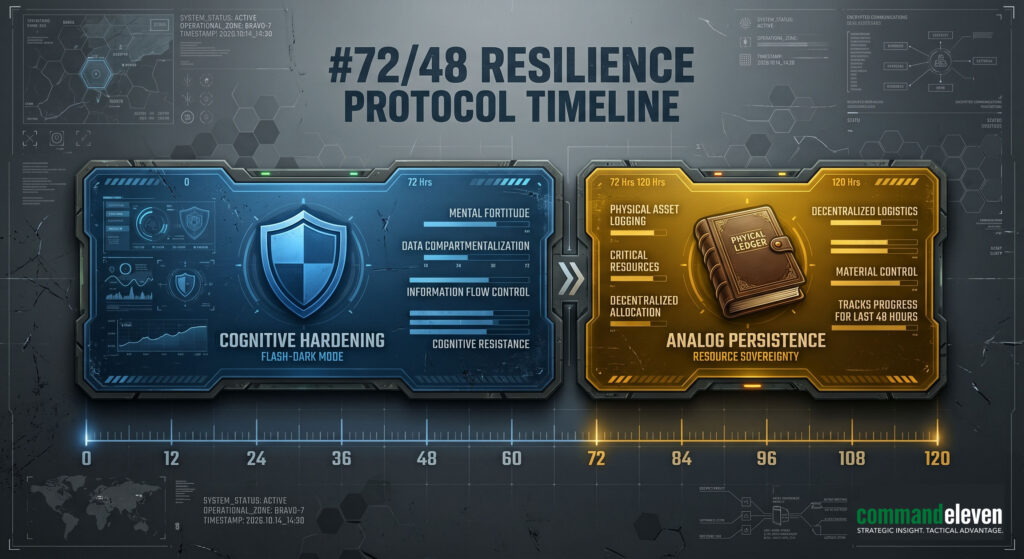
The 72/48 Resilience Protocol is the operational engine of the Mosaic Defense, designed to neutralize the effects of a Single-Trigger Threat or a sustained cognitive surge within the Madrassa Frontier. It provides a clinical framework for Administrative Persistence by isolating local governance from synthetic digital interference.
72-Hour Cognitive Hardening
Upon the detection of a high-velocity narrative surge or a Digital Mirage aimed at inducing Administrative Friction, the local Administrative Tile initiates a 72-hour hardening phase.
- Narrative Severance: The Tile enters a “Flash-Dark” state, severing non-essential digital links to prevent HMI Ghosting and narrative spoofing by external threat actors.
- C2 Sanitization: Internal communications are shifted to pre-verified, secure channels, ensuring that directives are not being influenced by laundered signals or the Sanitization Gap.
- Strategic Silence: By refusing to engage with synthetic digital panic, the Tile prevents the adversary from achieving Narrative Primacy.
48-Hour Analog Persistence
Following the hardening phase, the Tile operates in a state of Analog Persistence, relying on physical resource sovereignty to maintain order and utility.
- Analog Liquidity Deployment: The Tile utilizes its physical reserves – food, fuel, and medical supplies – to ensure that the community’s Logistical Oxygen is not depleted by digital financial or logistical severance.
- Physics-Based Governance: Administrative actions are coordinated via Hardware Truth , utilizing analog ledgers and manual audits to verify community needs and resource distribution.
- Utility as Counter-Signaling: By maintaining uninterrupted social and educational services during a crisis, the Tile demonstrates a level of resilience that shatters the extremist “Silent Echo”.
The Triple Lock Verification
The protocol is anchored by the Triple Lock Doctrine, a clinical audit process applied to all community-level narratives.
- Verification Layer 1: Digital signature analysis to identify the origin of a narrative signal.
- Verification Layer 2: Cross-referencing digital signals with physical HUMINT (Human Intelligence) assets on the ground.
- Verification Layer 3: Final validation through Hardware Truth, ensuring the narrative matches the physical reality of the sector.
Reclaiming the Battlespace: Restoring Logistical Oxygen
To secure the Cognitive Battlespace, the state must pivot from reactive interdiction to the active restoration of its own administrative utility. This process is the ultimate hedge against Institutional Rupture.
Administrative Utility as Kinetic Defense
In the Madrassa Frontier, superior social service delivery functions as a form of kinetic defense.
- Filling the Vacuum: By providing consistent, high-quality education and healthcare, the state Tile reclaims the “Psychological Terrain” previously occupied by the Madrassa Pipeline.
- Neutralizing the Pipeline: When the state provides superior Logistical Oxygen, the pipeline’s utility is spoofed, rendering its recruitment mechanisms ineffective.
The 45-Day Terminal Window
Strategic engagement is most effective within the 45-Day Terminal Window – the interval before a recruit’s indoctrination reaches the Kinetic Gate.
- Proactive Engagement: Tiles must identify at-risk youth during the initial stages of the “Software Update” and provide an alternative narrative based on Hardware Truth and state-sponsored opportunity.
- Narrative Interjection: By providing a tangible, physical path toward social utility, the state disrupts the transition from a consumer of the Digital Mirage to a physical facilitator of conflict.
Lowering the Conflict Premium
A resilient state focuses on reducing the surplus operational costs generated by narrative-driven friction.
- Streamlining Transit: By replacing centralized, high-friction checkpoints with Tile-based Hardware Truth verification, the state restores the velocity of trade along the Pakistan-Afghanistan border.
- Restoring Trade Velocity: Reducing administrative bottlenecks allows the N-5 corridor to regain its status as a protected sovereign asset, free from the “Silent Echo” of narrative-driven blockades.
- Economic Resilience: Lowering the Conflict Premium ensures that the state’s resources are directed toward development rather than reactive, narrative-driven security hardening.
Implementation & Governance Matrix
The transition to a Mosaic Defense model requires a systematic restructuring of state authority along the Madrassa Frontier. This matrix provides the clinical framework for the phased deployment of Administrative Tiles and the establishment of Hardware Truth as the governing standard.
Phased Deployment of Administrative Tiles
The restructuring must begin at the most high-friction sectors of the Pakistan-Afghanistan border.
- Phase I: Sector Isolation: Identifying and mapping “Asymmetric Hubs” to determine the optimal perimeter for the initial Tiles.
- Phase II: Utility Restoration: Pre-positioning state resources to ensure each Tile can immediately provide superior Logistical Oxygen (education, healthcare, and security) upon activation.
- Phase III: C2 Decentralization: Gradual transfer of decision-making authority from the centralized hub to the Tile administrator, anchored in the 72/48 Resilience Protocol.
Inter-Agency Hardware Truth Handshake
Persistence depends on the synchronization of intelligence across civilian, military, and administrative sectors within a Tile.
- The Ht Handshake Protocol: A mandatory verification process where digital intelligence signals must be physically “handshaked” by a HUMINT asset and a physical audit before being operationalized.
- Eliminating the Sanitization Gap: By requiring cross-agency physical verification, the state prevents laundered narratives or Digital Mirages from influencing multi-domain responses.
- Analog Ledger Integration: Maintaining a unified physical ledger of resources and personnel within the Tile to ensure Analog Liquidity during a Flash-Dark event.
Metrics for Administrative Persistence
Success in the cognitive battlespace is measured by the state’s functional durability.
- The Friction Index: Measuring the reduction in Administrative Friction and the Conflict Premium within a Tile over a 120-day cycle.
- Utility Velocity: Tracking the speed and consistency of state service delivery during simulated or actual cognitive surges.
- Narrative Rejection Rate: Assessing the community’s resilience against extremist “Software Updates” and the resonance of the “Silent Echo”.
The Persistence Mandate
The Madrassa Frontier is the decisive domain of the 2026 Multi-Domain Battlespace. The state’s survival no longer rests solely on kinetic superiority but on its capacity for Administrative Persistence – the unwavering ability to project Hardware Truth in the face of a Digital Mirage.
The Future of Sovereignty
Sovereignty is a function of utility. When the state allows its administrative core to be hollowed out by shadow educational networks, it concedes the Cognitive Frontier. To reclaim this domain, the state must embrace the Mosaic Defense, replacing the vulnerability of centralized command with the resilience of autonomous, hardened Administrative Tiles.
The CommandEleven Vision
This doctrine provides the clinical roadmap to neutralize the “Silent Echo”. By adhering to the 72/48 Resilience Protocol and reclaiming the state’s Logistical Oxygen, we ensure that the N-5 corridor and the broader frontier remain impervious to the Bamako Blueprint of institutional paralysis. The mandate is clear: the state must govern through physics, verify through reality, and persist through decentralization. In the cognitive battlespace, Hardware Truth is the only strategic anchor that cannot be laundered, spoofed, or erased.