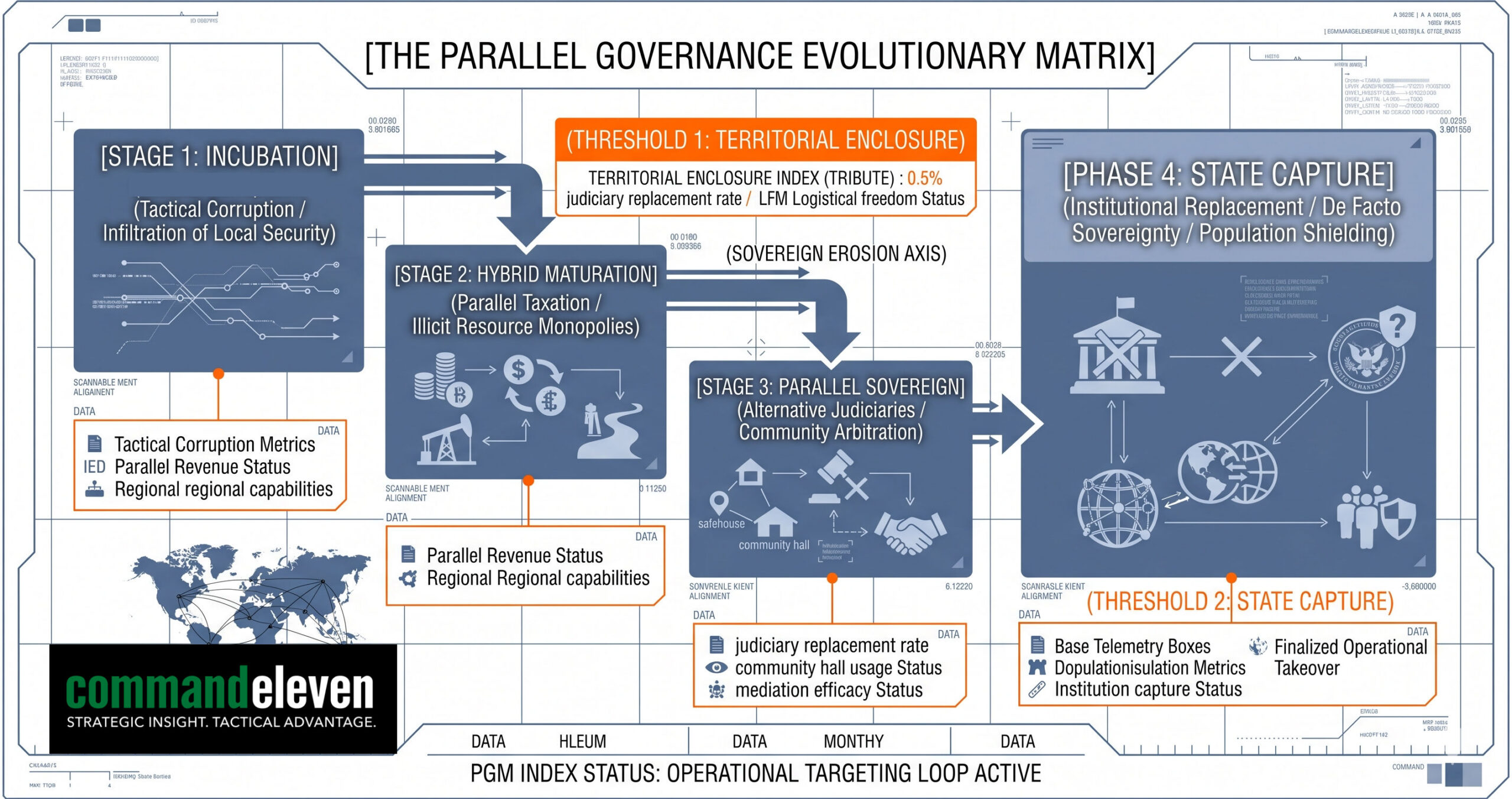
This blueprint charts the evolutionary trajectory of armed non-state actors as they transition from loose, ideologically driven underground cells into institutionalized parallel sovereigns. This technical framework maps structural shifts across three specific organizational thresholds.
The Structural Evolution Flow
Stage 1: Incubation & Clandestine Strike Cell
- Topology: Horizontal, decentralized, highly compartmentalized networks.
- Fiscal Model: {Opportunistic} – Relying primarily on localized ransom, petty extortion, and foreign donor drops.
- Civil Posture: Zero territorial visibility; pure anti-state subversion campaigns.
Stage 2: Hybrid Asymmetric Maturation
- Topology: Bifurcated structure containing a clandestine leadership core paired with localized military fronts.
- Fiscal Model: {Systematized Extraction} – Active taxation of regional trade routes, illicit petroleum (POL) lines, and narcotics transit lines.
- Civil Posture: Contested geographic presence; establishment of shifting safe zones and operational enclaves.
Stage 3: Parallel Sovereign Administration
- Topology: Centralized, bureaucratic, hierarchical ministries consisting of structured Shuras and specialized administrative Commissions.
- Fiscal Model: {Monopolized Tax Codes} – Implementation of formal Piso collection, structured trade tariffs, and cross-border customs extraction.
- Civil Posture: Alternative civil regulation, alternative quasi-judicial arbitration courts, and total territorial enforcement.
Doctrinal Assessment
Operational Insight: Transitioning across these thresholds is not automatic; it requires specific enabling conditions. An entity cannot move from Stage 2 to Stage 3 without achieving either severe state institutional decay or direct geographic sanctuary that protects its administrative bureaucracy from kinetic disruption. When an organization successfully sets up formal tax collection or alternative dispute resolution, they are no longer just fighting the state; they are actively replacing it.
Operational Evolution Matrix
To track an entity’s position within this structural arc, analysts deploy a specific set of operational indicators to measure structural change.
| Structural Variable | Stage 1 Posture | Stage 2 Posture | Stage 3 Posture |
| Command Topology | Flat network; cell autonomy is high to survive counter-terrorism targeting. | Regional commands operate with tactical independence under broad strategic guidance. | Highly centralized command councils (Rahbari Shura) managing specialized administrative ministries. |
| Logistical Infrastructure | Relying completely on black-market procurement and commercial retail diversion. | Securing dedicated border trade pipelines and maintaining mobile refining laboratories. | Dominating entire state-level infrastructure nodes, deep-sea ports, and transpacific shipping proxies. |
| Financial Liquidation | Cash-heavy, physical currency drops; simple peer-to-peer Hawala transfers. | Integration of digital asset layers (USDT) mixed with traditional transit extortion revenue. | Automated money laundering loops using extraterritorial casinos and VIP junket structures. |
| Civil Regulation | Social interaction is purely predatory or focused on security-vetted recruitment. | Intermittent enforcement of ideological codes or localized tribal mediation. | Institutionalized parallel legal structures, contract enforcement, and administrative border management. |
Kinetic Axes – 2026 Operational Realignment Series
- Kinetic Axes Series: Strategic Preface / 2026 Operational Realignment
- The Regime-Structure Evolution Blueprint
- Indian Subcontinent Regional Security Seams: Border Vulnerability Audit
- Western Weapons Proliferation: TTP & BLA Telemetry Audit
- Middle East and East Africa Kinetic Axes: Transnational Logistic Loops
- The Americas Core TCOs & Transpacific Convergence (Series Captstone)
- Transnational Threat ArchitectureL The Inter-Continental Junket Network
- Maritime Security Sub-Module: Transregional Maritime Logistics Nodes
- Governance & Territorial Control Sub-Module: Parallel Governance Metrics