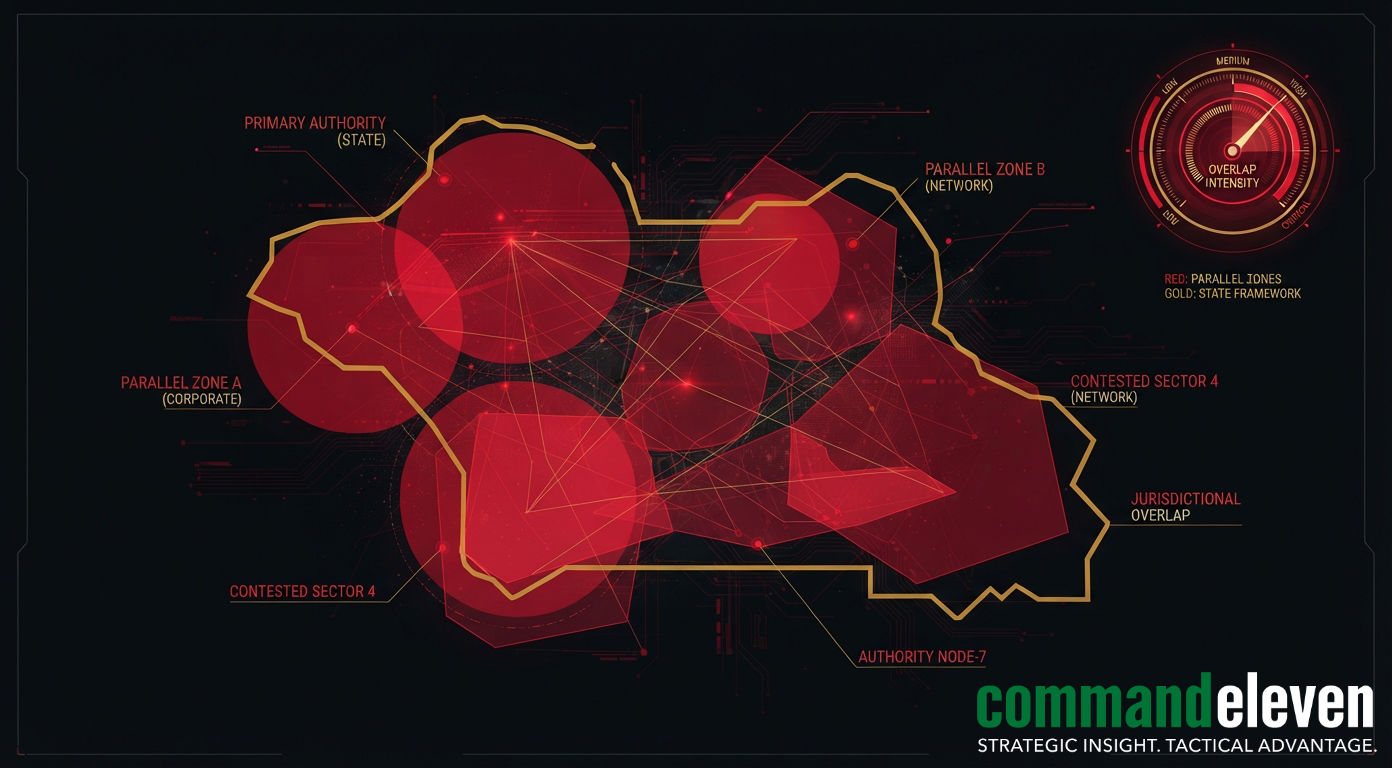
This module formalizes the analytical framework required to measure, evaluate, and track the mechanisms through which Tier-1 Transnational Organized Crime (TCO) syndicates, insurgent coalitions, and hybrid non-state armed actors replace state sovereign authority, establish parallel administrative institutions, and secure long-term, population-level insulation against state-led kinetic interventions.
The Parallel Governance Evolutionary Matrix
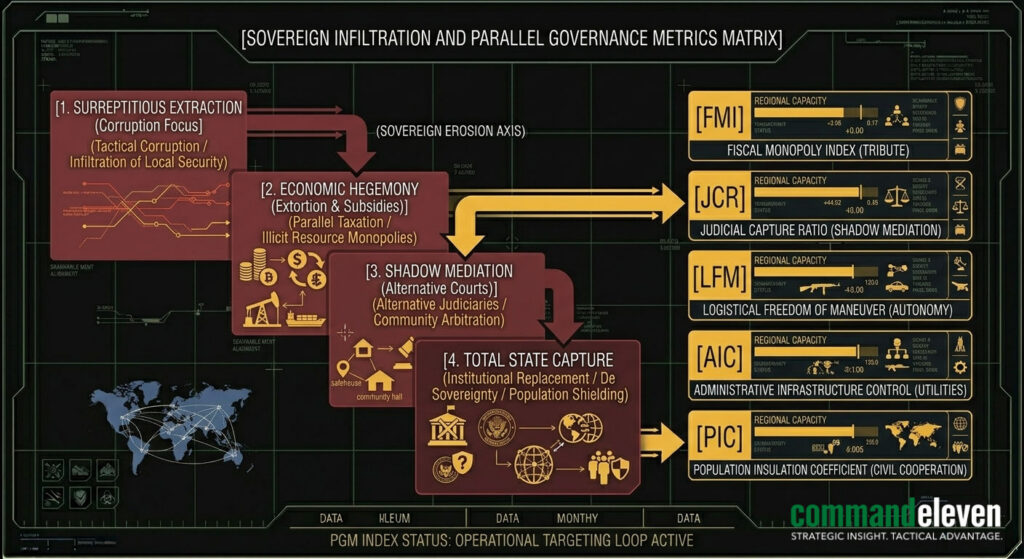
Non-state actors do not merely exploit security vacuums; they systematically build alternative social contracts. The acquisition of total territorial depth and population insulation evolves through four distinct, measurable phases.
Phase 1: Surreptitious Infiltration and Co-optation (The Entry Layer)
- Institutional Subversion: The network uses targeted economic leverage to co-opt municipal law enforcement, local customs officials, and low-level political administrators.
- Tactical Invisibility: At this stage, the group avoids direct competition with state symbols. Instead, it buys operational space, ensuring intelligence tip-offs, secure transit corridors, and legal insulation for its high-value leadership core.
Phase 2: Economic Hegemony and Shadow Taxation (The Fiscal Layer)
- Resource Regulation: The entity establishes an organized, predictable parallel taxation model (piso or insurgent levies) over all formal and informal economic activities within its zone. This includes systematically skimming local public works, commercial trucking lanes, and mineral extraction industries.
- Economic Dependency Provision: The group selectively reinvests portions of this extracted revenue back into the local community. By financing micro-loans, seasonal agricultural inputs, or direct emergency aid, it fosters community dependency and builds a grassroots baseline of loyalty.
Phase 3: Shadow Mediation and Alternative Judiciaries (The Legal Layer)
- The Judicial Vacuum: Exploiting the slow, corrupt, or non-existent nature of the formal state judicial system, the entity deploys shadow parallel mediation cells and tribal court mechanisms.
- Conflict Resolution Monopoly: By providing rapid, absolute, and enforceable arbitration over local land disputes, commercial contract breaches, and familial grievances, the network replaces the state as the primary legitimate source of local authority and social order.
Phase 4: Institutional Replacement and Total State Capture (The Sovereign Layer)
- De Facto Statehood: The entity achieves structural state capture. It openly manages civic infrastructure, regulates local labor markets, directs public education materials, and controls physical movement through militarized border check-gates.
- Asymmetric Sovereign Attrition: The civilian population becomes structurally integrated into the group’s survival apparatus. When the state attempts kinetic intervention, the community provides active early warning, manufactures public mass protests, and acts as human shields, rendering conventional counter-insurgency or law enforcement sweeps politically and operationally unsustainable.
The Parallel Governance Metric (PGM) Index
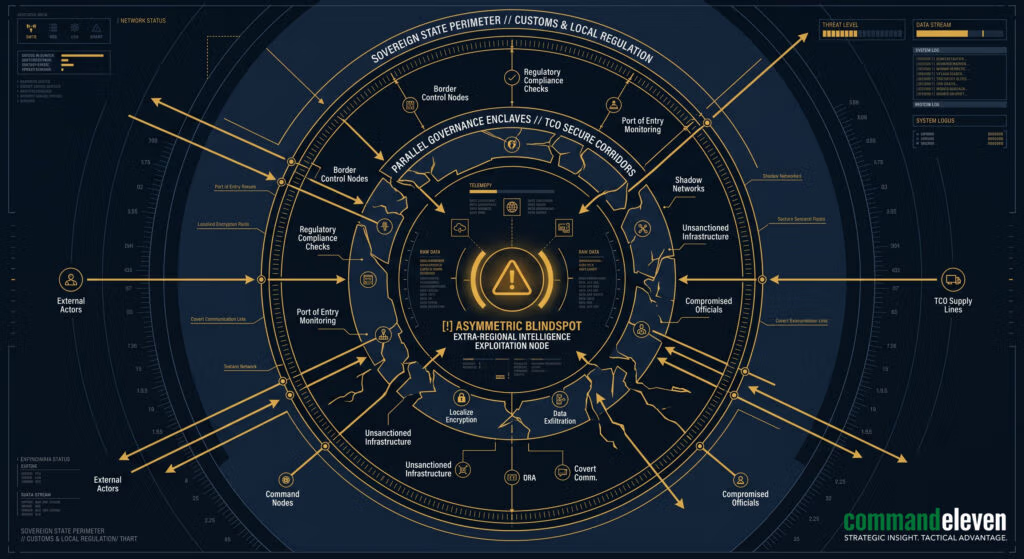
To quantify the level of sovereign erosion within any given operational theater, analysts evaluate five core indicators scored on a spectrum from Stage 0 (Total State Consolidation) to Stage 5 (Absolute Parallel Sovereignty).
| PGM Core Indicator | Measurement Parameters | Tactical Target |
| Fiscal Monopoly Index (FMI) | Percentage of local businesses and transit loops paying tribute vs. state taxes | Parallel Revenue Stream Identification |
| Judicial Capture Ratio (JCR) | Volume of civil/criminal disputes resolved via shadow tribunals vs. formal courts | Legal Infiltration Assessment |
| Logistical Freedom of Maneuver (LFM) | Capacity to deploy uniform-clad forces and run open check-gates without kinetic pushback | Territorial Depth Validation |
| Administrative Infrastructure Control (AIC) | Degree of management over utilities, clinics, and transport concessions | Institutional Replacement Mapping |
| Population Insulation Coefficient (PIC) | Civilian cooperation levels and denial of tactical human intelligence (HUMINT) | Community Infiltration Metrics |
Disruption Strategies for Governance Decoupling
Targeting an entity that has achieved parallel governance requires moving beyond conventional kinetic operations to systematically break the alternative social contract binding the population to the network.
- Disrupting the Fiscal Monopolization Matrix
- Vulnerability: Parallel governance structures require massive, predictable cash flows to maintain localized infrastructure subsidies and pay armed enforcement wings.
- Countermeasure: Deploy forensic financial teams to audit municipal public contracts, freeze the asset networks of local business proxies laundering extortion funds, and implement targeted anti-smuggling barriers along primary trade lanes generating resource rents for the group.
- Undermining Judiciaries and Restoring Legal Legitimacy
- Vulnerability: The network’s shadow mediation cells depend entirely on the speed, finality, and perceived fairness of their arbitration compared to a broken state system.
- Countermeasure: Deploy mobile, secure, and clean state judicial units directly into peripheral zones. Enforce rapid conflict resolution tracks for land and commercial disputes to break the non-state entity’s monopoly on local justice.
- Neutralizing the Population Insulation Shield
- Vulnerability: The network’s safety depends on the civilian population remaining a closed, non-communicative barrier against state security forces.
- Countermeasure: Design and deploy comprehensive, localized stabilization programs that deliver unconditioned infrastructure support, combined with localized whistleblower channels that protect anonymity to rebuild state HUMINT pipelines and break the enforcement of community Omertà.