Executive Summary
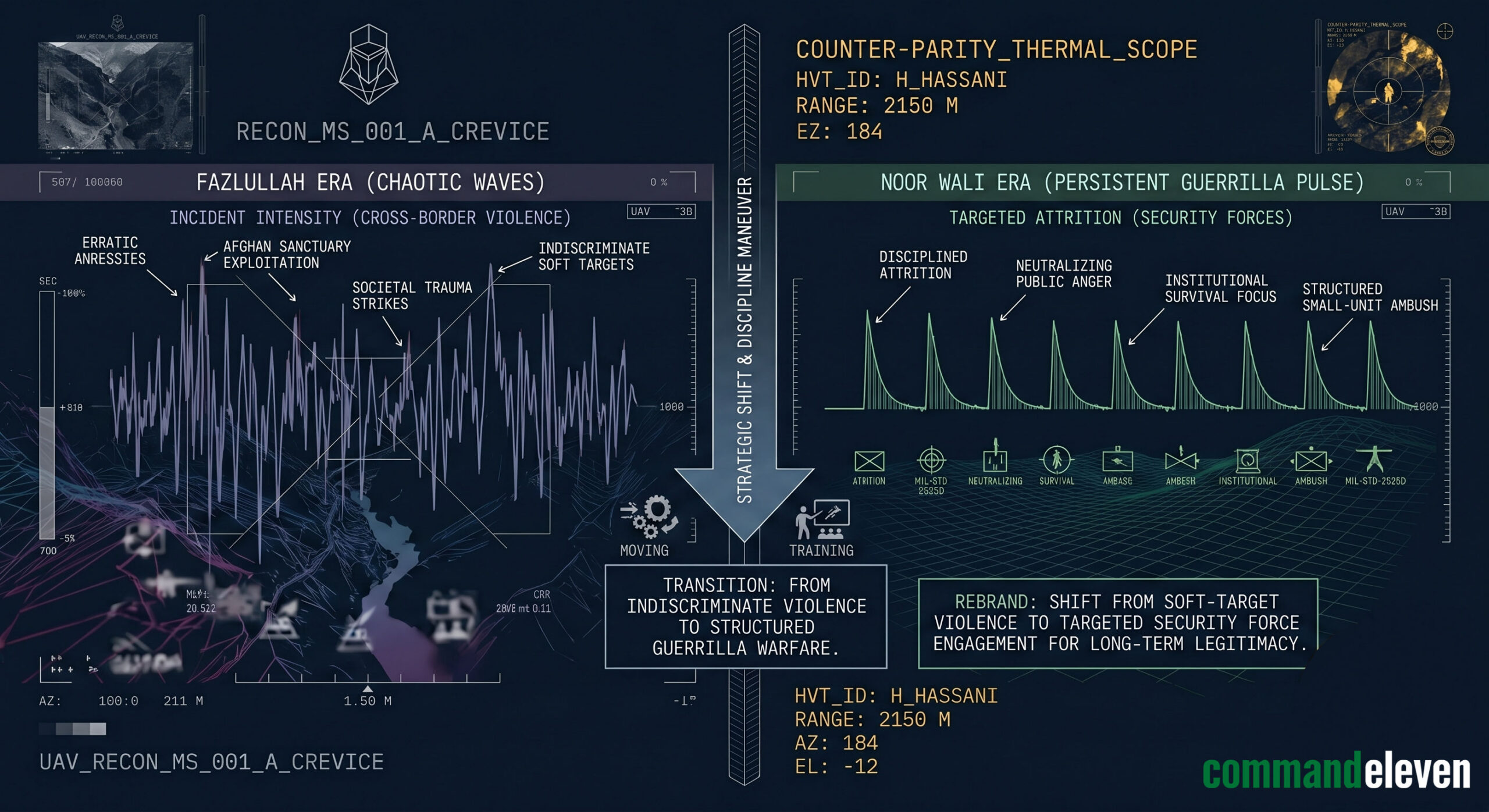
The ascension of Noor Wali Mehsud in 2018 marked the TTP’s transition from a terrorist entity into a structured, nationalist-leaning guerrilla force. Through the “New Manifesto,” Mehsud formally prohibited civilian targeting, focusing exclusively on security force attrition to neutralize public hostility and ensure institutional survival. This rebrand is a calculated strategic maneuver designed to exploit localized grievances and re-open political space for negotiations, representing a sophisticated long-term threat to the state’s territorial writ.
3 Key Takeaways
- Shift to Disciplined Attrition: The TTP has pivoted from indiscriminate massacres to targeted strikes against military and law enforcement assets to avoid domestic societal blowback.
- Nationalist Framing: By adopting the rhetoric of ethnic and tribal “liberation,” the TTP seeks to distance itself from globalist terror narratives and embed itself within localized political grievances.
- Survival via Rebranding: The absence of urban civilian carnage is a tactical choice to lower the “Conflict Premium” and allow political apologists to advocate for de-escalation and “peace talks.”
BLUF: The ascension of Noor Wali Mehsud in 2018 signaled a sophisticated structural and psychological rebrand of the Tehreek-e-Taliban Pakistan (TTP). By formally pivoting from the indiscriminate “Fazlullah-era” terror model to a disciplined, nationalist-leaning guerrilla framework, Mehsud has attempted to ensure institutional survival, neutralize public hostility, and re-open political space for negotiation while maintaining a protracted war of attrition against the state apparatus.
The Institutional Survival Maneuver
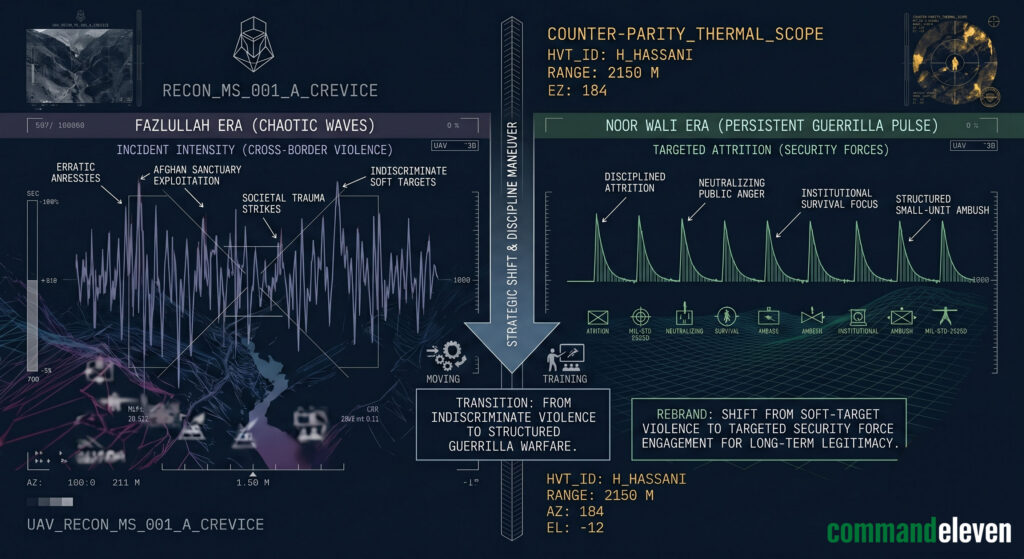
When Noor Wali Mehsud assumed the emirate of the TTP in June 2018, the organization was facing a crisis of existential legitimacy. The preceding era, dominated by Mullah Fazlullah, had been characterized by total doctrinal barbarism,culminating in the 2014 APS Peshawar massacre. This strategy had not only triggered a total military mandate for eradication but had also resulted in catastrophic societal rejection.
Mehsud’s “New Manifesto” (Mansoor-ul-Fatah) was a cold, calculated strategic maneuver. He recognized that for the TTP to persist, it had to stop being a de-territorialized death cult and start behaving like a structured insurgent army. This shift was not a moderation of ideology, but a refinement of methodology designed to shield the group from the total kinetic weight of the state.
The Tactical Pivot: Targeted Attrition
The hallmark of the Mehsud era is the Prohibition of Civilian Targeting. This directive serves as a mechanical constraint on operational cells to prevent the kind of public blowback that followed the 2007–2014 urban terror campaigns.
- Security Force Concentration: Every significant operation post-2018 has been meticulously redirected to focus exclusively on military, intelligence, and law enforcement targets. By narrowing the target set, Mehsud aims to frame the conflict as a “legitimate” war between two armed entities rather than a terrorist campaign against a population.
- Guerrilla Refinement: The TTP has moved away from high-visibility, “noisy” urban suicide bombings toward “cleaner,” high-impact guerrilla strikes. This includes the use of thermal-equipped sniper teams and coordinated IED ambushes in the border regions, utilizing the Technological Parity acquired following the 2021 US withdrawal.
- The Strategic Buffer: By avoiding civilian massacres, Mehsud provides a “narrative shield” for domestic political apologists and religious factions. This lack of urban carnage allows these actors to advocate for renewed “peace talks,” portraying the TTP as a “reformed” entity that can be re-integrated.
The “Nationalist” Rebrand: Sovereignty vs. Globalism
One of the most significant shifts in the manifesto is the move toward a nationalist narrative. Mehsud has sought to decouple the TTP’s image from Al-Qaeda’s globalist “Caliphate” rhetoric, instead portraying the group as a “liberation movement” for the tribal districts.
- Localized Grievance Exploitation: The TTP now aggressively mirrors the language of secular ethnic movements, attempting to position itself as the “armed wing” of tribal resistance against an “oppressive” state. This is a stigmergic attempt to bridge the gap between religious militancy and secular political dissent.
- Administrative Shadowing: In areas where the state’s writ is thin, the TTP attempts to implement its own rudimentary judicial and administrative structures. By offering a “disciplined” alternative to state utility, they seek to lower the Conflict Premium for local populations, incentivizing silence or passive support.
The Convergence Nightmare: Splinter Dynamics
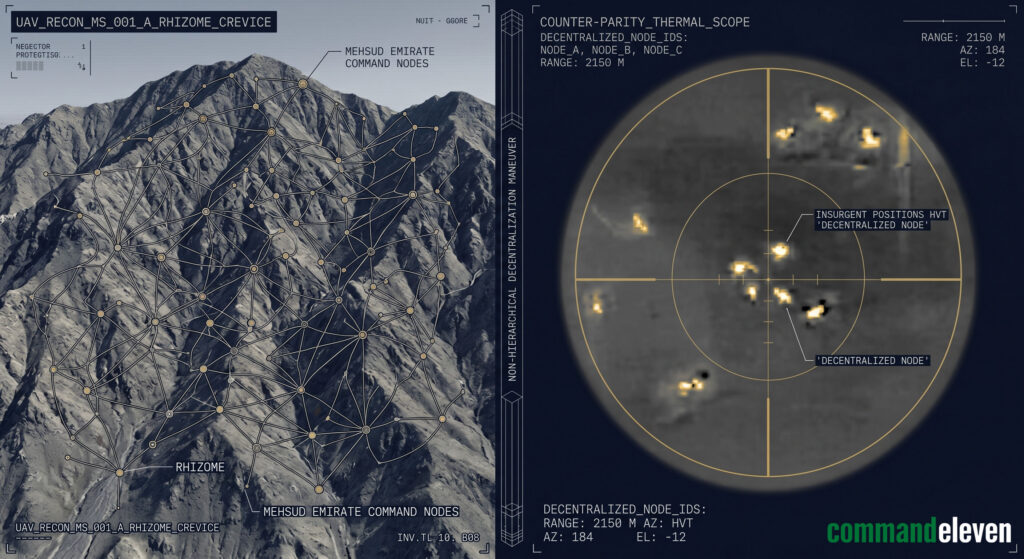
While the Mehsud manifesto mandates discipline, the “Long War” landscape has been complicated by tactical cross-pollination with other actors.
- The ISKP Buffer: Transnational groups like ISKP (Islamic State Khorasan Province) continue to maintain the indiscriminate terror model. This creates a “Strategic Buffer” for the TTP; ISKP executes the high-casualty civilian attacks that maintain ideological dominance, while the TTP maintains its “disciplined guerrilla” image by sticking to military targets.
- Tactical Synergy: Despite ideological rivalries, there is evidence of shared logistical corridors and technical handshaking. Secular groups like the BLA have adopted the religious militants’ complex suicide bombing tactics, while the TTP has adopted the “cleaner” hit-and-run models of nationalist insurgents.
Clinical Conclusion
The Noor Wali Manifesto represents a “sophisticated war of attrition” that is significantly more dangerous to state persistence than the preceding era of chaotic violence. By adopting a disciplined guerrilla model, the TTP has successfully prolonged the conflict while shielding itself from the total societal rejection it faced a decade ago. For the state, this means the conflict can no longer be solved by conventional might alone; it requires a superior counter-narrative and a permanent closure of the Sanitization Gap to combat the TTP’s calculated psychological rebranding.