Executive Summary
The security paradigm along the Pakistan-Afghanistan border has undergone a fundamental transformation as of May 2026. Following the collapse of the October 2025 ceasefire, Islamabad has operationalized the “Proactive Defense” doctrine through Operation Ghazab lil-Haq (Righteous Fury). This shift marks a departure from localized border management to strategic, deep-theater aerial campaigns targeting Tehrik-i-Taliban Pakistan (TTP) command nodes within Afghan sovereign territory. The conflict is further complicated by the TTP’s tactical evolution,leveraging NATO-grade weaponry and UAVs,and the underlying ideological rejection of the border by the Afghan Taliban, which continues to fuel Pashtun nationalist friction.
3 Key Takeaways
- Doctrine of Overt Coercion: Operation Ghazab lil-Haq establishes a new precedent for Pakistani military operations, moving beyond the border fence to strike militant leadership and logistics in Afghan urban centers like Kabul and Kandahar.
- Tactical Parity via Proliferation: The TTP has successfully bridged the technological gap with state security forces through the integration of thermal optics, M4 carbines, and commercial UAVs, increasing the lethality of their cross-border incursions.
- Collapse of Strategic Depth: The current hostilities represent the terminal failure of the “strategic depth” policy, as the ideological alignment between the Afghan Taliban and the TTP outweighs diplomatic or economic pressure from Islamabad.
The Transition to Overt Coercion
As of May 2026, the security paradigm along the Pakistan-Afghanistan border has undergone a fundamental transformation. The localized border skirmishes that characterized much of 2024 and 2025 have evolved into a state of high-intensity, multi-domain conflict. Following the failure of the October 2025 ceasefire,a diplomatic effort marred by persistent Tehrik-i-Taliban Pakistan (TTP) violations,Islamabad has operationalized its “Proactive Defense” doctrine.
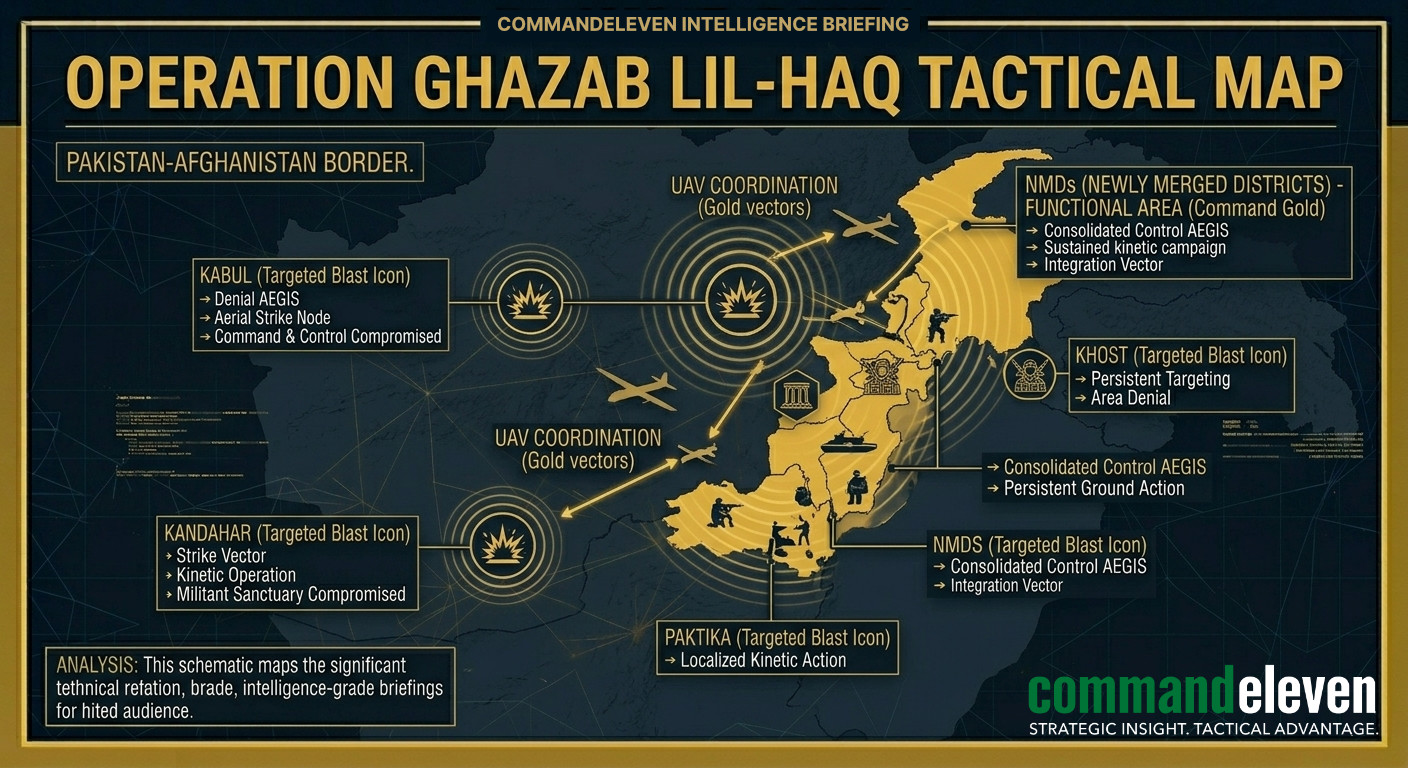
This shift is codified in Operation Ghazab lil-Haq (Righteous Fury), launched in February 2026. Unlike previous operations, which were largely confined to Pakistan’s sovereign territory in the Newly Merged Districts (NMDs), this operation explicitly targets the logistical and command-and-control (C2) nodes of militant groups within Afghanistan. This dossier analyzes the industrialization of the TTP’s insurgency, the ideological friction of Pashtun nationalism, and the strategic consequences of Pakistan’s deep-theater aerial campaign.
Operation Ghazab lil-Haq: Analyzing the Kinetic Shift
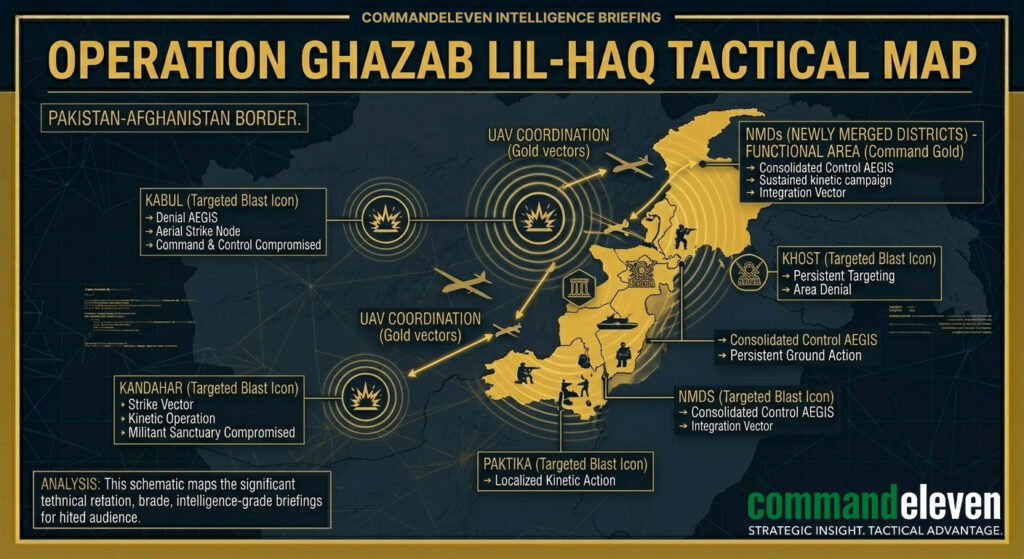
The primary objective of Operation Ghazab lil-Haq is the neutralization of “safe havens” in the eastern provinces of Afghanistan. This reflects a definitive conclusion by Pakistani intelligence that the Afghan Taliban (IEA) either lacks the capacity or the political will to restrain their ideological kin, the TTP.
Deep-Theater Aerial Campaigns
Between February and May 2026, the Pakistan Air Force (PAF) and tactical UAV wings executed a series of coordinated strikes across the Kabul, Kandahar, Paktika, and Nangarhar provinces.
- The March 12 Kabul Strike: In a significant escalation, Pakistani kinetic assets targeted a verified TTP safe house in the Khair Khana district of Kabul. This strike signaled that urban centers are no longer off-limits if they harbor high-value targets (HVTs).
- Strategic Interdiction: Strikes have increasingly focused on non-kinetic logistics, targeting fuel depots and small-scale ammunition manufacturing units in Khost and Kunar. The intent is to degrade the TTP’s ability to sustain long-term offensives in the winter months.
Operational Cost and Casualty Metrics
The human cost of this proactive posture has been substantial. Intelligence reports from UN monitors in early 2026 indicate over 750 civilian casualties in the first quarter alone. While Pakistan maintains that these are the result of collateral damage caused by the TTP’s policy of embedding within civilian populations, Kabul has used these metrics to galvanize domestic nationalist sentiment against Islamabad.
The TTP Resurgence: Tactical Evolution (2025-2026)
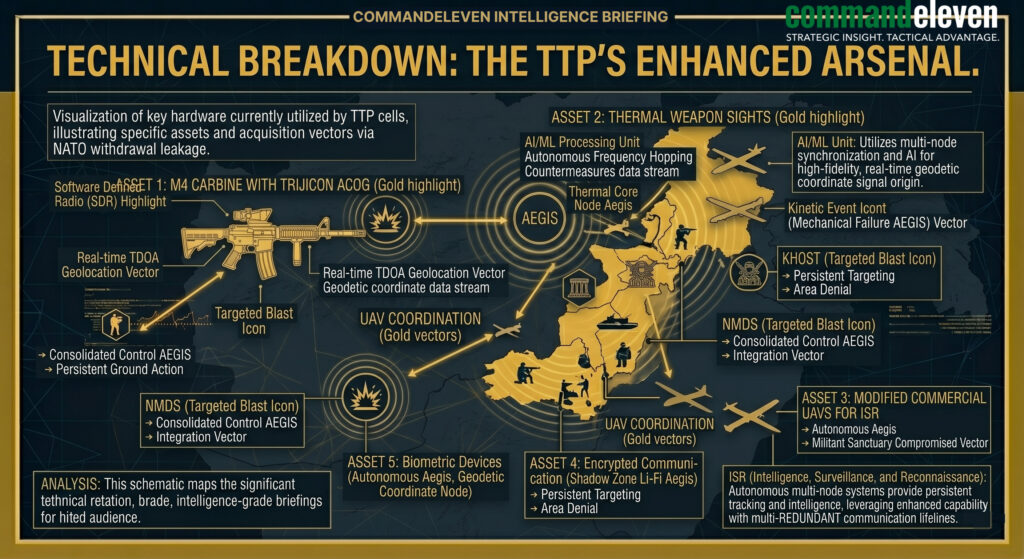
The TTP is no longer a decentralized collection of tribal militias; it has evolved into a disciplined paramilitary organization with a sophisticated operational footprint.
Command Centralization under Noor Wali Mehsud
Under the leadership of Mufti Noor Wali Mehsud, the TTP has successfully consolidated splinter groups (including factions of the Jamaat-ul-Ahrar). This centralization has enabled:
- Unified Operational Directives: A move away from indiscriminate bombings toward targeted assassinations and high-profile assaults on security installations.
- Revenue Management: The TTP has established a formal “taxation” system in the borderlands, extorting local businesses and developmental projects to fund their procurement of advanced weaponry.
Technological Parity and the “NATO Leak”
A critical factor in the TTP’s enhanced lethality is the proliferation of abandoned NATO equipment.
- Precision and Night-Vision: The widespread use of M4 carbines equipped with Trijicon ACOG optics and night-vision goggles (NVGs) has neutralized the traditional nighttime advantage held by Pakistani security forces.
- UAV Proliferation: As of May 2026, the TTP frequently utilizes commercial quadcopters for both ISR (Intelligence, Surveillance, and Reconnaissance) and improvised tactical drops (IEDs). This “air-to-ground” capability was notably demonstrated in the May 5 Bannu assault.
The Ideological Axis: Pashtun Nationalism and the Border Question
The kinetic conflict is layered atop a century-old ideological dispute regarding the legitimacy of the Pakistan-Afghanistan border.
The Rejection of “Sovereignty”
The Afghan Taliban, despite their reliance on Pakistan during the insurgency against NATO, remain ideologically committed to the rejection of the border as an international boundary. They frame it as a colonial imposition that bisects the Pashtun heartland. This ideological stance provides the TTP with a “social license” to move freely between provinces like Paktika (AFG) and South Waziristan (PAK).
Weaponizing Identity
Non-state actors have effectively leveraged Pashtun nationalist grievances to frame the Pakistani state’s security measures,such as fencing and biometric border controls,as “ethnic repression.” This narrative serves to:
- Inhibit Intelligence Gathering: Local populations in the NMDs are often caught between state requirements and militant threats, leading to a breakdown in local human intelligence (HUMINT).
- Fuel Displacement: The 2026 kinetic campaign has displaced over 115,000 civilians. These IDP camps have become fertile ground for militant recruitment and the spread of anti-state sentiment.
Geopolitical Implications: The Breakdown of the “Strategic Depth” Doctrine
For decades, Pakistan’s Afghan policy was guided by the pursuit of “strategic depth”,the desire for a friendly, stable government in Kabul to avoid a two-front war. The current friction represents the final collapse of this doctrine.
- The Two-Front Threat: With the TTP active in the west and heightened tensions in the east, Pakistan’s military resources are being stretched.
- Regional Realignments: The friction has created an opening for other regional actors. There are increasing indicators of tactical cooperation between the TTP and ISKP, despite their ideological differences, specifically aimed at destabilizing the Pakistani administrative grip on the border.
Intelligence Assessment and Forecasting (Q3-Q4 2026)
CommandEleven assesses that the Pakistan-Afghanistan border will remain the primary theater of regional instability for the remainder of 2026.
Key Indicators for the Next 90 Days:
- Urban TTP Cells: Watch for an increase in “lone actor” or sleeper cell activity in major Pakistani cities (Peshawar, Islamabad) as a retaliatory measure for the PAF strikes in Kabul.
- Afghan Conventional Buildup: Monitoring for the deployment of Afghan Taliban “Border Battalions” equipped with captured heavy armor near the Chaman and Torkham crossings.
- Third-Party Mediation: Watch for Qatari or Chinese diplomatic intervention as the humanitarian and economic costs of the border closure begin to impact regional trade.