Executive Summary
As of May 2026, the Myanmar Civil War has transitioned from an asymmetric guerrilla conflict into a systemic, territorial repartitioning of the state. The military junta (SAC) has lost operational control over two-thirds of the country, suffering unprecedented collapses of its regional command hubs. CommandEleven Intelligence assesses that the critical strategic variable is now the institutionalization of parallel governance by the National Unity Government (NUG) and Ethnic Armed Organizations (EAOs). This administrative web – comprising digital banking models like the Spring Development Bank and localized cross-border trade taxation – is actively choking the junta’s access to foreign exchange reserves. While ideological divisions regarding post-conflict state configuration create structural friction, the parallel administration has successfully achieved de facto sovereignty over vast territorial swathes.
3 Key Takeaways
- Administrative Repartitioning: Resistance governance operates across three distinct parallel models (NUG municipal councils, EAO autonomous proto-states, and joint borderland committees), successfully replacing collapsed junta administrative structures.
- Sovereign Fiscal Decoupling: The establishment of blockchain-anchored digital banks and the capture of critical border trading gates have allowed the resistance to create a parallel financial ecosystem, starvng the junta of customs and extraction revenues.
- The Airpower Vulnerability: The parallel state’s primary structural weakness is its lack of integrated air defense systems, leaving alternative governance centers, schools, and hospitals highly vulnerable to retaliatory junta air strikes.
The Tri-Tiered Administrative Framework
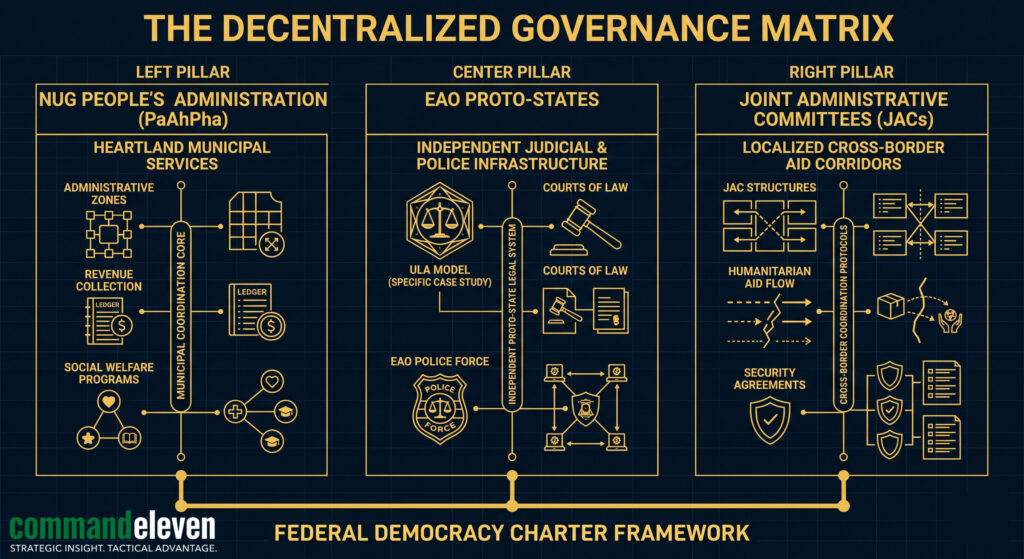
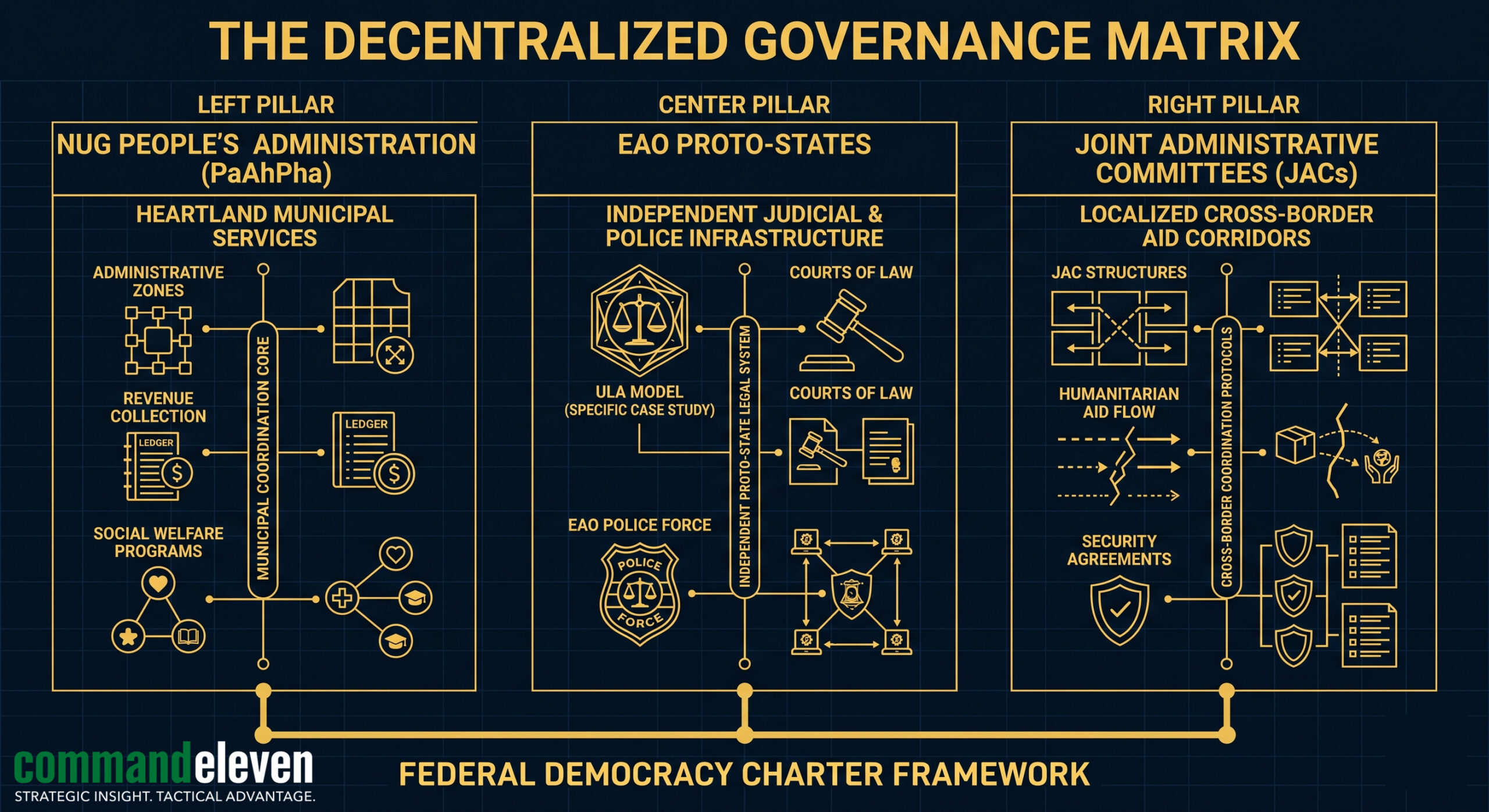
The governance architecture of liberated and contested territories operates across three distinct parallel administrative models, varying by ethnic geography and institutional capacity.
The NUG People’s Administration Bodies (PaAhPha)
In the Bamar heartland – specifically the Sagaing, Magway, and Mandalay regions – the NUG has established local administrative organs known as PaAhPha. These bodies function as municipal ministries, replacing the collapsed SAC local councils. They manage basic civil registries, primary healthcare clinics staffed by striking civil servants from the Civil Disobedience Movement (CDM), and localized primary education networks.
EAO Proto-States and the “Way of Rakhita”
In the ethnic borderlands, legacy EAOs have converted military victory into comprehensive state-building initiatives. The most advanced model is enforced by the United League of Arakan/Arakan Army (ULA/AA) in Rakhine State, which now controls 14 of the region’s 17 townships. Operating under the “Way of Rakhita” doctrine, the ULA has established formal judicial courts, a centralized police force, and a department of taxation that functions independently of the NUG, creating a de facto autonomous maritime proto-state.
Joint Administrative Committees (JACs)
In highly diverse regions like Karenni (Kayah) State, the Karenni Nationalities Defense Force (KNDF) and traditional ethnic leadership have formed joint councils. These interim administrative bodies serve as a bridge between the NUG’s federal aspirations and localized ethnic sovereignty, managing cross-border humanitarian aid corridors originating in Thailand.
Fiscal Infrastructure and Resource Extraction Economics
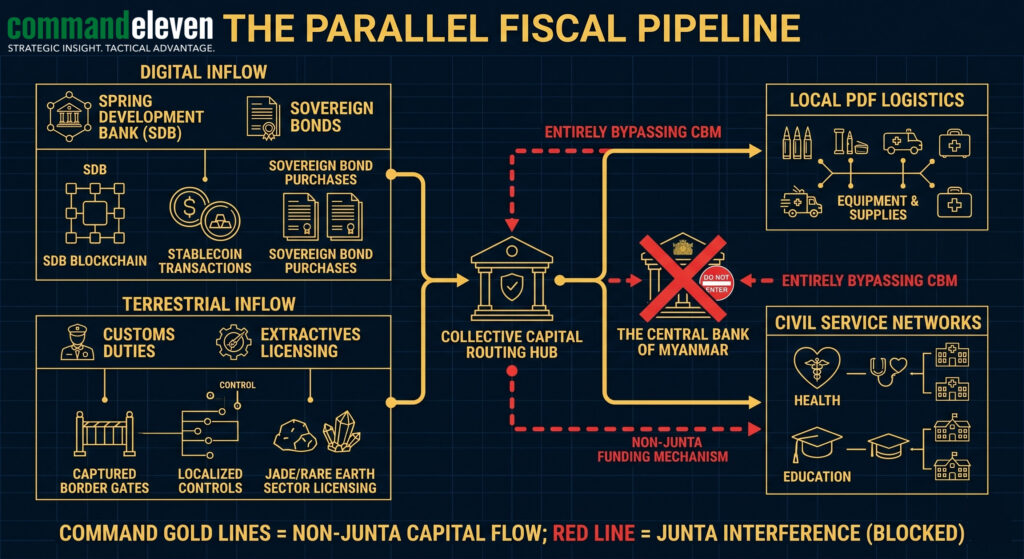
To sustain a multi-front war and administer territory, the resistance structures have formalized a parallel financial system that systematically bypasses the Central Bank of Myanmar.
Digital Banking and Sovereign Bonds
The NUG Ministry of Planning, Finance, and Investment has operationalized the Spring Development Bank (SDB), a blockchain-anchored, digital-first banking institution. The SDB allows the global diaspora and domestic citizens to securely open accounts, remit funds, and purchase non-interest-bearing NUG sovereign bonds using encrypted stablecoins. This digital infrastructure starves the SAC of foreign exchange reserves while providing liquid capital for PDF logistics.
Border Gate Taxation and Customs
Following the capture of critical border trading hubs – such as Myawaddy on the Thai border and Muse and Chinshwehaw along the China-Myanmar frontier – EAOs like the Karen National Union (KNU) and the Myanmar National Democratic Alliance Army (MNDAA) have seized control of customs houses. By levying systematic duties on cross-border trade, these groups generate millions in monthly hard-currency revenues, which are directly reinvested into administrative infrastructure and weapon procurement.
Extractives Regulation
In Kachin and Shan States, resistance coalitions have asserted sovereignty over jade, rare earth, and ruby mines. The Kachin Independence Army (KIA) has established regulatory frameworks for extraction, issuing localized mining licenses and imposing environmental and export taxes on Chinese extraction consortia, effectively forcing Beijing to recognize resistance administrative legitimacy.
Institutional Friction Points and Structural Vulnerabilities
Despite significant territorial consolidation, the resistance architecture faces internal structural challenges that prevent the formation of a singular unified state apparatus.
The Federal Democracy Charter Divergence
While the NUG, PDFs, and progressive EAOs are nominal signatories to the Federal Democracy Charter, deep-seated ideological differences persist regarding the post-junta configuration of the state. Elite EAOs, including the United State Wa Army (UWSA) and components of the Three Brotherhood Alliance, prioritize absolute regional autonomy and confederation status, viewing the NUG’s centralized federal model with historical suspicion.
Tactical Fragmentation of Command and Control
Although the NUG has established the Central Command Coordination Committee (C4) to synchronize military actions, localized PDFs frequently operate autonomously. This lack of centralized command leads to sporadic coordination failures, where independent factions launch urban attacks without consulting adjacent EAO units, exposing civilian populations to immediate Tatmadaw air and artillery reprisals.
The Airpower Vulnerability and Administrative Destruction
The parallel state’s primary operational vulnerability remains its lack of integrated air defense systems. The Tatmadaw, facing terminal ground-force attrition and a failed conscription campaign, relies on an intensified air campaign. Throughout early 2026, junta MiG-29 and Yak-130 platforms have targeted civilian administrative centers, schools, and hospitals in resistance-held townships – such as the destruction of the Mrauk-U General Hospital – preventing the stable institutionalization of alternative governance.
Intelligence Assessment & Forecasting (2026–2030)
CommandEleven Intelligence forecasts that the next 36 months will witness the complete normalization of a fractured, multi-centered governance reality in Myanmar.
- The Balkanization Trend: The central state will not be replaced by a singular democratic government in Bamako or Naypyidaw. Instead, Myanmar will solidify into a network of autonomous, ethnically managed cantons loosely allied under a weak federal framework.
- China’s Pragmatic Alignment: Beijing will continue to bypass the central junta, expanding formal diplomatic and economic relationships with borderland EAOs to guarantee the safety of the China-Myanmar Economic Corridor (CMEC).
- The Governance Race: The ultimate survival of the resistance depends on its transition from a military clearing force to an efficient administrative body capable of delivering public health, justice, and economic stability to a population experiencing deep poverty.