Executive Summary
As of May 2026, Tren de Aragua (TdA) has completed its transition from a localized Venezuelan prison gang into a dominant transnational criminal organization operating across the South American Pacific corridor and into the Western Hemisphere. CommandEleven Intelligence assesses that TdA’s rapid expansion relies on a hyper-violent operational model that exploits regional migration flows, establishes complete territorial dominance over informal border crossings, and deploys highly adaptive kinetic extortion networks. Unlike traditional, centralized drug cartels, TdA functions as a franchise-based criminal enterprise, optimizing revenue generation through low-overhead, high-margin illicit portfolios. These portfolios include human smuggling, sexual exploitation, contract assassination, and the systematic infiltration of localized economies, presenting an immediate security threat to municipal administrations from Santiago de Chile to North American urban centers.
3 Key Takeaways
- The Carceral Command Hub: Tren de Aragua utilized sovereign prison sanctuaries as unmonitored command and control stations to develop and export an adaptive, franchise-based criminal infrastructure across the Americas.
- Industrialization of Human Migration: The syndicate handles regional migration streams as a direct cash commodity, asserting absolute control over informal border crossings (trochas) to monetize human smuggling, labor, and forced sexual exploitation.
- Aggressive Operational Defiance: TdA displays an asymmetric willingness to engage in direct kinetic conflict with municipal security forces, deploying heavily armed, high-mobility small units that directly threaten urban police capabilities in target nations.
Origins, Structural Franchising, and the Prison-Hub Model
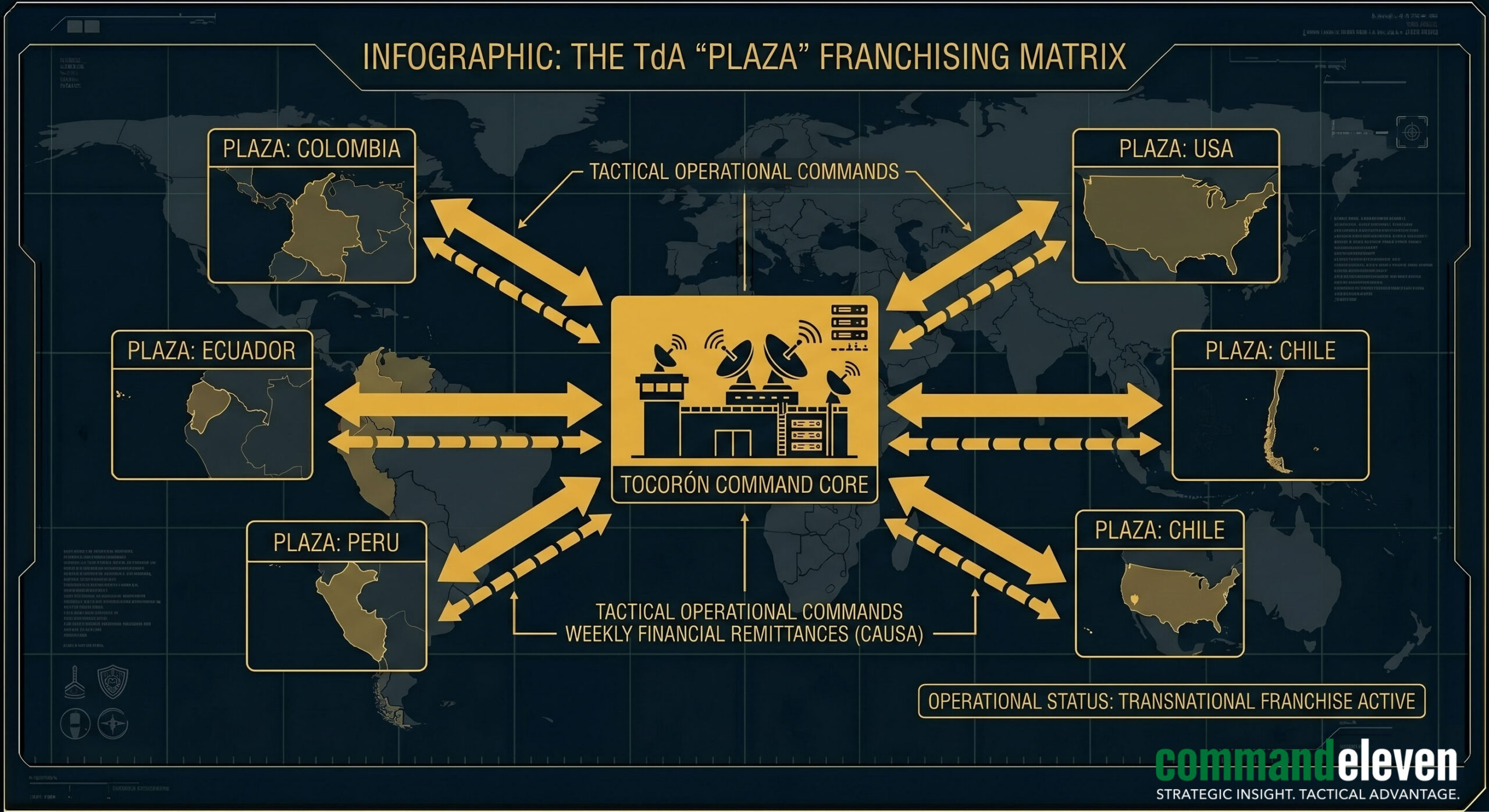
The rapid institutionalization of Tren de Aragua defies traditional hierarchical criminal models, utilizing a decentralized command structure anchored in carceral sanctuaries.
- The Tocorón Foundation: TdA originated inside the Centro de Tocorón prison in Aragua, Venezuela, under the leadership of Héctor Guerrero Flores (“Niño Guerrero”). The prison served as an unmonitored command, control, and communications center where the syndicate established parallel banking, weapons modification depots, and digital extortion operations before the state attempted a partial re-assertion of control.
- The “Plaza” Franchise Architecture: TdA expands by deploying trusted lieutenants (luceros) to establish geographic cells known as Plazas. These cells are granted substantial tactical autonomy to adapt to local illicit markets but must remit a fixed percentage of weekly revenues,known as causa,back to the central leadership core, ensuring continuous capital flow to the syndicate’s high command.
- Cell Inter-Connectivity: By leveraging encrypted mobile messaging networks, geographically isolated Plazas maintain real-time coordination. If a TdA cell in Peru encounters localized law enforcement pressure, it can instantly mobilize financial resources, fake identification logistics, and enforcement personnel from adjacent cells in Colombia or Chile to secure operational continuity.
Kinetic Extortion Mechanics and Localized Economic Infiltration
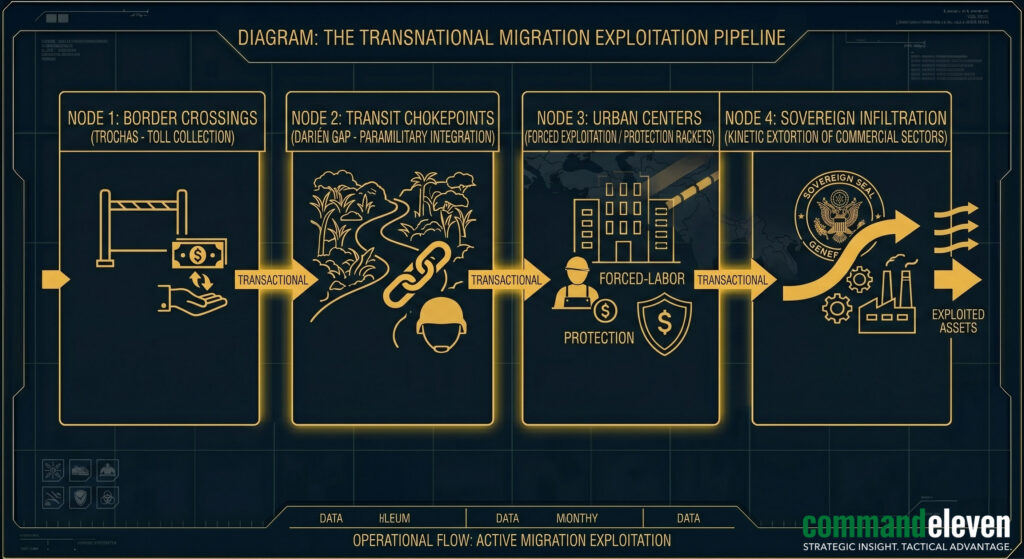
The primary revenue generator for Tren de Aragua is the execution of highly aggressive extortion campaigns that target vulnerable, informal populations before moving systematically into formal commercial sectors.
- Weaponized Human Smuggling (The Trochas): TdA systematically controls the informal border crossings,known as trochas,linking Venezuela to Colombia, Ecuador, Peru, and Chile. The syndicate treats migrants as a human commodity, levying per-capita transit tolls, forcing individuals to act as narcotics couriers, and kidnapping those unable to meet payment requirements to extort overseas diaspora relatives.
- Systematic Industrial Extortion: Upon consolidating a presence within an urban center, TdA implements a protection racket targeting micro-businesses, transport cooperatives, construction sites, and informal vendors. Refusal to pay the mandated vacuna or causa results in immediate kinetic retaliation, including hand grenade attacks against storefronts, public executions of non-compliant managers, and the systematic assassination of local union organizers.
- Monopolization of Human Trafficking: The syndicate has industrialized the sexual exploitation of migrant women across South America. TdA establishes complete control over specific urban entertainment districts, setting up clandestine processing centers where victims’ travel documents are seized, debts are artificially manufactured, and armed enforcers manage daily compliance through systematic physical intimidation.
Asymmetric Adaptation to the Western Hemisphere Transit Corridor
Throughout late 2025 and into early 2026, Tren de Aragua successfully expanded its logistical footprint northward, utilizing established migration corridors to embed operational cells inside North American urban centers.
- The Darién Gap Chokepoint: TdA has integrated its logistics with local Colombian paramilitary groups, such as the Clan del Golfo, to secure safe passage for its human smuggling cells through the Darién Gap. Within this ungoverned space, TdA manages specialized logistical waystations, providing fake identity documents, illicit financial transfers, and guides to escort high-value criminal assets toward the US southern border.
- Urban Cell Dispersal: Utilizing the cover of legitimate asylum-seeking populations, TdA operatives have established active cells in major US metropolitan areas, including New York, Chicago, Miami, and Denver. These cells specialize in high-margin retail crime rings, moped-enabled armed robberies, and the establishment of local distribution hubs for synthetic narcotics, directly challenging local municipal police capabilities.
- Asymmetric Law Enforcement Defiance: Unlike local gangs that attempt to evade law enforcement visibility, TdA cells routinely display an aggressive willingness to engage in direct kinetic conflict with state security forces. The group utilizes standard military tactics, deploying high-mobility small-unit teams armed with illegally modified automatic handguns and body armor, severely escalating the safety risks for urban police personnel.
Intelligence Assessment & Forecasting (2026–2030)
CommandEleven Intelligence forecasts that Tren de Aragua will undergo a process of structural criminal professionalization through 2030, presenting severe national security challenges across the Americas.
- Consolidation of Sovereign Safe Havens: Following political shifts and state-level fragmentation within northern South America, TdA will solidify de facto territorial enclaves where it operates alternative municipal governments, leveraging illicit wealth to buy complete immunity from local military and judicial structures.
- The Synthetic Narcotics Pivot: TdA will increasingly transition its revenue model away from human exploitation toward the domestic distribution of synthetic opioids and ketamine-based drug cocktails (such as Tusi), forming strategic alliances with Mexican cartels to trade territory access for wholesale product supply lines.
- Systemic Municipal Political Corruption: As the syndicate’s liquid financial reserves expand, its targeting vector will shift from low-level police bribes to the systematic funding of municipal and regional political campaigns across targeted Andean and Central American states, transforming TdA into a deeply entrenched political power broker capable of shaping national security policy from within.