Executive Summary
This intelligence dossier assesses the strategic expansion of the Alaskan Command and the structural integration of the Ambler Access Project within the broader Arctic security framework. Climate modification continues to increase navigation accessibility throughout the High North. This shift transforms the Arctic into a primary zone of geopolitical competition. The Russian Federation has completed a multi-year modernization of its northern military infrastructure, deploying advanced long-range radar networks and staging supersonic interceptors at coastal airbases. Simultaneously, the People’s Republic of China positions itself as a near-Arctic state, increasing its deployment of heavy diesel and nuclear-powered icebreakers to secure trade routes. The United States is responding by expanding its power projection capabilities, optimizing cold-weather tactical readiness, and securing domestic reserves of critical defense minerals. This assessment provides a comprehensive analysis of the infrastructure modifications, logistical corridors, operational vulnerabilities, and defensive strategies that will shape Arctic security architecture over the next decade.
Technical Takeaways
- Polar Power Projection: The expansion of all-weather infrastructure at Joint Base Elmendorf-Richardson and Eielson Air Force Base establishes a permanent, persistent multi-domain deterrence capability against foreign strategic aviation within the Air Defense Identification Zone.
- Supply Chain Decoupling: The strategic reauthorization of the Ambler Access Project provides the domestic defense industrial base with secure, unmonopolized lines of copper, cobalt, and zinc, directly mitigating reliance on foreign processing networks during an active conflict.
- Terrain Degradation Risks: Geotechnical vulnerabilities, primarily permafrost thermal degradation and severe sub-zero temperatures, constitute the primary structural threats to both military runways and industrial logistics corridors across the High North theater.
Alaskan Command Infrastructure Expansion and Force Posture Modifications
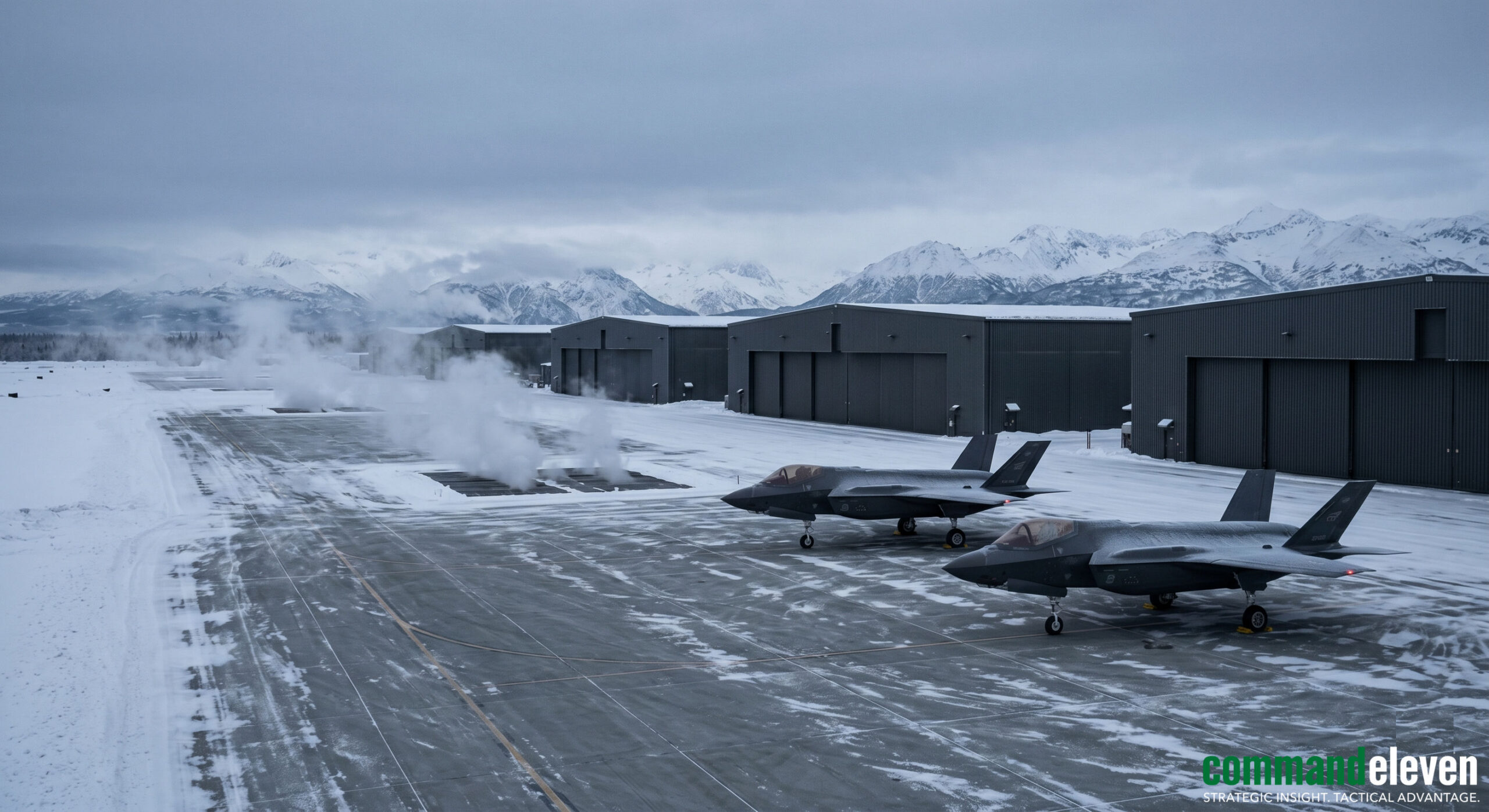
The Alaskan Command serves as the primary joint headquarters for power projection across the Arctic theater. The current operational reality demands a transition from traditional rotational training to a posture of persistent multi-domain deterrence. This shift requires significant capital investment in base infrastructure, advanced early warning radar grids, and long-range logistics networks. Joint Base Elmendorf-Richardson and Eielson Air Force Base are undergoing structural modifications to support an increased complement of fifth-generation fighter aircraft, specifically F-35A Lightning II and F-22 Raptor platforms. These installations provide immediate intercept capabilities against foreign strategic bombers violating the Air Defense Identification Zone.
Force posture adjustments also extend to ground and expeditionary units. The United States Marine Corps launched Campaign Alaska on May 9, 2025, establishing Marine Rotational Force-Alaska alongside a permanent Supporting Arms Liaison Team-Alaska at Joint Base Elmendorf-Richardson. This initiative integrates rotational units with localized fires coordination assets, ensuring the Fleet Marine Force can execute expeditionary advanced base operations in temperatures falling below minus forty degrees.
- Joint Base Elmendorf-Richardson Upgrades: Construction of reinforced all-weather hangars, expanded fuel storage capacity, and modernized runway heating systems to maintain continuous flight operations during extreme winter conditions.
- Eielson Air Force Base Deployment: Integration of advanced maintenance facilities designed to sustain the low-observable coatings of fifth-generation aircraft exposed to prolonged sub-zero temperatures.
- Campaign Alaska Activation: The May 2025 strategic directive that pairs rotational Marine infantry battalions with permanent air-naval gunfire liaison detachments to optimize cold-weather artillery and air support integration.
- Supporting Arms Liaison Team-Alaska: A specialized reserve detachment scheduled to achieve full operational capacity by fiscal year 2027, focusing on joint fires synchronization across austere littoral environments.
- Arctic Edge 2026 Exercise: A major multi-domain field training evolution conducted from February 23 to March 13, 2026, validating interoperability between North American Aerospace Defense Command forces and multinational Arctic allies.
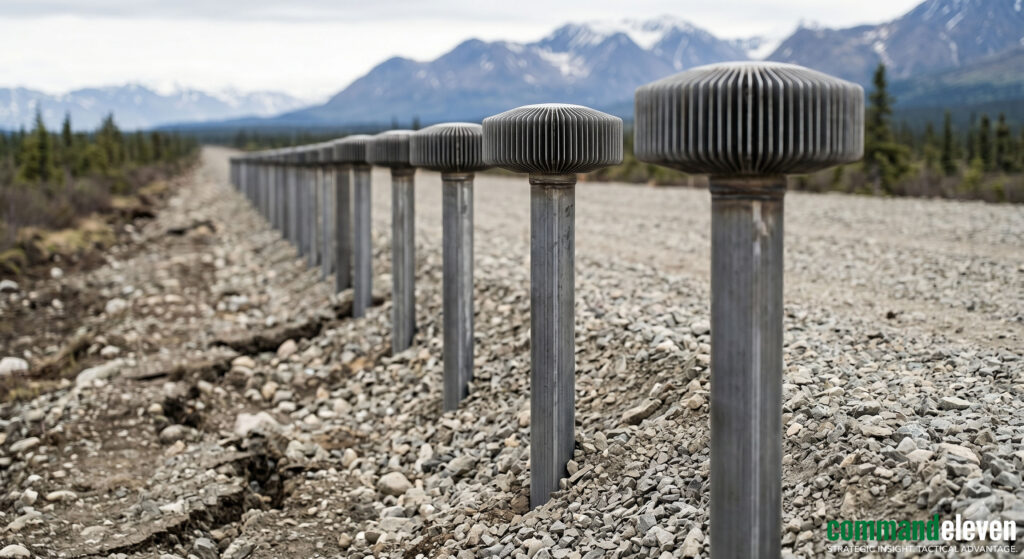
The expansion of these military facilities faces severe geographical and environmental constraints. Permafrost degradation undermines the structural integrity of foundations, runways, and radar towers, requiring the installation of expensive thermosyphon cooling systems to stabilize the underlying terrain. Additionally, the lack of deep-water port infrastructure in western Alaska limits the ability of United States Naval forces to conduct sustained surface operations in the Chukchi and Beaufort seas. While the Port of Nome expansion project aims to mitigate this capability gap, full operational readiness remains years away. This infrastructure deficit forces the Alaskan Command to rely heavily on aerial logistics corridors, which are inherently vulnerable to extreme winter weather patterns and foreign electronic warfare exploitation. Consequently, securing ground-based supply routes and localized energy production is essential to ensure base resilience during a prolonged regional crisis.
The Ambler Access Project and Strategic Mineral Security
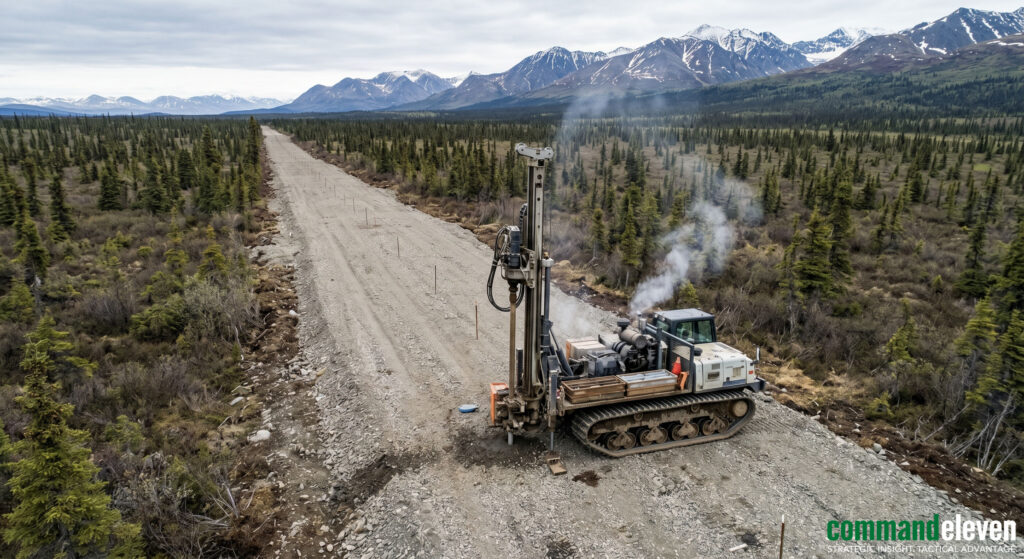
The Ambler Access Project is a planned two hundred-and-eleven-mile industrial access road designed to connect the Dalton Highway to the remote Ambler Mining District in northwest Alaska. The proposed route runs along the southern slopes of the Brooks Range, terminating at a region containing massive, untapped deposits of copper, cobalt, zinc, lead, silver, and gold. The United States Department of Defense identifies these materials as critical components for the domestic defense industrial base, specifically for the manufacturing of precision-guided munitions, radar sub-assemblies, satellite electronics, and high-capacity military batteries.
The project has experienced significant regulatory volatility over the last several years. Following a June 2024 Bureau of Land Management decision that selected a no-action alternative and terminated the right-of-way grant, the Alaska Industrial Development and Export Authority filed a direct appeal under Section 1106 of the Alaska National Interest Lands Conservation Act. On October 6, 2025, the President approved this appeal, directing federal agencies to promptly issue all necessary permits.
- Presidential Executive Order: The October 6, 2025 directive that reversed previous federal restrictions and ordered the immediate reinstatement of the fifty-year right-of-way grant for industrial construction.
- Bureau of Land Management Action: The October 21, 2025 reissuance of Right-of-Way Grant Number F-97112, officially authorizing the Alaska Industrial Development and Export Authority to commence ground engineering.
- Army Corps of Engineers Reinstatement: The prompt activation of suspended Clean Water Act Section 404 permits, enabling the construction of critical river crossings and gravel extraction sites.
- Trilogy Metals Equity Purchase: A $35.6 million federal investment resulting in a ten percent equity stake in the principal mining entity operating within the Ambler District.
- AIDEA Logistics Framework: The state-backed development agency managing the design, financing, and maintenance of the controlled-access industrial toll road.
The development of the Ambler Access Project is directly linked to national security objectives regarding supply chain decoupling from the People’s Republic of China. China currently controls a near-monopoly on global rare earth processing and advanced mineral refining capacity. By unlocking the Ambler Mining District, the United States secures an independent, domestic source of copper and cobalt, reducing its vulnerability to foreign export restrictions during an active conflict. The planned infrastructure features a controlled-access gravel road with no public access allowed, preserving its utility strictly for industrial logistics and resource extraction. The road will require the construction of approximately forty-eight bridges and nearly three thousand culverts to cross eleven major river systems. This complex civil engineering effort requires advanced geotechnical design to prevent thermal erosion of the underlying permafrost along the transportation corridor.
Russian Military Modernization and Chinese Economic Infiltration
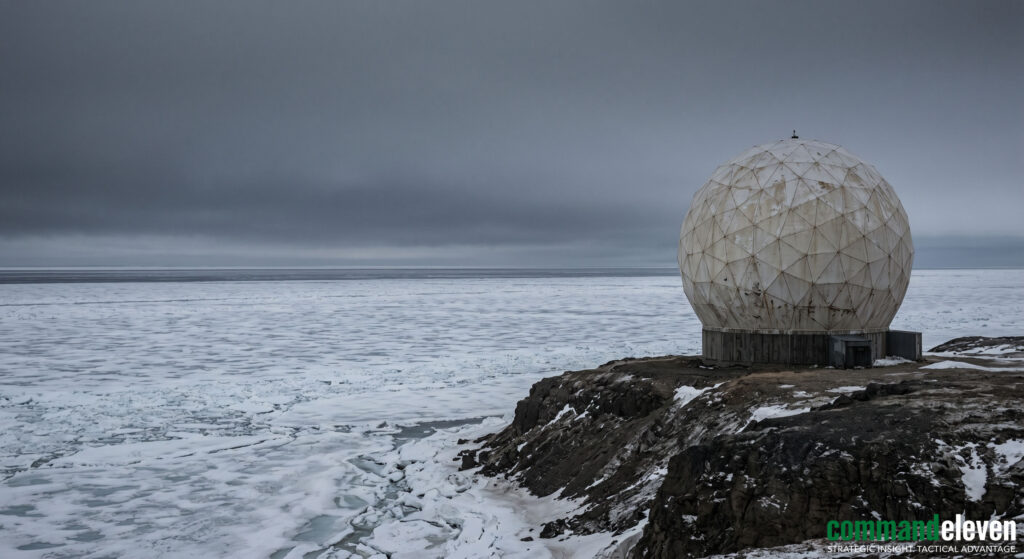
The strategic expansion of United States assets in Alaska occurs in direct response to intensifying foreign operations across the High North. The Russian Federation treats the Arctic as a primary strategic bastion, maintaining a dense network of modernized military installations along its northern coastline. The Russian Northern Fleet, operating out of Severomorsk, possesses a formidable complement of nuclear-powered ballistic missile submarines and guided-missile cruisers.
Furthermore, Moscow has re-activated dozens of Soviet-era airfields, deploying S-400 Triumf long-range surface-to-air missile systems and P-800 Oniks anti-ship cruise missiles to establish comprehensive anti-access and area-denial zones across the Northern Sea Route. This military buildup is matched by China’s expanding economic footprint in the region. Beijing’s Polar Silk Road initiative drives state-backed investments in Russian liquefied natural gas facilities and Nordic port infrastructure, demonstrating a long-term ambition to influence Arctic governance and secure alternative maritime shipping lanes.
- Northern Sea Route Militarization: The systematic deployment of coastal defense missile systems and electronic warfare units designed to restrict international navigation through the Eurasian Arctic.
- Teriberka LNG Logistics Hub: A remote settlement transformed in early 2026 into a critical bunkering and supply node supporting Russia’s sanctioned shadow fleet of liquefied natural gas carriers.
- S-400 Over-the-Horizon Coverage: The placement of advanced air defense regiments at Temp Air Base on Kotelny Island, extending Russia’s radar tracking and engagement envelope deep into the Arctic Circle.
- Polar Silk Road Initiative: Beijing’s long-term framework coordinating joint energy extractions, scientific research expeditions, and dual-use maritime transport infrastructure developments with Moscow.
- Sino-Russian Arctic Shipping Surge: A documented forty percent increase in unique vessel transits through the Arctic Polar Code area, reaching one thousand eight hundred and twelve ships by the conclusion of 2025.
The convergence of Russian military power and Chinese economic capital creates a complex threat matrix for the Alaskan Command. Joint naval exercises between the Russian Navy and the People’s Liberation Army Navy near the Aleutian Islands demonstrate an increasing capacity for combined power projection inside the United States economic exclusion zone. These maneuvers challenge traditional North American air and maritime defense assumptions. China’s investment in heavy icebreaker fleets further erodes the traditional geographic barriers that once protected the northern border of the United States. The introduction of state-sponsored Chinese research vessels equipped with acoustic sensors allows Beijing to map Arctic bathymetry, gathering critical undersea data that enhances the operational deployment of its attack submarine fleet. This integrated Sino-Russian challenge forces Washington to accelerate its infrastructure developments in Alaska to protect its sovereign borders and maintain regional stability.
Logistical Vulnerabilities, Environmental Friction, and Tribal Governance
The execution of the Alaskan Command expansion and the construction of the Ambler Access Project face severe logistical, environmental, and political challenges inside Alaska. The physical environment presents the primary operational hurdle. The proposed road must navigate complex sub-arctic terrain, crossing thousands of streams and wetlands that feed into the Yukon and Kobuk River systems.
Environmental groups and regional tribal coalitions maintain active resistance to the project, citing irreversible damage to critical fish spawning habitats and the migration corridors of the Western Arctic caribou herd. This domestic political friction triggers protracted legal battles that threaten to disrupt construction schedules and inflate project costs. Furthermore, tribal governance bodies wield significant legal influence through federal subsistence management frameworks, creating a highly litigious regulatory environment that complicates large-scale infrastructure deployment.
- Western Arctic Caribou Herd Disruption: The migratory impacts caused by the physical barrier of the gravel road, which intersects traditional calving grounds and winter foraging areas.
- Chinook and Chum Salmon Habitat Risks: Potential sedimentation and water quality degradation resulting from the construction of forty-eight industrial bridges over critical spawning tributaries.
- Tanana Chiefs Conference Opposition: A powerful coalition of interior tribal councils actively pursuing litigation to invalidate federal right-of-way grants and environmental permits.
- Doyon and NANA Tribal Agreements: A restricted-access land agreement signed in December 2025, establishing local subsistence committees while exploring potential spur road connections for regional villages.
- Permafrost Thermal Degradation: The engineering risk of roadbed heat absorption causing localized thawing, resulting in sinkholes, structural shifting, and continuous maintenance requirements.
The logistical vulnerability of Alaska’s transportation network remains a critical point of failure for military and industrial planners. The entire state relies on a limited number of transport arteries, primarily the Dalton and Richardson highways. Any physical disruption to these roads, whether caused by unseasonal flash floods, severe wildland fires, or targeted cyber operations against state infrastructure networks, immediately isolates remote installations and mining districts. The lack of redundant ground corridors means that a single bridge failure can halt the flow of critical minerals or military supplies for weeks. Additionally, advanced persistent threat groups linked to foreign intelligence services continuously target the digital supervisory control and data acquisition systems of Alaska’s energy utilities and transport hubs. Planners must address these physical and digital vulnerabilities by establishing decentralized supply depots and hardened local microgrids to survive prolonged isolation during a national security emergency.
Conclusion
The strategic convergence of the Alaskan Command infrastructure expansion and the authorization of the Ambler Access Project highlights the critical importance of Alaska in contemporary geopolitics. The High North is no longer a geographically isolated buffer zone, but an active theater of strategic competition. Russia’s extensive military modernization and China’s growing economic influence require a robust, permanent power projection capability from the United States. Unlocking the Ambler Mining District provides the domestic defense industrial base with secure lines of supply for essential metals, directly mitigating the strategic risks of foreign market monopolies. However, achieving full operational readiness requires overcoming severe environmental constraints, infrastructural deficits, logistical vulnerabilities, and complex local governance disputes. The failure to successfully execute these defensive and industrial projects will leave the northern flank of the United States exposed to increasing foreign assertiveness, fundamentally compromising North American homeland defense and global resource security over the next several decades.