Executive Summary
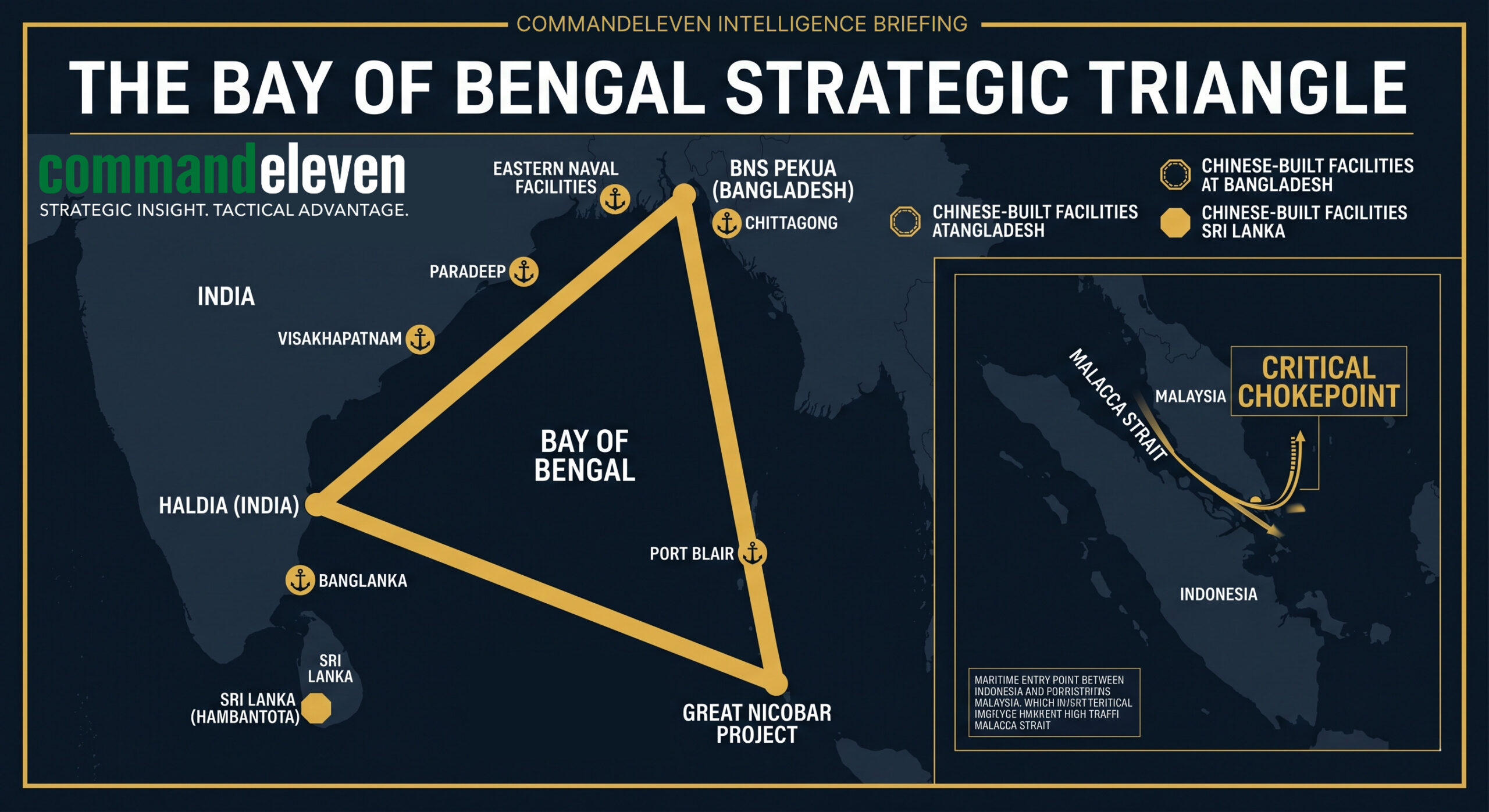
As of May 2026, the Bay of Bengal has transitioned from a secondary maritime zone into a primary theater of Indo-Pacific naval competition. The strategic landscape is defined by India’s “Eastern Fortress” doctrine, characterized by the operationalization of the Haldia Naval Detachment and the acceleration of the Great Nicobar Project to secure the Malacca Strait. This expansion is a direct response to the emerging Dhaka-Islamabad-Beijing axis, anchored by the full operationalization of the BNS Pekua submarine base and the historic warming of defense ties between Pakistan and Bangladesh. Furthermore, the commissioning of the INS Aridhaman SSBN solidifies the Bay’s status as a permanent nuclear bastion, fundamentally altering the sub-surface power balance in South Asian waters.
3 Key Takeaways
- Indo-Pacific “Toll Booth”: The Great Nicobar Project and the Galathea Bay trans-shipment port provide India with a permanent, high-readiness surveillance aegis over the western entrance of the Malacca Strait.
- The Bangladesh Realignment: The transition of BNS Pekua into a major sub-surface node, combined with the 2026 Pakistan-Bangladesh defense pact, challenges India’s traditional maritime hegemony in the northern Bay.
- Nuclear Bastion Status: With the induction of the third S2-class SSBN (INS Aridhaman), India has achieved the minimum threshold for a continuous at-sea nuclear deterrent, utilizing the Bay of Bengal as its primary second-strike launch zone.
The New Theater of Competition
As of May 2026, the Bay of Bengal has emerged as a primary theater for Indo-Pacific naval competition, moving away from its historical status as a secondary maritime zone. The strategic calculus has been fundamentally reshaped by the 2024 political shifts in Dhaka, which ended the decade-long Indo-centric alignment and opened the door for a Dhaka-Islamabad-Beijing axis.
India has responded with an aggressive “Eastern Fortress” doctrine, operationalizing the Haldia Naval Detachment in April 2026 and accelerating the Great Nicobar Project to act as a permanent gatekeeper to the Malacca Strait. Concurrently, the regional sub-surface balance has shifted with the 2025 rebranding and full operationalization of the BNS Pekua (formerly BNS Sheikh Hasina) submarine base, providing the People’s Liberation Army Navy (PLAN) with a potential “warm-water” docking station in the northern Bay. This dossier analyzes the infrastructure buildup, the resurgence of Pakistan-Bangladesh naval ties, and the technical expansion of India’s nuclear deterrent in these littoral waters.
India’s “Eastern Fortress” Doctrine
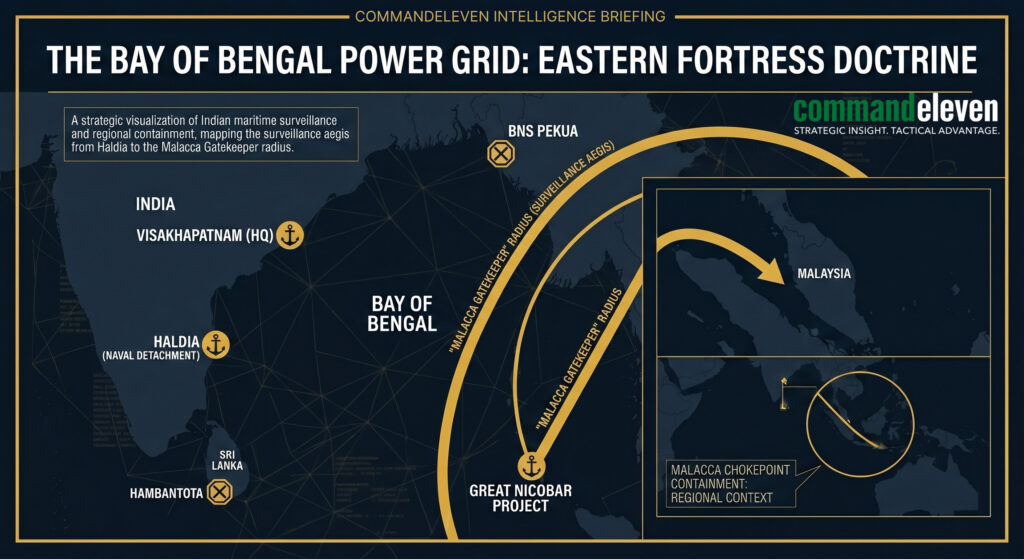
New Delhi’s maritime strategy in the Bay of Bengal has pivoted toward a “denial and surveillance” posture to counter the expanding Chinese footprint.
The Haldia Naval Detachment (Operationalized April 2026)
The establishment of the Haldia Detachment in West Bengal marks a seminal shift in northern Bay security.
- Tactical Focus: Operating as a compact, high-readiness outpost rather than a full-fledged command, Haldia leverages existing dock infrastructure to deploy Fast Interceptor Crafts (FICs) and New Water Jet Fast Attack Crafts (NWJFACs).
- Capabilities: These 300-tonne vessels, reaching speeds of 45 knots, are now equipped with Nagastra-1 loitering munitions, providing a precision-strike capability against maritime infiltration and asymmetric threats near the Bangladesh border.
- Strategic Rationale: The base allows the Indian Navy to bypass the time-consuming Hooghly River transit, offering direct, rapid access to the Bay of Bengal to monitor regional naval movements in real-time.
Great Nicobar Project: The Malacca Gatekeeper
India’s doctrine of “Strategic Depth” is anchored in the $9 billion Great Nicobar development.
- Military Integration: In February 2026, the project received final environmental clearances, accelerating the construction of a dual-use Greenfield International Airport and the Galathea Bay trans-shipment port.
- Surveillance Aegis: Once complete, this hub will host advanced coastal radar networks and long-range maritime patrol aircraft (P-8I Poseidons), effectively placing a permanent Indian “toll booth” at the entrance to the Malacca Strait.
The Dhaka-Islamabad-Beijing Maritime Axis
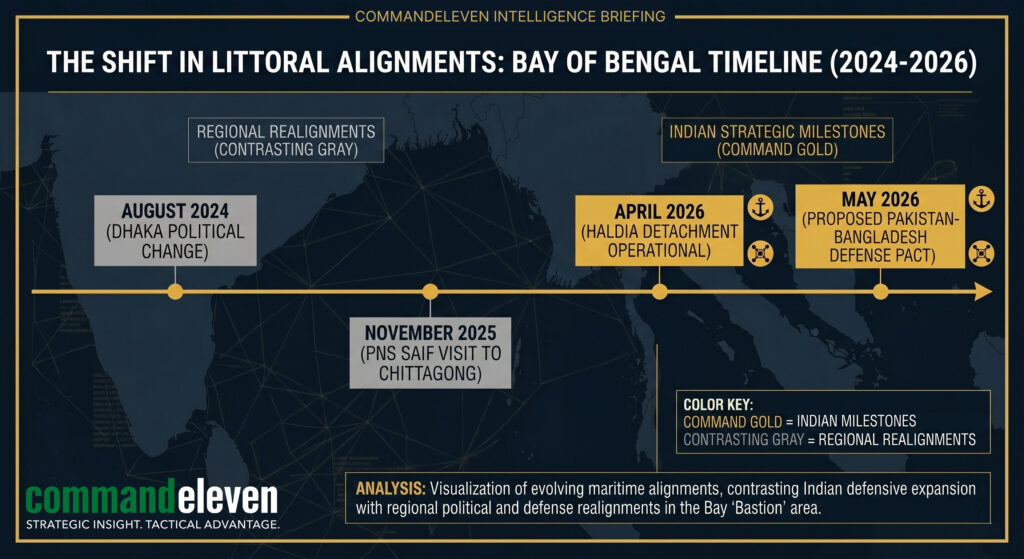
The 2024–2026 period has seen a dramatic realignment of Bangladesh’s defense priorities, causing significant concern in New Delhi.
BNS Pekua: The Sub-Surface Sentinel
Completed with Chinese assistance, the BNS Pekua (formerly BNS Sheikh Hasina) submarine base in Cox’s Bazar is now the largest such facility in South Asia.
- Technical Spec: Capable of dry-docking six submarines and eight warships simultaneously, the base provides the structural framework for a permanent Chinese presence.
- Strategic Intent: While nominally a Bangladesh Navy asset, the facility serves as a critical node in China’s “String of Pearls,” offering a logistical backup for PLAN assets operating in the Indian Ocean.
The Resurgence of Pakistan-Bangladesh Naval Ties
Following the August 2024 political change in Dhaka, defense relations between Pakistan and Bangladesh have seen a historic warming.
- Kinetic Cooperation: In November 2025, the Pakistan Navy frigate PNS Saif (a Chinese-built F-22P class) conducted a high-profile visit to Chittagong, marking the first such engagement in decades.
- 2026 Defense Pact: As of May 15, 2026, reports indicate a pending large-scale defense pact between Islamabad and Dhaka. This includes a transition to “two-star level staff talks” and potential collaboration on drone technology and missile maintenance at the Bangladesh Ordnance Factory (BOF).
Technical Analysis: The Nuclear Sub-Surface Balance
The Bay of Bengal has become the primary operational area for India’s sea-based nuclear deterrent.
Commissioning of INS Aridhaman (April 2026)
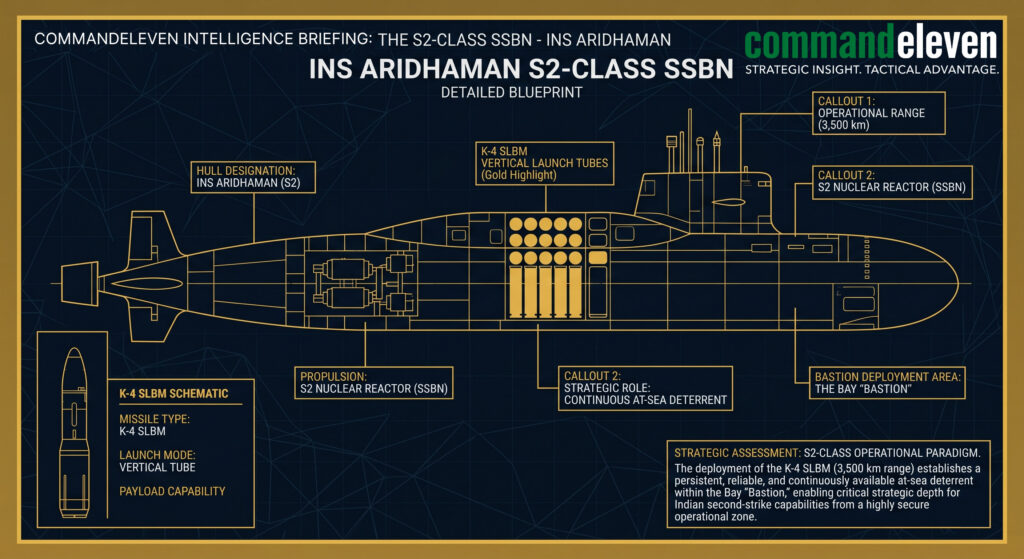
On April 3, 2026, India quietly commissioned its third nuclear ballistic missile submarine (SSBN), INS Aridhaman, at the Ship Building Centre in Visakhapatnam.
- Capability Upgrade: Unlike its predecessor, the Aridhaman is optimized to carry the K-4 SLBM (3,500 km range), allowing it to strike deep into adversary territory while remaining in the protected “bastion” of the Bay of Bengal.
- Continuous Deterrence: The induction of a third boomer provides the Indian Navy with the minimum threshold required for a continuous at-sea deterrent, ensuring one vessel is always on patrol.
Future S5-Class and SSN Trajectory
India has accelerated the design phase of the 13,500-ton S5-class SSBNs, which will carry intercontinental-range K-6 missiles. Concurrently, a lease for another Russian Akula-II class SSN (Chakra III) is on track for 2028 delivery to maintain sub-surface combat proficiency until indigenous SSNs (Project 77) enter service in the late 2030s.