
Executive Summary
The Syrian Arab Republic has transitioned into a consolidated narco-state where the production and trafficking of Captagon (fenethylline) is a primary pillar of state survival. Under the logistical oversight of the Fourth Armored Division, Syria has industrialized manufacturing to an unprecedented scale, generating an estimated $5.5 billion annually. Beyond mere revenue, Damascus has weaponized the “Captagon tap,” utilizing the drug trade as a high-stakes diplomatic lever to force regional normalization and mitigate the impact of international sanctions.
3 Key Takeaways
- State-Embedded Industrialization: Captagon production is no longer a localized criminal enterprise but an industrial-scale operation integrated into Syria’s state pharmaceutical and military infrastructure.
- Narco-Diplomacy: The Syrian regime employs the drug trade as a coercive tool, trading promises of border interdiction for diplomatic recognition and the easing of regional isolation.
- Sanctions Neutralization: The multi-billion dollar revenue stream from Captagon provides a permanent bypass to Western economic pressure, funding paramilitary structures and ensuring regime continuity.
Tactical Summary
The Syrian Arab Republic has evolved into a consolidated narco-state where the production and trafficking of fenethylline,commercially known as Captagon,have transitioned from a shadow economy to a primary pillar of state survival. As of May 2026, Captagon serves as both a critical source of hard currency and a potent diplomatic weapon. Damascus utilizes the “Captagon tap” to coerce regional neighbors, effectively trading promises of interdiction for diplomatic normalization and the easing of economic isolation. This dossier analyzes the industrialization of production, the role of the Fourth Armored Division, and the strategic calculus of narco-diplomacy.
Industrialization and State Integration
Unlike the makeshift labs of the early 2010s, Syrian Captagon production is now a sophisticated, state-embedded industrial enterprise.
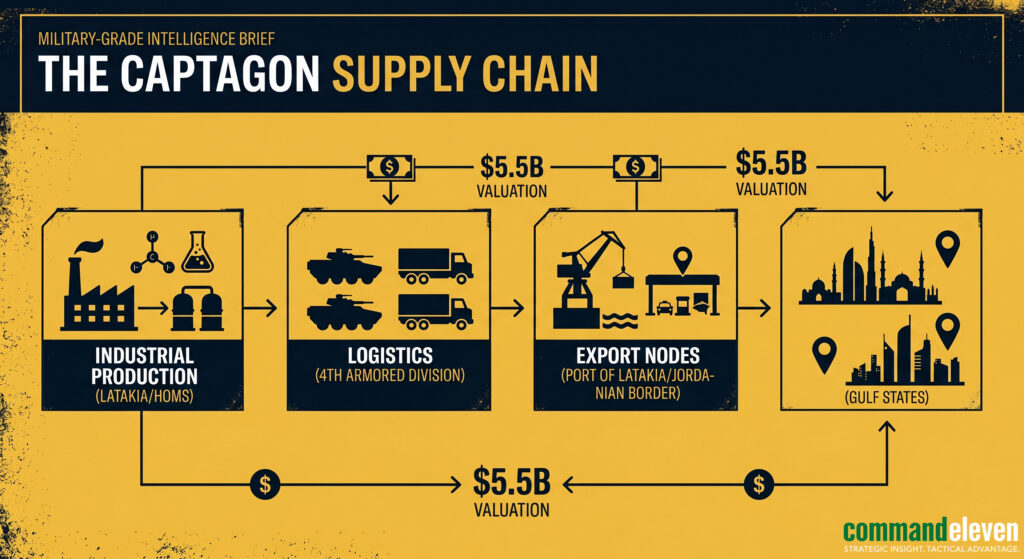
- Manufacturing Hubs: Production is centered in regime strongholds, particularly in industrial zones around Latakia, Tartus, and Homs. These sites utilize pharmaceutical-grade machinery and high-purity precursors imported under the guise of legitimate medical supplies.
- The Fourth Armored Division’s Role: Under the command of Maher al-Assad, the Fourth Armored Division acts as the chief logistical facilitator. They secure the movement of chemicals into the country and protect the transit of finished tablets to the borders. This “state-protected” status eliminates the risks typically associated with illicit manufacturing, allowing for economies of scale that outpace any other global narco-operation.
- Economic Substitution: With Syria’s formal GDP shattered by a decade of conflict and crushing sanctions, Captagon revenue,estimated by CommandEleven to exceed $5.5 billion annually,dwarfs the legal export market. This revenue is funneled directly into paramilitary payrolls and the maintenance of loyalist patronage networks.
Tactical Logistics and Distribution Networks
The distribution of Captagon is a multi-modal operation that exploits regional instability and corruption within neighboring security apparatuses.
Maritime Corridors
The Port of Latakia serves as a primary exit point for high-volume shipments. Tablets are frequently hidden within legitimate agricultural exports,such as fruit crates or industrial materials,and shipped to Southern Europe and North Africa before being rerouted to the primary market: the Gulf States.
The Southern Land Route
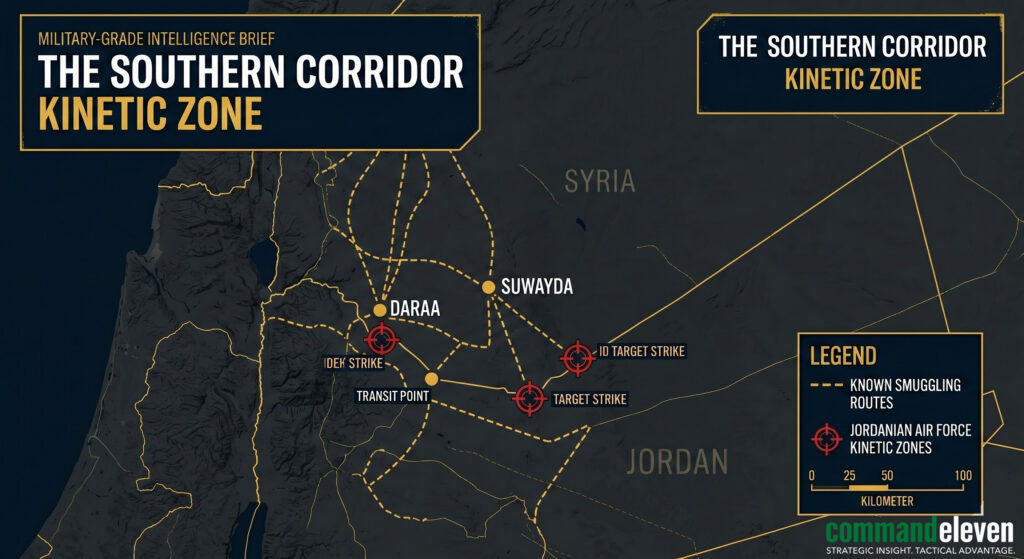
The border with Jordan is the most contested kinetic zone in the regional drug war.
- UAV Smuggling: Smugglers have increasingly adopted low-flying, commercial-grade drones to ferry small, high-value packages across the border, bypassing traditional thermal surveillance and border patrols.
- Armed Escorts: Smuggling convoys are frequently escorted by heavily armed units, leading to lethal skirmishes with the Jordanian Armed Forces. In early 2026, Jordan transitioned its posture to “Rules of Engagement” that include proactive airstrikes inside Syrian territory against suspected warehouses.
Captagon as a Geopolitical Lever
The most significant development is the weaponization of the trade as a tool of foreign policy, a strategy referred to as “Narco-Diplomacy.”
- The Normalization Gambit: Damascus has masterfully used the drug trade to force its way back into the Arab League. The implicit offer to regional powers (Saudi Arabia, UAE, and Jordan) is clear: diplomatic recognition and investment in exchange for a reduction in drug flows.
- The “Tap” Mechanism: When Damascus seeks concessions, border interdictions increase. When negotiations stall or sanctions are tightened, the flow of Captagon surges. This creates a “protection racket” dynamic on a sovereign scale, where regional stability is held hostage by the regime’s willingness to control its own criminal enterprises.
- Hezbollah’s Convergence: There is a deep operational synergy between Syrian state actors and Hezbollah. Hezbollah provides the expertise in cross-border smuggling and access to global laundering networks, while Syria provides the sovereign territory for unhindered production.
Regional and International Impact
The proliferation of Captagon is not merely a public health crisis for the Gulf; it is a strategic destabilizer.
- The Saudi Market: Saudi Arabia remains the world’s largest consumer of Captagon. The drug’s popularity across various social strata,from laborers to students,threatens the long-term human capital goals of “Vision 2030,” making drug interdiction a matter of national survival for Riyadh.
- Sanctions Evasion: The Captagon trade provides the Syrian regime with a permanent bypass to the Caesar Act and other international sanctions. As long as the narco-revenue flows, the regime remains insulated from Western economic pressure, rendering traditional diplomatic tools ineffective.
Intelligence Assessment and Outlook
CommandEleven assesses that the Syrian narco-state will continue to expand its production capacity throughout 2026. The regime has no viable economic alternative to replace the Captagon revenue. Consequently, any promises made to regional neighbors regarding “interdiction” are likely to be cosmetic or temporary.
Key Indicators to Monitor
- Chemical Precursor Flows: Tracking the import of acetic anhydride and other precursors through the Port of Tartus.
- Jordanian Kinetic Response: Increased frequency of Jordanian Air Force sorties into the Suwayda and Daraa provinces.
- Investment Cycles: Monitoring whether “normalization” leads to genuine reconstruction funds, which the regime may use to further refine its industrial pharmaceutical capabilities.
Conclusion
The Captagon trade is no longer a side effect of the Syrian conflict; it is a structural component of the Levant’s new regional order. For intelligence analysts, the drug trade must be viewed through the lens of statecraft,a sophisticated, multi-layered operation designed to ensure the survival of the Damascus government and project its influence across the Arab world.