Executive Summary
Supervisory Control and Data Acquisition (SCADA) systems and industrial control networks form the critical operational backbone of modern civil and military infrastructure, managing power grids, water distribution, and energy corridors. In contemporary conflict zones, these Operational Technology (OT) networks have transitioned from secondary tactical concerns to primary operational targets.
The structural risk within these environments stems from forced IT/OT convergence, where historically isolated legacy frameworks are exposed to external threats via remote deployment gateways and shared corporate infrastructure.
Because foundational industrial protocols – such as Modbus TCP, DNP3, and PROFINET – lack native cryptographic authentication, they are highly vulnerable to localized or remote command injection.
Adversarial state actors and advanced persistent threats (APTs) exploit these structural weaknesses through pre-positioned supply chain interdictions and synchronized cyber-physical campaigns, deploying destructive malware to trigger cascading system failures immediately prior to kinetic operations.
Addressing these vulnerabilities requires a strict departure from conventional commercial cybersecurity, prioritizing physical micro-segmentation, hardware-enforced data diodes, and analog mechanical overrides to insulate critical functions from network-borne destruction.
3 Key Takeaways
- IT/OT Convergence Eliminates Physical Air Gaps: The integration of legacy industrial control systems with internet-facing corporate frameworks has systematically compromised the historic isolation of infrastructure networks, providing adversaries with viable digital pathways into critical physical operations.
- Cryptographic Deficits in Legacy Protocols Enable Manipulation: Foundational OT communication protocols transfer command data in cleartext without built-in verification, allowing unauthorized actors who achieve network positioning to issue direct, destructive physical parameters to PLC units.
- Synchronization of Cyber and Kinetic Operational Timelines: Modern military doctrines actively integrate infrastructure degradation with physical maneuvers. Cyber-physical strikes targeting regional electrical and utility systems are timed to blind defensive early-warning assets, cripple logistical facilities, and generate civilian destabilization ahead of kinetic offensives.
The Architecture of OT Vulnerability
The fundamental risk within conflict-zone SCADA networks stems from the forced convergence of legacy OT systems with modern, internet-facing Information Technology (IT) corporate frameworks. Historically designed for physical isolation, contemporary industrial networks are routinely exposed via remote diagnostics, third-party vendor connections, and misconfigured industrial gateways.
Protocol Weaknesses (Modbus, DNP3, and PROFINET)
The legacy protocols underpinning vital infrastructure lack fundamental cryptographic primitives. Protocols like Modbus TCP and DNP3 operate with no native authentication or encryption. Consequently, any adversary achieving network positioning can execute arbitrary commands on Programmable Logic Controllers (PLCs) or Human-Machine Interfaces (HMIs). In an active theater, this allows electronic warfare or cyber units to issue catastrophic override instructions to physical actuators.
| Protocol | Core Vulnerability | Tactical Threat Exploitation |
| Modbus TCP | Lack of authentication, cleartext commands. | Unauthorized injection of coils/registers to trigger physical overspeed. |
| DNP3 | Cleartext transmission, weak spoofing validation. | Falsification of grid telemetry to trick dispatchers into safety shutdowns. |
| PROFINET | Layer 2 reliance, lack of cryptographic signing. | Local injection of malformed industrial frames causing fieldbus denial of service. |
Threat Vectors in Active Operational Theaters
Cyber-Physical Cascades
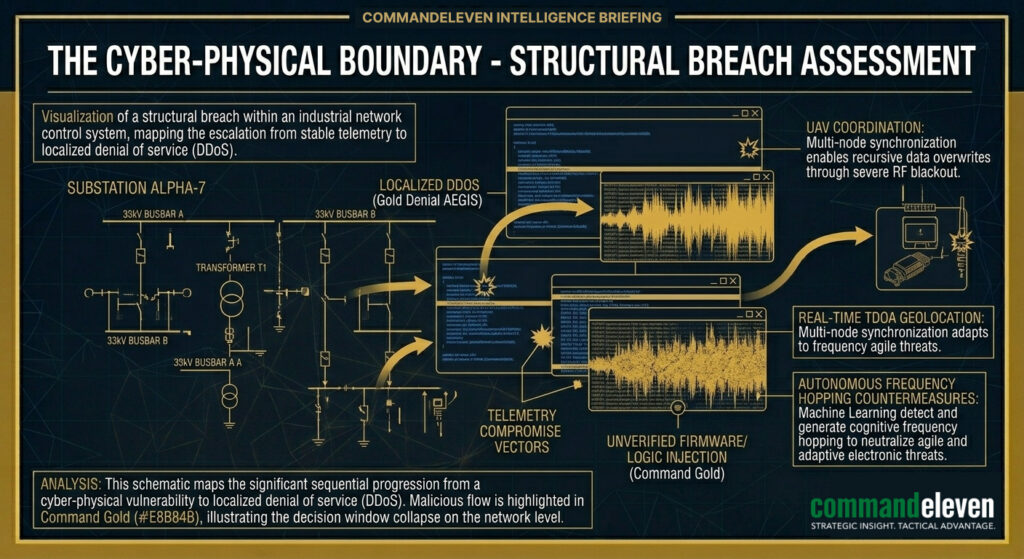
In conflict environments, cyber operations are synchronized with kinetic maneuvers. A state actor preparing a localized offensive can deploy destructive OT malware (e.g., variants derived from Industroyer or Industroyer2 frameworks) targeting electrical transmission substations. By opening circuit breakers via remote commands, the adversary induces localized blackouts, blinding military air-defense radars, disrupting regional communications, and fracturing civil defense capacity immediately prior to kinetic strikes.
Supply Chain Interdiction and Loitering Access
Industrial components pass through extensive regional supply chains before installation in contested territories. Advanced persistent threats (APTs) exploit this by intercepting hardware, flashing malicious firmware onto RTUs (Remote Terminal Units) or PLCs, and maintaining long-term, dormant access. This loitering capability is activated selectively when geopolitical tension scales into open conflict, rendering traditional perimeter defenses ineffective.
Operational Realism Note: The degradation of civil infrastructure via SCADA manipulation is highly asymmetric. A nominal expenditure of cyber assets can destroy multi-million-dollar turbine systems, creating long-term repair logistics bottlenecks due to specialized manufacturing lead times.
Case Studies: Cyber-Kinetic Convergence
The Regional Power Grid Exploitation Framework
Analysis of ongoing grey-zone conflicts demonstrates a repeatable methodology for infrastructure degradation. Attackers gain initial entry via IT-side spear-phishing or VPN credential theft. They then pivot across the IT/OT boundary via dual-homed servers or engineering workstations. Once inside the SCADA environment, the objective is dual-pronged: execute malicious firmware updates to brick the safety controllers, and rewrite the HMI display graphics to show normal operation while the physical process is driven to destruction.
This exact pattern has evolved from historical regional incidents into standardized military doctrine. The psychological impact of sudden utility collapse destabilizes urban centers, forcing defensive militaries to divert critical personnel from the front lines to secure domestic distribution nodes.
The Human-Machine Interface and Insider Risk
In contested conflict zones, shifting territorial control directly impacts the human operational element. SCADA control rooms may fall under new political or military authority rapidly, introducing significant insider threat dynamics. Operators working under duress or co-opted by state actors can leverage legitimate administrative access to bypass complex network defenses, introducing malware via physical USB ports or intentionally modifying safety thresholds on chemical processing valves.
Hardening Frameworks for Asymmetric Theaters
Mitigating SCADA vulnerabilities in unstable regions requires an aggressive shift toward a specialized tactical survival architecture. Standard corporate cybersecurity frameworks are inadequate under kinetic conditions.
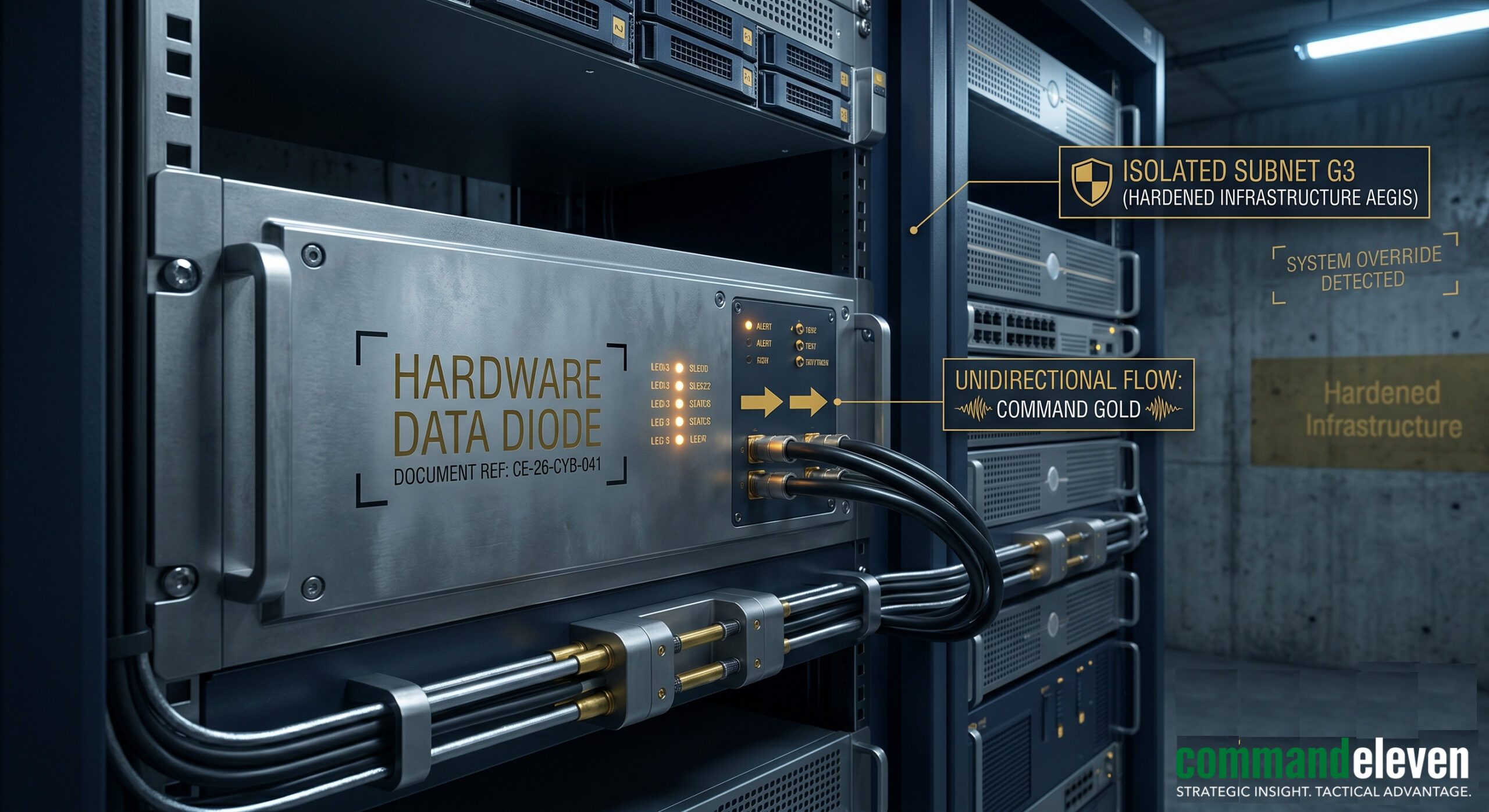
- Strict Physical Micro-Segmentation: Enforcing absolute physical separation between IT business networks and core OT distribution loops using hardware-enforced unidirectional security gateways (data diodes).
- Cryptographic Protocol Wrappers: Mandating the migration to secure protocols like DNP3 Secure (IEEE 1815-2012) or encapsulating standard Modbus traffic inside TLS tunnels to prevent interception and manipulation.
- Immutable Configuration Baselines: Deploying automated configurations that continuously poll PLCs and RTUs for changes, with automatic rollback capabilities when unauthorized logic alterations are detected.
- Kinetic Fail-Safes: Implementing analog, mechanical safety valves and physical overrides that operate completely independent of any digital network or computing device.