

Technical Takeaways
- Topographic Friction Outpaces Static Containment: Irregular networks decouple physical movement from traditional surveillance lines by mapping terrain anomalies. By routing tactical cells through vertical drainage ravines and ridgeline radar dead-zones, the adversary completely suppresses visual and radar signatures, rendering physical border fences ineffective.
- Digital Manifest Tampering Launders Physical Payloads: Precursor chemical supply chains and weaponized hardware survive customs checkpoints through database exploitation. By utilizing SQL injection scripts and cloned biometric profiles, syndicates alter high-risk tracking flags within automated port registries, transforming state infrastructure into passive transit vectors.
- Cryptographic Isolation Disables Geolocation Intercepts: The deployment of decentralized peer-to-peer mobile mesh networks eliminates insurgent dependencies on vulnerable public telecommunications infrastructure. Operating with asymmetric public-key encryption and steganographic embedding shields the core command grid, completely neutralizing state metadata collection and tracking.
Executive Summary
The systemic exploitation of historical transit corridors along the Pakistan-Afghanistan border demonstrates a critical vulnerability in traditional frontier containment frameworks. Irregular militant networks manipulate complex terrain anomalies and fragmented administrative enforcement sectors within the Khyber Pass corridor to execute persistent kinetic ingress. This infiltration methodology relies on the harmonization of physical geographic blind spots with the active digital subversion of automated border monitoring infrastructure. By routing highly mobile tactical cells and weaponized payloads through unmonitored mountain defiles, the adversary directly bypasses fortified border terminals and conventional infantry positions. Traditional static defensive postures fail to intercept this traffic because state security architectures rely on legacy physical barriers rather than dynamic, sensor-fused intercept arrays. Countering this high-velocity cross-border movement requires an aggressive, data-driven interdiction framework that treats geographic choke points as integrated physical and digital security vectors. This dossier evaluates the technical parameters of predictive terrain modeling, electronic signal shielding, and localized tribal co-optation that facilitate insurgent penetration across the rugged frontier line. Without the immediate execution of a decentralized, automated defensive infrastructure, the continuous optimization of these ingress vectors will permanently compromise regional border sovereignty and national administrative integrity.
Topographic Friction and Natural Ingress Corridor Mapping
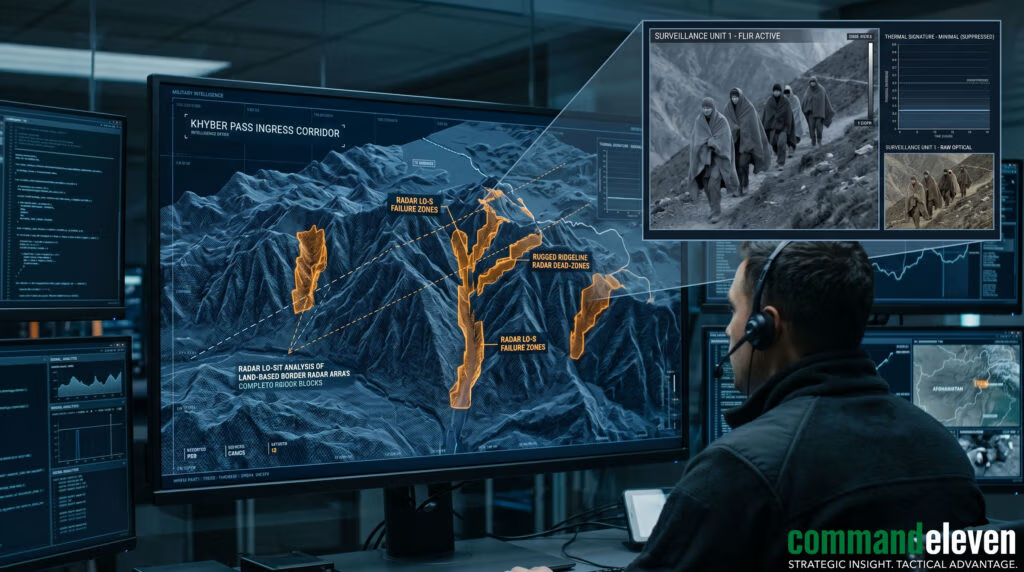
Militant networks exploit specific topographic friction points inside the rugged mountain geometry of the Khyber Pass corridor to bypass state border containment frameworks. Infiltration cells conduct extensive physical and digital reconnaissance to map out micro-terrain corridors where steep vertical features degrade the line-of-sight capabilities of state surveillance radars. These natural blind spots permit the covert massing of tactical assets and weapons payloads within striking distance of primary infrastructure lanes. The selected transit paths follow seasonal drainage channels and deep rock fissures that suppress the physical and thermal signatures of moving personnel. This exploitation of natural terrain barriers provides the baseline material security required to initiate large-scale cross-border infiltration runs.
- Deep vertical drainage ravines offer complete visual and electronic shielding from land-based border observation posts, permitting the unmonitored movement of high-value infantry cells.
- Rugged ridgeline radar dead-zones project geographic interference patterns that scramble the tracking algorithms of state-managed low-altitude aerial surveillance networks.
- Subterranean rock fissure systems serve as pre-positioned transit caches for weapons payloads, insulating the hardware from seasonal extreme weather variations.
- Unconsolidated scree transit tracks minimize the tracking utility of ground-based seismic sensor lines by masking the distinct footstep frequencies of moving cadres.
This precise terrain selection directly neutralizes the operational utility of static border watchtowers and physical fencing installations along the frontier. Concurrently, tracking data reveals that the syndicates coordinate these physical transit movements with localized electronic warfare operations. The physical movement of personnel through these mountain corridors remains entirely dependent on the network’s capacity to predict state surveillance blind spots accurately. Once an infiltration group clears the immediate geographic hazard zone, the unit transitions into the electronic shielding phase. This transition requires the deployment of advanced mobile signal manipulation arrays to preserve operational security.
The syndicates deploy mobile electronic jamming arrays to blind the tactical thermal imaging networks maintained by border guard units. By operating these devices during specific low-visibility weather patterns, the infiltration cells completely suppress their infrared tracking signatures as they traverse exposed high-altitude terrain. This tactical timing ensures that the group remains invisible to automated border alert systems during the most vulnerable phases of the ingress run. The electronic disruption is confined to local patrol sectors, preventing the triggering of wider provincial military alerts.
- Portable thermal suppression blankets utilize multi-layered composite materials to block internal body heat emissions from reaching airborne forward-looking infrared sensors.
- Low-power frequency sweeping jammers saturate the localized communication bands used by border patrols, delaying the transmission of real-time intercept coordinates.
- Handheld GPS signal alternators transmit falsified positioning metrics to state patrol units, steering intercept forces away from the active ingress path.
- Directional laser blinding modules disrupt the optical lenses of fixed perimeter cameras mounted along fortified border gate installations.
The application of localized electronic disruption ensures that the moving cells maintain total tactical surprise as they approach secondary transport lines. This signaling buffer allows the infiltration team to cross disputed territorial boundaries without activating national defense protocols. Once the team successfully navigates the frontier choke points, they link up with domestic logistics networks to facilitate deeper infiltration. This handover marks the transition from regional border smuggling to active nationwide network expansion.
Automated Monitoring Subversion and Electronic Network Hardening

The expansion of parallel transit lines across the frontier requires the continuous digital subversion of the automated border management systems managed by national immigration authorities. Specialized cyber cells within the militant alliance deploy custom software exploit packages to compromise the electronic databases tracking vehicle registries and biometric gate logs. By securing unauthorized administrative access to these networks, the syndicates insert falsified transit documentation into the state registry system. This digital infiltration permits the uninspected movement of weaponized materials through official commercial terminals under the cover of legitimate import front companies.
- SQL injection exploit payloads target known software vulnerabilities within border customs databases, granting remote administrative access to container cargo manifests.
- Cloned biometric identification profiles replicate the digital signatures of verified commercial truck drivers, allowing proxy agents to pass through biometric checkpoints.
- Automated registry deletion scripts remove specific vehicle identification numbers from high-risk tracking logs, preventing automated security flags from triggering alerts.
- Encrypted data exfiltration tunnels pass stolen border guard patrol schedules through legitimate web protocols, hiding the cyber intrusion from network security monitors.
The systematic compromise of customs databases converts state-managed security infrastructure into an active facilitator of the illicit proxy trade pipeline. Concurrently, operational analysis indicates that this digital penetration directly enhances the physical survivability of the smuggling fleet. With real-time access to uncorrupted patrol schedules, the syndicate’s transport units select transit windows that completely avoid active mobile military checkpoints. This synchronization of digital exploitation and physical logistics ensures the uninterrupted flow of advanced military hardware.
The militant cells deploy advanced communication security protocols to protect their internal command networks from state signals intelligence interception. Operational planners utilize decentralized, peer-to-peer mobile mesh networks that function entirely independent of public cellular infrastructure and internet service providers. This technical insulation prevents state electronic monitoring engines from collecting communication metadata or executing precision geolocation tracking against core leadership targets. The network’s communication loop remains unbreachable, preserving absolute operational security during high-velocity infiltration campaigns.
- Peer-to-peer mobile mesh transceivers communicate operational updates across localized frequencies using automated channel-hopping protocols to prevent state tracking.
- Asymmetric public-key encryption suites secure all text and voice communications transmitted between border staging cells and interior execution units.
- Steganographic file embedding applications hide tactical coordination messages within benign digital image files uploaded to public social media platforms.
- Automated hardware self-destruct modules execute memory zeroization commands on mobile devices if the user fails to input dual-factor physical credentials.
The implementation of advanced cryptographic isolation shields the core command grid of the alliance from state tracking mechanisms. This digital protection ensures that field cells can coordinate complex, multi-city logistics maneuvers without exposing the wider organizational architecture to state intelligence counters. By neutralizing the state’s electronic intercept capabilities, the syndicates maintain long-term structural durability across the entire frontier sector. The financial liquidity generated by these secure trade lines flows immediately into localized co-optation frameworks.
Tribal Co-optation and Parallel Border Governance Structures
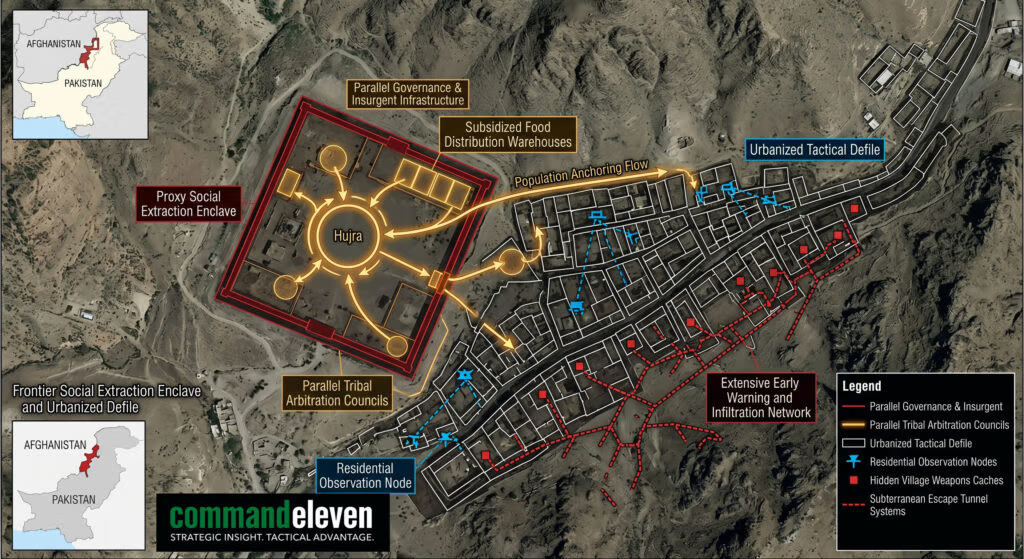
The long-term survival of the frontier ingress corridors depends on the systematic co-optation of the local tribal populations residing along the immediate border line. The syndicates build sophisticated community extraction frameworks that deliver basic utility services, alternative dispute resolution, and economic livelihood to populations abandoned by weak state governance. By managing local cross-border trade balances and funding local municipal needs, the proxies completely replace the administrative authority of the state. This social integration builds a dense human intelligence buffer that shields the proxy network from state kinetic actions.
- Parallel tribal arbitration councils deliver rapid mediation services for complex land ownership and commercial contract disputes based on local customary codes.
- Subsidized food distribution networks provide permanent food security to compliant frontier villages, linking community survival directly to network cooperation.
- Local infrastructure development funding builds parallel water filtration systems and roads that double as tactical staging routes for smuggling fleets.
- Direct financial subsidy programs allocate monthly cash stipends to influential tribal elders to secure their institutional loyalty and intelligence cooperation.
This deep societal co-optation converts the surrounding frontier population into an active extension of the proxy’s security infrastructure. Concurrently, human intelligence data indicates that the co-opted communities function as an extensive early warning network for the border cells. Any physical movement of state military forces, intelligence tracking units, or foreign customs advisors is immediately logged and transmitted to proxy command elements. This total situational awareness makes tactical surprise impossible for state interdiction forces attempting to reclaim the pass.
The syndicates integrate this human intelligence buffer with physical defensive structures embedded within the local border settlements. The villages surrounding the primary ingress corridors are transformed into dense tactical defiles, characterized by fortified observation posts and hidden weapons depots. The networks use these civilian enclaves to launch asymmetric counter-attacks against any state forces attempting to execute a land-based clearing operation. This urban militarization forces the state to face catastrophic political and material costs if it chooses to deploy conventional kinetic mass.
- Fortified residential observation nodes disguised as standard community dwellings monitor all land-based military approach paths to the transit trails.
- Hidden village weapons caches store anti-tank guided missiles and heavy machine guns inside civilian structures to support sudden defensive mobilizations.
- Subterranean escape tunnel systems connect separate village sectors, allowing proxy fighters to shift tracking vectors during active engagements without exposing positions.
- Civilian human shield frameworks place high-density residential housing developments adjacent to key proxy staging warehouses to deter state artillery strikes.
The stabilization of these land-based defensive grids grants the proxy network total operational independence within the frontier enclave. The state cannot regain control of the pass through isolated conventional maneuvers, as the landward side remains anchored in a hostile, co-opted indigenous population. This integration of geographic friction and social co-optation creates a resilient threat matrix that resists traditional counter-terrorism strategies. Reclaiming sovereignty requires a comprehensive doctrine that addresses the economic, digital, and military structures of the proxy colony simultaneously.
Multi-Modal Transport Integration and Supply Chain Resilience

The finished synthetic payloads and tactical components enter global distribution channels through highly optimized, multi-modal transport networks managed by the cartel’s logistical arm. The networks use sophisticated data analytics and supply-chain software to balance inventory levels across international distribution nodes dynamically. This technological integration removes structural bottlenecks from the distribution chain, maximizing delivery velocity to target markets. The distribution operations are masked within legitimate international e-commerce and express freight systems, reducing the visibility of individual shipments.
- Predictive supply-chain optimization software models international law enforcement deployment patterns to calculate the lowest-risk transit paths for finished assets.
- Decentralized e-commerce front operations manage thousands of low-volume postal shipments daily, diluting the impact of individual state customs seizures.
- Automated package tracking interfaces monitor the real-time status of international express freight deliveries via encrypted, public network mirrors.
- Moisture-resistant vacuum sealing hardware prevents chemical off-gassing and detection by specialized canine units at international mail sorting facilities.
The deployment of automated, low-volume distribution models allows the cartel to scale its market penetration while minimizing exposure to mass interdiction events. Concurrently, financial intelligence indicates that this logistical resilience protects the syndicate’s profit margins from regional enforcement spikes. By spreading risk across thousands of independent transit vectors, the cartel ensures that localized seizures do not disrupt the macro-supply chain. The financial liquidity generated by these global sales flows immediately into decentralized money laundering networks.
The syndicates deploy advanced financial manipulation cells to launder the proceeds of global narcotics sales back into the chemical procurement loop. These cells use combinations of trade-based money laundering, mirror trading, and digital asset networks to move capital across international borders instantly. This financial fluidness ensures that procurement cells receive continuous funding to secure fresh precursor chemical inventories. The integration of financial automation with physical supply chains creates a closed-loop economic system that resists traditional state sanctions.
- Decentralized cryptocurrency network nodes execute high-volume, automated token mixers to anonymize the digital transaction history of narcotics proceeds.
- Trade-based mirror company networks manipulate import-export invoicing for legitimate commodities to justify large capital transfers across international borders.
- Automated micro-structuring banking software distributes large cash reserves across thousands of low-value personal accounts to evade automated financial flags.
- Offshore corporate shell structures obscure the ultimate beneficial ownership of financial assets through complex, multi-jurisdictional legal registrations.
The execution of automated money laundering networks completely neutralizes the state’s capacity to execute disruptive asset seizures. This financial shielding ensures that the transnational alliance maintains the liquidity required to fund continuous procurement operations. The capital loop directly feeds the next iteration of the chemical supply chain, sustaining the operational velocity of the syndicate. This self-funding economic model requires a synchronized, multi-national intelligence response to achieve structural disruption.
Institutional Corruption and Border Safety Network Compromise
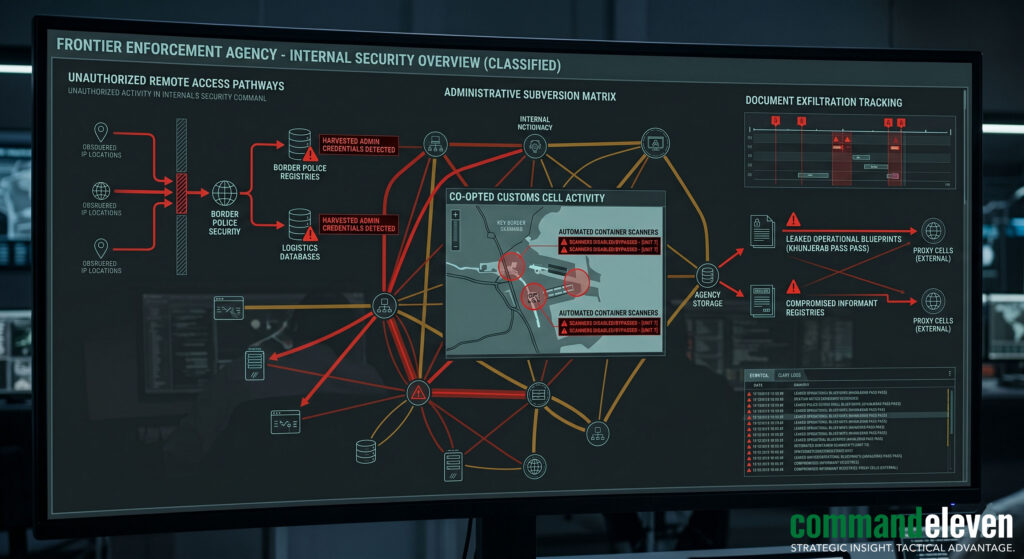
The maturation of the cross-border alliance establishes a deep system of institutional subversion within the administrative agencies tasked with border enforcement. By deploying massive financial corruption assets, the networks co-opt local customs officers, border guards, and civilian administrative officials along the frontier line. This subversion converts state-managed infrastructure nodes into passive facilitators of the illicit cross-border trade pipeline. The internal breakdown of state authority ensures that the physical and digital operations of the triad face zero friction within the compromised zones.
- Co-opted customs officials disable automated container scanning hardware during specific hours to permit the uninspected passage of weaponized payloads.
- Infiltrated border police alter mobile patrol paths to create predictable, unmonitored transit slots for high-value militant convoys.
- Compromised administrative clerks issue valid state identification cards to foreign fighters, embedding them legally within the domestic population registry.
- Corrupted judicial personnel delay the processing of arrest warrants and suppression orders targeting the financial fronts of core triad leaders.
This institutional co-optation creates a structural vulnerability that threatens the integrity of national security frameworks from within. By manipulating the internal mechanisms of border enforcement agencies, the syndicates ensure that their logistics pipelines remain operational regardless of official state policy shifts. This internal rot neutralizes the effectiveness of multi-million dollar border fencing and surveillance initiatives. The state’s failure to secure its own administrative personnel directly subsidizes the expansion of parallel proxy authority.
The triad leverages this institutional subversion to access sensitive state intelligence files regarding counter-terrorism tracking indicators and operational plans. This deep intelligence penetration allows the network to preempt state raids, execute key tracking assets, and protect its primary financial laundering nodes from asset seizure. The state’s command grid becomes compromised, transmitting vital tactical parameters to the very adversary it is attempting to dismantle. Reclaiming institutional integrity requires an immediate, total purge of corrupted elements from the border security architecture.
- Leaked operational blueprints provide advance warning of major conventional military sweep operations, allowing militant cells to evaporate target zones early.
- Compromised informant registries expose the identities of local state assets, leading to immediate, systematic execution campaigns by triad assassination teams.
- Stolen intelligence tracking metrics reveal the specific visual and electronic indicators used by state analysts to flag anomalous border transits.
- Infiltrated logistics databases track the movement of state military supply convoys, allowing tactical cells to plan high-velocity road ambushes.
The compromise of internal state intelligence metrics makes traditional counter-insurgency execution models entirely obsolete. The transnational network operates with absolute visibility into state planning, rendering reactive security operations useless. This structural crisis requires the rapid deployment of autonomous surveillance systems and isolated command cells that operate completely independent of local administrative frameworks. Reclaiming sovereignty demands a total restructuring of the state’s border posture, fusing uncorrupted tracking technology with decisive kinetic force.
Integrated Frontier Hardening and Doctrinal Reorientation Frameworks
The systematic exploitation of the Khyber Pass corridor by transnational insurgent networks requires an immediate, structural overhaul of national border defense and counter-terrorism doctrines. Containment models that rely entirely on static physical barriers and periodic infantry sweeps fail to disrupt an adversary operating with technological parity, digital database penetration, and safe-haven insulation. To secure permanent territorial reclamation and preserve national sovereignty, the state must implement a unified, sensor-fused interdiction framework that targets the network’s physical supply chains, digital systems, and corrupted administrative enclaves simultaneously. The institutionalization of the #72/48 Protocol is mandatory to shield national command grids from the digital manipulation and sensory ruptures executed by proxy electronic warfare units. Furthermore, the state must eliminate the structural vulnerabilities within border enforcement registries by enforcing strict, automated biometric verification protocols across all transit hubs. Reclaiming sovereign authority requires replacing reactive enforcement postures with persistent, data-driven pre-emptive operations across the entire frontier perimeter. This conflict represents a critical structural competition for control over the international border line and the preservation of institutional integrity. Victory requires the uncompromising application of hardware truth to permanently dismantle the parallel economic and tactical ecosystem sustaining cross-border kinetic ingress.