Executive Summary
The landscape of global illicit drug trafficking has fundamentally transitioned from agricultural cultivation to specialized, industrial-scale chemical synthesis. This structural shift has permanently decoupled narcotics production from geographical, seasonal, and atmospheric constraints. This white paper delivers a comprehensive technical and operational audit of the transnational alliance between East Asian Transnational Criminal Organizations (primarily Chinese Triad Syndicates, including the 14K and Sun Yee On) and tier-one Mexican cartels (the Sinaloa Cartel and the Jalisco New Generation Cartel, or CJNG).
Investigating the operational mechanics of this nexus as of May 2026, this paper maps the global chemical procurement pipelines for synthetic fentanyl production. It analyzes the advanced chemical masking techniques used to bypass international export controls, details the engineering configurations of localized industrial synthesis laboratories inside Mexico, and explores the parallel, encrypted digital and financial architectures,including decentralized finance and Anonymity-Enhanced Coins,that sustain this high-velocity, multi-billion-dollar asymmetric supply engine.
3 Key Takeaways
- The Synthetic Revolution: The transition from agricultural cultivation to pure industrial chemical synthesis has permanently insulated narcotics production from geographical, seasonal, and atmospheric vulnerabilities, crippling perimeter-centric interdiction strategies.
- Exploitation of Chemical Masks: Triad procurement operations leverage advanced additive chemistry to insert temporary molecular masks onto regulated substances, shifting high-volume shipping payloads into unlisted, legally deniable designer precursors that easily clear automated border screening systems.
- Strategic State Connivance: The expansion of the proxy supply engine is sustained by a pattern of permissive state-level export enforcement in origin manufacturing sectors, converting the synthetic opioid epidemic into a deniable lever of long-term geopolitical pressure against Western societies.
The Death of the Agrarian Model
For over a century, the global narcotics trade relied on the agrarian model. The production of organic narcotics,such as cocaine from coca leaf cultivation in the Andean ridge or heroin from poppy fields in the Golden Triangle and Afghanistan,required extensive land control, favorable weather cycles, and massive peasant labor forces. These vulnerabilities provided state law enforcement and military agencies with explicit, physical targets for interdiction, including satellite-monitored crop eradication, aerial chemical spraying, and localized rural military sweeps.
The emergence of synthetic opioids, dominated by fentanyl and its chemical analogues, has completely dismantled the traditional agrarian framework. Fentanyl is a pure product of laboratory engineering. It requires zero agricultural inputs, can be synthesized in modular, non-descript urban or industrial facilities, and possesses a potency-to-volume ratio that renders legacy border interception strategies functionally obsolete.
A single kilogram of pure fentanyl powder yields approximately 500,000 lethal doses, shifting the primary metric of smuggling success from high-volume maritime bulk cargo to low-profile, highly concentrated technical distribution packages. The optimization of this synthetic paradigm has forced a strategic convergence between the world’s premier chemical production networks and its most aggressive kinetic distribution enterprises, forming the Triad-Cartel Nexus.
The Sourcing Architecture: Triad Procurement Networks
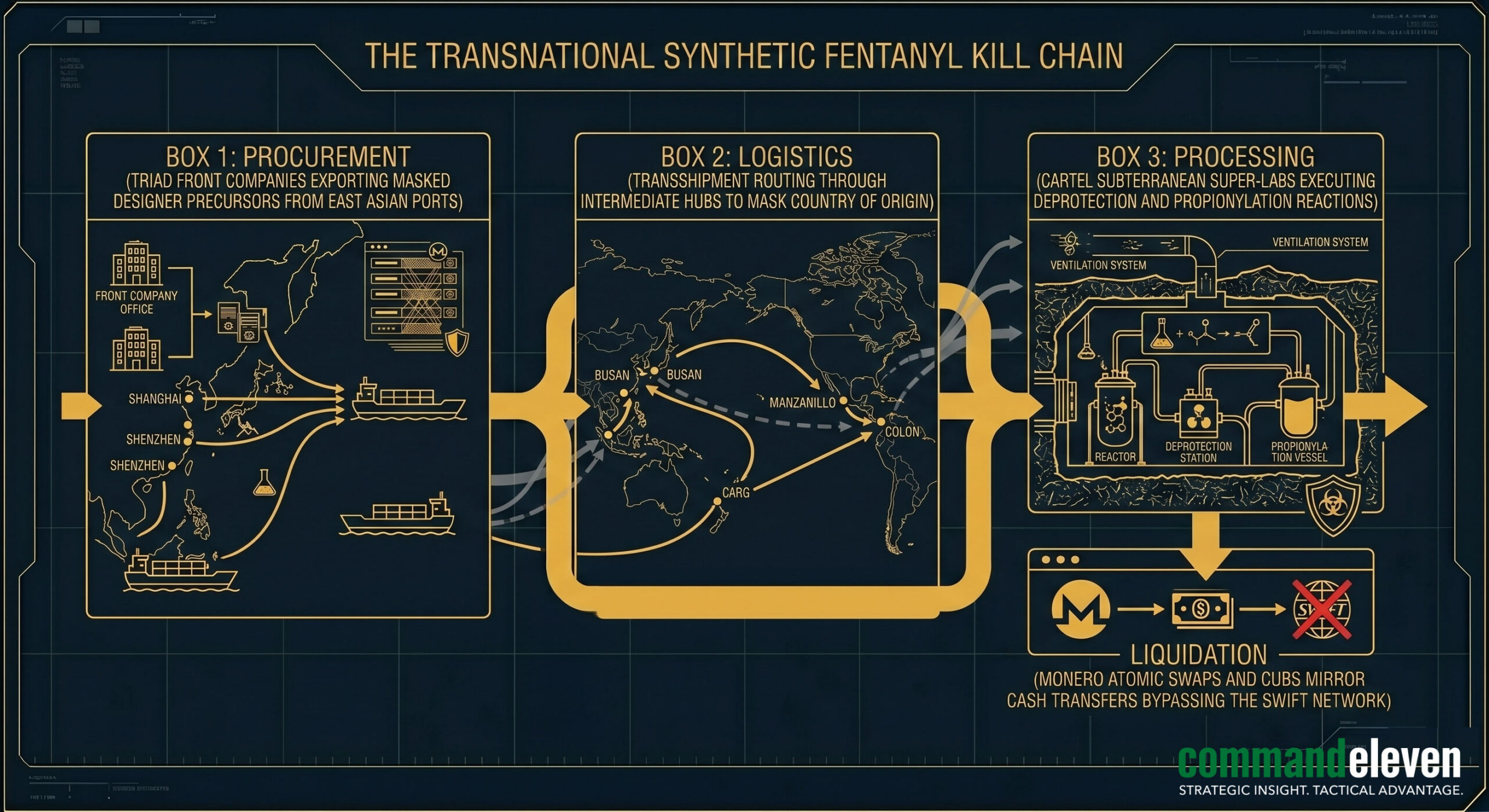
The upstream segment of the synthetic fentanyl supply chain begins within the massive, deeply integrated chemical and pharmaceutical sectors of East Asia, primarily inside the People’s Republic of China and emerging chemical manufacturing hubs in India. Chinese Triad syndicates operate as the vital bridge, translating raw industrial capacity into a specialized, deniable procurement network for Mexican cartel engineers.
The Chemical Landscape and Legal Divergence
The production of synthetic fentanyl requires specific chemical building blocks, known as core precursors and pre-precursors. International regulatory bodies, such as the International Narcotics Control Board (INCB), maintain strict tracking schedules for primary fentanyl precursors, including:
- ANPP (4-Anilino-N-phenethylpiperidine)
- NPP (N-Phenethyl-4-piperidone)
To bypass these international regulatory frameworks, Triad procurement networks exploit the legal divergence inherent in global chemical manufacturing. They do not export scheduled precursors directly. Instead, they shift production to unregulated pre-precursors and designer precursors,chemical compounds that are structurally altered by adding temporary functional groups or protective molecular masks. These altered chemicals fall outside existing national and international control lists, allowing them to be manufactured and exported with absolute legal deniability.
Front Company Engineering and the E-Commerce Pipeline
Triad syndicates utilize an extensive network of legitimate chemical export firms, pharmaceutical front companies, and logistics brokers operating out of industrial zones in Wuhan, Shanghai, and Shenzhen. These entities utilize advanced digital storefronts and global B2B e-commerce platforms to market their products directly to international buyers.
- The Masked Manifest: Shipments are mislabeled under fraudulent Harmonized System (HS) codes, masquerading on customs declarations as benign industrial materials such as titanium dioxide, cosmetic pigments, silicone oils, or agricultural fertilizers.
- Logistical Routing and Transshipment Nodes: To obfuscate the true origin of the cargo, Triad logistics brokers rarely route shipments directly from China to Mexico. Instead, containers are pushed through complex, multi-layered transshipment routes.
Containers are frequently routed through intermediate ports of entry possessing immense commercial volume,including the United States, Canada, or Western European hubs,where they are un-batched, re-packaged, and assigned new bills of lading by complicit freight forwarders before being forwarded to their final destinations in Mexico. This process strips away the initial high-risk country-of-origin flags that trigger automated customs inspection alerts.
Additive Chemistry and Advanced Precursor Masking
The core technical advantage of the Triad-Cartel Nexus lies in the deployment of sophisticated Additive Chemistry designed to exploit loopholes in automated customs screening systems, such as Raman spectroscopy and Fourier-transform infrared (FTIR) testing suites utilized at international borders.
Structural Modification: The Ester and Carbamate Loops
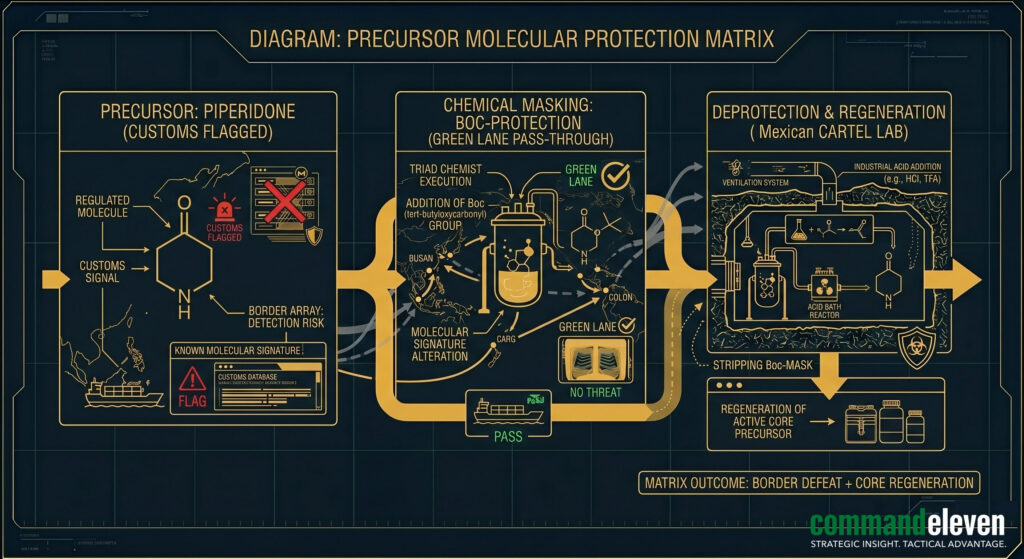
When international law enforcement agencies update their controlled substance schedules to include specific pre-precursors, Triad chemists respond by executing minor structural modifications to the target molecules. A common methodology involves protecting the nitrogen atom or the carbonyl group of a piperidone ring with an easily removable chemical mask, such as an ester, a carbamate, or a benzyl group.
- The Non-Controlled Mask: For example, by converting a regulated precursor into its tert-butyl carbamate derivative (Boc-protected analogue), the chemical structure is legally changed. It will not match the digital signatures stored within customs screening databases, passing through automated spectroscopic inspections as an unlisted, legal industrial chemical.
- On-Site Deprotection: Once these masked precursors arrive safely inside cartel-controlled territory in Mexico, the process is reversed. Cartel laboratory technicians execute simple, high-yield deprotection reactions,often requiring nothing more than exposing the chemical to low-cost, readily available industrial acids like hydrochloric or sulfuric acid,to strip away the molecular mask, regenerating the active precursor required for fentanyl synthesis.
Dual-Use Industrial Chemical Integration
Concurrently, the nexus prioritizes the procurement of pure dual-use chemicals,common industrial substances that possess vital roles in legitimate manufacturing but are simultaneously required as reagents, solvents, or catalysts in the fentanyl synthesis process. These include:
- Aniline: Extensively used in the global dye and polyurethane plastics industries, aniline is a fundamental building block for the synthesis of ANPP.
- Propionyl Chloride: A standard reagent used in the production of pharmaceuticals and agricultural pesticides, it is critical for the final propionylation step that converts the intermediate phenethylpiperidine compound into active fentanyl.
- Organic Solvents (Acetonitrile, Toluene, Dichloromethane): Immense volumes of these solvents are required to act as reaction media and extraction agents during laboratory processing. Because these chemicals are imported by the ton for legitimate Mexican industrial sectors, the cartel can easily divert massive quantities into illicit laboratories through subverted domestic distribution networks.
Downstream Synthesis: Cartel Laboratory Engineering
Upon successful extraction of the chemical shipments from Mexican maritime ports, the logistical chain transfers control to the downstream synthesis sector managed by the cartels. The engineering configuration of these production sites has evolved from rudimentary, rural setups into highly sophisticated, industrialized super-labs capable of processing multi-ton precursor batches continuously.
The Subterranean and Industrial Footprint
To mitigate the risk of detection by airborne thermal imaging, satellite reconnaissance, or tactical military drones, cartels construct their primary synthesis facilities inside highly insulated environments. These include deep-subterranean complexes excavated beneath remote ranchlands in Sinaloa and Jalisco, or hidden sections within legitimate industrial warehouses operating inside major municipal manufacturing zones (such as Culiacán, Guadalajara, or Tijuana).
- Thermal and Acoustic Insulation: Concrete structures are lined with specialized insulating materials to absorb the immense heat signatures generated by large-scale chemical reactions. Heavy-duty industrial generators powering the facilities are fitted with advanced muffling systems and buried underground to eliminate acoustic detection.
- Vapor Management and Scrubber Arrays: The synthesis of fentanyl generates highly toxic, corrosive chemical vapors that can easily kill operators or tip off law enforcement through environmental contamination. Modern super-labs feature industrial-grade ventilation networks equipped with closed-loop chemical scrubbers. These arrays route toxic exhaust through neutralizing baths of sodium hydroxide or activated carbon filters, stripping out acidic gases and volatile organic compounds before releasing completely odorless air into the external environment.
Synthesis Methodology: The Optimized Siegfried Profile
Inside the super-labs, cartel engineers deploy optimized variants of classic chemical synthesis routes, primarily the Siegfried Method or modified Janssen Routes, streamlined to maximize yield while minimizing processing time.
- Step 1: Reductive Amination: The starting material (NPP or its deprotected equivalent) is reacted with aniline in the presence of a reducing agent, such as sodium triacetoxyborohydride or sodium borohydride, within massive industrial glass-lined chemical reactors. This step synthesizes the critical intermediate compound, ANPP.
- Step 2: Propionylation: The isolated ANPP intermediate is subjected to a secondary reaction with propionyl chloride. This process introduces the propionyl group onto the nitrogen atom, completed within a highly controlled temperature range to prevent thermal degradation of the forming molecule.
- Step 3: Isolation and Crystallization: The resulting crude fentanyl base is dissolved in organic solvents and treated with hydrochloric gas or concentrated hydrochloric acid. This reaction precipitates high-purity fentanyl hydrochloride, which is filtered, washed, and dried into a fine white or off-white crystalline powder, ready for industrial tableting or bulk transport.
Industrialized Tableting and Counterfeit Pill Press Operations
The final phase of processing requires converting the bulk fentanyl powder into consumer-ready delivery formats. Cartels operate dedicated, high-volume tableting facilities separate from the primary chemical synthesis labs to prevent cross-contamination and isolate financial risks.
- Automated Rotary Pill Presses: Cartels import industrial-grade, multi-station rotary pill presses directly from international manufacturers, often utilizing Triad front companies to secure the machinery under the guise of legitimate vitamin or supplement production. These automated presses are capable of stamping out up to 100,000 counterfeit pharmaceutical pills per hour.
- The Counterfeit Matrix: The fentanyl powder is blended with pharmaceutical binders, fillers, and coloring agents before being pressed into counterfeit pills designed to perfectly mimic legitimate prescription medications, such as M30 oxycodone tablets, Xanax, or Adderall.
- Micro-Dosing Inconsistency (The “Hot Spot” Variable): Because cartels lack the ultra-precise, pharmaceutical-grade blending equipment required to achieve absolute homogeneity across multi-ton batches, the distribution of active fentanyl within counterfeit pills is highly inconsistent. A single batch can produce pills containing non-lethal micro-doses alongside tablets containing fatal “hot spots” exceeding 5 milligrams of pure fentanyl, driving the extreme mortality rates observed within consumer destination markets.
The Financial Architecture: Decentralized Networks & Anonymity-Enhanced Coins
The high-velocity flow of precursors and finished synthetic products requires a parallel, highly sophisticated financial architecture to manage international payments, secure supply lines, and liquidate billions in illicit revenue. The Triad-Cartel Nexus has systematically abandoned legacy banking integration and traditional physical cash smuggling in favor of an All-Digital, Decentralized Clearing Model.
Cryptocurrency as the Primary Settlement Asset
International settlements between Mexican cartel procurement executives and East Asian chemical suppliers are executed almost exclusively using digital assets. Tether (USDT) on the Tron ($TRX$) network serves as the baseline transactional currency for high-volume, wholesale precursor orders due to its fast processing speeds, low gas fees, and deep liquidity pools within decentralized exchanges.
- The Procurement Transaction: When a cartel cell orders a multi-ton shipment of designer precursors, the payment is initiated via encrypted communication networks (such as Threema or Session). The cartel transfers the agreed USDT value directly to an unhosted digital wallet managed by the Triad cell, completely bypassing the compliance controls, wire-transfer delays, and international reporting flags of the traditional SWIFT banking system.
The Monero (XMR) Anonymization Circuit
To permanently sever the public blockchain audit trail linking the Mexican cartel wallets to the East Asian chemical networks, the nexus integrates an automated Anonymization Circuit powered by Anonymity-Enhanced Coins (AECs), primarily Monero (XMR).
- Step 1: Cross-Chain Bridging: The initial stablecoin capital is broken down into hundreds of micro-transactions and pushed through decentralized cross-chain bridges and automated market maker (AMM) liquidity pools, converting the assets into high-liquidity layer-1 tokens like Bitcoin or Litecoin.
- Step 2: Trustless Atomic Swaps: These tokens are immediately routed through automated atomic swap scripts, executing a direct, peer-to-peer cryptographic exchange into Monero without utilizing centralized exchanges or third-party intermediaries.
- Step 3: Internal Protocol Hiding: Once inside the Monero blockchain, the funds are routed through an internal network of air-gapped blind wallets. Monero’s native protocol-level privacy features,Ring Signatures (hiding the sender), Stealth Addresses (hiding the recipient), and RingCT (encrypting the transaction value),permanently blind the tracking capabilities of automated blockchain forensics software. After running through multiple obfuscation loops, the funds are swapped back into high-liquidity stablecoins or Bitcoin, possessing a completely clean, un-tainted cryptographic ledger history.
Mirror Liquidation via Chinese Underground Banking (CUBS)
The finalized, clean digital capital is subsequently integrated into the Chinese Underground Banking System (CUBS) operating across North America and Western Europe to execute low-risk fiat liquidation.
- Capital Flight Convergence: Wealthy Chinese nationals seeking to evade strict domestic capital flight restrictions and move wealth out of East Asia partner with CUBS brokers. The brokers match these individuals with the cartel’s clean digital asset pools.
- The Flying Money (Fei Chien) System: The clean crypto tokens are transferred directly to the Chinese national’s overseas unhosted wallet. In return, the CUBS network releases equivalent values of local, physical fiat cash (USD, CAD, or EUR) from domestic cash pools held in North American distribution hubs. This cash is subsequently routed through Trade-Based Money Laundering (TBML) schemes,such as purchasing legitimate electronics, textiles, or agricultural goods for export to Mexico,where they are sold on the domestic market to generate clean, auditable Mexican Pesos, completing the multi-billion-dollar clearing loop.
Geopolitical Implications and Asymmetric Warfare Postures
The operational efficiency of the Triad-Cartel Nexus presents severe national security and geopolitical challenges that extend far beyond traditional law enforcement boundaries, effectively acting as a form of Asymmetric, Non-Linear Warfare against Western nation-states.
Strategic Societal Attrition
The deliberate, massive influx of synthetic opioids into Western consumer markets induces profound, permanent societal attrition. The high mortality rates,exceeding 70,000 fatal fentanyl overdoses annually within the United States alone,deplete young demographic cohorts, impose immense financial strains on public healthcare systems, and devastate the socio-economic stability of urban centers. This condition generates long-term domestic instability that reduces the focus and strategic capacity of target nations to project power overseas.
State Connivance and Geopolitical Leverage
CommandEleven Intelligence assesses that the persistence of the Triad-Cartel Nexus is enabled by a pattern of strategic state connivance. While the central government in Beijing enforces an ultra-strict domestic drug policy, it maintains a highly permissive regulatory approach regarding the export of un-scheduled designer precursors and chemical manufacturing equipment by domestic firms targeting foreign markets. By refusing to enforce comprehensive, extraterritorial chemical tracking or share real-time shipping telemetry with Western law enforcement agencies, the state can utilize the synthetic fentanyl epidemic as a powerful, deniable lever of geopolitical pressure, implicitly tying its willingness to curb precursor exports to Western concessions on unrelated diplomatic, trade, or security fronts.
The Failure of Legacy Countermeasures
The synthetic revolution has permanently broken the utility of traditional counter-narcotics strategies. Legacy frameworks built on physical interception, crop eradication, and centralized banking monitoring are structurally incapable of stopping a supply chain that operates via altered molecular masks, decentralized cross-chain finance, and highly concentrated, modular synthesis super-labs. To secure operational relevance, defensive national security strategies must move away from perimeter interdiction, transitioning toward proactive cyber-kinetic disruption of the digital and financial clearing nodes that sustain the nexus.
Intelligence Assessment & Forecasting (2026–2030)
CommandEleven Intelligence forecasts that the Triad-Cartel Nexus will evolve toward higher levels of technological integration and biological diversification between 2026 and 2030.
The Nitazene Transition and Super-Potency Scaling
As international scrutiny and detection capabilities against fentanyl analogues intensify, Triad chemical networks are already shifting production toward next-generation synthetic opioid classes, primarily Nitazenes (such as isotonitazene and protonitazene). Nitazenes possess a potency profile that can reach up to ten times greater than standard fentanyl, allowing cartels to achieve equivalent lethal shipping volumes at a fraction of the physical cargo size, completely resetting the technical parameters of border detection.
Full Automation of Subterranean Laboratory Complexes
By 2028, cartel super-labs in Mexico will integrate automated, closed-loop chemical synthesis systems monitored by localized edge-AI controllers. These automated chemical reactors will dynamically adjust temperature ranges, precursor drip speeds, and pH balances based on real-time sensor data, maximizing product purity while eliminating human technical operators from the high-risk synthesis phase. This reduces the footprint of detectable personnel and insulates the operation from localized law enforcement infiltration.
Permanently Sovereign Insulated Cryptographic Havens
To counter advanced, state-level blockchain tracking initiatives, the nexus will collaborate with heavily sanctioned or non-aligned sovereign states to establish physical, heavily fortified server infrastructures dedicated to hosting independent decentralized exchanges, automated atomic swap nodes, and custom privacy coins. These digital clearing havens will operate completely outside the regulatory jurisdiction of Western international banking treaties, guaranteeing absolute financial insulation for the procurement and logistics lines of the global synthetic drug trade through 2030.