Executive Summary
The traditional paradigm of Western Hemisphere defense assumes a clear demarcation between transnational criminal organizations (TCOs) driven by financial profit and state-sponsored terrorist networks motivated by ideological or geopolitical revisionism. This white paper delivers an operational and technical audit of the systematic convergence between the Islamic Revolutionary Guard Corps-Quds Force (IRGC-QF), Lebanese Hezbollah’s External Security Organisation (Unit 910), and tier-one Mexican and Latin American cartel networks (including the Sinaloa Cartel and the Tren de Aragua logistics pipeline).
Investigating this hybrid threat vector as of May 2026, this paper maps the operational infrastructure of Iran’s asymmetric infiltration into the United States’ southern periphery. It analyzes the transactional mechanics where Iranian state actors trade advanced cryptographic laundering systems, false documentation architectures, and military-grade weapon components for unhindered access to established cartel human smuggling, narcotics, and entry corridors. This convergence creates a deniable, pre-positioned platform for potential kinetic, cyber-kinetic, and sabotage operations within the United States domestic homeland.
3 Key Takeaways
- The Pragmatic Operational Hybrid: The convergence between the IRGC-QF and Latin American transnational cartels functions as a pure, non-ideological logistical alliance, trading state-backed documentation and financial isolation mechanics for untraceable tactical access corridors.
- Hardware and Capability Transfers: Iranian asymmetric power projection has stepped directly into cartel territorial conflicts, delivering advanced explosive engineering specifications (EFPs) and long-range unmanned aerial vehicle (UAV) modification kits capable of neutralizing local state armor and electronic jamming fields.
- Pre-Positioned Sabotage Infrastructure: The proxy network provides a deniable, covert platform for pre-positioned kinetic and cyber assets within the United States domestic boundary, designed for activation as a symmetric retaliatory weapon during a major geopolitical flashpoint in the Middle East.
The Cartel-Terror Convergence Mechanics
The strategic landscape of asymmetric warfare has evolved past the historical boundaries of direct state-on-state confrontation. For revisionist state actors facing severe conventional military and economic constraints, the projection of power requires the cultivation of irregular, deniable, and highly adaptive proxy networks capable of threatening an adversary’s domestic sanctuaries. The ultimate theater for this non-linear power projection by the Islamic Republic of Iran is the Western Hemisphere, utilizing the sovereign blind spots and porous borders of Latin America.
Historically, Western defense analysts dismissed the potential for long-term collaboration between Middle Eastern ideologically driven movements and Latin American criminal syndicates, citing deep cultural, linguistic, and theological cleavages. This analytical framework failed to recognize the pragmatic, transactional nature of modern asymmetric warfare. The intersection between the IRGC-QF and Latin American TCOs does not require theological alignment; it operates as a pure logistical and operational symbiosis.
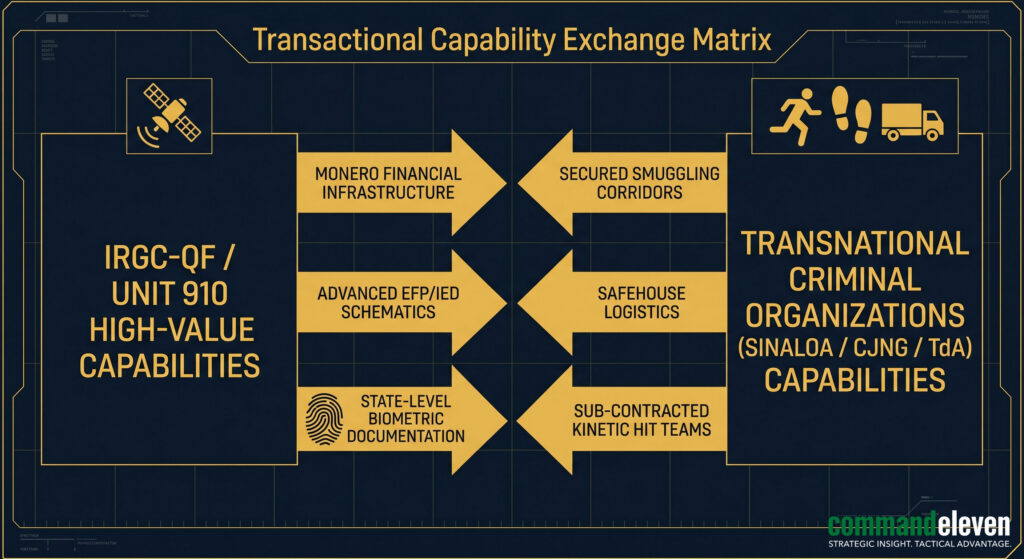
The IRGC-QF requires deniable, pre-positioned access points, smuggling corridors, and local protection networks to move personnel and equipment close to the United States border. Concurrently, cartels require sophisticated financial isolation, untraceable international procurement channels for advanced armaments, and corruption networks that can operate globally. The optimization of this mutual requirement has birthed a deep, subterranean nexus where criminal logistics are systematically converted into foreign intelligence assets.
The Tri-Border Area (TBA) and the Venezuelan Sovereign Canopy
The structural foundation of Iran’s Western Hemisphere footprint relies on two primary geographic and political sanctuaries that provide the legal immunity and physical infrastructure required to operate without Western intelligence interdiction.
The Tri-Border Area (TBA) Financial Hub
The borderlands encompassing Ciudad del Este (Paraguay), Foz do Iguaçu (Brazil), and Puerto Iguazú (Argentina),collectively known as the Tri-Border Area,remain the primary logistical engine for Lebanese Hezbollah’s global financial operations.
- The Commercial Camouflage: Specialized clans within the Lebanese diaspora operate massive wholesale and retail trading networks, electronics import-export firms, and money exchange houses (casas de cambio) throughout the TBA. These legitimate businesses serve as a front to wash hundreds of millions of dollars in illicit capital generated from local counterfeit goods, pirated software, and direct multi-ton cocaine distribution partnerships with Brazilian syndicates like the Primeiro Comando da Capital (PCC).
- The Remittance Network: Once the capital is integrated into local commercial cash flows, it is routed through informal remittance systems (such as Hawala) or transferred directly into Islamic banks operating out of West Africa and the Middle East, directly funding Hezbollah’s domestic military procurement and rocket development programs.
The Venezuelan Sovereign Canopy
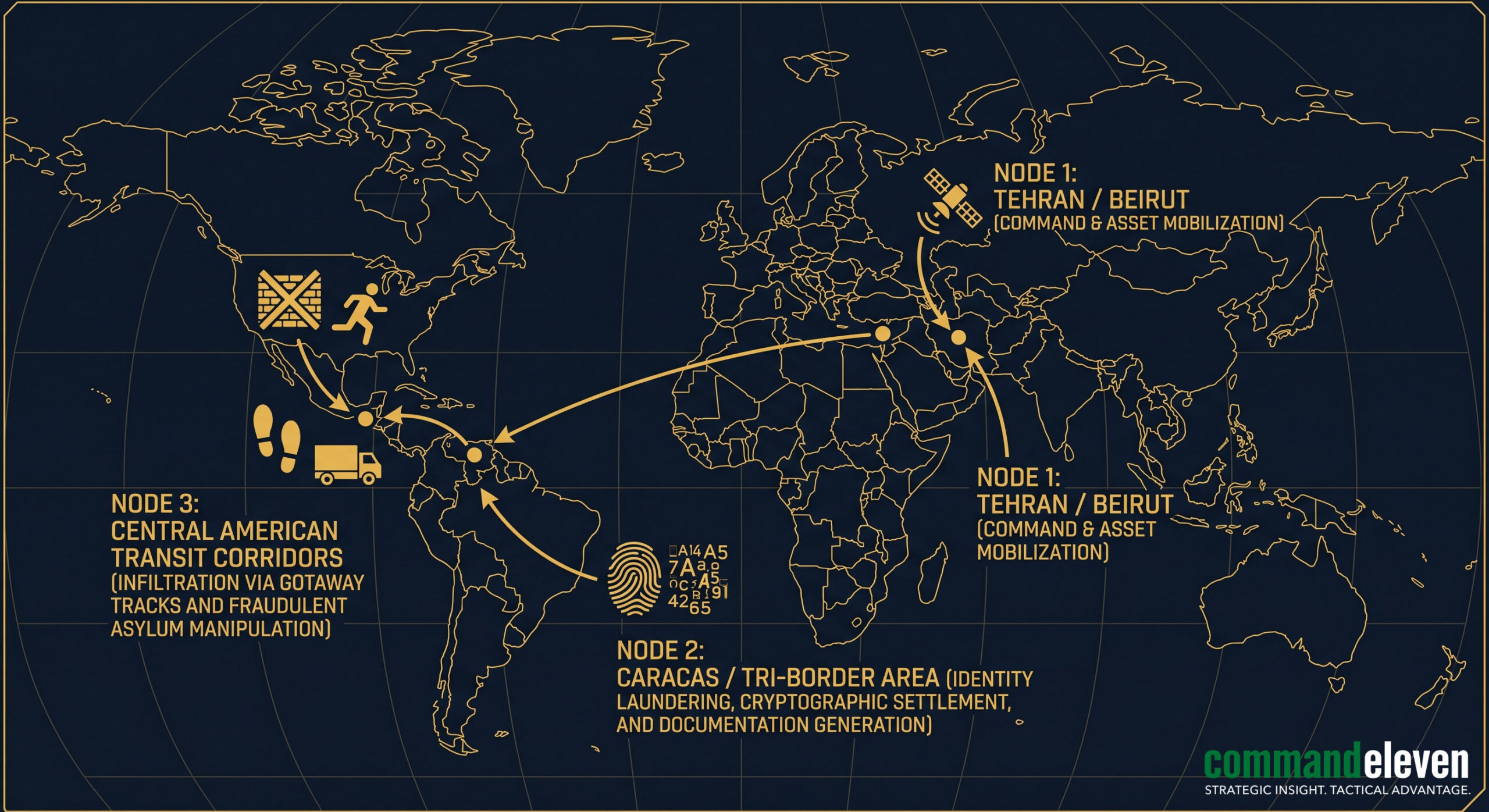
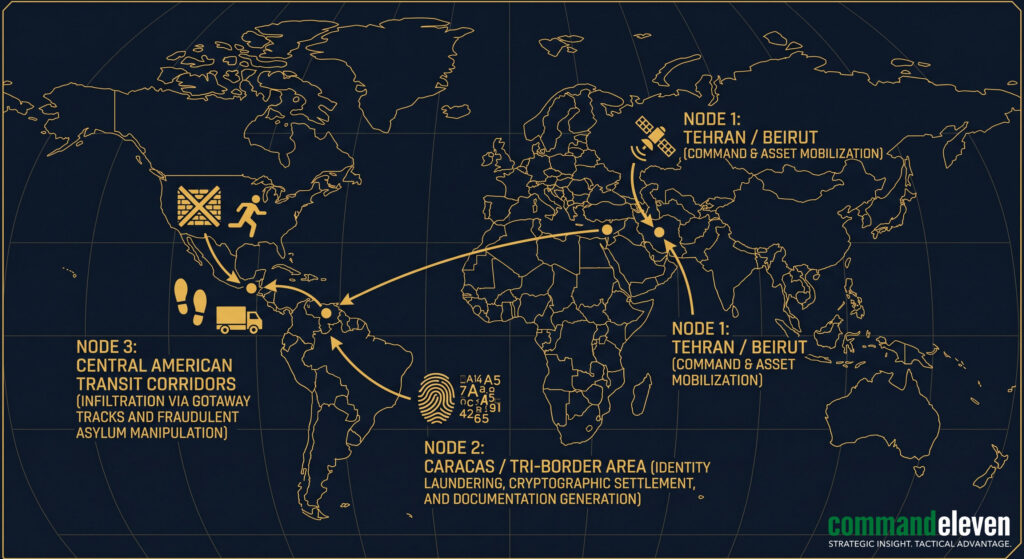
The operational integration of the IRGC-QF into Latin American state structures achieved full institutionalization under the regulatory and diplomatic canopy of the Venezuelan regime.
- State-Sanctioned Logistical Hubs: Through deep bilateral state agreements, Venezuela functions as Iran’s primary forward operating base in the Americas. The IRGC-QF and Unit 910 operatives are granted complete diplomatic immunity, operating under the cover of commercial trade attachés, industrial agricultural engineers, or regional airline personnel (such as the historical Conviasa and Emtrasur transport networks).
- The Cryptographic Passport Pipeline: The Venezuelan administrative apparatus (SAIME) has systematically issued authentic, legally valid Venezuelan national identity documents, passports, and birth certificates to Middle Eastern intelligence operatives. By assigning valid Hispanic identities and clean background histories to IRGC-QF assets, Iran can route its personnel through international transit hubs, visa-free zones, and regional immigration frameworks without triggering Western counter-terrorism watchlist databases.
- The Tren de Aragua Nexus: The complete breakdown of formal state administration in Venezuela has allowed the IRGC-QF to build direct links with the country’s premier transnational criminal export, Tren de Aragua (TdA). TdA’s comprehensive control over the informal border checkpoints (trochas) spanning South and Central America provides the IRGC-QF with a pre-packaged, covert transit corridor capable of moving personnel northward to the US southern border entirely outside official immigration monitoring tracks.
Transactional Logistical Mechanics: Assets for Access
The relationship between the IRGC-QF and Mexican cartels,specifically the Sinaloa Cartel and the Jalisco New Generation Cartel (CJNG),is maintained via a strict transactional economy. Iran does not seek to control cartel territory; it purchases specific cartel capabilities by providing specialized high-value technical assets.
Advanced Money Laundering Arbitrage
Mexican cartels face continuous operational bottlenecks regarding the liquidation and international placement of billions in physical US street cash. The financial engineering branch of the IRGC-QF has stepped into this vacuum by introducing advanced Cryptographic Clearing Loops.
- Monero Architecture Integration: IRGC financial engineers have taught cartel networks how to construct automated anonymization pipelines using Anonymity-Enhanced Coins (AECs) like Monero ($XMR$). By routing stablecoin injections through automated cross-chain bridges and trustless atomic swaps into air-gapped Monero blind wallets, the network strips away the public ledger audit trails that Western blockchain analytics platforms rely on.
- Mirror Financial Settlements: Iran utilizes its state-controlled banking shells and front companies in Asia and the Middle East to execute mirror transactions on behalf of the cartels. Clean, fully auditable digital capital is delivered to cartel accounts or suppliers overseas, while the cartels provide equivalent values of physical US cash directly to IRGC-QF operatives inside North America, entirely bypassing the SWIFT network and international anti-money laundering (AML) controls.
Military-Grade Hardware and Unmanned Systems Proliferation
To expand their kinetic dominance over state forces and rival syndicates, Mexican cartels require advanced military hardware. The IRGC-QF leverages its state-backed defense manufacturing base to deliver these capabilities covertly.
- Advanced IED Engineering Specifications: Operational data shows a sharp increase in the sophistication of Improvised Explosive Devices (IEDs) and roadside bombs deployed by cartels in Michoacán and Jalisco. These devices feature specialized shape-charge geometries and dual-stage electronic initiation systems that mirror the exact technical specifications of the Explosively Formed Penetrators (EFPs) deployed by Iranian-backed militias in Iraq and Yemen, engineered specifically to punch through armored police and military vehicles.
- UAV Modification Kits: Cartels have extensively weaponized commercial Unmanned Aerial Vehicles (UAVs) for tactical bombardment. The IRGC-QF provides modified electronic components, long-range servo release loops, and specialized guidance software patches derived from its Ababil and Shahed drone programs, allowing cartel operators to deploy high-precision aerial IEDs that can bypass localized radio frequency (RF) jamming fields.
Cyber-Kinetic Capabilities and Digital Infrastructure Sharing
The convergence has expanded into the digital ecosystem, where state-sponsored Iranian APT groups (such as MuddyWater or Charming Kitten) share offensive cyber toolkits with cartel cells.
- Industrial SCADA Target Maps: In exchange for safe-house logistics and transport assistance along the border, Iranian cyber actors provide cartel technical nodes with specialized ransomware configurations, zero-day exploit packages, and architectural maps of regional critical infrastructure, including municipal water treatment facilities, electrical sub-stations, and local law enforcement communication routers along the US southern periphery.
Infiltration Vectors: Exploiting the Southern Border Corridor
The ultimate objective of the IRGC-QF’s Western Hemisphere infrastructure is the ability to project covert assets across the United States southern border. This operational goal is achieved by embedding specialized personnel within the vast, high-volume migration and trafficking streams managed by cartel logistics.
Infiltration via the “Gotaway” Stream
The primary infiltration vector utilizes the Gotaway mechanism,covert entry tracks through rugged terrain where individuals deliberately avoid all contact with border enforcement personnel.
- Specialized Tactical Escort: High-value IRGC-QF or Unit 910 operatives are assigned to elite, cartel-managed smuggling cells that operate separate from mass migrant groups. These cells utilize advanced tactical hardware, including encrypted satellite radios, terrain-matching digital mapping applications, and thermal night-vision optics.
- Sovereign Camouflage: Operatives dress in standard tactical camouflage, apply specialized mud-patterning to negate thermal signatures, and utilize remote, unmonitored border crossing sectors across the Sonoran Desert or the rugged mountain corridors of West Texas, completely evading physical apprehension and biometric data capture.
Fraudulent Asylum Exploitation via Identity Laundering
Alternatively, assets exploit the legal and bureaucratic processing delays inherent to formal border processing checkpoints.
- The Hispanic Presentation: Equipped with legally authentic, biometric-matched Venezuelan or Colombian passports generated via state-level corruption networks (such as the SAIME pipeline), an Iranian intelligence asset can present themselves at an official US Port of Entry under a false Hispanic identity.
- Exploiting Bureaucratic Saturation: The asset claims political asylum, utilizing pre-rehearsed, cartel-provided narratives detailing persecution by local syndicates or political regimes. Given the severe saturation of immigration courts and detention facilities, the asset is issued a formal Notice to Appear (NTA) and released into the domestic interior, successfully achieving long-term legal placement while their fraudulent documentation is processed through multi-year judicial backlogs.
The Threat Manifestation: Pre-Positioned Assets and Sabotage Risks
The presence of the IRGC-QF/Cartel nexus creates an immediate, severe danger to the United States domestic homeland. This infrastructure is not designed for routine criminal operations; it functions as a Pre-Positioned Strategic Weapon cued for execution during a major geopolitical flashpoint.
Deniable Kinetic Strikes and Decapitation Operations
The IRGC-QF has demonstrated a persistent intent to execute targeted assassinations against high-value targets inside the United States, including former national security officials, diplomats, and Iranian dissidents.
- The Sub-Contracted Assassin Model: To achieve complete deniability and avoid direct state attribution that would trigger an immediate US military response, the IRGC-QF does not deploy its own operational teams to execute a strike. Instead, it utilizes its established financial and logistical leverage to sub-contract the kinetic operation to elite cartel assassination crews (sicarios). These criminal cells possess native local knowledge, immediate access to untraceable heavy weaponry, and established escape routes, presenting a highly lethal, deniable threat vector inside the domestic interior.
Critical Infrastructure Sabotage During Geopolitical Flashpoints
Should conventional military conflict erupt between Western powers and the Islamic Republic in the Middle East, the IRGC-QF is postured to activate its pre-positioned border infrastructure to launch immediate, symmetric retaliatory strikes inside the US homeland.
- Physical Sabotage of Energy and Maritime Assets: Utilizing the tactical access corridors managed by cartel smuggling nodes, specialized sabotage units equipped with military-grade explosives, commercial diving gear, and anti-materiel rifles can target high-value, poorly defended critical infrastructure. Primary targets include energy pipelines crossing the Texas border, desalinization facilities, electrical transmission substations, and critical maritime shipping locks along the Gulf Coast, disrupting economic continuity and forcing the containment of domestic military assets inside the homeland.
Intelligence Assessment & Forecasting (2026–2030)
CommandEleven Intelligence assesses that the IRGC-QF/Cartel nexus will undergo a process of deep technological and operational synchronization through 2030, permanently altering the national security paradigm of the Western Hemisphere.
Dynamic AI-Driven Border Trajectory Mapping
By 2028, the proxy network will integrate specialized machine-learning models to direct infiltration operations. These predictive engines will ingest real-time telemetry from border sensors, local weather cycles, border patrol deployment rotations, and satellite imagery, dynamically generating optimized, low-risk crossing vectors for high-value intelligence assets, outlacing human-configured defensive enforcement patterns.
Proliferation of Loitering Munitions Production in Sovereign Enclaves
As Western maritime interdiction capabilities intensify, the IRGC-QF will transition from exporting assembled components to the decentralized manufacturing of loitering munitions directly within cartel-controlled sovereign enclaves inside Mexico and Central America. Utilizing industrial 3D-printing arrays and commercial electronics pipelines, these local facilities will manufacture expendable attack drones locally, providing syndicates and state proxies with organic, long-range precision-strike capabilities capable of targeting US domestic assets across the frontier line.
The Failure of Legacy Border Defense Paradigms
The evolution of this hybrid state-criminal threat permanently breaks the utility of traditional, compliance-driven border security strategies. Frameworks built on the assumption of managing simple, economic migration flows or uncoordinated narcotics smuggling cannot contain a threat vectors that operates via state-backed identity laundering, advanced cryptographic finance, and highly organized asymmetric warfare planning. To survive through 2030, national security strategy must move past perimeter interdiction, executing proactive, forward-deployed cyber-kinetic and intelligence operations to dismantle the command nodes and sovereign sanctuaries that sustain this proxy bridgehead in the Americas.