
Executive Summary
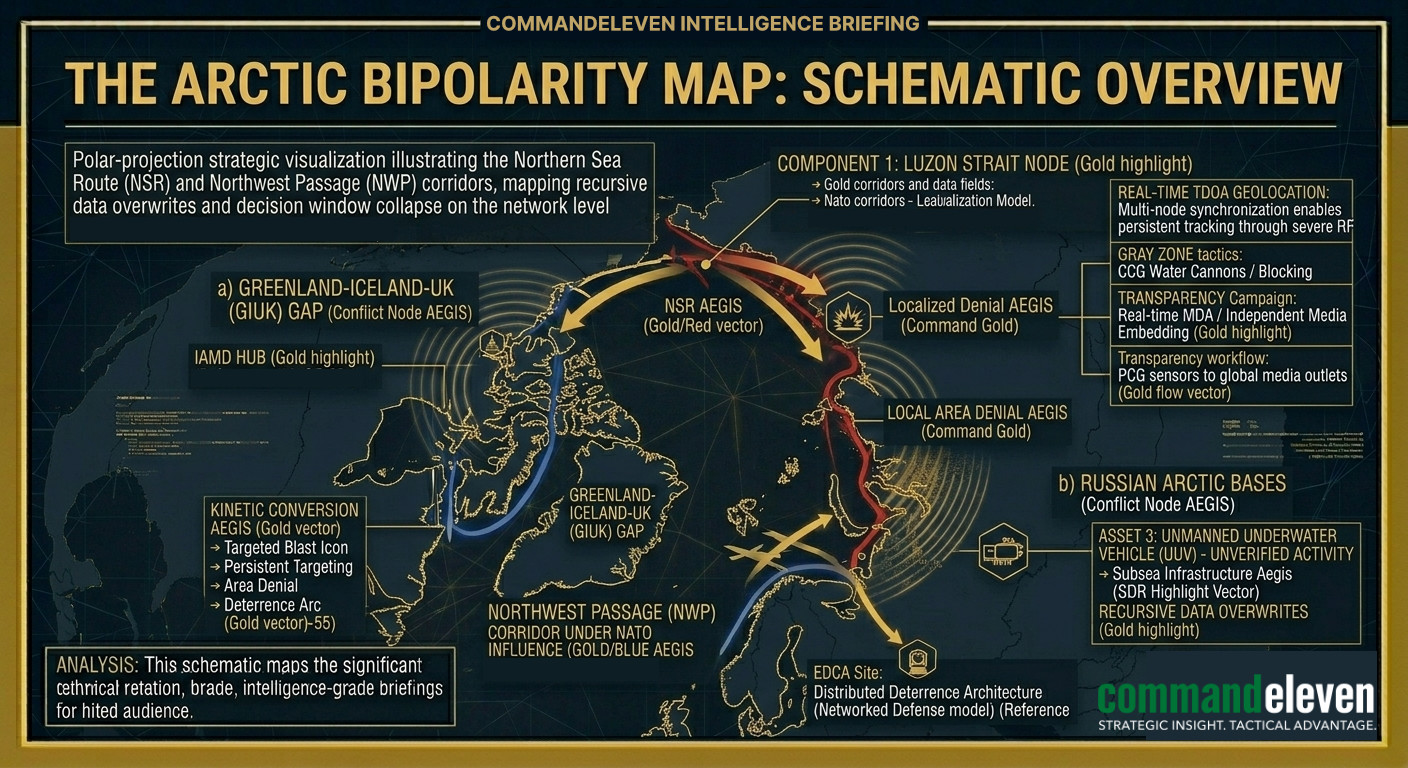
As of May 2026, the Arctic Corridor has transitioned from a remote frontier into a primary theater of geopolitical and resource competition. The acceleration of sea-ice melt has operationalized the Northern Sea Route (NSR) as a year-round transit corridor, which Russia manages under a “gatekeeper” model integrated with its Northern Fleet. To counter the Russo-Chinese “Polar Silk Road” and the resulting “Icebreaker Gap,” Western powers have formalized the ICE Pact (Icebreaker Collaboration Effort). This trilateral alliance between the US, Canada, and Finland aims to standardize icebreaker production and fortify Arctic-hardened ISR. CommandEleven Intelligence assesses that the region is now the critical “resource battery” for the global energy transition, where logistical tonnage and deep-water port access have become the definitive metrics of sovereign influence and maritime dominance.
3 Key Takeaways
- Militarization of the NSR: Russia has successfully institutionalized a “Fortress Arctic” posture, utilizing S-400 and Bastion-P systems to create a multi-layered A2/AD bubble that secures its energy exports while monitoring NATO maritime traffic.
- Activation of the ICE Pact: The shift from symbolic coordination to industrial execution among the US, Canada, and Finland marks a strategic effort to challenge Russia’s nuclear-powered icebreaker dominance and secure Western polar supply chains.
- Economic Bifurcation: The emergence of parallel shipping lanes – the Russo-Chinese controlled Northern Sea Route and the Western-led Northwest Passage – reflects a broader systemic split in global maritime governance and polar standards.
Strategic Geopolitics: The Northern Sea Route (NSR) and Military Posture
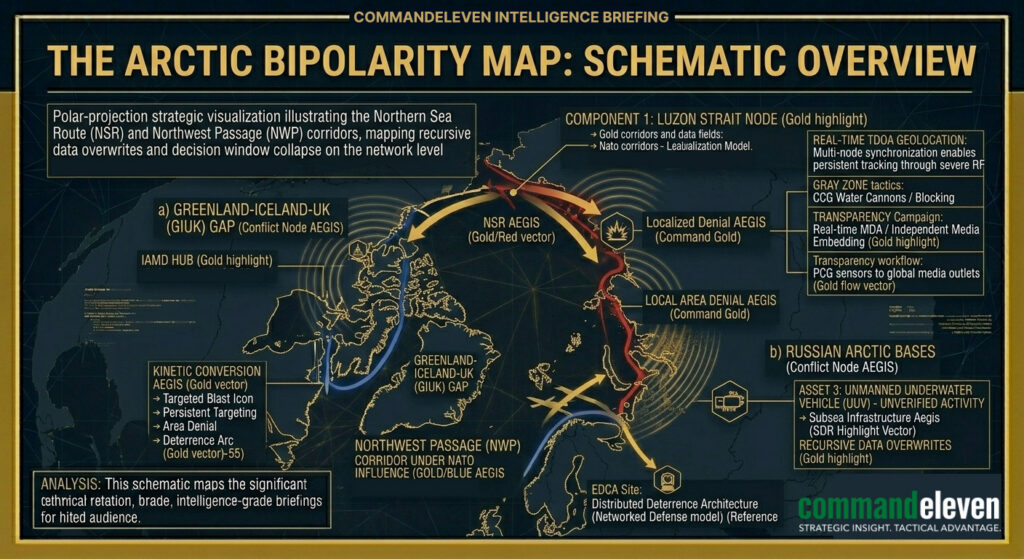
Russia continues to treat the NSR as a sovereign internal waterway, implementing a permit-based “gatekeeper” model that integrates civilian trade with the Northern Fleet’s kinetic capabilities.
- The “Fortress Arctic” Doctrine: In early 2026, Russia finalized the deployment of S-400 Triumf units and Bastion-P coastal defense systems across the Rogachevo and Nagurskoye airbases. This multi-layered A2/AD (anti-access/area-denial) bubble is designed to monitor and, if necessary, interdict NATO maritime traffic.
- The Greenland Pivot: Geopolitical tension escalated in early 2026 following renewed US strategic interest in Greenland. This maneuver is a direct response to Chinese and Russian investments in Greenland’s rare earth deposits and logistics infrastructure, framing the island as a critical “unsinkable aircraft carrier” for NATO’s northern flank.
- NATO “Cold Response 2026”: In March 2026, NATO concluded its largest Arctic exercise to date, involving 32,500 personnel from 14 nations. The exercise validated the Agile Combat Employment (ACE) concept, utilizing dispersed runways in Norway, Sweden, and Finland to project air power under extreme sub-zero conditions.
The Polar Silk Road and Resource Extraction
China’s “near-Arctic state” status has been operationalized through the Polar Silk Road, securing a non-dollar “sanction-proof” trade link with Russia.
- Hydrocarbon Lifeline: In the first quarter of 2026, crude oil shipments via the NSR increased significantly, with China’s NewNew Shipping Line investing 5 billion rubles in a logistics hub at Provideniya Bay. This corridor provides a strategic bypass to the Malacca Strait, insulating energy flows from Western naval interdiction.
- Critical Mineral Scramble: The Arctic holds approximately 13 billion barrels of oil in untapped basins like Greenland’s Jameson Land and significant deposits of copper, zinc, and lead. The 2026 transfer of land for the Ambler Road in Alaska signifies a shift toward industrial-scale mining of “defense-critical” minerals required for the global energy transition.
- Governance Friction: China’s 2026 diplomatic stance emphasizes that the Arctic “concerns the overall interests of the international community,” challenging the Arctic Council’s exclusive governance and pushing for a multilateral management of polar shipping lanes.
Polar Logistics: The Icebreaker Collaboration Effort (ICE Pact)
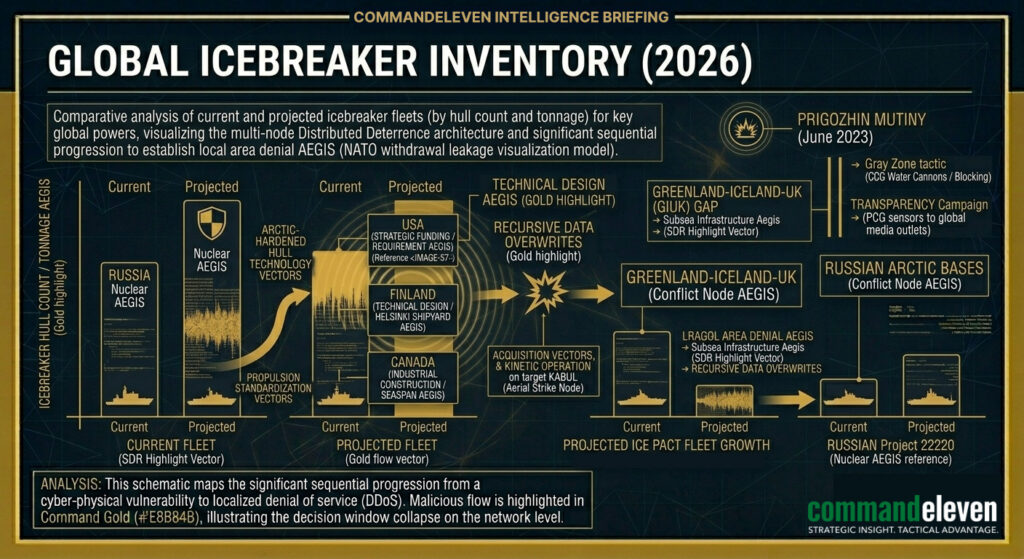
The “Icebreaker Gap” remains the primary logistical vulnerability for Western powers. In 2026, the ICE Pact transitioned from coordination to industrial execution.
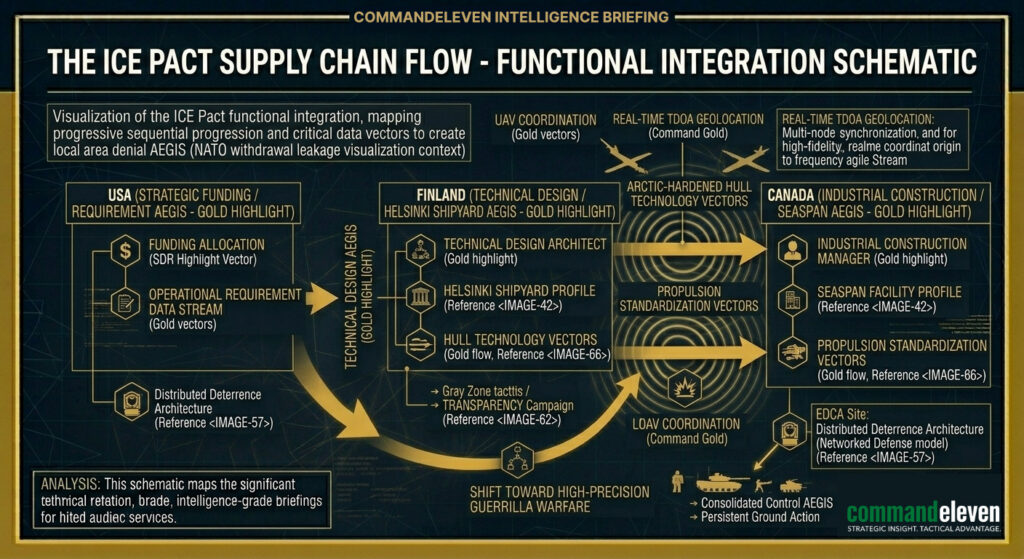
- The ICE Pact (Canada-Finland-US): In May 2026, Helsinki hosted trilateral meetings to align shipyard capacity. Work is currently underway on the hull of Canada’s Polar Max icebreaker, while Finnish and Canadian shipbuilders (Seaspan, Davie) are providing technical design for the US Arctic Security Cutter program.
- Technology & Supply Chains: The pact focuses on standardized propulsion systems and “Arctic-hardened” hulls to reduce bottlenecks. The goal is to establish a unified western supply chain for icebreakers to challenge Russia’s nuclear-powered Project 22220 dominance.
- Deep-Water Port Infrastructure: South Korea has emerged as a critical logistical partner, passing legislation in May 2026 to designate regional hub ports and an Arctic Route Commission, aiming to position Seoul as the primary Asian gateway for Arctic shipping.
Intelligence Assessment & Forecasting (2026–2030)
CommandEleven Intelligence forecasts that the Arctic will see a “bifurcation of polar standards” between 2026 and 2030.
- Two Parallel Routes: We expect the emergence of a Sino-Russian NSR governed by Rosatom-led pilotage and a Western-led Northwest Passage (NWP) supported by the ICE Pact fleet.
- Cyber-Kinetic Risks: Arctic logistics hubs, heavily dependent on satellite links for navigation, are primary targets for cyber-kinetic interference. We forecast a rise in “signal spoofing” as a deniable tool for territorial harassment.
- Economic Viability: While the NSR offers a 30-40% reduction in travel distance between Asia and Europe compared to the Suez Canal, high insurance premiums and environmental risks will keep it a niche corridor for bulk commodities and energy rather than high-volume container traffic through 2030.