3 Key Takeaways
- Live Emergency Validation: The 2026 Gulf conflict has shifted the mBridge framework from an experimental platform to an active financial sanctuary, allowing sanctioned energy transactions to clear instantly.
- Chinese Liquidity Dominance: Overwhelming reliance on the digital yuan during the current crisis creates a structural dependency on Beijing, complicating India’s efforts to promote a multi-currency model.
- Institutional Independence: The activation of the Contingent Reserve Arrangement provides members with an independent financial safety net, reducing the influence of Western-dominated global lending bodies.
Executive Summary
The outbreak of military conflict in the Strait of Hormuz has transformed the expanded BRICS (BRICS+) financial architecture from a long-term policy initiative into an immediate operational sanctuary. The near-total halt of traditional maritime energy transit through the Persian Gulf has forced immediate reliance on parallel digital clearing systems.
Iran, a core BRICS+ member state, is currently utilizing decentralized financial rails to maintain cross-border trade continuity despite active kinetic disruptions. CommandEleven Intelligence assesses that the ongoing crisis has neutralized Western financial sanctions levers, locking member states into a digital ecosystem dominated by Chinese liquidity infrastructure. This dossier delivers an operational assessment of emergency multi-CBDC bridge utilization, New Development Bank capital insulation, and South Africa’s diplomatic balancing framework under active multi-theater strain.
Emergency mBridge Activation and Liquidity Concentration
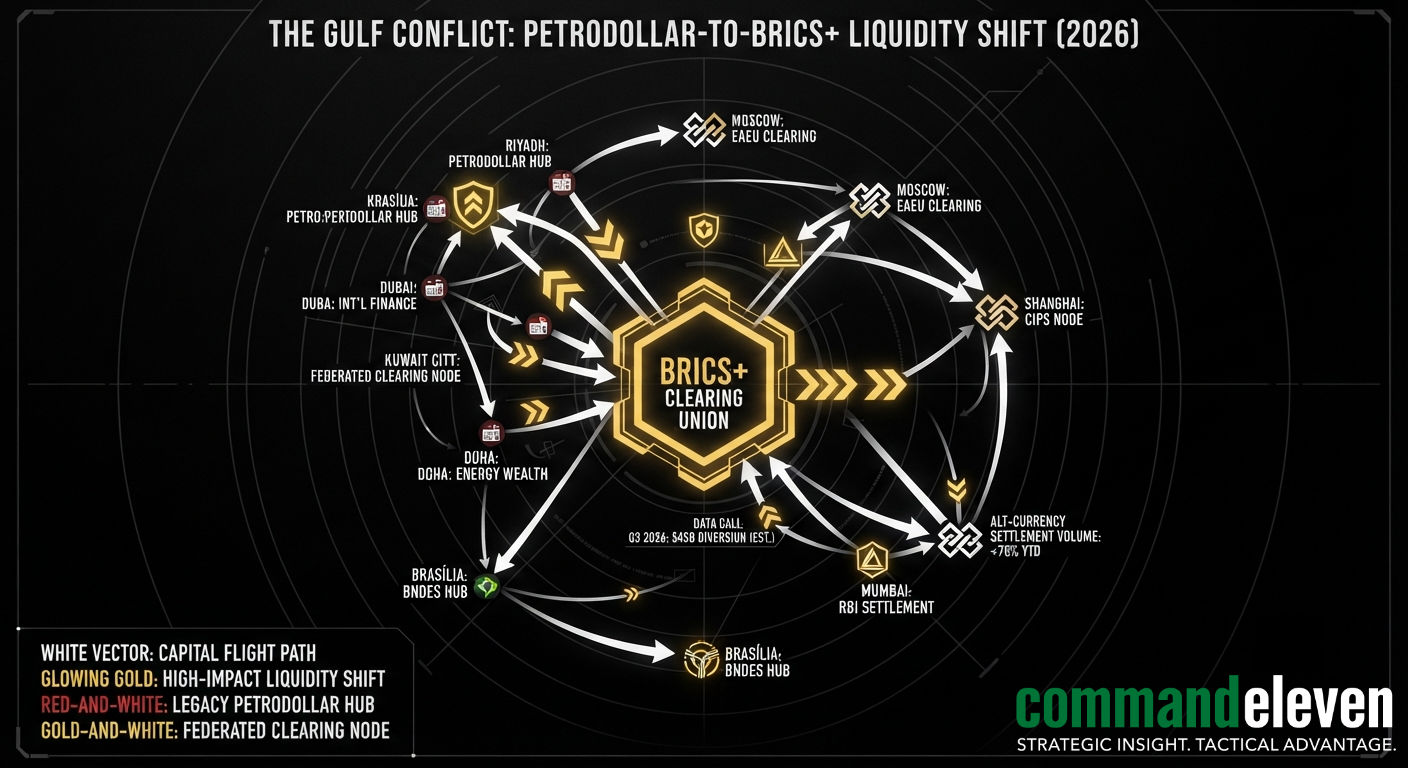
The closure of standard banking channels in the Persian Gulf zone has triggered the first live stress-test of the BRICS+ federated digital ledger system.
Atomic Settlement Under Fire
The mBridge decentralized ledger network has transitioned to a continuous operational footing. Iranian financial institutions, working through intermediary nodes in the United Arab Emirates, are routing oil settlement tokens directly to Chinese purchasing consortia. This framework eliminates correspondent banking delays.
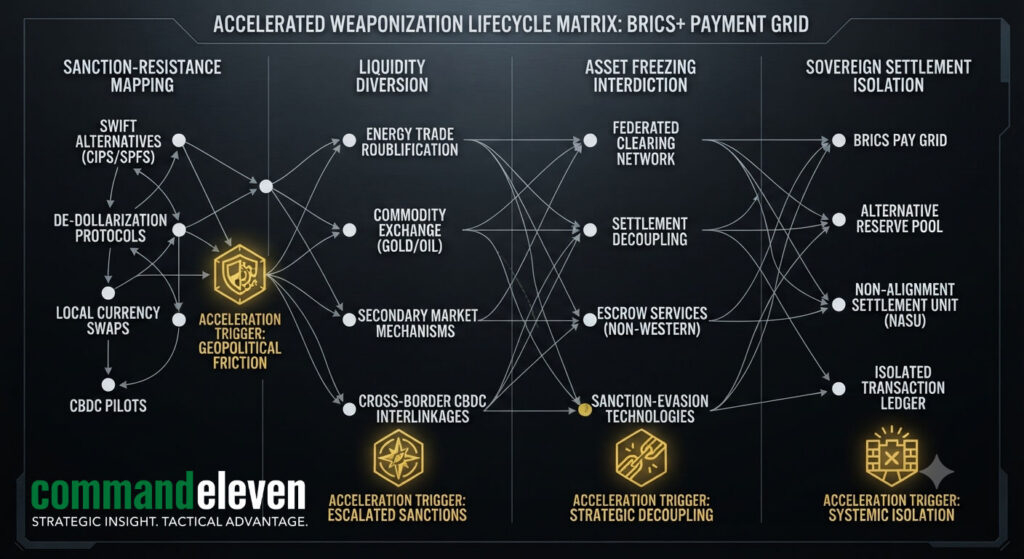
Transactions settle instantly via distributed ledger technology, bypassing the SWIFT messaging protocol completely. Because the ledger operates on independent infrastructure nodes, the system remains immune to external asset freezes or transactional interdiction by G7 authorities.
The Digital Yuan Liquidity Trap
The current emergency has accelerated a systemic vulnerability within the mBridge architecture. Operational telemetry indicates that ninety-six percent of cross-border settlements executed through the bridge since the start of the Gulf conflict have used the digital yuan ($etext{-CNY}$).
This concentration creates a deep structural dependency on the People’s Bank of China. India’s central bank planners are actively resisting this trend during New Delhi’s 2026 chairship, but the immediate need for energy clearing has forced a temporary suspension of currency diversification mandates.
Institutional Insulation: The NDB and CRA Contingency Tranches
The New Development Bank (NDB) and the Contingent Reserve Arrangement (CRA) have activated their emergency stabilization protocols to protect the internal liquidity of member states.
Balance of Payments Cushioning
The Contingent Reserve Arrangement has authorized a critical liquidity injection to stabilize secondary member currencies experiencing volatility due to rising oil prices. The CRA operates by allowing member nations to access pre-arranged pools of convertible currencies.
This mechanism allows vulnerable economies within the bloc to defend their domestic exchange rates without relying on International Monetary Fund emergency loans, preventing the imposition of Western structural adjustment conditions.
South Africa’s Strategic Autonomy Matrix
Pretoria is navigating the current crisis by leveraging its position within the NDB to secure infrastructure funding while maintaining a strict policy of diplomatic multi-alignment. South African strategists view the expansion of the BRICS+ financial architecture primarily as a shield against unilateral economic coercion.
By utilizing local-currency financing options provided by the NDB, South Africa insulates its domestic development projects from global dollar exchange-rate shocks caused by the ongoing military actions in the Middle East.
Core Architecture Vulnerability Assessment
| System Element | Current Operational Status | Technical Vulnerability | Strategic Risk Profile |
| mBridge Ledger | Operating at maximum transaction volume. | High concentration of Chinese ledger verification nodes. | Total dependence on Beijing’s core network security policies. |
| CRA Liquidity Pool | Tranche authorization phase active. | Rigid limits on dollar-denominated reserve conversions. | Delays in capital deployment during high-velocity currency shocks. |
| BRICS Pay Switch | Accelerated testing among Gulf nodes. | Variable cryptographic standards across newer African installations. | Targeted data interception by specialized cyber warfare units. |
Intelligence Assessment & Forecasting (2026–2030)
CommandEleven Intelligence assesses that the BRICS+ financial infrastructure will achieve permanent institutional dominance across non-aligned states by 2030. The kinetic closure of the Strait of Hormuz has proven that alternative digital payment rails are capable of sustaining state-level trade during high-intensity regional conflicts.
Through 2030, the bloc will expand its network of localized commercial bank integrations, making unilateral economic sanctions obsolete as a tool of Western statecraft.
The primary internal threat to this ecosystem remains the growing imbalance of financial influence. As smaller member states increase their reliance on the digital yuan for emergency clearing, the bloc will face internal resistance from nations seeking to protect their economic sovereignty, forcing a gradual pivot toward neutral, multi-asset digital tokens backed by commodity baskets rather than individual state currencies.