3 Key Takeaways
DPI Hegemony Mitigation: The use of interoperable API layers rather than a single unified currency allows individual members to retain monetary sovereignty while bypassing Western clearing loops.
Institutional Execution: India’s 2026 chairship has shifted the BRICS+ platform from rhetorical discussions about de-dollarization into an active, infrastructure-driven integration phase.
Synchronized Timelines: The sequence of ministerial meetings in mid-July 2026 confirms a coordinated effort to align transport, labor, and technology architectures to support an independent financial framework.
Executive Summary
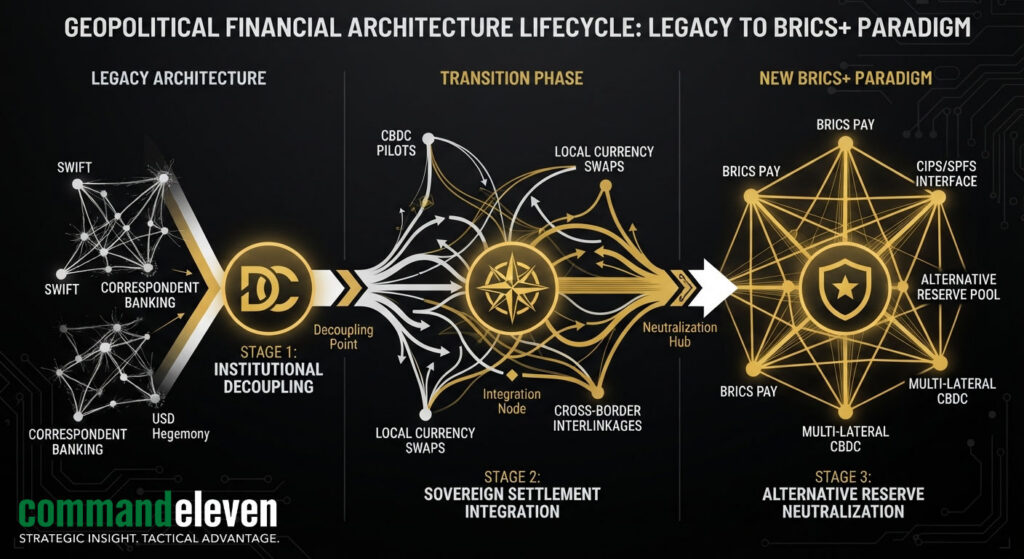
As of mid-July 2026, the geo-economic consolidation of the expanded BRICS bloc (BRICS+) has transitioned from conceptual framework planning into an active institutional phase. Under the active rotating chairship of India, the bloc has formalized an overarching agenda defined as “Building Resilience and Innovation for Cooperation and Sustainability”. This policy framework represents a calculated shift away from purely reactive sanctions evasion toward the construction of an offensive, parallel financial architecture designed to decrease reliance on G7 clearinghouses.
CommandEleven Intelligence assesses that the ongoing integration of digital public infrastructure (DPI) and alternative payment mechanisms across new member states is designed to insulate intra-bloc commerce from Western regulatory oversight. This dossier delivers an operational audit of India’s 2026 chairship pillars, the integration of new member financial nodes, and the systemic challenges facing the bloc’s cross-border settlement architecture.
India’s “Humanity First” Doctrine and the Four pillars of Integration
The mid-July 2026 ministerial sessions in New Delhi have codified the technical parameters of the BRICS financial realignment under a centralized strategic concept.
Structural Breakdown of the 2026 Chairship Pillars
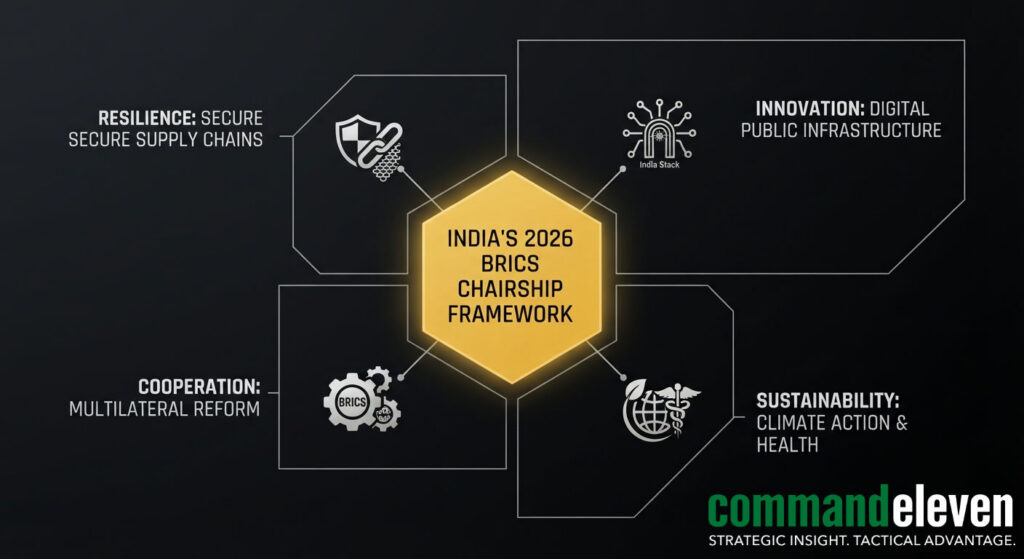
The Indian Ministry of External Affairs has organized the bloc’s cross-border technical alignment into four core operational areas:
- Resilience: Building supply chain mechanisms and institutional networks to insulate member states from unilateral G7 economic sanctions and financial restrictions.
- Innovation: Scaling digital public infrastructure (DPI), artificial intelligence models, and interoperable fintech networks across the Global South to build alternatives to legacy clearing networks.
- Cooperation: Maximizing developmental financing via the New Development Bank (NDB) and coordinating multi-currency cross-border trade facilitation.
- Sustainability: Coordinating resource flows, green finance initiatives, and energy transitions to establish independent commodity pricing benchmarks independent of Western boards.
Chronological Interlocking of Ministerial Sessions
The real-world implementation of these pillars has accelerated through a series of focused mid-July 2026 technical sessions:
- July 10, 2026 (Transport Ministers’ Meeting): Formalization of maritime and overland logistics corridors to support alternative currency clearing zones without relying on Western insurance providers.
- July 14, 2026 (Trade Union Forum Meeting): Synchronization of cross-border labor market standards and remittance tracking systems.
- July 15, 2026 (Labour and Employment Ministers’ Meeting): Alignment of technical integration protocols for managing gig-economy digital cross-settlements.
Multi-State Architecture and Clearinghouses
The expansion of the BRICS+ matrix has created a fragmented technical landscape, forcing the core members to build digital abstraction layers to achieve financial synchronization.
The Cross-Border DPI Bridge Interoperability
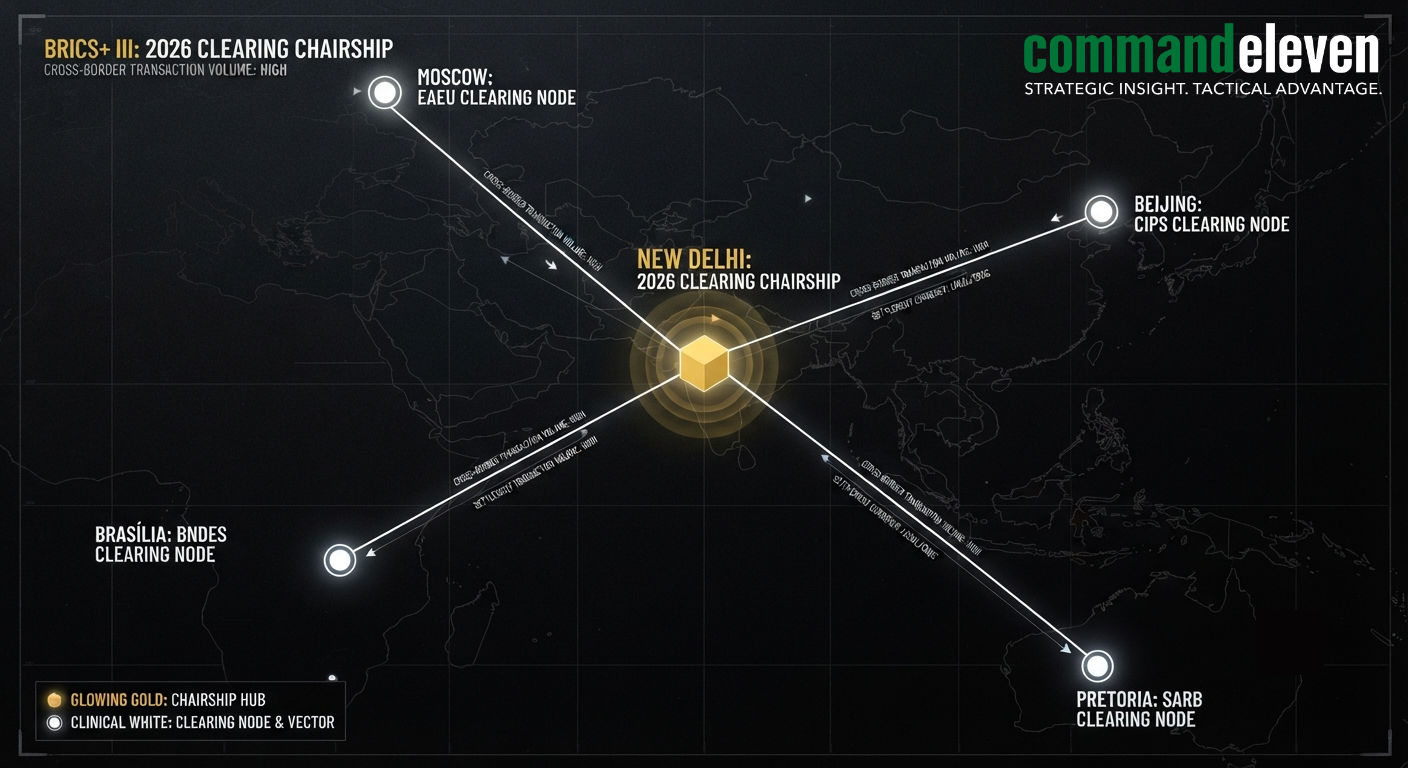
Rather than attempting to enforce a single currency model, which faces internal political resistance from members concerned about regional dominance, India’s 2026 chairship focuses on linking independent sovereign payment networks. By using unified API adapters, the system connects India’s Unified Payments Interface (UPI), China’s central bank digital currency infrastructure ($etext{-CNY}$ systems), and Brazil’s Pix platform into a single cross-border settlement track. This architecture allows commercial entities to settle high-volume trade invoices in local currencies within seconds, bypassing correspondent banks located in Western jurisdictions.
The Mechanics of Tokenized Commodity Liquidity
To support this transaction volume, the New Development Bank (NDB) has expanded its issuance of local-currency bonds. By tokenizing sovereign debt instruments and commodity reserves (specifically agricultural and energy baskets), the bloc has established a liquidity buffer that allows members to settle structural trade imbalances without converting assets into USD or Euros, reducing exposure to Western asset freezes.
Operational Integration Matrix: BRICS+ Financial Tracks
| Integration Vector | Technical Execution Mechanism | Mid-July 2026 Status | Primary Friction Point |
| DPI Interoperability | Unified API messaging layer linking Pix, UPI, and sovereign CBDCs. | Active rollout across newly admitted African nodes. | Variable digital infrastructure readiness among Tier 3 members. |
| NDB Local Debt Pools | Distributed tokenization of sovereign local-currency bonds. | Expansion of non-USD credit lines for infrastructure projects. | Differing credit rating baselines among expanded member states. |
| Unified Customs/Logistics | Real-time digital manifest synchronization via transport networks. | Codified during the July 10 Transport session. | Disparities in physical border security and automated scanning infrastructure. |
Intelligence Assessment & Forecasting (2026–2030)
CommandEleven Intelligence assesses that the BRICS+ financial framework will achieve functional institutional insulation by 2030, reducing the strategic efficacy of Western economic sanctions.
The transition from exploratory currency swaps to an active, DPI-linked settlement network will allow non-aligned states to hedge their geopolitical exposure. By maintaining parallel processing tracks, regional powers can participate in G7 capital markets while routing sanctioned commodity trades through the insulated BRICS+ architecture.
The primary vulnerability within this financial architecture remains the structural divergence between New Delhi’s “Humanity First” multilateral approach and Beijing’s push for digital yuan dominance. As the transaction volume handled by the multi-CBDC bridge expands, secondary member states will likely resist adopting Chinese monetary tools, prompting India to advocate for multi-asset tokenization frameworks to maintain strategic autonomy within the bloc.