Executive Summary & Macro-Financial Context
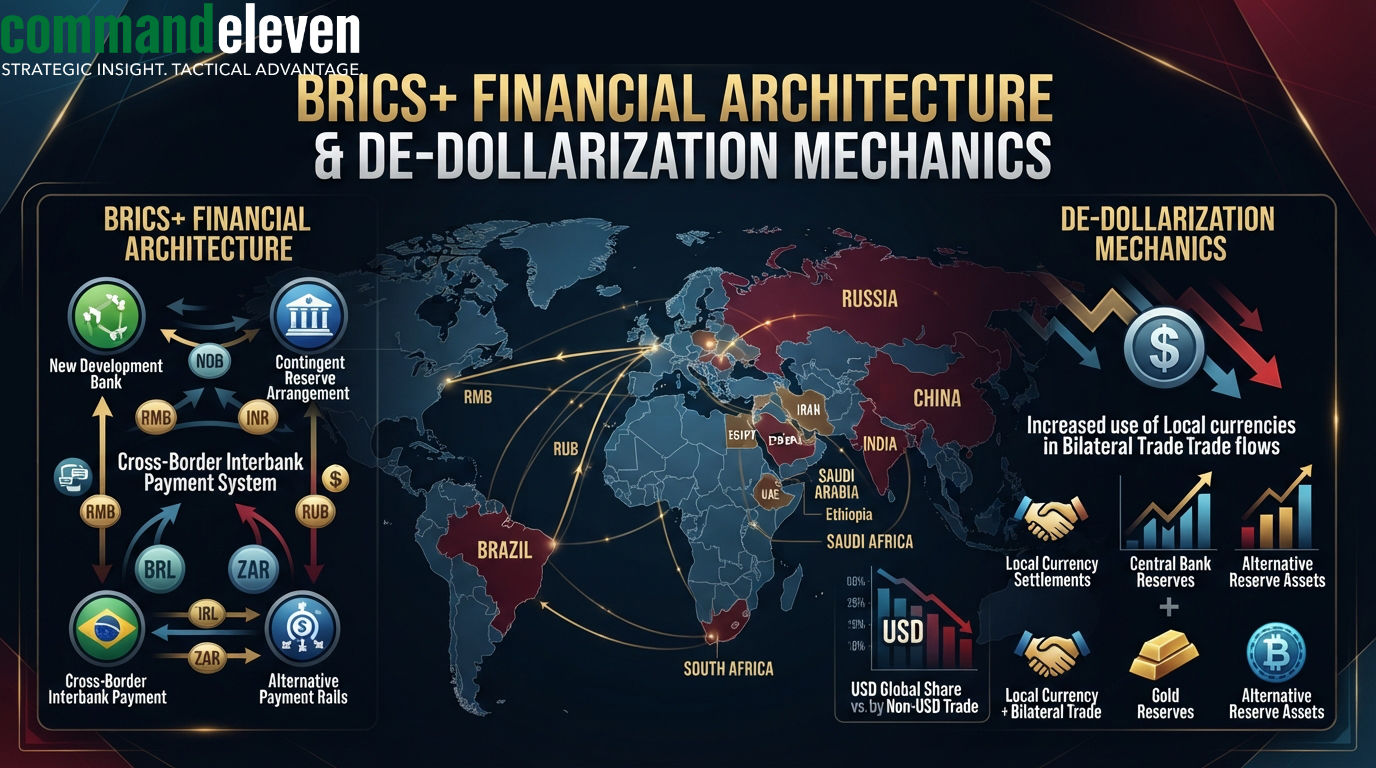
As of July 2026, the structural expansion of the BRICS grouping (comprising core founders alongside expanded members including Iran, the United Arab Emirates, Egypt, and Ethiopia) has accelerated the formalization of a parallel global financial architecture. Driven by the systemic weaponization of the US Dollar (USD) via Western sanctions frameworks, asset freezes, and exclusion from the Society for Worldwide Interbank Financial Telecommunication (SWIFT) network, the BRICS+ bloc has transitioned from rhetorical advocacy for multipolarity to the operational deployment of alternative settlement, clearing, and reserve mechanisms.
The strategic goal of this institutional pivot is not the immediate, total replacement of the USD as the primary global reserve currency, but rather the creation of an insulated, multi-currency financial ecosystem. This ecosystem allows participating states to execute cross-border sovereign trade in energy, agricultural commodities, and industrial raw materials without routing transactions through Western correspondent banks or clearing clearinghouses subject to US jurisdictional oversight.

Institutional Framework & Alternative Settlement Platforms
Non-SWIFT Messaging Integration: CIPS, SPFS, and SFMS
To mitigate the existential operational threat of SWIFT disconnection, BRICS+ member states have prioritized the technical linking of their respective domestic financial messaging platforms:
- Cross-Border Interbank Payment System (CIPS): Developed by the People’s Bank of China (PBOC), CIPS serves as the central rail for international Renminbi (RMB) clearing and settlement. CIPS has expanded its participant network across the Middle East, Eurasia, and Africa, operating both as a direct messaging protocol and as a settlement mechanism that bypasses SWIFT entirely.
- System for Transfer of Financial Messages (SPFS): Russia’s domestic messaging platform, operated by the Bank of Russia, has been integrated with CIPS and regional banking networks in Iran and Belarus, facilitating real-time financial telemetry for state-sanctioned energy transactions.
- Structured Financial Messaging System (SFMS): India’s financial communications network has established API-level interfaces with regional banking partners in the Gulf and Southeast Asia, enabling rupee-denominated trade accounting without reliance on Western data hubs.
Project mBridge & Distributed Ledger Settlement
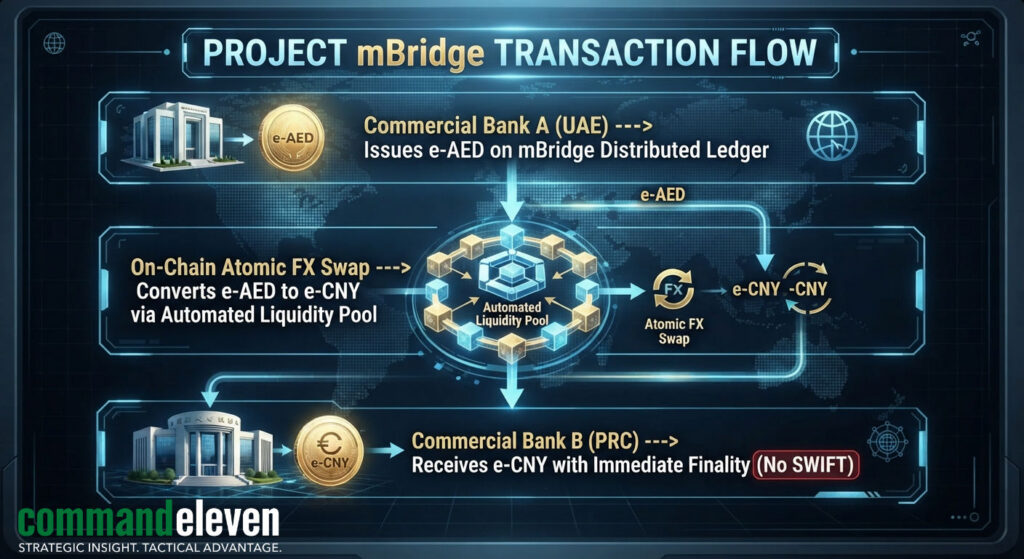
Project mBridge,a multi-Central Bank Digital Currency (mCBDC) platform developed collaboratively by central banks in China, the UAE, Thailand, Hong Kong, and Saudi Arabia,represents the most technologically advanced mechanism for real-time, cross-border foreign exchange (FX) settlement:
- Atomic Settlement: Utilizing a custom, purpose-built distributed ledger (mBridge Ledger), the platform executes real-time peer-to-peer cross-border transfers and FX transactions using central bank digital currencies.
- Elimination of Correspondent Banks: By allowing central banks and commercial participants to settle directly on-chain, mBridge reduces settlement times from days to seconds while eliminating correspondent banking fees and US clearinghouse chokepoints.
The New Development Bank (NDB) & Sovereign Liquidity
The New Development Bank (NDB), headquartered in Shanghai, functions as the institutional counterweight to the International Monetary Fund (IMF) and the World Bank:
- Local Currency Capital Injection: The NDB has mandated that a minimum of 30% to 40% of its total loan portfolio be denominated and disbursed in the local currencies of borrower member states (e.g., RMB, INR, BRL, ZAR), directly reducing foreign exchange risk and structural dollar dependency for emerging market infrastructure projects.
- Contingent Reserve Arrangement (CRA): Operating as a $100 billion financial safety net, the CRA provides member states with emergency liquidity support during balance-of-payments crises, insulating participant economies from Western capital flight and speculative currency pressures.
Commodity-Backed Currency Models & Central Bank Gold Accumulation
To establish intrinsic value and trust for non-dollar trade units, BRICS+ central banks have executed a strategic reallocation of sovereign reserves away from US Treasury securities and toward physical gold, energy credits, and tangible commodities.
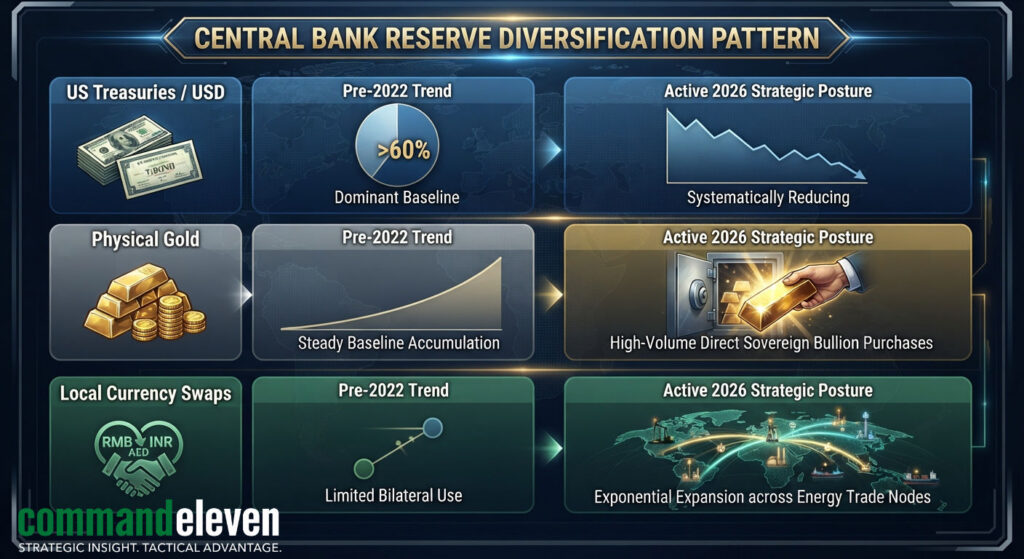
- Sovereign Gold Accumulation: Central banks across China, Russia, India, and the Gulf states have registered unprecedented net additions to official gold reserves, storing physical bullion domestically to guarantee non-fiat asset backing during systemic financial crises.
- Petroyuan & Energy Basket Clearing: The agreement between major Gulf oil producers and China to settle select crude oil shipments in RMB represents a structural shift in the petrodollar regime. Hydrocarbon trades settled in RMB are increasingly linked to gold-convertibility options hosted on the Shanghai Gold Exchange (SGE), providing exporters with immediate asset monetization pathways outside Western banking channels.
Geopolitical Friction Points & Structural Constraints
Despite technical advances in alternative settlement platforms, the BRICS+ financial project faces significant internal economic asymmetries and geopolitical frictions:
- Capital Account Inconvertibility: The non-convertibility of the Renminbi under China’s strict capital controls limits its willingness or ability to absorb global trade surpluses in the same manner as the US open capital market.
- Bilateral Trade Imbalances: As demonstrated in early Russia-India rupee trade settlements, vast structural trade asymmetries lead to frozen, unconvertible currency holdings in foreign commercial accounts, forcing reliance on complex, multi-tiered commodity swap schemes.
- Heterogeneous Strategic Priorities: Members such as India, Brazil, and the UAE maintain deep economic and security ties with Western economies, rejecting anti-Western geopolitical posturing while pursuing pragmatic financial hedging, in contrast to the explicit anti-hegemonic frameworks driven by Moscow and Beijing.
Strategic Forecasting & Quantitative Baseline Indicators (H2 2026)
The trajectory of BRICS+ de-dollarization through the second half of 2026 indicates continued incremental, structural decoupling rather than a sudden global monetary reset.
Key quantitative metrics to track include:
- Non-USD Intra-BRICS Trade Share: The percentage of intra-bloc trade settled in non-dollar currencies (projected to cross 75% across core members by end-of-year 2026).
- mBridge Transaction Volume Growth: The expansion of daily settlement volumes on Project mBridge, specifically monitoring commercial oil and gas transaction flows routed through Middle Eastern central bank nodes.
- Foreign Treasury Liquidation Rates: The net rate at which major BRICS+ central banks decrease their holdings of short- and long-term US Treasury debt relative to physical gold reserve expansion.