
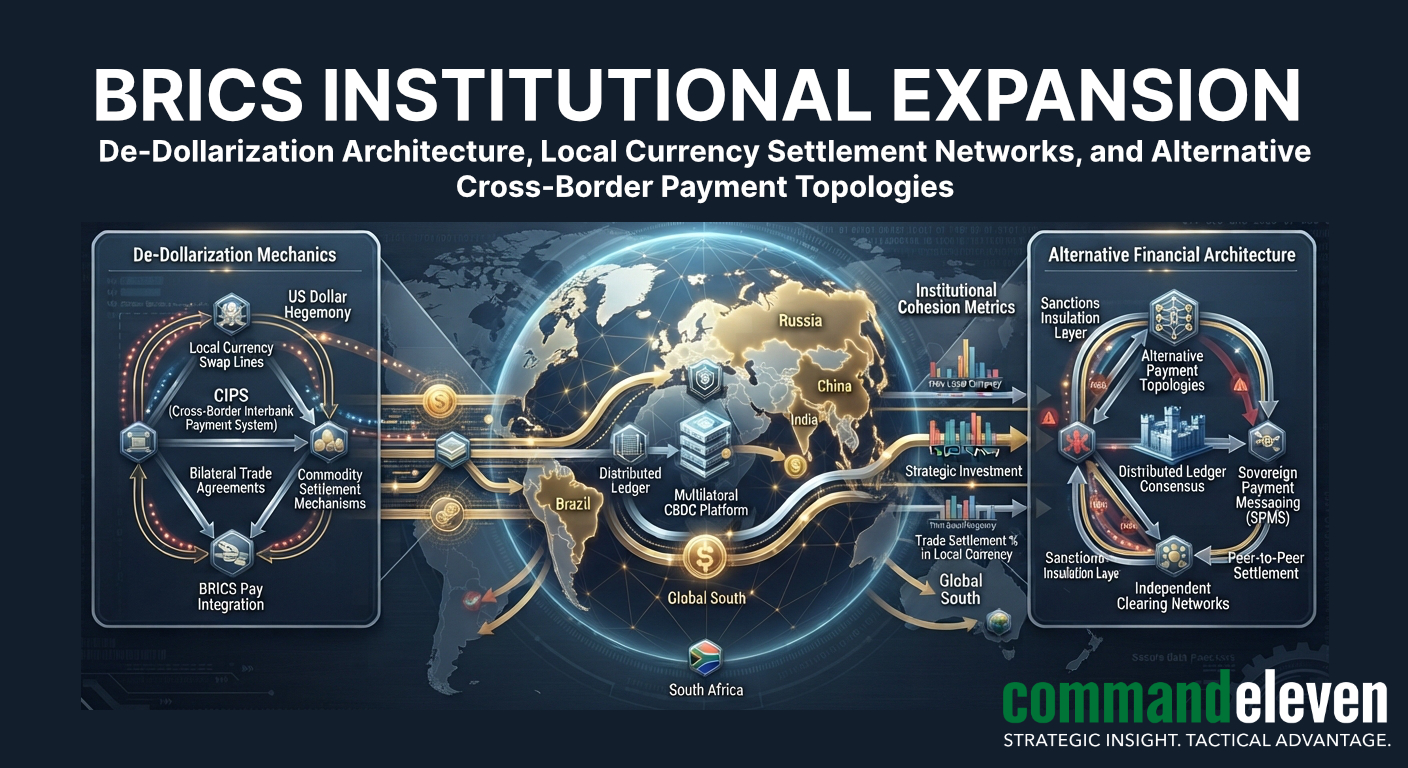
Executive Summary & Macro-Financial Dynamics
As of August 2026, the structural expansion of the BRICS grouping,encompassing core members alongside its growing network of partner states,has transitioned from symbolic diplomatic multilateralism into an institutionalized effort to construct a parallel international financial architecture. Driven by the systematic weaponization of Western financial clearing systems, primary reserve currency sanctions, and G7 asset freezes following post-2022 geopolitical escalations, the BRICS block has focused its strategic resources on de-risking from the U.S. Dollar (USD) and the Society for Worldwide Interbank Financial Telecommunication (SWIFT) network.

This dossier provides a comprehensive operational audit of the BRICS institutional expansion, the mechanics of alternative cross-border payment topologies, local currency trade settlement frameworks, and the systemic challenges obstructing the creation of a unified reserve currency.
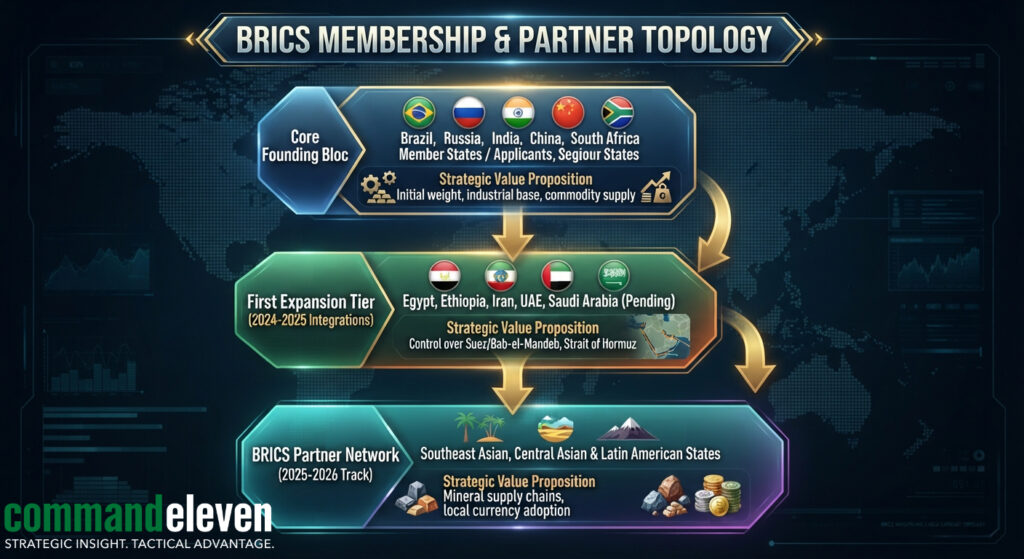
Institutional Expansion Topology and Membership Geopolitics
The institutional footprint of BRICS has expanded across critical geopolitical chokepoints, maritime trade corridors, and energy-producing regions, transforming the bloc into a powerful economic coalition.
Geoeconomic Consolidation of Energy Corridors
The integration of major energy-exporting nations,specifically Iran, the United Arab Emirates, and ongoing operational coordination with Saudi Arabia under OPEC+ alignments,places a dominant share of global hydrocarbon production within a single diplomatic framework:
- Petrodollar De-coupling: The willingness of member states to clear oil and natural gas transactions in non-USD denominations (such as RMB, AED, and INR) directly undermines the structural reliance on the petrodollar recycling system that has anchored global foreign exchange reserves since the 1970s.
- Maritime Chokepoint Overlap: With members framing key maritime passageways,including the Bab-el-Mandeb Strait, the Strait of Hormuz, the Suez Canal, and the Malacca Strait periphery,BRICS members maintain significant structural leverage over global energy supply routes.
The New Development Bank (NDB) and CRA Recalibration
The Shanghai-headquartered New Development Bank (NDB) serves as the primary sovereign debt and infrastructure funding alternative to the International Monetary Fund (IMF) and World Bank:
- Local Currency Capital Allocation: The NDB mandate enforces that a minimum of 30% to 40% of all project lending be executed in the local currency of the recipient state. This minimizes foreign exchange duration mismatch risk for developing nations borrowing for long-term infrastructure assets.
- Contingent Reserve Arrangement (CRA): Originally structured as a $100 billion swap framework to protect member states against short-term balance-of-payments crises, the CRA is undergoing technical reconfiguration to operate independently of IMF-linked conditionality triggers.
Alternative Cross-Border Payment Topologies and Messaging Interlinks
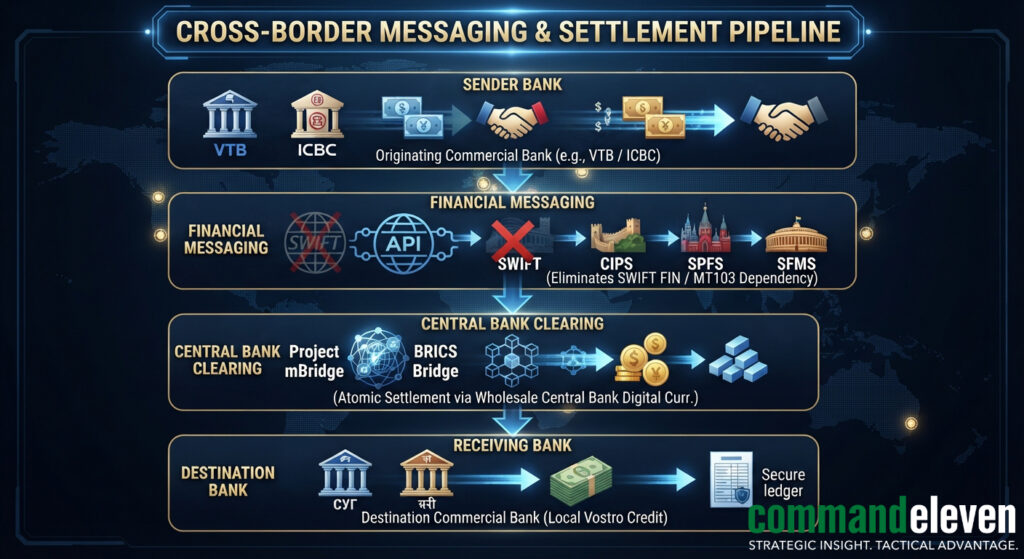
To bypass the structural vulnerabilities of SWIFT and Western correspondent banking systems subject to Office of Foreign Assets Control (OFAC) enforcement, BRICS nations have interlinked domestic financial messaging and settlement grids.
Interlinked National Financial Messaging Systems
Rather than relying on a single centralized alternative, member states have created API-driven translation gateways connecting their national financial messaging networks:
- CIPS (China): The Cross-Border Interbank Payment System acts as the primary clearing mechanism for RMB-denominated international trade, offering direct participant access across hundreds of global financial institutions.
- SPFS (Russia): The System for Transfer of Financial Messages provides encrypted, SWIFT-independent financial messaging for Russian institutions and foreign correspondent banks operating within Eurasia.
- SFMS (India): The Structured Financial Messaging System provides the domestic clearing backbone, now configured with bilateral gateways to communicate with SPFS and CIPS protocols for direct trade settlement.
Project mBridge and Distributed Ledger Topologies
The deployment of multi-CBDC (Central Bank Digital Currency) architectures, such as Project mBridge (developed in collaboration with the Bank for International Settlements Innovation Hub alongside central banks of China, the UAE, Thailand, and Saudi Arabia) and the proposed BRICS Bridge, fundamentally alters cross-border liquidity:
- Atomic Settlement: Utilizing a purpose-built, distributed ledger technology (DLT) consensus mechanism, mBridge enables real-time, peer-to-peer, atomic settlement of cross-border foreign exchange transactions.
- Elimination of Correspondent Chains: By allowing commercial banks to transact directly using wholesale CBDCs issued by their respective central banks, the system eliminates traditional Western correspondent banks. This reduces transaction settlement times from days to seconds while insulating clearing data from Western regulatory visibility.
Local Currency Settlement Architecture and the “BRICS Unit” Proposal
To reduce exposure to Western exchange rate volatility and sanctions risks, BRICS trade networks rely on local currency settlement mechanisms and synthetic reserve unit concepts.

Vostro/Nostro Mechanics and Structural Trade Imbalances
Bilateral trade cleared in national currencies encounters severe friction when structural trade imbalances exist:
- The Rupee-Rouble Friction Model: When India imported vast volumes of discounted Russian crude oil settled in Indian Rupees (INR) via Special Non-Resident Rupee Accounts (SRVA), Russian exporters accumulated tens of billions of dollars worth of trapped INR reserves within Indian banks that could not be easily converted or deployed outside the domestic Indian market.
- Mitigation via Third-Currency Clearing: To resolve balance-of-trade accumulation, settlements shifted toward secondary non-Western currencies possessing deep international liquidity,primarily the Chinese Yuan (RMB) and the UAE Dirham (AED),or through trade-based balancing involving capital goods and industrial machinery exports.
The “BRICS Unit” and Commodity-Anchored Reserve Concepts
To resolve the structural limitations of bilateral local currency trade without requiring a single supranational central bank (like the European Central Bank), BRICS financial strategists have proposed the “BRICS Unit”:
- Basket Composition: The Unit is conceptualized as a synthetic calculation unit whose value is anchored to a weighted basket comprising 40% physical gold reserves held by member central banks and 60% a basket of member national currencies (RMB, RUB, INR, BRL, ZAR).
- Transactional Accounting: The Unit functions not as physical circulating currency, but as an accounting measure for clearing international trade balances, pricing bulk commodities (crude oil, natural gas, agricultural exports, industrial metals), and holding sovereign reserves immune to Western asset freezes.
Structural Vulnerabilities, Geopolitical Friction, and Strategic Limits
Despite rapid institutional expansion, the BRICS de-dollarization framework faces severe structural constraints, internal geopolitical rivalries, and market friction points.
- Sino-Indian Geopolitical Friction: Strategic rivalry between New Delhi and Beijing creates a natural ceiling for BRICS monetary integration. India consistently resists initiatives that promote the Chinese Yuan (RMB) as the default reserve currency of the Global South, fearing Beijing’s geoeconomic hegemony across Asia.
- Capital Controls and Currency Convertibility: Neither the Chinese RMB nor the Russian Rouble is fully convertible on open global capital markets without regulatory restrictions. The absence of deep, liquid, and unconstrained capital markets within BRICS economies prevents their national currencies from displacing the USD or Euro as primary global store-of-value assets.
- SWIFT/USD Network Effects: The U.S. Dollar continues to account for the overwhelming majority of global trade invoicing, foreign exchange turnover, and global bank reserves. Western financial institutions retain powerful secondary sanctions mechanisms, threatening foreign commercial banks with exclusion from USD clearing if they participate in sanctioned transaction networks.
Strategic Intelligence Indicators & Key Metrics (H2 2026)
To track the progress and operational impact of BRICS financial expansion through late 2026, intelligence monitoring must focus on the following quantitative indicators:
- Non-USD Trade Invoicing Metrics: Tracking the percentage of total trade volume between BRICS members and Global South partners settled in non-USD currencies, specifically RMB and AED.
- Project mBridge Transaction Volumes: Monitoring the daily volume and value of atomic cross-border foreign exchange settlements processed via the mBridge DLT network.
- Central Bank Physical Gold Accumulation: Tracking the pace of physical gold purchases by BRICS central banks as a proportion of total sovereign foreign exchange reserves.
- NDB Local Currency Debt Issuance: Measuring the ratio of local-currency-denominated bonds issued by the New Development Bank relative to hard-currency (USD/EUR) issuances.