
Executive Summary
The strategic landscape of the Levant has undergone a qualitative shift from the “saturation” doctrine of unguided rockets to the high-precision capabilities of Precision-Guided Munitions (PGMs). Through “Project 99,” legacy rocket systems like the Fateh-110 and Zelzal-2 are being retrofitted with indigenous guidance kits, reducing Circular Error Probable (CEP) from hundreds of meters to sub-10-meter accuracy. This “Precision Revolution” grants non-state actors the strategic reach of a sovereign air force, enabling surgical strikes against critical infrastructure and military nodes while neutralizing the traditional air superiority of state actors.
3 Key Takeaways
- Asymmetric Precision: Retrofitting legacy rockets with GPS/INS guidance kits has granted non-state actors the ability to strike high-value infrastructure with surgical accuracy, fundamentally altering the regional deterrence calculus.
- Supply Chain Hardening: The transition to subterranean, “forward production” facilities and component-based smuggling has made the PGM supply chain highly resilient to traditional interdiction and airstrikes.
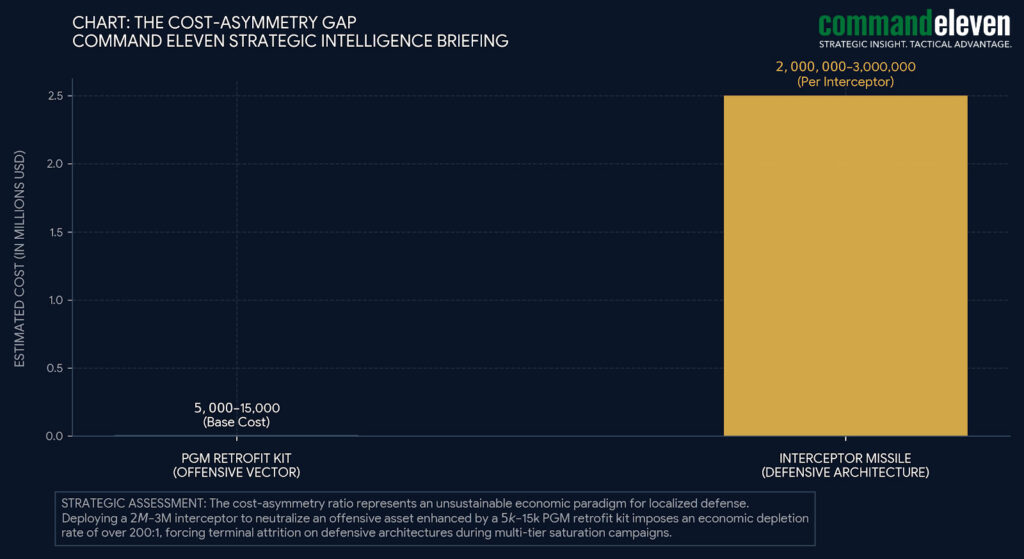
- Economic Attrition: The cost-asymmetry between low-cost PGM conversion kits and multi-million dollar air defense interceptors creates an unsustainable defensive burden for regional state actors.
The Precision Revolution in Asymmetric Warfare
The strategic landscape of the Levant has transitioned from the era of “statistical fire”,where volume of fire compensated for lack of accuracy,to an era of Sovereign Precision. Historically, non-state actors and regional proxies relied on massive salvos of unguided Grad, Fajr, and Zelzal rockets to saturate enemy air defenses, accepting high Circular Error Probable (CEP) rates as an inherent limitation.
As of May 2026, this paradigm has been rendered obsolete. The proliferation of Precision-Guided Munitions (PGMs) has granted asymmetric actors the capability to conduct “surgical” strikes against critical infrastructure, military command nodes, and economic targets with a high degree of confidence. This shift fundamentally alters the deterrence calculus: a single precision-guided missile now possesses the strategic utility previously assigned to a battery of one hundred unguided rockets. This analysis explores the technical mechanisms enabling this transition and the specific platforms being utilized to erode traditional air superiority in the northern theater.
Platform Evolution: The Upgrade Path
The core of the PGM threat lies not in the creation of entirely new missile systems, but in the sophisticated retrofitting of legacy “dumb” rockets. This modular approach allows for rapid proliferation without the need for an advanced aerospace industrial base.
Legacy Systems Integration: The Fateh-110 and Zelzal-2
The primary platforms for conversion are the Fateh-110 (solid-fueled, short-range ballistic missile) and the Zelzal-2 (heavy unguided rocket).
- The Fateh-110 Platform: Originally designed with a rudimentary guidance system, newer iterations (Fateh-110 Fourth Generation) and their regional variants have been optimized for high-maneuverability and terminal accuracy.
- The Zelzal-2 Retrofit: The Zelzal-2, traditionally an unguided 610mm rocket, serves as the ideal “bus” for precision kits due to its high payload capacity and range (~200 km). By integrating a guidance section, this platform is transformed from a terror weapon into a strategic asset capable of striking specific hangers at airbases or individual cooling towers at power plants.
The “Project 99” Initiative: Conversion Mechanics
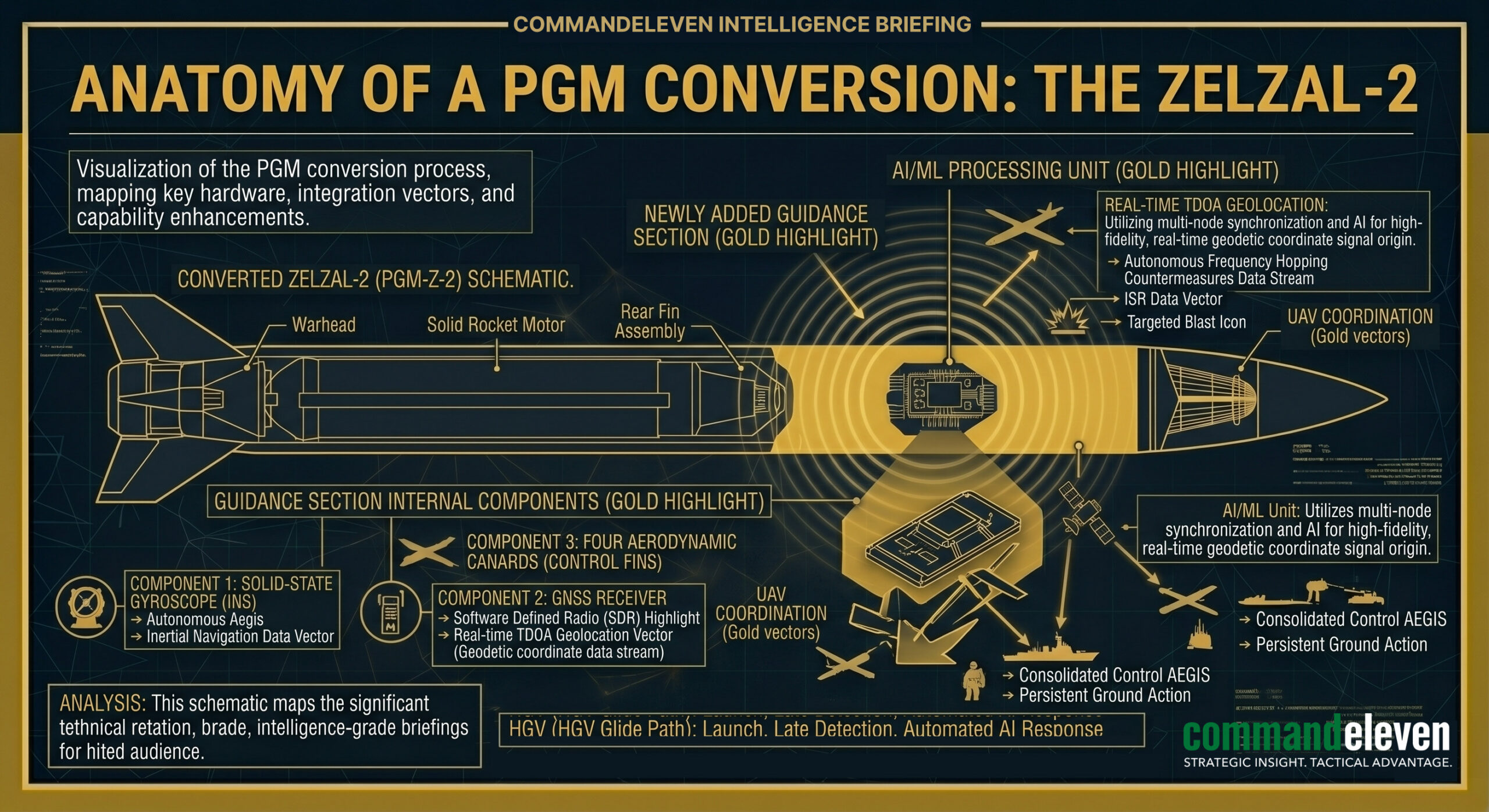
“Project 99” refers to the decentralized technical effort to manufacture and install indigenous guidance kits. This process involves the insertion of a Control and Guidance Section between the existing rocket motor and the warhead.
- Aerodynamic Control (Canards): The most visible indicator of a PGM conversion is the addition of four independently actuated aerodynamic fins (canards) near the nose of the missile. These fins allow the projectile to adjust its flight path in real-time to correct for atmospheric disturbances or targeting errors.
- The Guidance Kit (INS/GNSS):
- Inertial Navigation System (INS): Utilizes solid-state gyroscopes and accelerometers to track the missile’s position relative to its launch point. This system is immune to external interference but prone to “drift” over long distances.
- Global Navigation Satellite System (GNSS): By integrating GPS or GLONASS receivers, the missile can constantly update its position and correct INS drift.
- Terminal Accuracy (CEP Reduction): Through these technical integrations, the Circular Error Probable,the radius of a circle within which 50% of missiles will land,has been reduced from 500m–1,000m down to sub-10 meters.
Terminal Homing and Multi-Seeker Capabilities
Recent intelligence indicators suggest the deployment of multi-mode seekers in the final flight phase.
- Electro-Optical (EO) / Infrared (IR): Allowing the missile to “see” its target during the terminal dive, enabling the engagement of moving targets or specific structural vulnerabilities within a building.
- Anti-Radiation Seekers: Designed to home in on the radio-frequency emissions of air defense radars (e.g., the EL/M-2084 Multi-Mission Radar), effectively acting as a suppression of enemy air defense (SEAD) tool.
The “Forward Production” Doctrine: Hardening the Supply Chain
The logistical strategy for PGM proliferation has moved beyond the vulnerable “ship-and-store” model toward a decentralized, indigenous manufacturing cycle. This shift is designed to neutralize the efficacy of interdiction strikes on transit convoys.
Subterranean and Hardened Manufacturing
Manufacturing and assembly have been relocated to high-survivability environments.
- Deep-Basing (CERS Facilities): In Syria, the Scientific Studies and Research Center (CERS) facilities have moved critical assembly lines into subterranean complexes bored into limestone massifs. These facilities are designed to withstand significant kinetic penetration.
- The “Unit 108” Network: This specialized logistical unit manages the transfer of components rather than completed missiles. By moving guidance kits in small, modular batches via civilian transport or light vehicles, the footprint is minimized, making detection by traditional ISR (Intelligence, Surveillance, and Reconnaissance) exceptionally difficult.
Component-Based Proliferation
The “democratization” of PGM technology relies on the modularity of its components.
- Miniaturized Actuators: The servo-motors required to move the control fins (canards) are now sourced from dual-use industrial catalogs, masking their military purpose.
- Carbon-Fiber and Specialized Resins: Local production of airframe components utilizes high-strength carbon fiber to reduce weight and increase range. The domestic mastery of these materials allows for the replacement of damaged parts without external supply.
- Technical Sovereignty: Regional specialists provide “on-site” training to local engineering cells. This creates a self-sustaining cycle where technical malfunctions can be diagnosed and fixed within the theater, eliminating the need to return hardware to the original manufacturer.
Counter-Intervention & The Contested Environment

The presence of PGMs fundamentally disrupts the “Permissive Air Environment” previously enjoyed by state actors in the region.
The “Saturation-Precision” Hybrid Attack
Asymmetric actors now utilize a tiered attack architecture to ensure PGM lethality.
- Tier 1: Swarm Saturation: Deployment of low-cost, expendable One-Way Attack (OWA) UAVs (e.g., Shahed-series variants) to trigger and deplete the interceptor stocks of multi-tier air defenses like the Iron Dome or David’s Sling.
- Tier 2: The Precision Strike: Once the defensive radar is saturated or the interceptor magazines are low, PGMs are launched on flattened, high-speed trajectories. The reduced time-to-target compared to drones makes interception significantly more complex.
The Electronic Warfare (EW) Frontier
The reliance of PGMs on GNSS (GPS/GLONASS) has turned the Levant into a high-intensity EW laboratory.
- GPS Spoofing and Meaconing: State actors frequently utilize high-power spoofing to “drift” the missile’s navigation, making it believe it is hundreds of meters away from its true location.
- The Anti-Jamming Counter: Modern PGM kits in the Northern Front have begun integrating CRPA (Controlled Reception Pattern Antennas). These systems use spatial filtering to “null” the direction of a jammer while maintaining a lock on legitimate satellite signals.
- Resilient INS Backup: If GNSS is totally denied, the missile reverts to its high-grade Inertial Navigation System. While the CEP increases, it remains sufficiently accurate for “area-denial” against large industrial complexes or military bases.
Strategic Implications for Regional Stability
The consolidation of PGM capabilities on the Northern Front has moved beyond tactical experimentation and is now a primary driver of regional security shifts.
The Erosion of Quantitative Deterrence
Historically, regional state actors relied on the qualitative edge of their air forces to offset the numerical superiority of non-state rocket inventories. PGM proliferation has neutralized this advantage.
- Targeted Attrition: The ability to strike specific high-value nodes,such as air traffic control towers, desalination plants, and open-cycle gas turbines,means that a non-state actor can cause disproportionate economic and operational paralysis with a minimal expenditure of assets.
- Economic War of Attrition: The cost-asymmetry between a PGM conversion kit (estimated in the low thousands of dollars) and a high-tier interceptor (estimated at $2–3 million per shot) is unsustainable for state budgets in a prolonged high-intensity conflict.
Infrastructure Vulnerability and “The Second Strike”
The Levant’s civilian infrastructure has become a de facto extension of the battlefield.
- Grid Paralyzation: By targeting the “Points of Interconnect” in Lebanon and Syria’s already fragile power grids, PGM-armed actors can plunge entire regions into darkness, disrupting command and control (C2) and civil governance simultaneously.
- The MAD Paradox: We are seeing the emergence of a localized “Mutually Assured Destruction” (MAD) dynamic. As of May 2026, the threshold for a full-scale kinetic intervention has risen because both state and non-state actors recognize that such an engagement would result in the near-total destruction of their respective critical infrastructure.
Intelligence Assessment and Forecasting (2026–2030)
CommandEleven assesses that PGM proliferation is in an “acceleration phase,” where the technology will become more accessible, portable, and difficult to detect.
Miniaturization and the “Portable PGM”
The next five years will see the migration of PGM technology from large ballistic platforms (Fateh-110) to smaller, more mobile assets.
- Guided 122mm Rockets: We anticipate the wide-scale deployment of guidance kits for 122mm (Grad) rockets. This will allow light, highly mobile units to achieve precision-strike capabilities currently reserved for heavy missile units.
- Loitering Munition Integration: The distinction between a PGM and a kamikaze drone is blurring. By 2030, “loitering PGMs” will likely dominate the Northern Front, capable of waiting in a designated kill-box for a specific thermal or electronic signature before striking.
Non-Kinetic Defense and Directed Energy
As traditional kinetic interceptors reach their economic and physical limits, the focus will shift toward non-kinetic neutralization.
- Directed Energy Weapons (DEW): High-power microwave (HPM) and laser systems are being accelerated for deployment by 2027. These systems offer a “zero-cost-per-shot” solution that can theoretically engage PGM swarms at the speed of light, bypassing the “magazine depth” problem of current missile defenses.
- Cyber-Kinetic Interruption: Future intelligence operations will focus on “left-of-launch” intervention,compromising the software within the guidance kits or the ground-control stations before the missile ever leaves the rail.
Final Assessment
The Northern Front has entered a permanent state of high-tech volatility. The “Precision Revolution” has granted non-state actors the strategic reach of a sovereign air force, forcing a complete recalibration of regional defensive postures and diplomatic negotiations.