Tradecraft Note & Confidence Tiering
This dossier follows CommandEleven’s standard sourcing discipline. Every substantive claim is tiered by confidence rather than folded into a single narrative. Given the volume of “fog of war” reporting generated by an active shooting conflict, several claims in circulation , including some in the request that generated this dossier , are stronger in public discourse than they are in the underlying reporting. This edition flags those gaps explicitly rather than smoothing over them.
[CONFIRMED] Reported by named officials on the record, or independently corroborated by multiple mainstream outlets citing reviewed documents.
[ASSESSED] Consistent with open-source reporting and analyst consensus, but resting on anonymous sourcing, doctrine statements, or pattern inference rather than a confirmed operational fact.
[SPECULATIVE] Plausible given the threat actor’s history and doctrine, but not supported by specific public evidence at this time; included because it shapes the risk conversation, not because it is established.
Key Judgments
- [CONFIRMED] Iran’s leadership has publicly and repeatedly signaled a doctrinal shift from a defensive to an offensive posture since the appointment of a new IRGC command structure in early August 2026, with senior officials stating the armed forces should now be prepared to “take operations to the enemy’s territory.”
- [ASSESSED] A vessel-launched UAV attack on California is a real item in FBI threat reporting, but the FBI itself has labeled the underlying intelligence uncorroborated and non-actionable, and multiple federal and state officials have since pushed back publicly on the story’s framing. It belongs in this dossier as a live data point, not as an imminent, credible plot.
- [CONFIRMED] Iran-linked actors have demonstrated a credible, escalating cyber capability against Western energy infrastructure, evidenced by the four-day outage of a small UK generating facility in July 2026 and a parallel wave of intrusions against U.S. municipal water systems across multiple states.
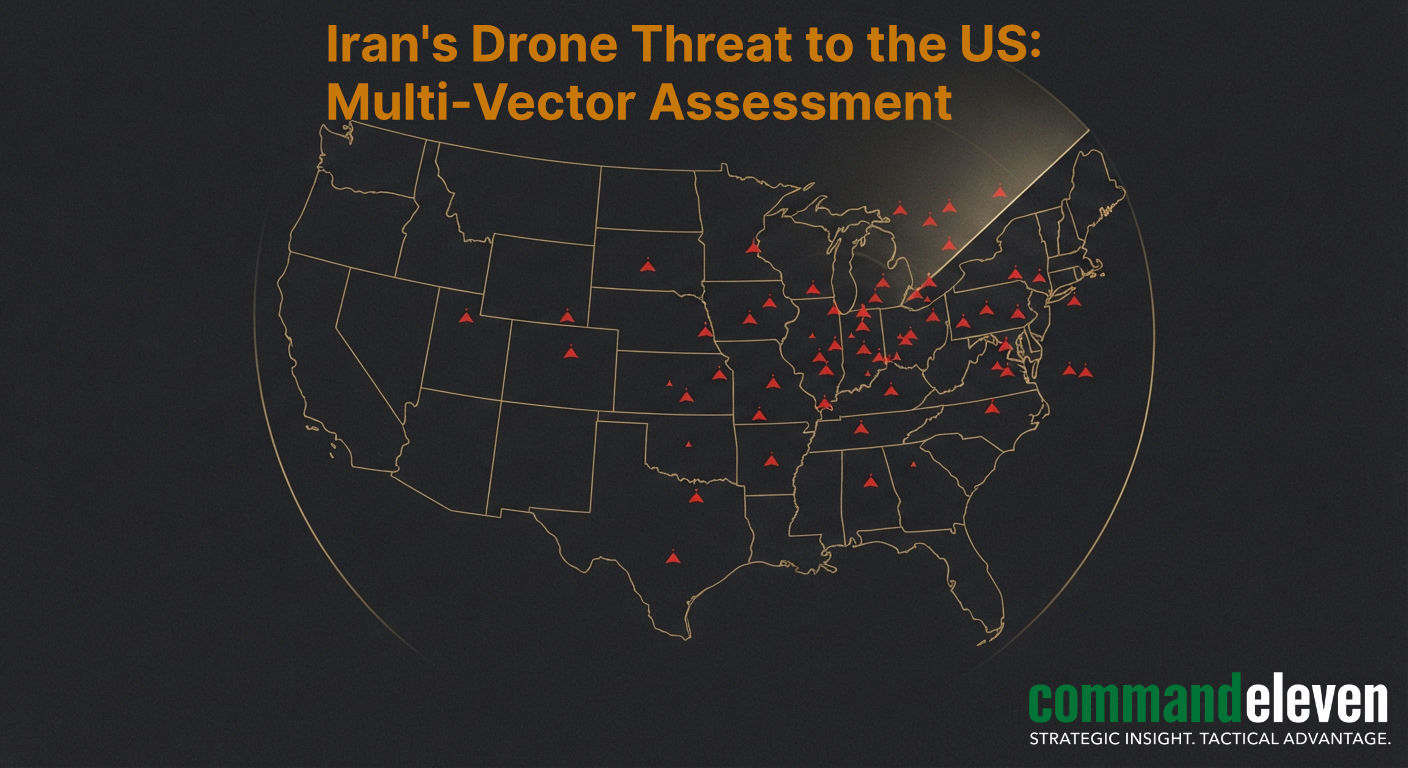
- [CONFIRMED] A homeland drone swarm attack is the vector where intent and capability gap most clearly intersect: NORTHCOM’s own deputy commander has stated on the record that the U.S. cannot currently detect or defeat a small drone swarm launched from inside its own borders. This is a genuine, acknowledged structural vulnerability independent of what Iran specifically intends.
- [ASSESSED] The cartel-IRGC-Hezbollah nexus and domestic sleeper-cell networks are longstanding, serious lines of concern that CommandEleven tracks in the ongoing IRGC series , but “fully embedded” and “active for decades awaiting a go order” are stronger characterizations than current open-source reporting supports. They are treated here as an assessed enabling layer, not a confirmed standing attack cell.
- [ASSESSED] The framing that Iran has threatened “economic warfare on the US to defeat Trump in the midterms” inverts the primary reporting: it is the Trump administration that has threatened an intensified (‘Economic D-Day’) sanctions campaign against Iran. Separately, regional analysts assess that Iran has a strategic incentive to prolong the conflict through the November midterms to maximize political pressure on the administration. Both strands are real; they are not the same claim.
Strategic Context: The Doctrinal Shift
The operating environment for this dossier is an active, still-escalating U.S.-Iran war that began with U.S.-Israeli strikes in late February 2026 that killed Supreme Leader Ali Khamenei, followed by the installation of Mojtaba Khamenei as his successor and a subsequent reorganization of the IRGC, Basij, and General Staff leadership in early-to-mid August 2026.
That reorganization has been accompanied by explicit public statements from senior IRGC figures , including Brigadier General Yadollah Javani (IRGC political deputy) and Mohammad Reza Naqdi (adviser to the IRGC commander-in-chief) , that Iran’s military doctrine is moving from defensive to offensive, built around a “maximum deterrence” concept under which defensive action is framed as inherently offensive in character. Javani has stated publicly that adversaries “should expect strategic surprises.” Newly appointed IRGC commander-in-chief Ahmad Vahidi has reportedly been instructed to prepare for offensive operations directly on adversary soil.
This is best read as declaratory doctrine and political signaling rather than a specific operational order for an attack on U.S. soil. It sets conditions and lowers the political threshold for a range of asymmetric options , it does not, on its own, specify which option Tehran or its proxies would choose, against what target, or on what timeline.
Threat Vector Inventory
Maritime-Launched UAV Threat to the California Coast
[CONFIRMED] In late February 2026, the FBI distributed a bulletin to California law enforcement stating it had acquired “unverified information” that, as of early February 2026, Iran “allegedly aspired” to conduct a surprise UAV attack against unspecified California targets, launched from an unidentified vessel off the coast, in the event the U.S. struck Iran. The bulletin explicitly stated the FBI had “no additional information on the timing, method, target, or perpetrators.”
[ASSESSED] The story’s credibility has been actively contested since publication. Multiple law-enforcement and intelligence officials told CBS News there was no credible intelligence underpinning the alert and called it “not actionable.” White House Press Secretary Karoline Leavitt demanded a retraction, calling the coverage misleading. A former senior counterterrorism official characterized the likely origin as intercepted informal conversation among individuals with possible IRGC/Quds Force affiliation, rather than an operational plot. Separately, a senior law-enforcement official has assessed that the subsequent 12-day U.S.-Israeli air campaign materially degraded whatever Iranian capability existed to execute the idea.
Analytic takeaway: this item belongs in a dossier as a live signal of Iranian aspiration and of how thin the evidentiary bar can be for a public threat bulletin , not as evidence of a credible, resourced plot. Treat it as a category (maritime approach to a soft coastline) worth monitoring, not as a specific confirmed operation.
Cyberattacks on Western Critical Infrastructure
[CONFIRMED] Iran-linked hackers took a small British power-generating facility offline for four consecutive days in July 2026 , described by UK officials as the first successful attack of its kind against British energy infrastructure. The UK government stated the facility was small-scale and that the wider national grid was never at risk, and GCHQ’s National Cyber Security Centre has said it now handles at least four “nationally significant” cyberattacks per week.
[CONFIRMED] The UK incident occurred contemporaneously with a wave of Iran-attributed intrusions against U.S. municipal water systems across at least seven states, which prompted a joint CISA/FBI/EPA advisory.
Analytic takeaway: this is the vector with the clearest demonstrated capability-to-effect chain of any covered here. It targeted small, less-hardened nodes rather than headline infrastructure, and officials on both sides of the Atlantic have been careful to frame the impact as contained , but it establishes that Iran-linked actors can achieve physical operational effect on Western utility infrastructure, which is a meaningful capability marker independent of scale.
The Cartel–IRGC–Hezbollah Nexus as an Access Layer
[ASSESSED] U.S. intelligence officials have separately expressed growing concern about the expanding use of drones by Mexican drug cartels and the possibility that platform, and smuggling-route access could be leveraged against U.S. targets near the border. This is a distinct, narrower claim than a standing operational alliance between the cartels and the IRGC/Hezbollah for a coordinated attack.
CommandEleven’s own IRGC series (Part I–III, with Part IV on Hezbollah’s Unit 910 planned) tracks this nexus in depth, including Quds Force strategy under sanctions and Iran’s Latin American buildup. That body of work should be treated as the authoritative internal reference for this vector; it should not be conflated here with a claim that the cartels are “fully embedded” with IRGC/Hezbollah in an operational sense , open-source reporting supports a longstanding, opportunistic relationship (smuggling routes, money laundering, occasional weapons/logistics overlap) more than a fused command relationship.
Domestic Sleeper-Cell / Homegrown Network Dimension
[SPECULATIVE] The premise of IRGC sleeper cells having been positioned inside the U.S. “for decades, waiting for a go call” is a serious, recurring concern in the counterterrorism community and has been raised again in reporting around the FBI’s California bulletin (“Iran may be activating sleeper cells,” per KTLA/ABC reporting) and around Academy Awards security posture in Los Angeles. It is not, however, backed by a confirmed, named network in current public reporting. Treat this as a standing background risk that shapes force-protection posture at high-profile events, not as a specific confirmed cell structure.
Economic and Electoral-Timing Dimension
[CONFIRMED] On 19–20 August 2026, President Trump publicly threatened an intensified sanctions campaign against Iran , termed an “Economic D-Day” , targeting third countries providing Iran a financial lifeline. Iran’s Foreign Ministry and IRGC spokesmen dismissed the threat as an implicit admission of military defeat and as nothing new after 47 years of sanctions.
[ASSESSED] Separately, regional analysts have argued that Iran has a strategic incentive to prolong the conflict , particularly pressure on the Strait of Hormuz and oil markets , through the November 2026 U.S. midterm elections, on the theory that high fuel prices and an unresolved war erode the Trump administration’s political standing. This is an analyst interpretation of Iranian strategic logic, not a documented Iranian operational order, and should be presented to clients as such.
Correction of framing: the phrase “Iran’s threat to wage economic warfare on the US to defeat Trump” does not match the primary sourcing. “Economic warfare” in current reporting is the term Trump himself used to describe the U.S. campaign against Iran. What is assessed, separately, is an Iranian incentive to use continued military and market pressure to shape U.S. domestic politics. Getting this sequencing right matters for the dossier’s credibility and should be corrected at the source before publication.
Special Section: Drone Swarm Attack Potential
ORGANIZATIONAL AND POLICY-LEVEL ANALYSIS ONLY , SEE TRADECRAFT NOTE
The Ukraine Precedent, at the Conceptual Level
Ukraine’s war has normalized two concepts globally that are relevant to homeland risk framing: (1) that small, low-cost, commercially-derived drones can be launched from concealed or improvised positions well inside a target country’s own territory rather than from a foreign front line, and (2) that maritime drone platforms can be used to threaten targets from coastal or open water. Operation Spiderweb , Ukraine’s deep-strike drone operation against Russian air bases , is now a standard reference point in U.S. professional military discussion (including by NORTHCOM officials themselves) for why perimeter-based, front-line-oriented air defense concepts are poorly matched to this threat class.
This dossier deliberately stops at that conceptual level. It does not detail launch-platform construction, payload configuration, swarm coordination methods, or defeat of specific countermeasures. CommandEleven’s editorial standard reserves that category of detail for vetted government and institutional clients, and Anthropic’s usage policies preclude Claude from producing it in any context, including this one , flagging that plainly here rather than working around it.
The Acknowledged U.S. Homeland Detection Gap
[CONFIRMED] Army Lt. Gen. Joseph Jarrard, deputy commander of U.S. Northern Command and vice commander of the U.S. element of NORAD, stated on the record at the Space and Missile Defense Symposium in Huntsville, AL on 13 August 2026 that the U.S. cannot currently defend against a drone swarm launched from inside its own borders. Asked directly whether NORTHCOM could defeat such a swarm, he answered “No.” He attributed this to a structural sensor-coverage gap , “We don’t have the sensors, and depending on where that swarm is going to attack, it depends on whether we have any sensors at all, and also whether we’ve got any effectors to go after that problem” , not merely a shortage of interceptor weapons.
[CONFIRMED] Jarrard noted NORAD’s original design logic (Cold War-era, oriented toward Soviet bombers and ballistic missiles on predictable Arctic approach routes) is structurally mismatched to a threat that can be assembled, transported, and launched from inside the country with no predictable axis of approach. Reporting also notes he is the second NORTHCOM general in four months to make this admission publicly, and that a Pentagon counter-drone task force (Joint Interagency Task Force 401) has been directing hundreds of millions of dollars toward the problem, with much of that funding currently prioritized to CENTCOM given the active Iran war rather than to domestic coverage.
Analytic takeaway: this is the single most consequential, best-corroborated fact in this dossier. It is a capability gap that exists independent of Iranian intent , acknowledged on the record by the U.S. official responsible for the mission , and it is the reason a drone swarm scenario deserves disproportionate analytical attention relative to how well-evidenced Iranian operational planning against the homeland currently is.
Assessed Iranian and Proxy Intent vs. Demonstrated Capability
[ASSESSED] Iran and Iran-aligned militias have demonstrated drone attack capability against U.S. forces and installations in the CENTCOM area of responsibility throughout 2026, including a March 2026 FPV drone attack by an Iran-backed militia against a U.S. air base in Baghdad. This establishes proxy operational competence with small attack drones in an active theater.
[SPECULATIVE] Translating that demonstrated regional capability into a coordinated multi-drone swarm attack executed on U.S. domestic soil is a substantially higher bar: it requires platform acquisition or fabrication inside the U.S. (or smuggled entry), pre-positioning, coordination, and a launch decision authorized at a political level willing to accept the escalation risk of a direct homeland attack , which would cross a threshold Iran has not crossed even at the height of the current war. No public reporting currently places Iran or a proxy at that stage of planning against a U.S. domestic target.
Net assessment: intent-signaling (doctrinal shift, “strategic surprises” rhetoric, FBI bulletin) is trending upward; demonstrated capability against the homeland specifically is not yet evidenced in open sources; the defensive gap on the U.S. side is confirmed and severe. The risk this section highlights is asymmetric , it is driven as much by the acknowledged American detection gap as by any specific confirmed Iranian plan.
Comparative Assessment
| Vector | Confirmed Intent | Demonstrated Capability | Homeland Defensive Gap |
| Maritime UAV (CA) | Unverified / disputed | Not evidenced | Moderate , coastal detection thin |
| Critical-infra cyber | Confirmed pattern | Confirmed (UK, US water) | Sector-dependent, improving |
| Cartel/proxy access | Assessed, longstanding | Partial / logistics-level | Border-region specific |
| Domestic sleeper network | Speculative | Not evidenced publicly | N/A , law enforcement lane |
| Drone swarm (homeland) | Rhetorical / doctrinal only | Regional (CENTCOM), not homeland | Confirmed severe , Jarrard, Aug 2026 |