Key Takeaways
- Fragmentation, not collapse: The Captagon trade’s post-Assad trajectory is decentralization, not decline , command has fragmented from a single military division to a distributed network of residual regime elements, tribal militias, and criminal syndicates.
- Sanctions-resilient financial architecture: Financial clearing through hawala networks and stablecoin settlement keeps the trade largely insulated from international banking sanctions.
- Enduring use as geopolitical leverage: Captagon has functioned as a diplomatic lever as much as a revenue stream, and its residual use as asymmetric leverage against the GCC is likely to persist even as state control weakens.
- Substitution risk from interdiction pressure: Interdiction success is generating a secondary risk: syndicates retooling existing infrastructure toward methamphetamine and synthetic opioids, a more dangerous substitution than the status quo.
Executive Summary
Through the final years of the Assad regime, the industrial-scale production and export of fenethylline (Captagon) functioned as a state-integrated financial pillar rather than a peripheral criminal enterprise. Command sat with the Syrian Arab Army’s 4th Armored Division under Maher al-Assad, working alongside Military Intelligence branches and Lebanese Hezbollah logistics cells, generating an estimated $5–$10 billion in annual gross revenue that helped sustain the regime through sanctions and currency collapse.
CommandEleven Intelligence assesses that the collapse of the Assad government in late 2024 did not end the trade , it fragmented it. Despite transitional-authority raids that dismantled 15 industrial-level laboratories and 13 storage facilities, and regional interdiction that intercepted an estimated 177 million tablets (roughly 30 tonnes), production has decentralized into a resilient, multi-node network of former military factions, local warlords, and transnational criminal syndicates operating across Syria, Lebanon’s Baalbek-Hermel region, and into Iraq and North Africa.
This dossier consolidates CommandEleven’s prior Levant-series drafts on the Syrian narco-state into a single strategic reference, covering the trade’s institutional architecture, financial mechanics, use as a diplomatic lever, and post-transition trajectory through 2030. In line with CommandEleven’s editorial standards, this version omits production chemistry and precursor-sourcing detail, which is reserved for government and intelligence clients.
From State Monopoly to Decentralized Network
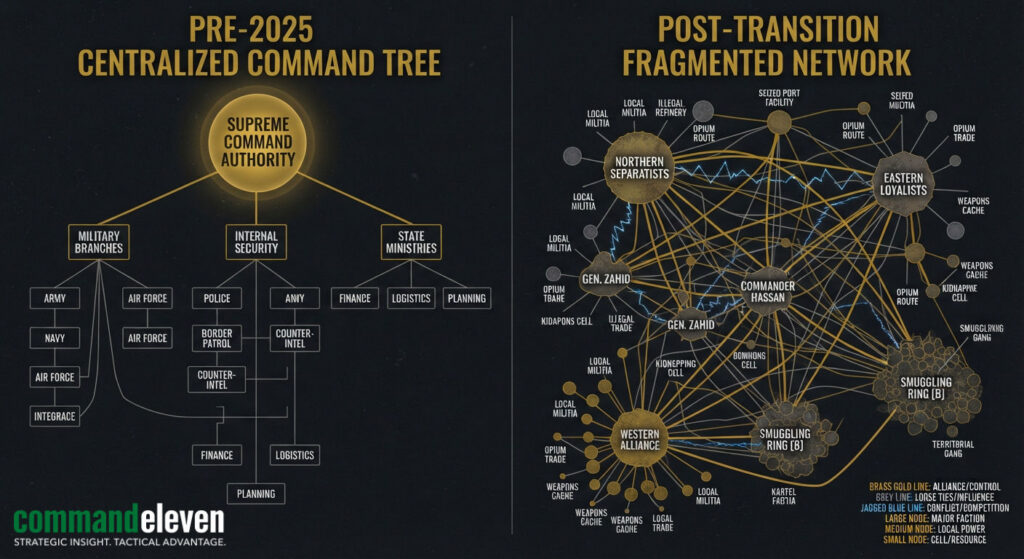
The Captagon trade’s structure has shifted fundamentally with Syria’s political transition, moving from vertical state integration to a fragmented, multi-actor market.
| Dimension | Pre-2025 (Regime-Controlled) | 2025–2026 (Post-Transition) |
| Command structure | Centralized under the 4th Armored Division / regime security services | Fragmented among residual military factions, local warlords, and criminal syndicates |
| Production model | Fixed industrial-scale facilities (e.g., Mezzeh Air Base, Douma, Al-Dimas, Yaafour) | Mobile, modular, and decentralized production nodes in peripheral border zones |
| Geographic footprint | Concentrated around Damascus, Homs, and the coast | Dispersed into Sweida, Quneitra, eastern Lebanon, and western Iraq |
| State relationship | Primary regime revenue and survival mechanism | Localized shadow economy; disavowed but not eliminated by the transitional government |
- Loss of the centralized umbrella: The 4th Armored Division’s loss of its production bases in and around Damascus dissolved the centralized command loop that once regulated and protected the trade. Residual military elements, local warlords, and tribal militias absorbed the remaining production assets, operating independently of any central authority.
- Incomplete eradication: The transitional administration in Damascus, led by Ahmad al-Sharaa, has conducted extensive raids, but CommandEleven assesses total eradication remains unachieved; production has instead migrated deeper into ungoverned and lightly governed border zones.
Institutional and Command Architecture
The 4th Armored Division’s Legacy Role
- Institutional backbone: Under Maher al-Assad’s command, the 4th Armored Division functioned as an integrated security, logistics, and enforcement entity , securing production sites, escorting shipments, and insulating the trade from external scrutiny through military checkpoints and intelligence cover.
- Intelligence-branch facilitation: Local Military Intelligence branches recruited, protected, and taxed smuggling networks in southern Syria, using allied local factions to manage tactical border crossings while shielding regular army units from direct exposure.
Hezbollah and Cross-Border Integration
- Lebanese borderland integration: The Baalbek-Hermel region of eastern Lebanon functions as an integrated production and transit corridor. Hezbollah-linked networks have historically provided technical expertise and secure storage infrastructure, and this borderland has absorbed displaced production capacity since the Assad regime’s collapse.
Post-Transition Actors
- Residual regime networks: Former regime military commanders, local defense units, and criminal syndicates in the Syrian-Lebanese borderlands retain access to legacy equipment, transit corridors, and market relationships.
- Tribal and militia adaptation: In southern Syria , particularly Daraa and As-Suwayda , local tribal networks and autonomous armed factions have filled the resulting security vacuum, providing protection and transport services for a share of trade revenue.
Trafficking Corridors and Regional Reach
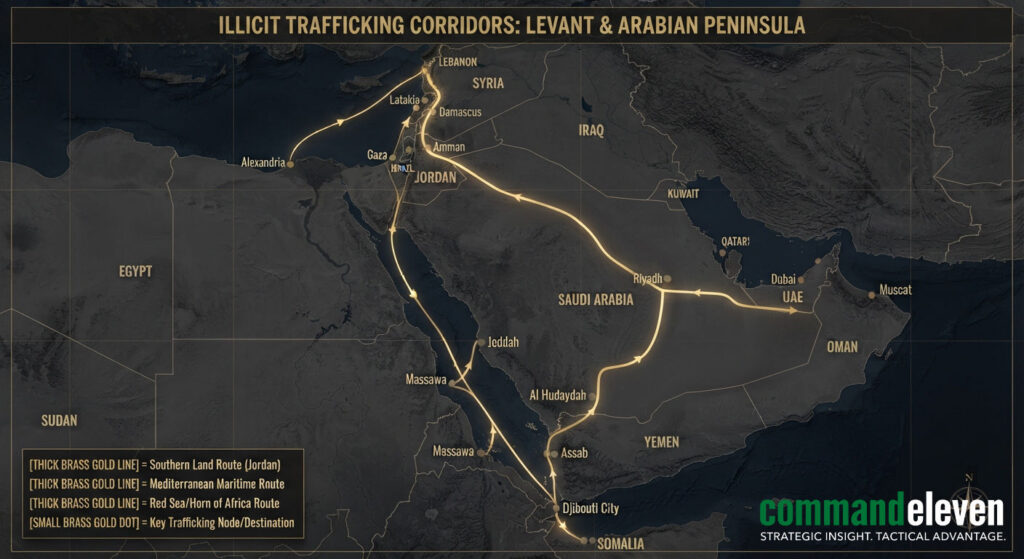
Captagon moves from Syrian and Lebanese production nodes toward Gulf Cooperation Council end-markets , the highest-value consumer base , via three broad corridors.
- Southern land corridor (Jordan): The border between southern Syria and Jordan is the most heavily contested trafficking front, with regular clashes between smuggling networks and the Jordanian Armed Forces as traffickers push shipments toward Saudi Arabia.
- Maritime corridor (Mediterranean): Captagon shipments are concealed within legitimate commercial cargo , industrial machinery, construction materials, and agricultural exports , moving through Latakia and Tartus, often rerouted through intermediary European or North African ports to obscure Syrian origin before reaching Gulf destinations.
- Emerging corridor (Red Sea/Horn of Africa): Trafficking networks have increasingly opened a route through western Iraq into the Red Sea via the Horn of Africa, diversifying away from the more heavily interdicted Jordanian and Mediterranean routes.
Regional interdiction has had a measurable market effect: sustained seizures , including an estimated 177 million tablets (roughly 30 tonnes) across the Arab region , have tightened supply and pushed up retail prices in destination markets, increasing margins for syndicates that successfully deliver intact shipments.
Financial Architecture
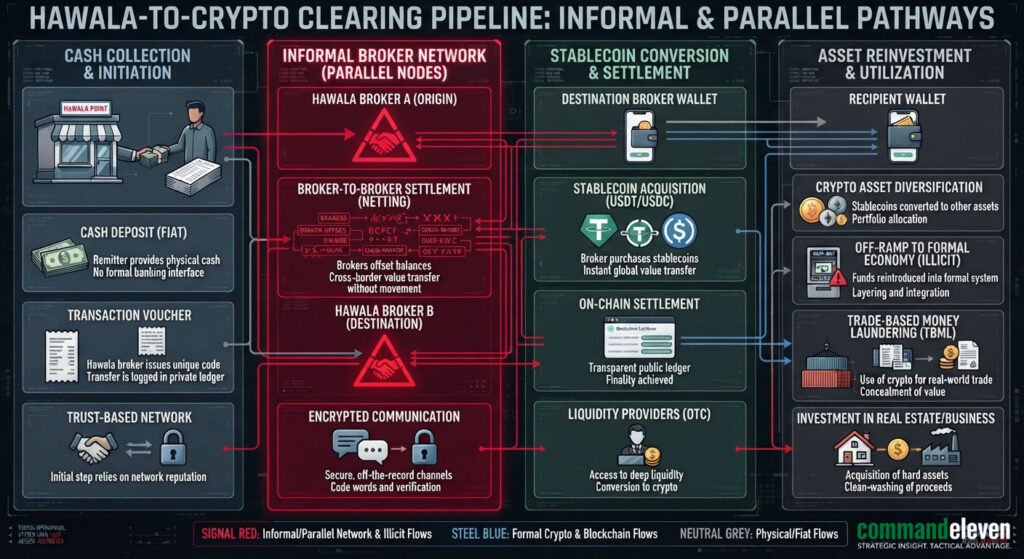
The Captagon trade generates multi-billion-dollar annual revenue that moves almost entirely outside the formal international banking system.
- Hawala networks: Physical cash collected at Gulf consumer markets is cleared through informal hawala brokers operating across Beirut, Damascus, Dubai, and Istanbul, settled through trade-based money laundering rather than conventional bank transfers.
- Cryptocurrency settlement: Higher-tier syndicates increasingly settle wholesale transactions in stablecoins (notably USDT), using over-the-counter crypto desks in regional financial centers to convert digital assets into fiat while insulating funds from international banking sanctions.
- Asset laundering and reinvestment: Illicit proceeds are absorbed into legal economies through investment in real estate, commercial shipping, transport and logistics firms, and hospitality ventures across the Levant and parts of Eastern Europe.
Captagon as a Tool of Statecraft
Both before and after the regime’s fall, Captagon has functioned as more than a revenue stream , it has been wielded as a deliberate instrument of regional leverage.
- Narco-diplomacy: During Syria’s Arab League normalization talks, Damascus tied counter-narcotics cooperation to concessions , reconstruction financing, sanctions relief, and diplomatic re-legitimization , while field intelligence indicated core production nodes were not being dismantled, only lower-tier, non-aligned smugglers.
- Asymmetric leverage against the GCC: CommandEleven assesses the flooding of GCC markets with low-cost, highly addictive stimulants functions as a form of non-linear warfare, generating public-health and internal-security strain in target states that offsets the Gulf’s conventional military and financial advantages.
Market Effects and Emerging Risks
- Synthetic substitution risk: United Nations Office on Drugs and Crime reporting indicates regional syndicates are increasingly retooling existing processing infrastructure toward high-purity methamphetamine production, introducing a cheaper and more destructive substance into regional markets as Captagon supply tightens.
- Environmental and public-health fallout: Ad hoc destruction of seized chemical stockpiles by regional authorities , including open-air burning and uncontrolled dumping , has caused documented soil and water contamination in tri-border areas, a secondary public-health consequence of interdiction itself.
Intelligence Assessment and Forecast (2026–2030)
- Geographic diversification: High-tier traffickers are likely to relocate portions of the industrial pipeline outside the immediate Levant theater, using unstable environments in North Africa , particularly Libya and Sudan , as fallback processing sanctuaries.
- Deepening financial informality: Financial clearing is likely to separate further from formal regional banking, shifting toward decentralized cross-chain finance and privacy-focused settlement methods.
- Persistent enforcement gap: Diplomatic eradication pledges from Damascus are likely to remain largely cosmetic; the trade’s profitability and its embeddedness in provincial security economies make sustained enforcement politically and financially costly for the transitional government.
- Product diversification risk: Continued interdiction pressure is likely to accelerate the shift toward methamphetamine and synthetic-opioid production using existing distribution relationships, introducing new public-health risk to regional and potentially European markets.
Strategic Indicators to Monitor
- Seizure geography and volume: Volume and location of seizures across Jordan, Iraq, and Gulf entry points as a proxy for shifting production and transit geography.
- Cross-border kinetic activity: Frequency and intensity of clashes between trafficking networks and Jordanian and Iraqi border forces.
- Gulf market pricing: Retail price trends in Gulf destination markets as an indicator of supply disruption or market resilience.
- Synthetic-substitution signals: Evidence of processing infrastructure being retooled toward methamphetamine or synthetic opioids.
- Transitional-government enforcement credibility: Syrian transitional-government enforcement actions against production nodes linked to residual regime or Hezbollah-affiliated networks, as a test of political will versus cosmetic compliance.