Key Takeaways
- Fragile, non-structural recovery: Lebanon’s macroeconomic stabilization , 3.5% real GDP growth and easing inflation , is a dollarization-driven rebound, not a structural recovery, and rests on remittances and foreign stipends rather than reformed institutions.
- Entrenched parallel sovereignty: Hezbollah’s AQAH financial network, Al-Sajjad retail system, and independent energy imports constitute a durable parallel sovereignty that formal reform has not begun to dislodge.
- Severe infrastructure and revenue deficit: Postwar damage estimated at $8B–$14B, a bankrupt electricity grid, and captured ports and border crossings leave the formal state financially and physically incapable of reasserting control.
- Structurally bifurcated security sector: The LAF’s dependence on foreign stipends and its policy of avoiding confrontation with non-state actors mean Lebanon’s security landscape will remain bifurcated between a fiscally fragile state force and an entrenched non-state security apparatus.
Executive Summary
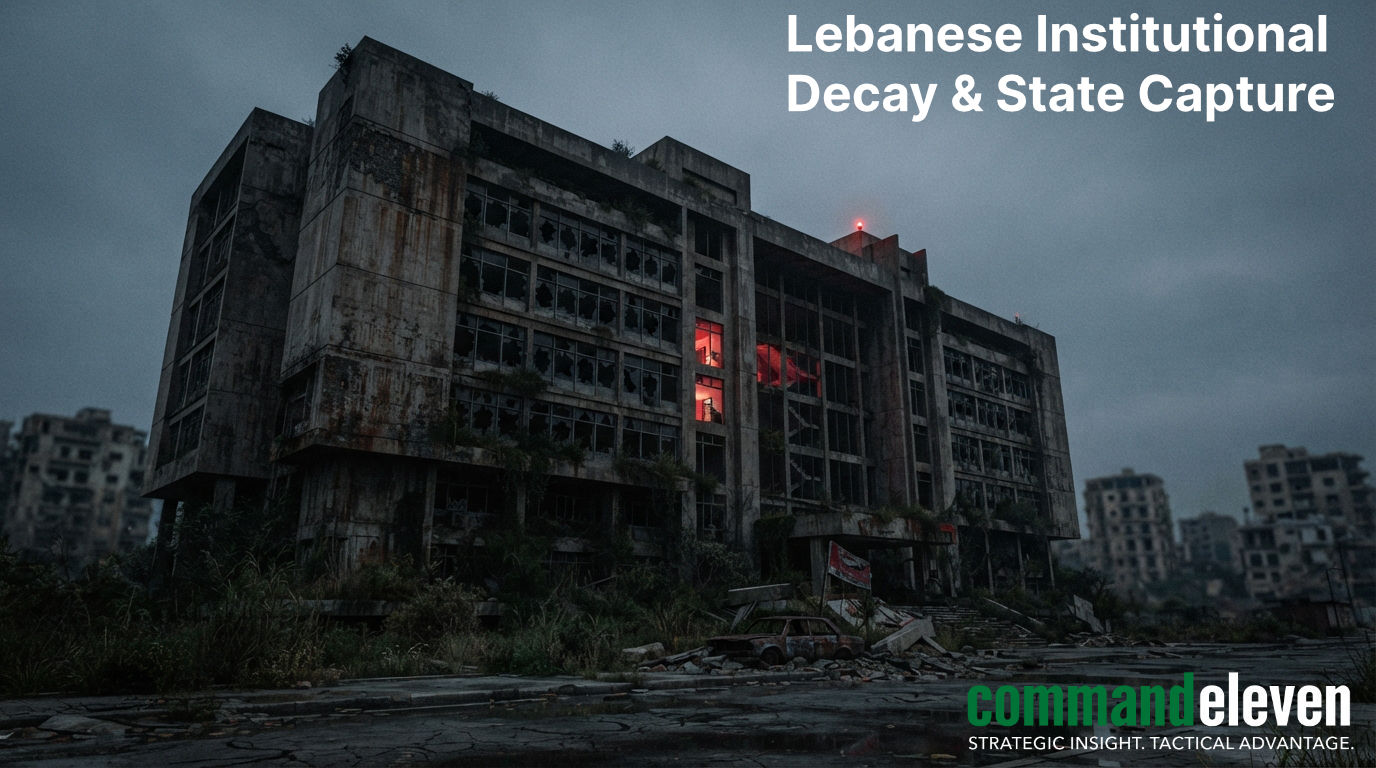
As of late 2026, the Lebanese Republic remains a structurally fragmented state. Formal institutions have stabilized administratively but not substantively: the election of President Joseph Aoun and formation of a centralized cabinet restored a functioning executive process, yet the state has not recovered its monopoly on the legitimate use of violence, its monetary sovereignty, or effective control over its own borders and ports.
CommandEleven Intelligence assesses that Lebanon’s recovery is best described as a fragile, base-effect-driven rebound (real GDP +3.5%, inflation easing toward the mid-teens) occurring in parallel with , not in place of , the permanent entrenchment of non-state governance. Hezbollah’s Al-Qard al-Hassan (AQAH) financial network, independent security zones, and control over key logistics nodes constitute a durable parallel sovereignty that formal reform efforts have not begun to dislodge. Compounding this, postwar reconstruction needs (estimated at $8B–$14B in physical damage) far outstrip the state’s fiscal capacity, deepening dependence on remittances, foreign stipends, and informal cash flows.
This dossier consolidates CommandEleven’s prior Levant-series drafts on Lebanese institutional decay into a single reference assessment, integrating the macroeconomic, financial, infrastructural, security, and governance dimensions of the crisis and forecasting the trajectory through 2030.
Macroeconomic Collapse and Monetary Duality
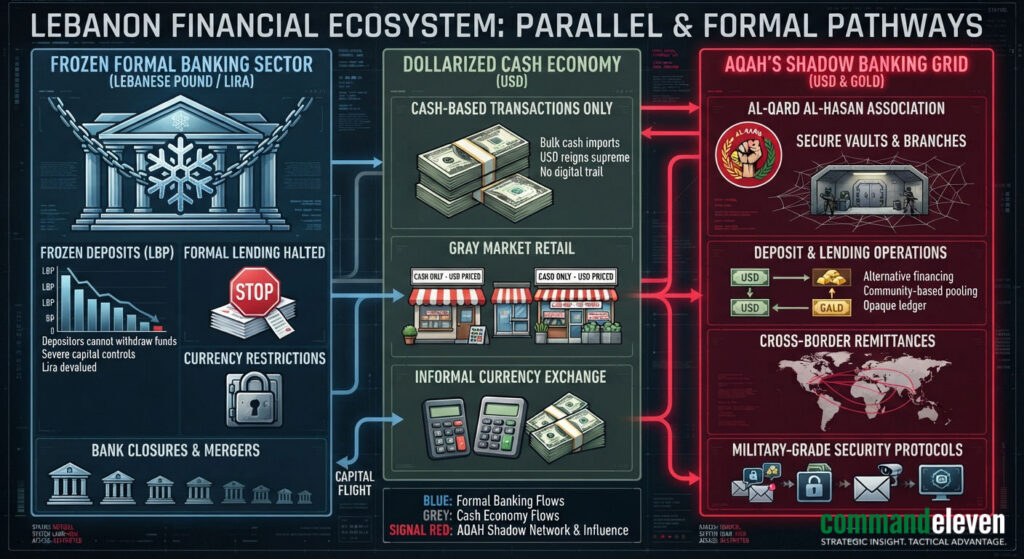
Lebanon’s formal financial system has not recovered from the 2019 sovereign default and banking collapse; it has instead been structurally bypassed by a dollarized cash economy operating largely outside state oversight.
Banking Insolvency and the Financial Gap
- Terminal insolvency: Commercial banks remain functionally insolvent following Banque du Liban’s (BDL) default on foreign-currency obligations. An unaddressed financial gap exceeding $70 billion leaves retail depositors locked out of foreign-currency savings under informal capital controls (the “lollar” haircut).
- Stalled reform: The cabinet’s Financial Stabilization and Deposits Repayment Act (the “Financial Gap” law) addresses the allocation of historic banking losses in principle, but full execution remains blocked by domestic political polarization, leaving standard corporate lending frozen.
Dollarization and the Cash Economy
- Near-total dollarization: Over 90% of consumer transactions, wages, and service pricing are now denominated in US dollars, which halted the hyperinflation spiral but stripped BDL of conventional monetary policy tools.
- Cash-economy expansion: The unrecorded cash economy has grown from roughly 15% of GDP before 2019 to more than 60% today (World Bank estimate), fed by diaspora remittances ($6B–$7B annually), humanitarian assistance, informal trade, and cash-based funding to political-military factions.
- AML/CTF exposure: The absence of an electronic transaction trail heightens Lebanon’s exposure to anti-money-laundering/counter-terrorist-financing (AML/CTF) gaps and the risk of an FATF grey- or blacklist designation.
| Indicator | Pre-2019 Baseline | H2 2026 Status |
| Exchange rate (LBP/USD) | 1,507.5 | ~89,500–90,000 |
| Formal commercial credit | ~$45B active loans | Near zero (frozen) |
| Informal cash economy | ~$2.5B (~15% of GDP) | >$10B (>60% of GDP) |
| Public-sector real wages | Functional benchmark | Equivalent to <$100/month |
| Population below poverty line | ~28% | >75% (World Bank est.) |
Hezbollah’s Parallel Financial and Logistics Architecture
As the formal banking sector froze, Hezbollah institutionalized a self-sufficient shadow economy that now functions as a de facto parallel financial system for its constituency.
Al-Qard al-Hassan (AQAH)
- Scale: Operating since the 1980s as a registered NGO, AQAH functions as an unregulated shadow bank holding hundreds of thousands of accounts. It issues gold-backed, interest-free micro-loans in physical USD and runs an independent ATM network concentrated in Beirut’s southern suburbs (Dahiyeh), the Bekaa Valley, and South Lebanon.
- Sanctions resilience: AQAH operates entirely outside BDL regulation and the SWIFT messaging network, drawing capital from Iranian/IRGC transfers, gold deposits, and diaspora donations. This insulates it from conventional international sanctions and lets Hezbollah pay salaries, fund reconstruction, and sustain its military wing independent of the formal banking freeze.
Parallel Retail and Energy Networks
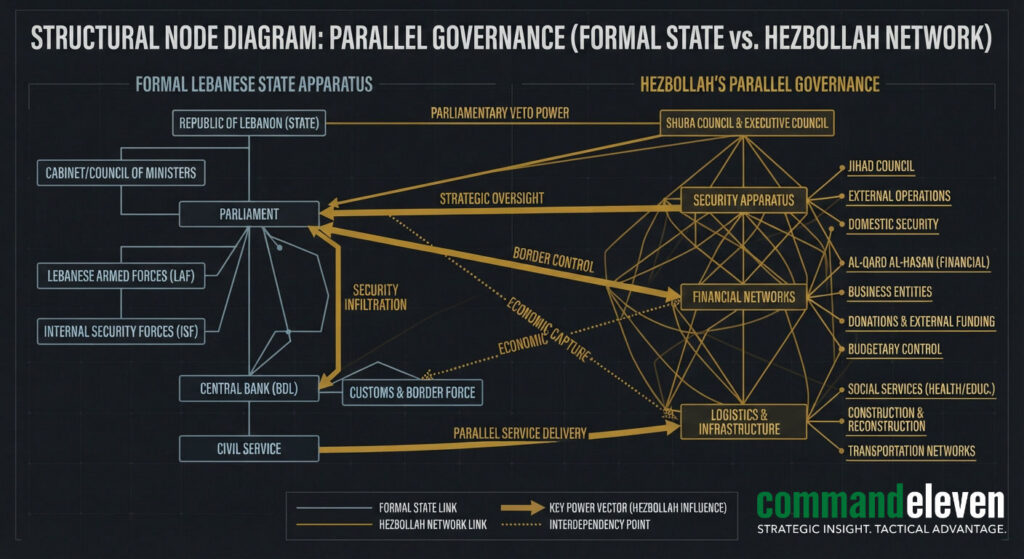
- Al-Sajjad retail network: The “Al-Sajjad” cooperative loyalty-card system distributes subsidized goods imported directly from Iran and Syria through dedicated supermarkets, bypassing formal Lebanese customs and functioning as an insulated social safety net for the group’s base.
- Autonomous fuel supply: Hezbollah coordinates direct overland imports of Iranian hydrocarbons via the Syrian border, distributing fuel to hospitals, municipalities, and generator operators within its zones of influence , positioning the group as a guarantor of life-support infrastructure independent of the Ministry of Energy.
Infrastructure Capture and Sovereign Leakage
The Electricity and Utility Deficit
- EDL collapse: State utility Électricité du Liban (EDL) generates under 300 megawatts against national demand exceeding 3,000 MW, providing as little as two to four hours of grid power daily.
- Generator cartels: Private neighborhood generator cartels , operating with the implicit protection of local political bosses , fill the gap at unregulated USD rates, extracting an estimated $1.5 billion annually from households.
- Water and telecom parallel to EDL: Water pumping stations are frequently offline due to power and fuel shortages, driving dependence on private tanker fleets; telecom outages (OGERO) have similarly spurred illegal satellite and local wireless ISP networks , alongside Hezbollah’s own independent fiber-optic network, which also supports its signals-intelligence capability.
Ports, Airport, and Border Leakage
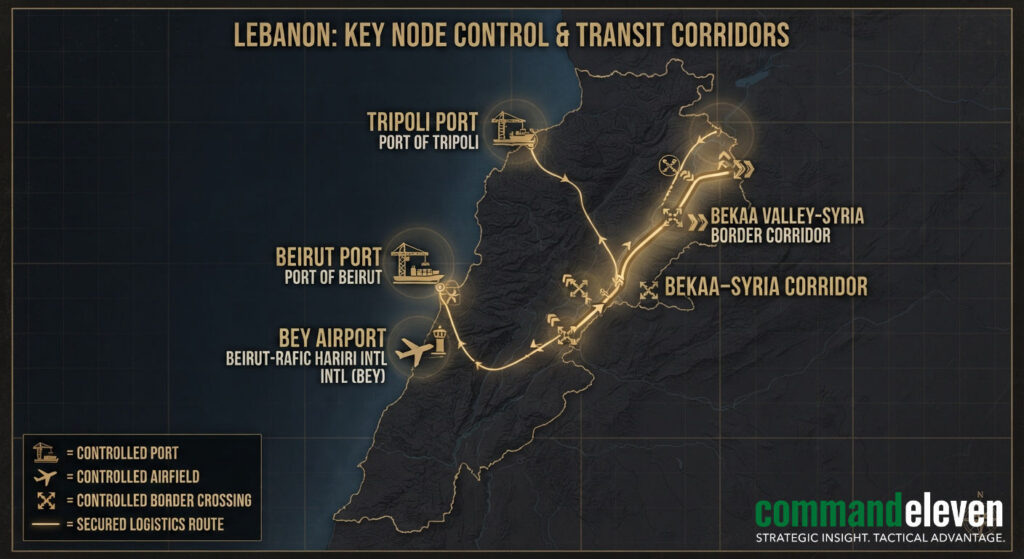
- Seaport capture: The ports of Beirut and Tripoli are divided among factional customs interests that falsify manifests, adjust valuations, and disable container scanners in exchange for illicit fees, depriving the treasury of customs revenue.
- Airport influence: Security around Beirut–Rafic Hariri International Airport (BEY) , including cargo inspection and passenger screening , is heavily influenced by Hezbollah’s dedicated security apparatus, creating unmonitored corridors for cash and sensitive materiel.
- Porous land border: Formal eastern border crossings (Masnaa, Al-Qaa) operate alongside dozens of unmonitored crossing points along the Bekaa–Syria corridor used for fuel, arms components, and personnel transit outside state customs oversight.
Postwar reconstruction estimates vary by source and reporting window , from $8B–$11B in direct structural damage to bridges, highways, and utilities, to a broader $14B figure inclusive of economic losses from the 2023–2024 regional conflict. Either figure far exceeds available sovereign reconstruction financing.
Security Sector Fragmentation
The Lebanese Armed Forces (LAF)
- Fiscal dependency: The LAF remains the only institution retaining cross-sectarian legitimacy, but real-term devaluation has eroded personnel salaries by more than 90%, driving desertion and secondary employment. Operational continuity depends on foreign stipends (notably from the US and Qatar) and foreign military sales grants for equipment and fuel.
- Operational restraint: To avoid internal sectarian fracture, the LAF avoids direct confrontation with non-state armed groups, functioning as an internal-security buffer rather than an enforcer of state monopoly on force.
Non-State Security Dominance
- Parallel security apparatus: Hezbollah maintains independent intelligence and security organs (including units associated with counter-intelligence and specialized operations) operating outside state oversight, with exclusive territorial control in Dahiyeh, the Bekaa, and South Lebanon, including subterranean command infrastructure.
- Political veto power: Through its parliamentary “blocking third,” Hezbollah can stall executive appointments, judicial inquiries, and financial-reform legislation that threatens its operational or financial autonomy , a structural veto that also obstructs the reforms needed to unlock IMF or World Bank support.
Governance, Judicial Paralysis, and Social Strain
- Taif framework breakdown: The Taif Agreement’s consociational power-sharing model has devolved into institutional deadlock, blocking financial-gap legislation, judicial-independence bills, and power-sector reform.
- Judicial invalidation: The judiciary remains politically paralyzed; the frozen investigation into the 2020 Beirut Port explosion remains the clearest symbol of systemic impunity for political and financial elites.
- Refugee and resource strain: Lebanon hosts more than 1.5 million displaced Syrians, straining water, healthcare, and waste-management systems , friction that sectarian factions increasingly exploit rhetorically to deflect from institutional corruption.
- Localized security fragmentation: In Christian, Druze, and Sunni areas alike, localized self-defense groups and private security firms have emerged to fill the vacuum left by municipal policing, further fragmenting national jurisdiction.
Foreign Geopolitical Competition
- Iranian sustainment: Tehran sustains Hezbollah’s political and military infrastructure through continuous hard-currency and fuel transfers, preserving the group’s role as the primary power broker in the Levant.
- Western security assistance: The United States, France, and European partners provide targeted security assistance to the LAF and Internal Security Forces (ISF) aimed at preventing total state failure.
- GCC conditionality: Gulf Cooperation Council states have curtailed direct bailouts, conditioning major assistance on structural reform, anti-corruption enforcement, and reduced Hezbollah dominance.
Intelligence Assessment and Forecast (2026–2030)
CommandEleven Intelligence assesses that Lebanon’s structural fragmentation is unlikely to reverse within the current political framework. Key forecast lines:
- Institutional preservation as facade: Formal offices of state (the presidency, premiership, and parliament) will likely persist chiefly as a legal vehicle for soliciting international aid and loans, rather than as effective governing bodies.
- Electoral paralysis: Upcoming parliamentary elections are likely to produce a polarized legislature that further delays banking-secrecy reform and the laws needed to unlock a formal IMF program.
- Territorial cantonalization: Expect deepening cantonalization, with Christian, Druze, and Sunni enclaves increasingly adopting Hezbollah’s model of localized security and financial self-sufficiency.
- Stagflation risk: A recurrence of regional security incidents disrupting maritime or airport logistics would likely reverse the current fragile recovery, pushing inflation back into double digits via a stagflation cycle.
- Captive foreign policy: Given the state’s inability to enforce maritime or terrestrial boundary treaties, Lebanese territory is likely to remain a forward staging platform for external non-state operations.
Strategic Indicators to Monitor
CommandEleven recommends continuous collection against the following indicators to track the trajectory of Lebanese institutional decay:
- Foreign salary support: Continuity of foreign salary stipends for the LAF/ISF; any reduction would likely trigger a sharp rise in desertion and institutional fragmentation.
- AQAH footprint growth: Rate of AQAH branch and ATM expansion, and growth in gold-backed lending volume, as a proxy for parallel-system entrenchment.
- FATF compliance status: Lebanon’s FATF grey/blacklist trajectory as the unbanked cash economy continues to expand.
- Parallel exchange-rate spreads: Divergence between official BDL rates, money-transfer-company rates, and informal street rates as an indicator of capital flight.
- Utility collapse frequency: Frequency of grid blackouts exceeding 48 consecutive hours and their correlation with local civil unrest.
- Infrastructure friction incidents: Friction incidents between state and non-state security personnel at Beirut’s port and airport perimeters.