

Executive Summary
As of May 2026, Hypersonic Glide Vehicles (HGV) have fundamentally disrupted the global strategic balance by neutralizing traditional Integrated Air and Missile Defense (IAMD) architectures. Operating within the “uncertainty zone” of 40 – 100 km, HGVs utilize aerodynamic lift and atmospheric skipping to bypass exo-atmospheric interceptors and terrestrial radars. This technical analysis identifies two primary drivers of this disruption: the Aero-Thermodynamic Barrier, which requires advanced UHTC materials to survive 2,000°C+ temperatures, and the Decision Window Collapse, which reduces retaliation timelines to under ten minutes. CommandEleven Intelligence warns that the dual-capability of these platforms, combined with their unpredictable trajectories, has significantly increased the risk of inadvertent escalation and the erosion of Mutually Assured Destruction (MAD).
3 Key Takeaways
- Kinetic Neutralization: HGVs exploit the “seam” in current defenses, using non-ballistic maneuvering to stay below the reach of SM-3 interceptors and above terminal point defenses like THAAD.
- Material Science as a Strategic Bottleneck: The ability to maintain structural integrity and communication through an ionized plasma sheath at Mach 5+ remains the primary engineering hurdle for sustained hypersonic flight.
- The AI Necessity: The reduction of warning times forces a transition toward autonomous fire-control systems and space-based LEO sensor layers, as human-speed decision-making is no longer viable for hypersonic interception.
Flight Mechanics and the “Uncertainty Zone”
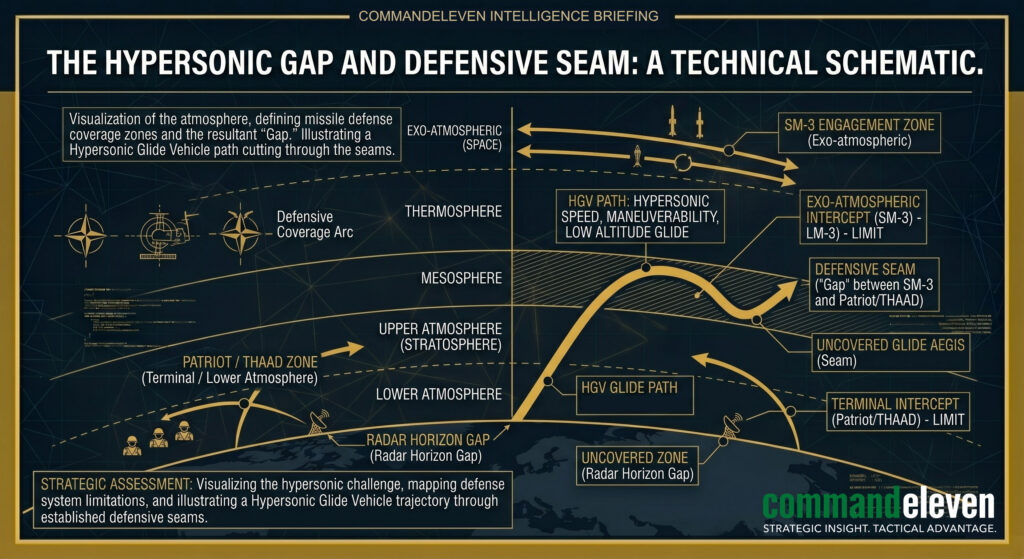
The operational advantage of a Hypersonic Glide Vehicle (HGV) lies in its ability to exploit the “seam” between traditional air defense layers. By operating in the near-space environment (40 – 100 km), HGVs remain too low for exo-atmospheric interceptors and too high for most tactical surface-to-air missiles.
Boost-Glide Dynamics and Separation
Unlike an ICBM, which remains attached to its booster for a full ballistic arc, an HGV utilizes its rocket booster only for initial acceleration and altitude.
- Separation Profile: Upon reaching the edge of the atmosphere, the glide body detaches. Instead of continuing into a high-apogee vacuum, it pitches down to “level off” within the thin upper atmosphere.
- Aerodynamic Lift: The HGV is designed with a high lift-to-drag ratio – typically around 2.6 at Mach 20. This allows the vehicle to convert its massive kinetic energy into aerodynamic lift, enabling sustained flight at altitudes where conventional aircraft would stall.
Atmospheric Skipping (Phugoid Trajectories)
The HGV employs a “skip-glide” or phugoid motion, effectively bouncing off the denser layers of the atmosphere like a stone skipping across water.
- Energy Management: Each “skip” allows the vehicle to extend its range by briefly exiting the denser atmosphere to minimize drag, before dipping back down to generate the lift required for the next maneuver.
- The Tracking Gap: These oscillations create significant difficulties for ground-based radars. Because the vehicle’s altitude and velocity are constantly shifting in a non-Keplerian fashion, fire-control computers cannot rely on gravity-based parabolic models to predict its future position.
Trajectory Unpredictability and IPP Neutralization
Traditional missile defense relies on Impact Point Prediction (IPP). If you know the launch coordinates and the initial velocity, the laws of physics dictate a singular, predictable destination.
- Cross-Range Maneuverability: HGVs can perform aggressive lateral maneuvers, shifting their flight path by hundreds of kilometers during the glide phase.
- The Interception Window: By the time a defense system detects a maneuver, the pre-calculated “interception box” is already obsolete. This forces the defender into a “reactive” mode, drastically reducing the probability of a kinetic kill.
Engineering Constraints: The Plasma Shield and Thermal Loading
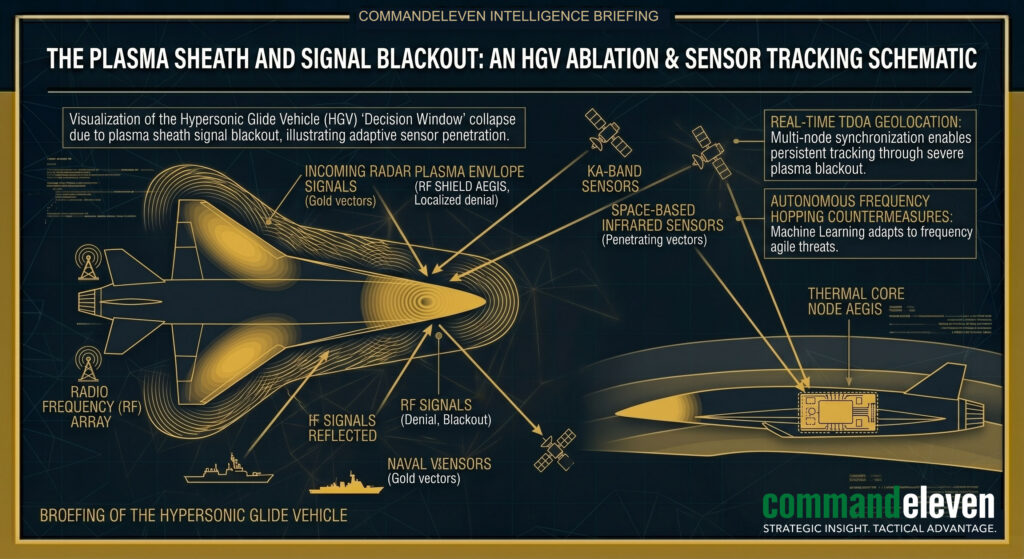
Operating at Mach 5+ within the atmosphere creates a “hostile laboratory” environment. The friction between the air and the vehicle airframe generates temperatures that would liquefy standard aerospace alloys.
Aero-Thermodynamics and Leading-Edge Stress
Stagnation points, such as the nose cone and leading edges of the winglets, bear the brunt of the atmospheric compression.
- Thermal Gradients: Temperatures at these points can exceed 2,000°C to 3,000°C. In contrast, the internal electronics must be maintained at operational temperatures, creating an extreme thermal gradient across just a few centimeters of material.
- Ablation vs. Hot Structure: Legacy re-entry vehicles used ablative shields that charred and flaked away to carry heat. Modern HGVs require “Hot Structures” – materials that retain their shape and structural integrity while glowing white-hot to maintain aerodynamic precision throughout the flight.
Material Science: UHTCs and C/C Composites
The survival of the airframe depends on two primary classes of advanced materials:
- Carbon/Carbon (C/C) Composites: These provide high specific strength and thermal shock resistance. However, they oxidize rapidly above 500°C, requiring sophisticated ceramic coatings to prevent “burn-through” during the long-duration glide.
- Ultra-High-Temperature Ceramics (UHTCs): Compounds such as Zirconium Diboride and Hafnium Diboride are used for sharp leading edges. These materials have melting points above 3,000°C and maintain the knife-like geometry required for hypersonic lift generation.
The Plasma Communications Blackout
As the HGV compresses the air, it creates a “shock layer” so hot that it strips electrons from gas molecules, creating a localized envelope of ionized gas (plasma).
- Signal Attenuation: This plasma sheath acts as an electromagnetic shield. Standard S, C, and X-band frequencies (1 – 10 GHz) used for GPS and telemetry are reflected or absorbed by the plasma, leading to a total “communications blackout.”
- Technical Workarounds: 2026-era engineering solutions include aerodynamic “shaping” to create thin spots in the plasma (windows) or using ultra-high-frequency (Ka-band or higher) signals that can penetrate higher electron densities.
Interception Challenges: The Defensive Gap
The arrival of the Hypersonic Glide Vehicle (HGV) has rendered the current global Integrated Air and Missile Defense (IAMD) architectures functionally porous. The technical challenge is not merely the speed of the threat, but the compression of the “detect-to-engage” sequence.
Sensor Blind Spots and the Curvature Constraint
Traditional terrestrial radar systems are limited by the physical horizon.
- The Horizon Problem: A ballistic missile, which arches high into space, is detectable by Long-Range Discrimination Radars (LRDR) almost immediately after boost-phase. In contrast, an HGV’s lower flight altitude (40 – 70 km) allows it to stay hidden behind the Earth’s curvature for a significantly longer duration.
- Reaction Time Degradation: By the time a ground-based X-band radar acquires a track on an incoming HGV, the vehicle may be less than 500 km away. At Mach 10, this leaves the defender with less than 150 seconds to verify the threat, assign an interceptor, and achieve a kinetic solution.
Interceptor Kinematics and the “Energy Gap”
Current interceptors, such as the SM-3 or THAAD, are designed to hit targets moving on predictable paths.
- Lateral G-Load Mismatch: To intercept a maneuvering target, the interceptor must be able to out-maneuver it, typically requiring a maneuver capability $3times$ to $5times$ greater than the target. While an HGV can pull high-G turns in the thin atmosphere, current exo-atmospheric interceptors rely on Divert and Attitude Control Systems (DACS) that are optimized for space, not the aerodynamic stresses of the upper atmosphere.
- The “Basket” Problem: Because the HGV can shift its terminal impact point late in flight, the “threat cloud” or “uncertainty basket” that the interceptor must cover is too vast for a single kinetic-kill vehicle to reliably manage.
Directed Energy and Non-Kinetic Solutions
Given the difficulty of “hitting a bullet with a bullet” at hypersonic speeds, the defense industry has pivoted toward speed-of-light solutions.
- High-Power Lasers (HEL): To neutralize an HGV, a laser must dwell on a specific point of the airframe long enough to induce structural failure. However, since HGVs are already designed to withstand extreme aero-thermodynamic heating, a laser must exceed the vehicle’s existing thermal protection thresholds, requiring megawatt-class power levels that are not yet mobile-deployable.
- High-Power Microwaves (HPM): Rather than melting the airframe, HPM systems aim to “fry” the internal guidance electronics. This is particularly effective against HGVs because the plasma sheath (discussed in Section III) can, under specific conditions, act as an antenna, funneling the microwave energy directly into the vehicle’s unshielded internal components.
Strategic Stability and “First-Strike” Incentives
The introduction of HGVs does not merely change the mechanics of war; it fundamentally alters the psychology of deterrence. The collapse of warning times creates a “use it or lose it” dilemma for nuclear-armed states.
Compression of the Decision Window
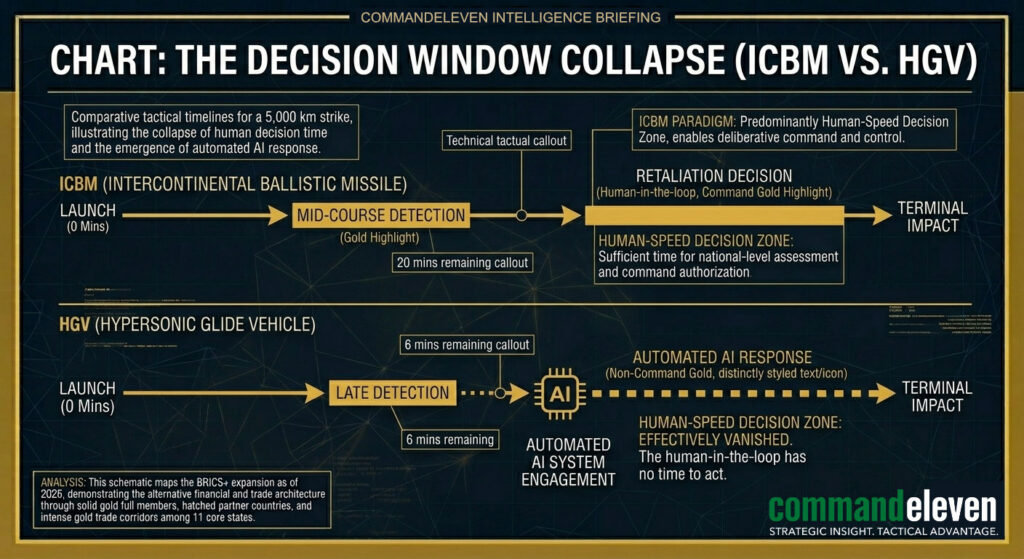
In the Cold War era, the “Dead Hand” or retaliatory strike was predicated on a 20-to-30-minute warning.
- Decision Paralysis: With HGVs, the time from detection to impact in a regional theater can be as low as 5 to 7 minutes. This forces national leadership to either delegate launch authority to automated AI systems or pre-delegate it to field commanders, both of which drastically increase the risk of accidental escalation.
- Launch-on-Warning: The inability to intercept an HGV encourages a “Launch-on-Warning” posture. If a state believes its command-and-control nodes are about to be decapitated by an uninterceptible hypersonic strike, they are incentivized to launch their entire arsenal immediately upon the first radar hit.
Target Ambiguity and the “Warhead Dilemma”
One of the most destabilizing features of HGVs is their dual-capability (Conventional or Nuclear).
- The Ambiguity Trap: When a defender detects an incoming HGV – such as the Russian Avangard or Chinese DF-17 – they have no way of knowing if it is carrying a tactical conventional payload or a strategic nuclear warhead.
- Inadvertent Escalation: If a state mistakenly identifies a conventional strike as a nuclear decapitation attempt and responds with a nuclear counter-strike, the “Hypersonic Seam” has effectively triggered a full-scale global conflict from a localized engagement.
Erosion of Mutually Assured Destruction (MAD)
The historical stability of MAD relied on the certainty of retaliation.
- The Decapitation Strike: HGVs offer the theoretical possibility of a “Splendid First Strike” – the ability to destroy an adversary’s leadership and communication infrastructure before they can even confirm an attack is underway.
- The Arms Race Spiral: As one state deploys HGVs to bypass defenses, the adversary does not respond by building more defenses (which are failing), but by building their own HGVs. This leads to a quantitative arms race where the only defense is a faster offense, further eroding global strategic stability.
Intelligence Assessment & Forecasting (2026 – 2030)
The trajectory of hypersonic warfare indicates that the current “defensive gap” will catalyze a radical transformation in global sensing and automated response. CommandEleven Intelligence assesses that by 2030, the reliance on human-in-the-loop decision-making for missile defense will be phased out in favor of autonomous, space-based architectures.
The Transition to Space-Based Sensor Layers
Terrestrial and maritime radar systems have reached their physical limits regarding HGV detection. The shift toward orbital sensing is the only viable path to achieving “birth-to-death” tracking.
- LEO Constellation Integration: By 2027, the deployment of Low-Earth Orbit (LEO) constellations, specifically the Hypersonic and Ballistic Tracking Space Sensor (HBTSS), will provide the high-sensitivity infrared telemetry required to track the heat signatures of HGVs throughout their glide phase.
- Cued Engagement: These satellite layers will act as the “eyes” for terrestrial interceptors, providing mid-course updates that allow interceptors to be launched toward an “uncertainty box” before ground-based radars even acquire the target.
Autonomous Interception and AI-Driven Fire Control
The compression of the decision window to less than five minutes necessitates the removal of human latency from the kill chain.
- Non-Linear Interception Algorithms: Standard linear prediction models are failing. Future fire-control systems will utilize machine learning to analyze the “maneuver habits” of specific HGV platforms, predicting the most likely lateral shifts based on atmospheric density and velocity.
- The “Algorithmic Trigger”: We forecast the implementation of “Pre-Authorized Autonomous Response” protocols. In this scenario, AI systems will be granted the authority to launch non-kinetic or kinetic interceptors the moment a hypersonic threat is confirmed, with human oversight restricted to a “veto-only” role.
Counter-Hypersonic Proliferation and Asymmetric Leveling
While HGVs are currently the province of tier-one military powers, the technology is rapidly trickling down to regional actors through technology transfers and indigenous development.
- Regional Arms Races: The deployment of HGVs in the Indian Subcontinent and the MENA region will fundamentally destabilize localized balances of power. Smaller states may view HGVs as a “silver bullet” to neutralize the conventional naval or air superiority of larger neighbors.
- The “Hypersonic Proxy”: There is a significant risk of “proxy-level” hypersonic deployment, where major powers provide downgraded HGV technology to allied non-state or semi-state actors to test defensive responses in active conflict zones without risking direct escalation.
Final Technical Summary
Hypersonic Glide Vehicles represent more than a faster missile; they represent the obsolescence of static defense. For CommandEleven Intelligence, the baseline assumption is that any fixed high-value asset – aircraft carriers, command bunkers, or energy hubs – must now be considered vulnerable. Survival in the 2026 – 2030 era depends on Distributed Deterrence and the rapid adoption of space-based sensing to reclaim the lost minutes of the decision window.