Executive Summary
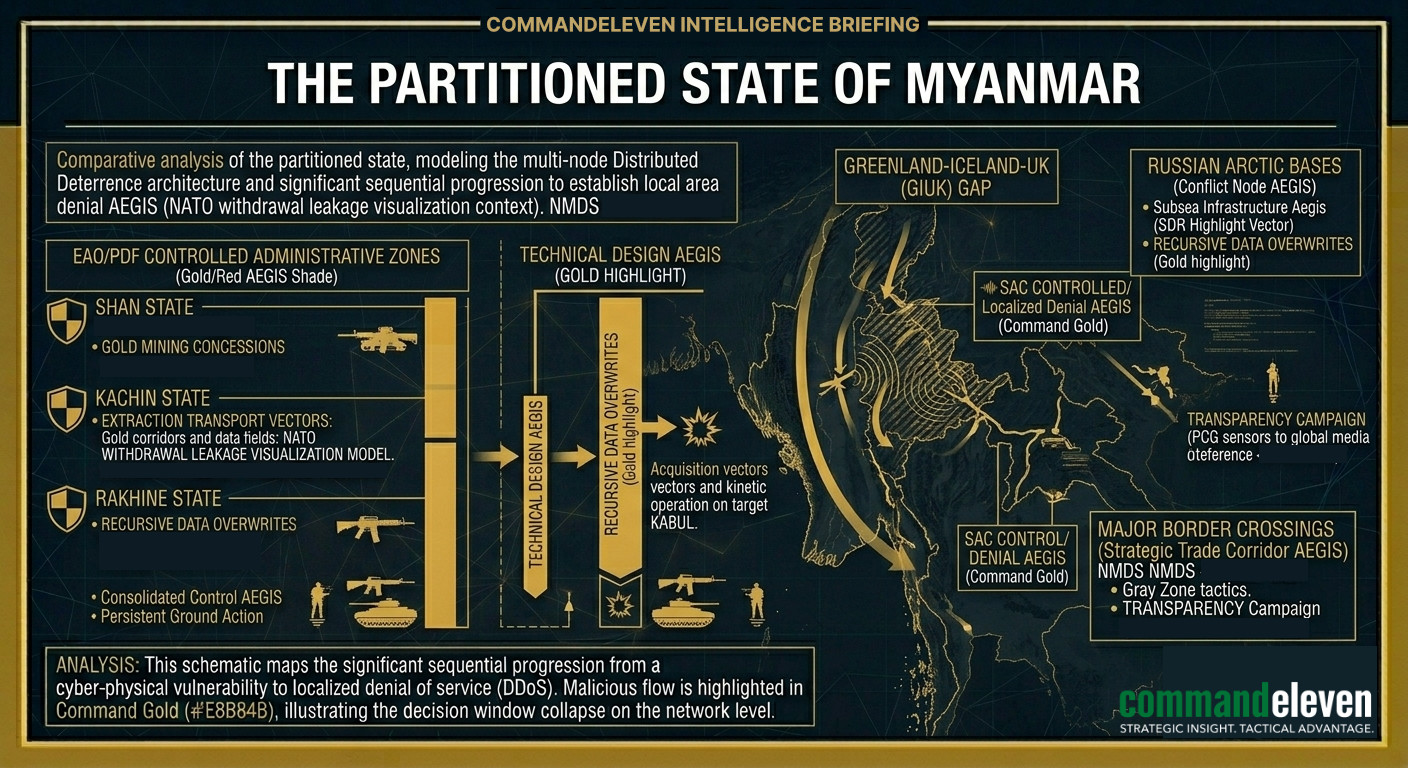
As of May 2026, the Myanmar Civil War has transitioned from a fragmented insurgency into a systemic territorial repartitioning of the state. The State Administration Council (SAC) has effectively retracted to the central Bamar heartland and fortified urban centers, while the periphery is governed by an increasingly sophisticated network of Ethnic Armed Organizations (EAOs) and People’s Defense Forces (PDFs). The institutionalization of EAO governance in Shan, Kachin, and Rakhine states has created functional proto-states that manage taxation, justice, and infrastructure. This collapse of the SAC’s frontline morale and the emergence of a decentralized Myanmar have fundamentally reshaped regional border security and forced neighboring powers, particularly China, into a posture of extreme pragmatism to secure strategic economic corridors.
3 Key Takeaways
- Institutionalization of Non-State Governance: EAOs, specifically the Arakan Army and the Three Brotherhood Alliance, have transitioned from guerrilla forces to functional administrative bodies, providing judicial and civil services that supersede the retracted central state.
- Systemic Military Attrition: The Sit-Tat is facing a terminal manpower crisis, characterized by hollowed-out battalions and failed conscription efforts, leading to a defensive “fortress” posture in urban centers.
- Geopolitical Pragmatism: Regional powers are bypassing the central junta to engage directly with EAOs to secure critical infrastructure, such as the China-Myanmar Economic Corridor (CMEC), reflecting the reality of Myanmar’s fragmentation.
The Retraction of the State Administration Council (SAC)
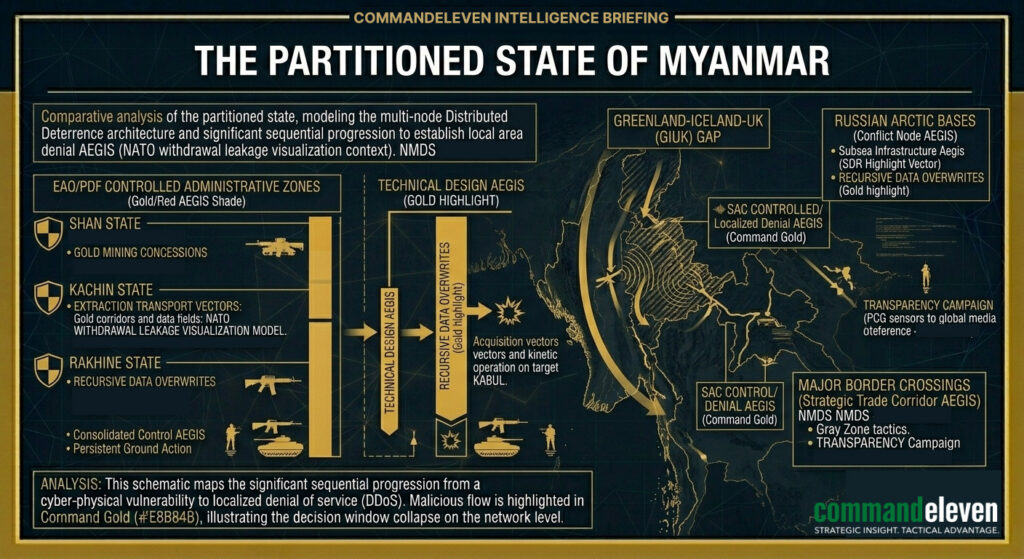
The SAC’s “fortress” strategy, initiated in early 2025, has reached a critical failure point. By concentrating remaining loyalist battalions in Naypyidaw, Yangon, and Mandalay, the military junta has conceded vast swaths of the borderlands to the Three Brotherhood Alliance and the Arakan Army (AA).
- Logistic Attrition: Interdiction of major highways (Route 1 and Route 2) by PDF cells has rendered the overland resupply of isolated junta outposts impossible.
- The Manpower Deficit: The 2024 conscription law has failed to fill the ranks of the Sit-Tat. Desertion rates in the first quarter of 2026 have increased by 22 percent compared to the same period in 2025.
EAO Governance and Post-Junta Administration
In liberated zones, the “Resistance” is no longer a clandestine movement but a functional administrative body.
- The Shan State Model: The Myanmar National Democratic Alliance Army (MNDAA) and the Ta’ang National Liberation Army (TNLA) have established civil administrations that manage taxation, electricity, and local policing.
- The Arakan Army (AA) Sovereignty: In Rakhine State, the AA has achieved near-total autonomy. The “Way of Rakhita” is now the primary judicial and administrative framework, operating with a degree of sophistication that mirrors a sovereign state.
Regional Stability and Border Dynamics
The fragmentation of Myanmar has created immediate security challenges for neighboring states.
- The Thai-Myanmar Border: Increased refugee flows and the spillover of kinetic exchanges into Thai territory have forced Bangkok to shift from “quiet diplomacy” to an active border fortification posture.
- China’s Strategic Balancing: Beijing continues to maintain ties with both the SAC and key EAOs along the northern border to secure its energy pipelines and the China-Myanmar Economic Corridor (CMEC).
Ethnic Armed Organization (EAO) Consolidation and Strategic Governance
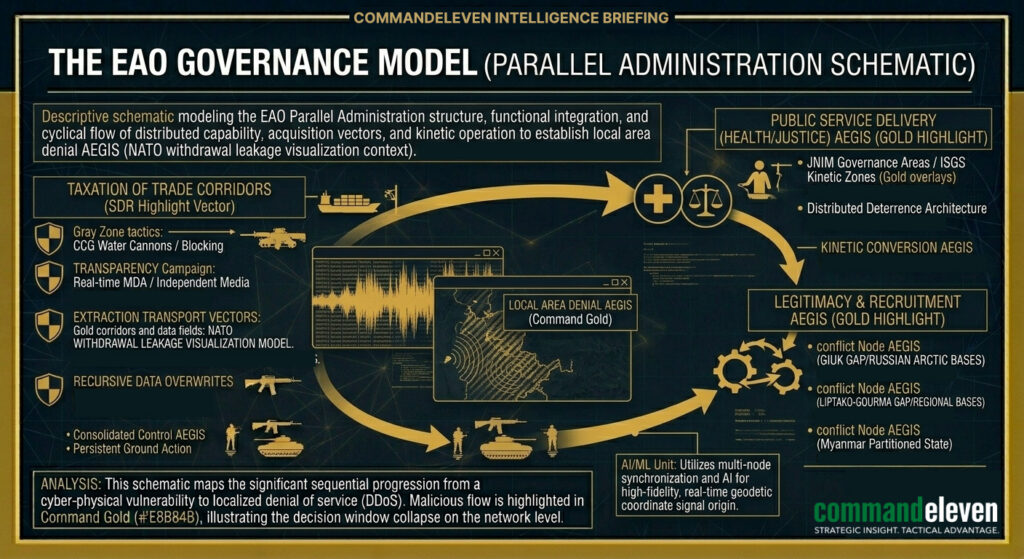
As of May 2026, the territorial landscape of Myanmar has shifted from fluid frontline exchanges to the institutionalization of non-state governance. Resistance forces, primarily the Three Brotherhood Alliance, have effectively transitioned from guerrilla warfare to civil administration across nearly 70 percent of Myanmar’s territory. By December 2024, the military had lost its Northeastern Command in Lashio and its Western Command in Ann, marking a terminal loss of strategic control in Shan and Rakhine States.
The “Way of Rakhita”: The Arakan Army’s Proto-State
In Rakhine State, the Arakan Army (AA) has operationalized a parallel state structure that is now the de facto authority for millions.
- Judicial and Civil Autonomy: The AA’s political wing, the United League of Arakan (ULA), has implemented a comprehensive judicial system that operates independently of the SAC. This system manages land disputes, criminal justice, and taxation, often drawing on local legitimacy that the Bamar-led Sit-Tat never achieved.
- Public Services: Despite the junta’s continued air supremacy and retaliatory strikes, the ULA has maintained basic infrastructure, including health clinics and local policing, utilizing a decentralized revenue model based on the taxation of trade corridors and natural resources.
Shan State and the “Northern Alliance” Administrative Hubs
In northern Shan State, the Myanmar National Democratic Alliance Army (MNDAA) and the Ta’ang National Liberation Army (TNLA) have established administrative hubs in captured district capitals such as Laukkai and Lashio.
- Economic Integration: These zones are increasingly integrated with the Chinese economy. Local governance focuses on stabilizing border trade, managing hydropower assets, and reopening the China-Myanmar Economic Corridor (CMEC) infrastructure under EAO oversight.
- Tactical Friction: While these groups cooperate within the Three Brotherhood Alliance, 2026 reports indicate localized friction over the demarcation of tax collection zones and the management of high-value artisanal mines, necessitating a continuous diplomatic balancing act among the alliance members.
Sit-Tat Capability Attrition: The Collapse of Professionalism
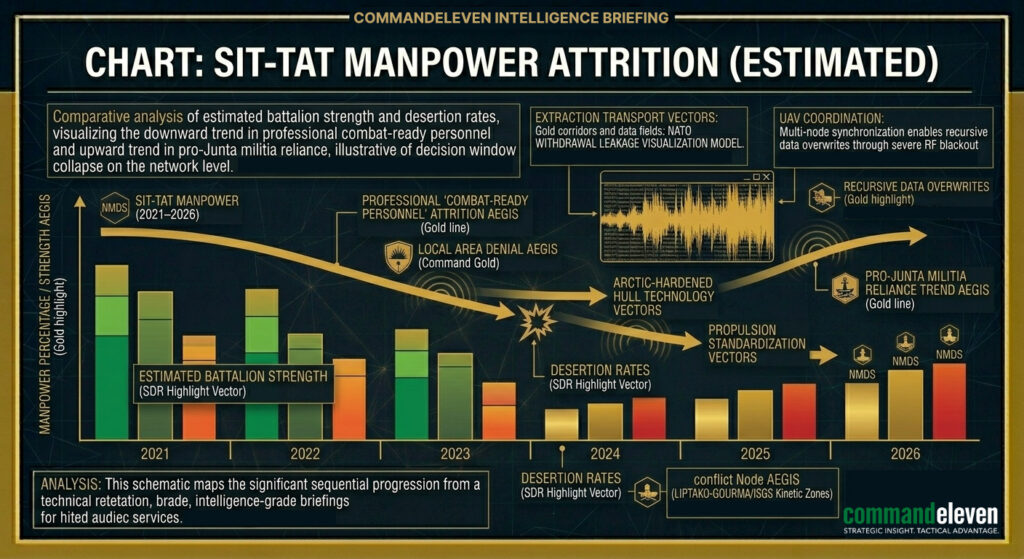
The State Administration Council (SAC) military, the Sit-Tat, is no longer the cohesive force that seized power in 2021. By May 2026, its “fortress” strategy,concentrating forces in the Bamar heartland,has resulted in a hollowed-out command structure plagued by structural decay.
Demographic and Manpower Crises
The 2024 mandatory conscription law has failed to provide a viable solution to the Sit-Tat’s manpower deficit.
- Desertion and Defection: Estimates for early 2026 show that desertion rates remain high, with thousands of low-ranking personnel abandoning posts rather than facing the high-attrition “clearance” operations ordered by Naypyidaw. The loss of regional command headquarters has shattered the myth of military invincibility, leading to a profound morale crisis.
- Hollow Battalions: Many Sit-Tat battalions currently operate at 40 to 50 percent of their designated strength. The reliance on pro-junta militias, such as the Pyusawhti, has diluted professional standards and increased the frequency of war crimes, further alienating the civilian population.
Technological Stagnation vs. Asymmetric Evolution
The Sit-Tat’s primary remaining advantage,air supremacy,is being challenged by resistance innovation.
- Air Support Constraints: While the Myanmar Air Force continues to conduct heavy shelling and aerial strikes, its effectiveness is limited by logistical bottlenecks and the increasing risk of shoulder-fired anti-aircraft systems (MANPADS) acquired by EAOs.
- Asymmetric Parity: PDFs and EAOs have industrialized the use of First-Person View (FPV) drones and improvised loitering munitions. This has forced the Sit-Tat to adopt a defensive, bunkered posture, where even reinforced bases in the central Dry Zone are vulnerable to precision aerial harassment.
Geopolitical Realignment: China’s Pragmatic Pivot
Beijing’s strategy in Myanmar as of 2026 is one of extreme pragmatism. While China continues to deal with the SAC for formal diplomatic purposes, its operational focus has shifted to the EAOs that control the physical infrastructure of the CMEC.
Securing the CMEC Infrastructure
- Infrastructure Protection: China has established direct communication channels with the MNDAA and TNLA to ensure that gas and oil pipelines,critical to China’s energy security,remain operational.
- Border Stabilization: Beijing has pressured both the junta and the Northern Alliance to maintain “trade corridors” even during active conflict. This has resulted in a unique “conflict-trade” hybrid, where goods continue to flow across the border while military operations occur only kilometers away.
The US and “Values-Based” Engagement
The US and its allies remain supportive of the National Unity Government (NUG) but struggle with the lack of a unified resistance military command.
- Sanctions Efficacy: US-led sanctions targeting aviation fuel and military-controlled banks have hindered the SAC’s ability to sustain long-term offensives but have not led to a systemic collapse.
- The Shadow Economy: The rise of a resistance-controlled shadow economy, including the mining of rare earth elements in EAO-held territories, provides an alternative revenue stream that bypasses the formal global financial system.