Summary
The Senate Select Committee on Intelligence convenes its annual Worldwide Threats hearing on Tuesday, March 18, 2026. This is not a routine oversight session.
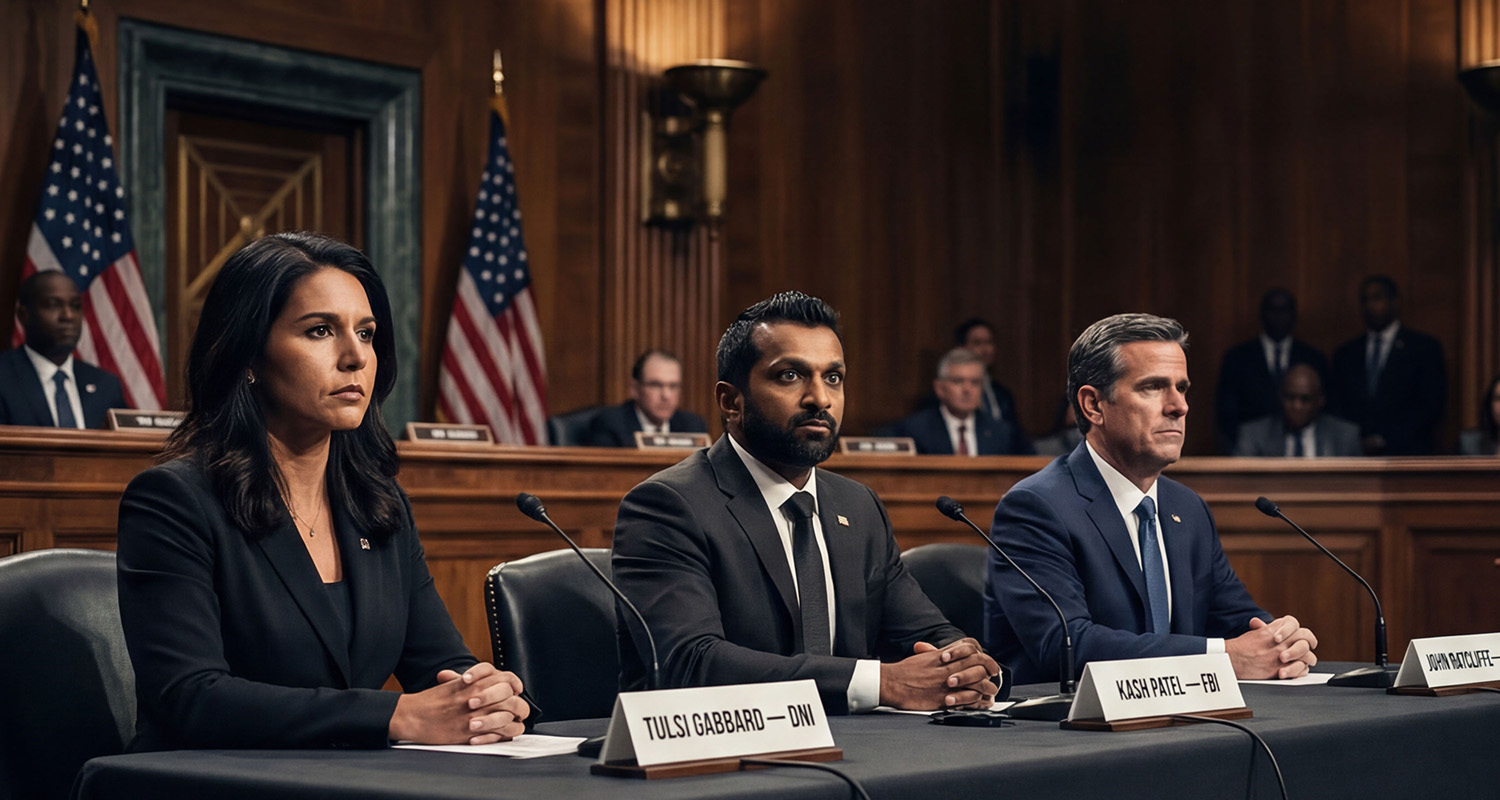
Three intelligence principals will testify — Director of National Intelligence Tulsi Gabbard, CIA Director John Ratcliffe, and FBI Director Kash Patel — and each arrives under extraordinary circumstances that have no recent precedent.
The hearing takes place against a backdrop of active military conflict. Operation Epic Fury, the U.S. strikes against Iranian nuclear and military infrastructure, has reshaped the intelligence environment in ways that the Intelligence Community has not yet fully processed, let alone translated into reliable assessments. Iran has not responded with the mass-casualty attack that many analysts predicted. It has instead activated a layered, distributed pressure campaign — maritime, cyber, proxy, and potential homeland — that defies the binary deterrence logic of previous administrations.
The three witnesses represent a departure from the institutionalist culture that has historically insulated the DNI, CIA, and FBI from political friction during this hearing.
Gabbard brings a skepticism of intelligence community (IC) orthodoxy that has made career analysts uncomfortable. Ratcliffe inherits an agency still processing the operational consequences of Epic Fury. Patel runs a bureau whose domestic counterterrorism posture is under pressure from multiple simultaneous threat streams — four known domestic kinetic events in the preceding months, a confirmed 93% lone-actor probability assessment, and a persistent question about what CJNG’s 35-plus city cells are actually positioned to do.
The SSCI has its own fault lines. The committee’s Republican majority will push for more aggressive posture and lean into the vindication narrative of Epic Fury.
Democratic members will probe casualty figures — specifically the KC-135 floor of 13 U.S. personnel, six non-combat and seven combat — and the legal basis for continued operations. The Article 51 self-defense notification to the UN Security Council, submitted by the administration before the strikes, will surface in questioning about whether the legal predicate holds.
What distinguishes this hearing from its predecessors is the convergence of three threat streams that previously had separate committee jurisdictions:
- Iran as a state actor (SSCI-traditional)
- the IRGC-cartel nexus as an organized crime and border security problem (SJC and Homeland)
- the domestic radicalization vector (FBI-dominant)
All three will collide in Tuesday’s testimony.
The committee will attempt to use the public hearing to establish the narrative frame before the closed session, where the actual damage assessments live.
The classified annex is almost certainly where the Khamenei status question, the MuddyWater pre-positioning of U.S. infrastructure, and the true state of Hezbollah’s rocket inventory will be addressed.
The public hearing will produce headlines. The closed session will produce policy.
This intelligence assessment provides CommandEleven’s pre-hearing intelligence briefing:
- what each witness will face
- what the committee factions want
- what the IC will and will not disclose publicly
- what to watch for in real time
OPERATIONAL INSIGHT: To evaluate the technical frameworks CommandEleven utilizes to mitigate these specific risks, view our Intelligence Operational Architecture or explore our broader Government and Defense portfolio.