Summary
Part One of this 4-part co-authored series from CommandEleven Intelligence and Survival Dispatch was published yesterday on our affiliated platform Dead Drop Intel, which discusses in detail the real possibility of the Iranian threat to the US homeland.
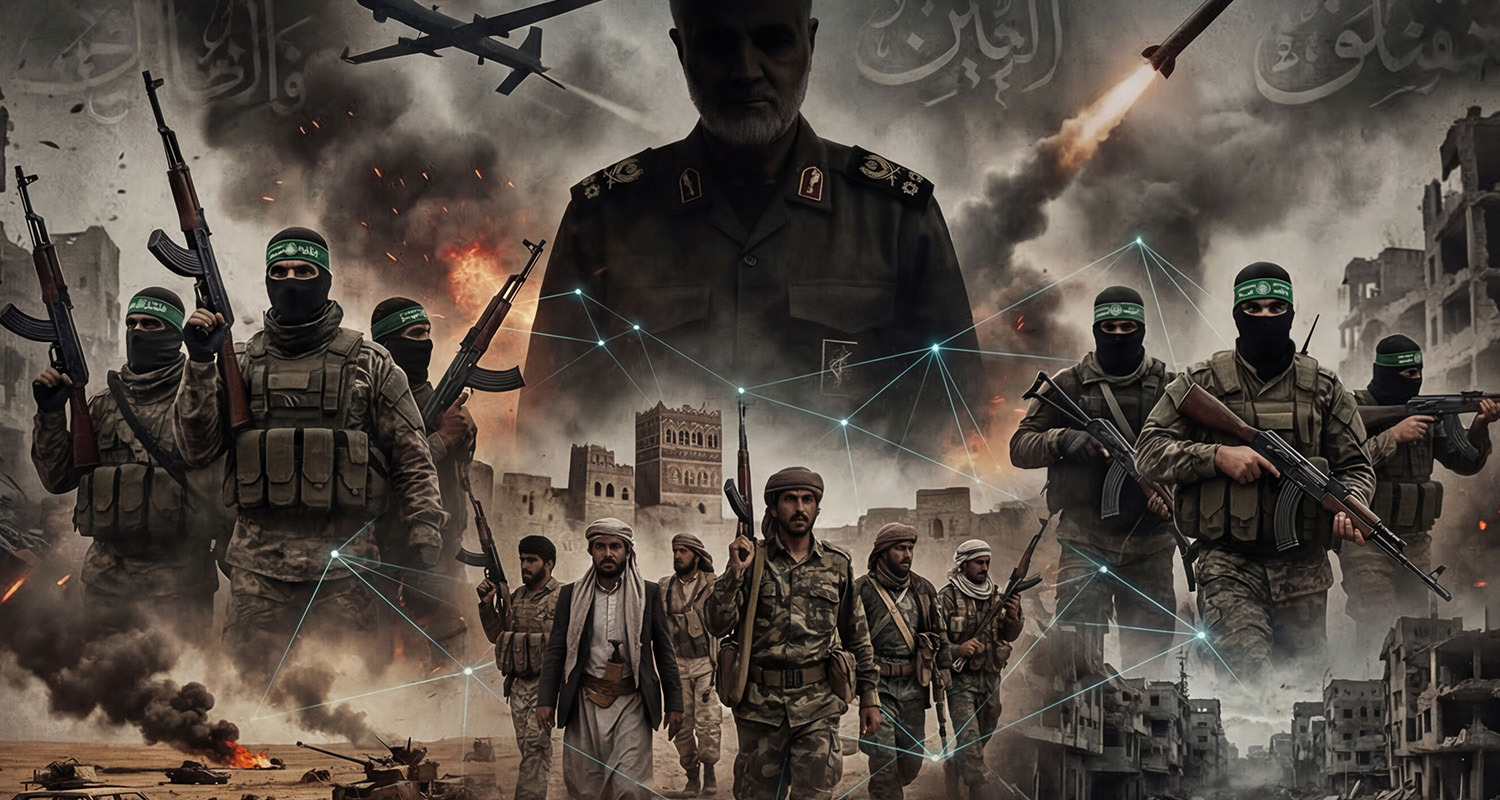
Iran’s Islamic Revolutionary Guard Corps — principally through its Quds Force expeditionary arm — has spent four decades constructing the most sophisticated state-sponsored terrorist and insurgent network in the contemporary world. What Tehran calls the “Axis of Resistance” is, in operational terms, a distributed force-multiplication architecture: a constellation of armed Non-State Actors stretching from the Lebanese Mediterranean coast through Gaza, Syria, Iraq, and Yemen, each receiving Iranian weapons, financing, training, and strategic direction in exchange for serving as kinetic instruments of Iranian regional policy.
It must be understood that this architecture is not circumstantially assembled. It was deliberately designed.
The Quds Force, under successive commanders from Ahmad Vahidi through Qasem Soleimani to the current Esmail Qaani, developed over four decades a doctrine of asymmetric forward deployment — positioning lethal capability against Iran’s adversaries at maximum geographic range while maintaining deniability and minimizing direct Iranian exposure.
The result is a network through which Tehran can:
- threaten American bases in Iraq, Syria, and the Gulf
- sustain military pressure on Israel from four simultaneous fronts
- hold Saudi and Emirati energy infrastructure at risk
- interdict global maritime commerce through Bab al-Mandab and the Red Sea
- project influence into Pakistani domestic politics through a combination of financial patronage and support for Baloch insurgent actors
The sustained military campaign of Epic Fury — American and allied strikes against Iranian nuclear facilities, IRGC command nodes, and defense infrastructure since late 2025 — has degraded but not dismantled this network. Hezbollah absorbed unprecedented leadership losses in 2024. Hamas lost Yahya Sinwar, Mohammed Deif, and Ismail Haniyeh within months of one another. The Houthis have sustained consistent American and allied bombardment through the Red Sea interdiction campaign. The IRGC’s own command tier has been depleted: Mohammad Reza Zahedi, the Quds Force Syria-Lebanon commander, was eliminated in the April 2024 Damascus strike. Thirty-one autonomous regional IRGC commanders now operate with significant independence, their command chains to Tehran severed or degraded.
Yet the network functions.
Hezbollah fired its “Al-Asf al-Ma’kul” salvo from southern Lebanon as recently as March 2026, demonstrating residual rocket capacity despite the 2024 war.
The Houthis activated their Bab al-Mandab “Hour Zero” threat concurrent with the Hormuz closure. Iraqi armed groups placed bounties on US and CIA commanders in theater.
The Pakistan-border Jaish al-Adl relationship continues to generate cross-border provocations.
What has changed is not the network’s existence. What has changed is its degree of independence from Tehran — and that change cuts both ways.