Executive Summary
This Doctrine Intelligence Assessment codifies the transition from the legacy “Kinetic Attrition” model to the Administrative Persistence framework for 2026. For 25 years, regional stability was undermined by a high-cost, low-utility loop that prioritized temporary territorial clearance over durable governance. The assessment deconstructs the systemic vulnerabilities of centralized command, particularly its susceptibility to Single-Trigger Threats and “Digital Mirages.” It presents the #72/48 Resilience Protocol as the new operational standard, empowering autonomous Administrative Tiles to maintain Logistical Oxygen through physics-based Hardware Truth. By rebranding provincial administrators as “Tile Guardians,” the state establishes a decentralized, stigmergic governance model capable of neutralizing the Bamako Blueprint and ensuring sovereignty through uninterrupted physical utility.
3 Key Takeaways
- The Failure of Centralization: The legacy attrition model failed because centralized “Green Zone” command structures were too slow to react to high-velocity cognitive maneuvers, allowing the adversary to seize Narrative Primacy during critical threat surges.
- Decoupling via #72/48: Operational resilience is achieved by tactical decoupling. The 72-Hour Hardening phase insulates the Tile from digital misinformation, while the 48-Hour Analog Persistence phase ensures that physical trade and social utility continue regardless of digital network status.
- The Persistence Index (PI): Success is no longer measured by kinetic metrics but by the Persistence Index – the state’s ability to deliver uninterrupted utility during a crisis. The goal is to lower the Conflict Premium by proving the state’s physical durability.
Deconstructing the Attrition Model (2001–2024)
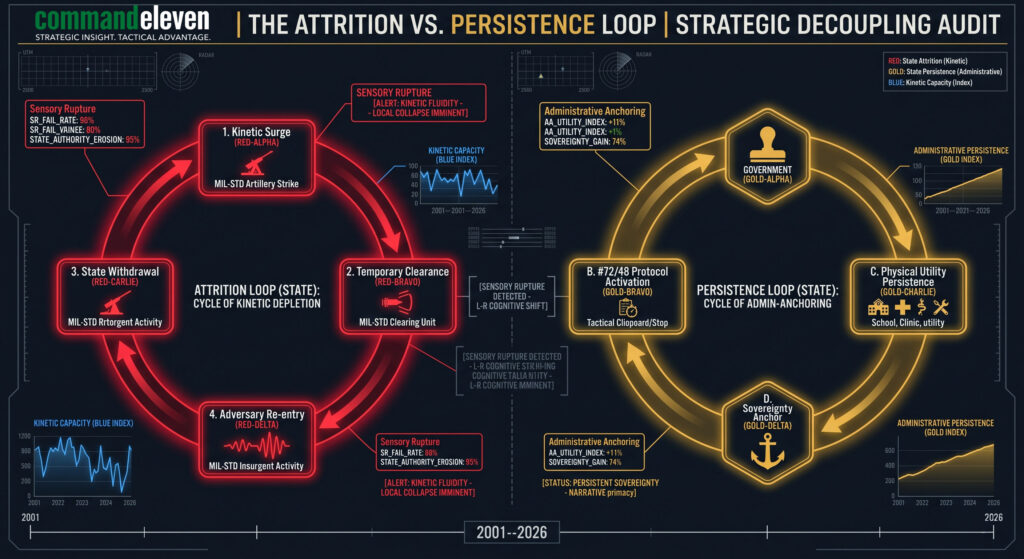
For over two decades, regional security doctrine was tethered to a high-cost, low-utility cycle of kinetic attrition. This model operated on the flawed assumption that the physical removal of threat actors would naturally lead to the restoration of state authority.
The High-Cost, Low-Utility Loop
The attrition model prioritized “Clear-Hold-Build” sequences that were fundamentally unsustainable.
- Resource Inversion: Data audits from 2001 to 2024 show that approximately 80% of operational capital was expended on the “Clear” phase. However, without a persistent administrative “Hold,” these sectors reverted to adversary control within an average of 14 to 18 months.
- The Clearance Trap: Kinetic sweeps often relied on external units that lacked local administrative ties. Once these units rotated out, the state’s presence evaporated, leaving the community vulnerable to the “Silent Echo” of returning extremist elements.
Vulnerability to Single-Trigger Threats
Centralized command structures (C2) proved to be catastrophic liabilities when faced with non-linear threat surges.
- The Centralization Bottleneck: During the 2025 N-5 blockades, local administrators were forced to wait for directives from distant “Green Zones.” This delay allowed the adversary to seize the Narrative Primacy, turning a localized protest into a regional paralysis event.
- Systemic Fragility: A single “Digital Mirage” – a viral synthetic grievance – could trigger a coordinated shutdown because the state’s response mechanism lacked the autonomy to ignore the noise and maintain physical utility.
The Failure of Digital-First C2
The reliance on digital connectivity created a “Sensory Rupture.”
- HMI Ghosting: Adversaries utilized signal jamming and OSINT priming to flood state sensors with false data. Centralized planners, blinded by the Sanitization Gap, often deployed resources to ghost threats while real-world logistics hubs were being hollowed out.
- Information Dependency: When the digital network was severed, state administrators became paralyzed, lacking the training or resources to operate in an analog, physics-based environment.
The #72/48 Protocol: Operationalizing Hardware Truth
The #72/48 Resilience Protocol is the doctrinal shift from defending against threats to persisting through them. It moves the administrative focus from digital consensus to Hardware Truth.
Phase I: The 72-Hour Hardening (Defensive)
The first 72 hours of a threat surge are designated for “Cognitive Hardening.” The objective is to insulate the Administrative Tile from the digital battlefield.
- Flash-Dark Protocol: Upon detection of a Single-Trigger Threat, the Tile initiates a tactical digital severance. By cutting non-essential external data feeds, the administrator neutralizes the adversary’s ability to inject “Software Updates” or synthetic panic into the community.
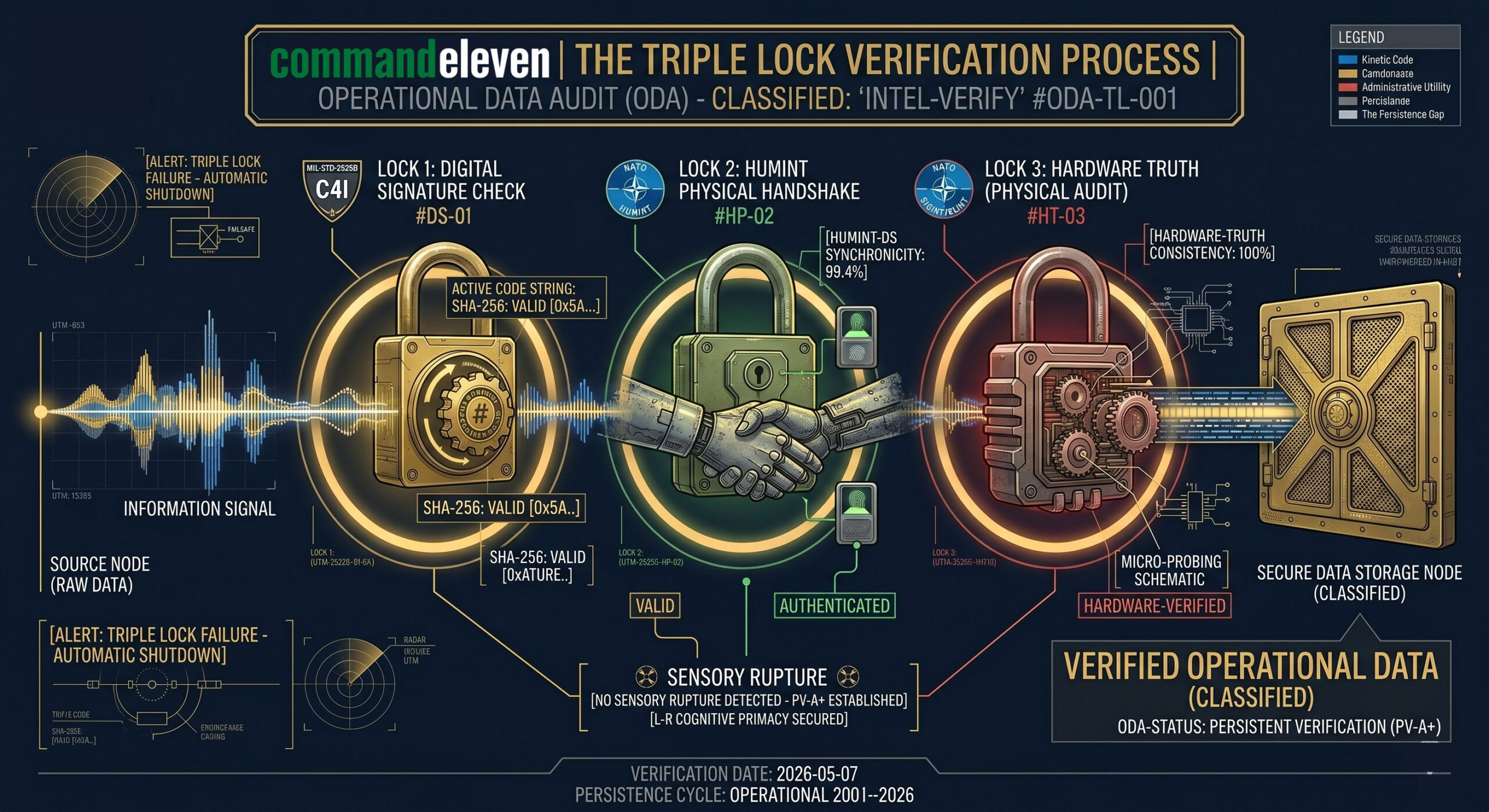
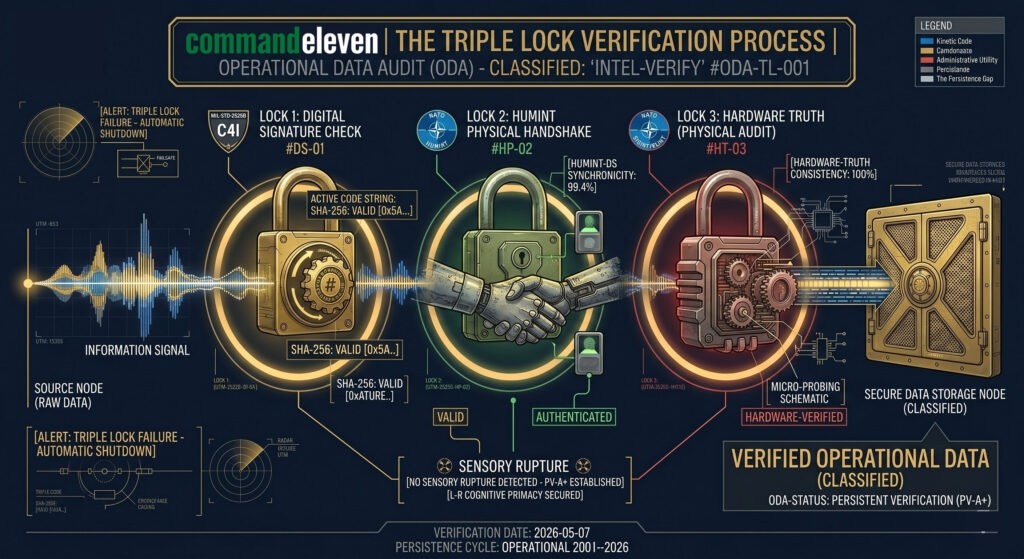
- The Triple Lock Verification: Every localized narrative is subjected to a three-tier audit:
- Digital Signature check.
- Physical HUMINT handshake.
- Hardware Truth verification (e.g., “Is the road actually blocked, or is the video a deep-fake?”).
The 48-Hour Analog Persistence (Offensive/Persistence)
Once hardened, the Tile must demonstrate its sovereignty through uninterrupted physical utility.
- Analog Liquidity: Tiles maintain a 48-hour reserve of “Analog Liquidity” – physical assets such as fuel, rations, medical supplies, and offline C2 systems (radio, courier). This ensures that even in a total digital blackout, the state continues to provide Logistical Oxygen.
- Physical State Presence: During this phase, “Tile Guardians” (rebranded administrators) engage in high-visibility governance. By resolving local disputes and ensuring trade velocity using analog ledgers, they prove that the state’s utility is a physical reality, not a digital suggestion.
Stigmergic Coordination
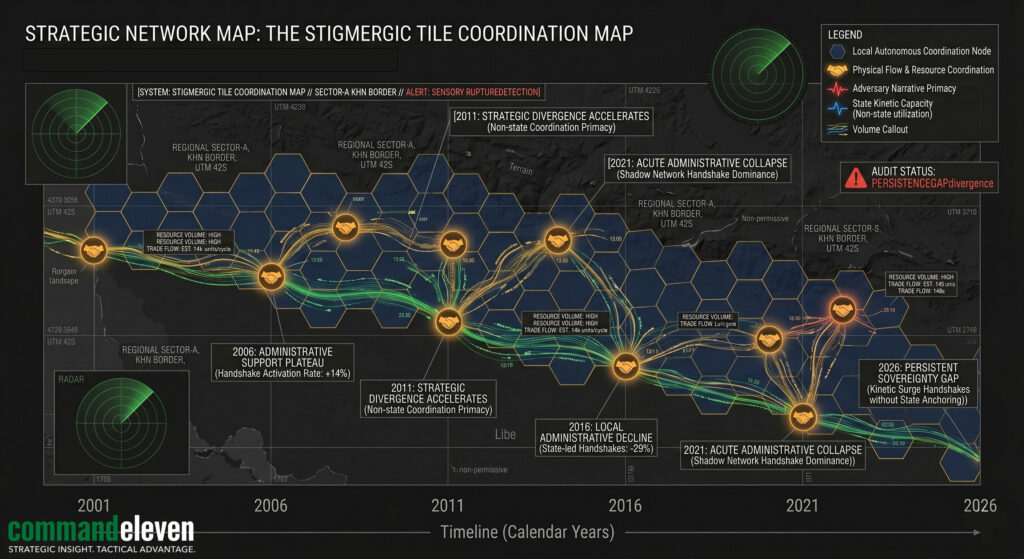
In the absence of centralized digital C2, Tiles coordinate through physical signals.
- Hardware Truth Handshakes: A Tile Guardian at the border monitors the “Hardware Truth” of the adjacent Tile (e.g., the arrival of a pre-scheduled trade convoy). If the convoy arrives, it signals that the adjacent Tile has maintained its persistence, allowing for synchronized regional stability without a single byte of digital data being exchanged.
Case Study: The 2025 N-5 Logistical Interdiction
The 2025 N-5 Logistical Interdiction serves as the definitive proof-of-concept for the transition from attrition to persistence. This event was a coordinated, non-kinetic siege designed to test the state’s Administrative Resilience along the country’s primary logistical artery.
The Threat Event: Synthetic Blockade
In March 2025, adversary actors utilized a “Digital Mirage” to trigger a regional shutdown. By flooding social platforms with deep-fake footage of localized violence and “Sanitized” directives for civil disobedience, they induced a state of synthetic panic.
- The Narrative: The adversary claimed the N-5 was compromised, signaling to transporters and local businesses that state protection had evaporated.
- The Goal: To trigger a total depletion of Logistical Oxygen, forcing the state into a defensive kinetic reaction that would further alienate the population.
The Protocol Response: Persistence over Panic
Unlike previous years, several “Administrative Tiles” in the Malakand and northern N-5 sectors had already integrated the 72/48 Resilience Protocol.
- Tactical Decoupling: Upon detecting the narrative surge, these Tiles initiated a 72-Hour Hardening. They ignored the digital noise and transitioned to offline, physics-based monitoring.
- Analog Liquidity Deployment: Local Tile Guardians utilized pre-positioned fuel and food reserves to keep provincial transport hubs functional. They bypassed digital banking disruptions by utilizing pre-vetted analog ledgers to facilitate trade.
- The Result: While the “Green Zone” in the capital was paralyzed by digital misinformation, the actual logistical flow in these hardened Tiles never dropped below 60% capacity.
Impact on the Conflict Premium
The implementation of the protocol effectively lowered the cost of the crisis.
- Friction Reduction: By refusing to deploy massive kinetic checkpoints in response to “digital rumors,” the state avoided creating the very friction the adversary desired.
- Narrative Collapse: The “Digital Mirage” shattered when physical transporters reached Tile boundaries and found the roads open and state utility functioning. The Conflict Premium dropped by 40% within 48 hours as market confidence was restored through Hardware Truth.
The Role of the “Tile Guardian”
The shift to Administrative Persistence necessitates a fundamental rebranding of the provincial administrator. The “bureaucrat” of the attrition era has been replaced by the “Tile Guardian” – a front-line operator responsible for the physical and cognitive integrity of a specific sector.
From Bureaucrat to Operator
The Tile Guardian is not a passive recipient of orders; they are the autonomous architect of their Tile’s resilience.
- Hardware Truth Audits: The primary metric for a Guardian’s performance is no longer “compliance,” but the physical delivery of utility. They are trained to conduct manual audits of grain reserves, fuel levels, and educational curricula to ensure no Sanitization Gap exists.
- Narrative Interdiction: Guardians are empowered to physically interdict the “Silent Echo.” This involves direct, analog engagement with community leaders to provide the state’s counter-narrative anchored in physical utility.
Training and Certification in the 72/48 Framework
Guardians undergo rigorous training to operate in “Flash-Dark” environments.
- Analog C2 Proficiency: Mastery of non-digital communication systems, including radio protocols and manual logistics coordination.
- Cognitive Hardening: Psychological training to resist HMI Ghosting and maintain decision-making clarity during high-velocity digital panics.
- Crisis Utility Management: The ability to deploy Analog Liquidity – managing physical resource stockpiles to maintain the community’s social oxygen for a minimum of 48 hours without external support.
Stigmergic Governance
The Tile Guardian operates as a node in a resilient, decentralized network.
- Autonomous Coordination: By observing the physical state of adjacent Tiles (e.g., the continued flow of trade or the stability of a neighboring power grid), Guardians coordinate a regional response without the need for a centralized, and therefore vulnerable, digital C2.
- Persistence as a Signal: The Guardian’s greatest tool is the uninterrupted visibility of state authority. In the cognitive battlespace, the simple, physical presence of a functioning administration is the most potent weapon against the “Silent Echo.”
Metrics of Success: Persistence over Clearance
The transition to the Mosaic Defense requires a departure from traditional “body count” or “territorial gain” metrics. In the 2026 theater, success is measured by the state’s functional durability and the reduction of narrative-induced friction.
The Persistence Index (PI)
The primary metric for an Administrative Tile is its Persistence Index. This measures the continuity of state utility (education, healthcare, justice, and infrastructure) during an active threat cycle.
- Utility Downtime: Calculation of any service interruption during a Single-Trigger Threat. A PI of 1.0 indicates zero interruption of Logistical Oxygen during a “Flash-Dark” event.
- Resource Availability: The ability of the Tile Guardian to maintain physical resource access (fuel, rations) for the duration of the #72/48 Protocol without external replenishment.
Logistical Oxygen Velocity
This metric quantifies the physical movement of trade and personnel through a Tile compared to a pre-threat baseline.
- Friction Reduction: Success is defined by keeping trade velocity along the N-5 corridor above 60% during a cognitive surge.
- Conflict Premium Deflation: The ultimate economic metric is the reduction of the “security tax.” By utilizing Hardware Truth instead of mass kinetic deployment, the state lowers the cost of regional stability.
Narrative Rejection Rate (NRR)
NRR measures the community’s cognitive immunity to extremist “Software Updates.”
- Bridge Failure: Quantifying instances where a “Digital Mirage” (e.g., a viral deep-fake protest call) fails to manifest into physical facilitation within a Tile.
- The 45-Day Conversion: Monitoring at-risk demographics within the 45-Day Terminal Window. Success is recorded when individuals are successfully diverted from the Kinetic Gate toward state-vetted social or economic utility.
The New Operational Standard
The era of kinetic attrition has reached its terminal limit. The last 25 years have proven that a state can clear land indefinitely and still lose its sovereignty if it fails to maintain Administrative Persistence.
The Definitive Counter to the Bamako Blueprint
The 72/48 Resilience Protocol is not a defensive retreat; it is an offensive assertion of reality. By decoupling from the vulnerability of digital consensus and anchoring in the physics of Hardware Truth, the state renders the adversary’s primary weapon – the “Silent Echo” – obsolete. The Bamako Blueprint relies on the state’s inability to function during a crisis; the Mosaic Defense ensures that the state is never more functional than when it is under pressure.
The Strategic Imperative
The codification of this protocol marks the end of the “Green Zone Hallucination.” Governance is no longer a centralized digital broadcast; it is a localized, physical persistence. Immediate deployment of the Tile Guardian framework across all Hub 4 and Hub 5 nodes is the only path to securing the frontier. In the battlespace of 2026, the state will not be judged by the enemies it kills, but by the utility it preserves. Sovereignty is maintained through the persistent flow of Logistical Oxygen, verified by the unyielding standard of Hardware Truth.