Executive Summary
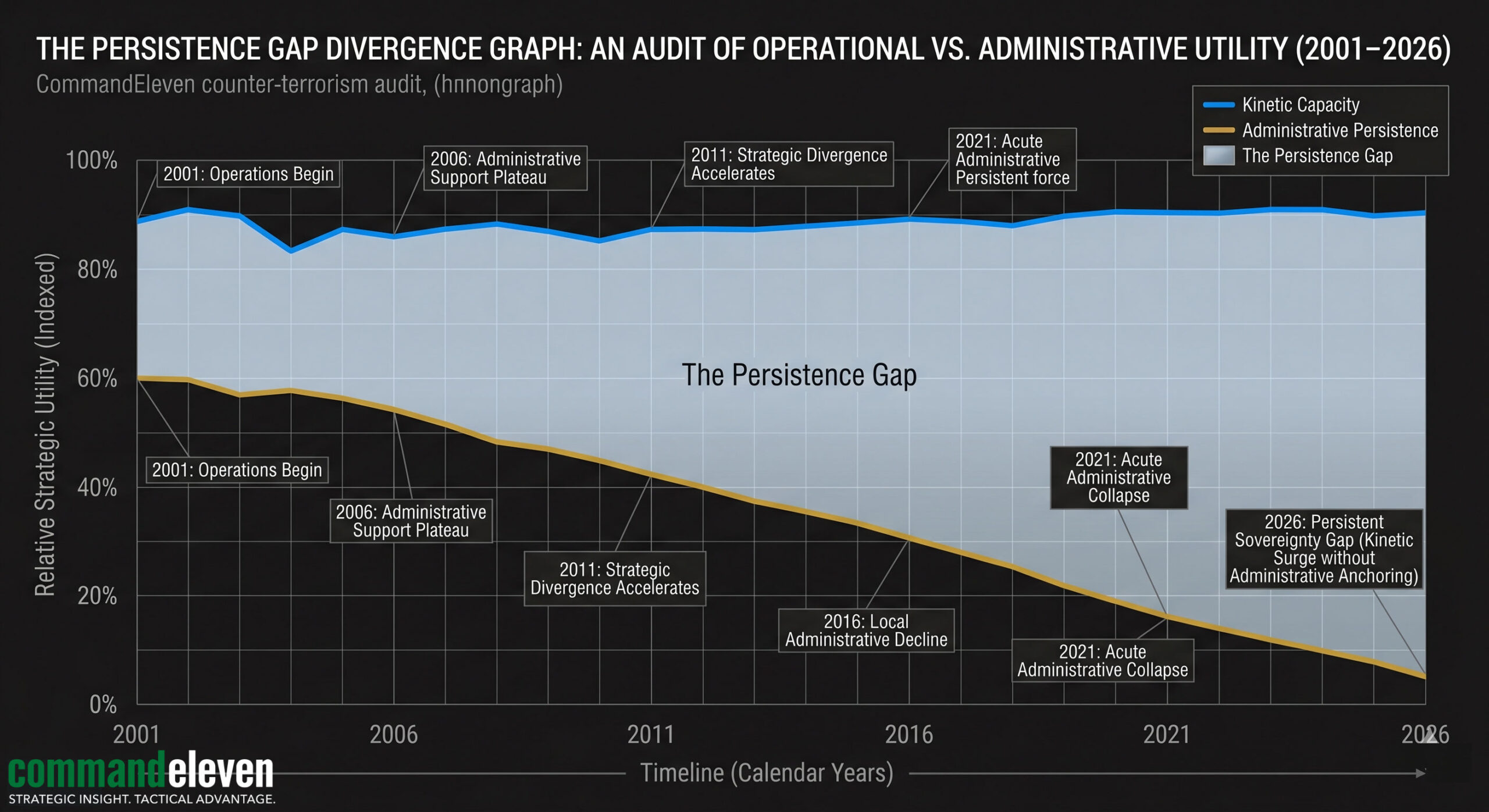
The “Persistence Gap” identifies the strategic failure of the state to translate kinetic military dominance into durable administrative authority over a 25-year period. While the “Kinetic Surge” phase successfully neutralized physical threats, it inadvertently created a vacuum in the Cognitive Frontier. This audit deconstructs how the state fell victim to the Green Zone Hallucination, mistaking infrastructure development for governance while the Madrassa Pipeline evolved into a high-velocity asymmetric logistics hub. By providing the “Logistical Oxygen” the state failed to deliver, the pipeline secured Narrative Primacy, leading to the Institutional Hollowing observed by 2024. The document concludes that reclaiming sovereignty requires a shift from centralized command to a Mosaic Defense anchored in Hardware Truth.
3 Key Takeaways
- Software Over Hardware: The primary failure of the 2001–2020 period was the prioritization of physical infrastructure (buildings) over the cognitive curriculum (the “Software Update”). Without a persistent administrative presence, state-funded assets were weaponized by the adversary.
- The Conflict Premium Trap: Excessive physical hardening and security checkpoints inadvertently raised the Conflict Premium for local populations, stalling trade velocity and forcing provincial sectors into the pipeline’s shadow economy.
- The Persistence Mandate: Sovereignty is a function of utility. The state can only neutralize the “Silent Echo” by out-performing the pipeline in service delivery, ensuring that Logistical Oxygen is provided by state-governed Administrative Tiles.
The Persistence Gap Defined
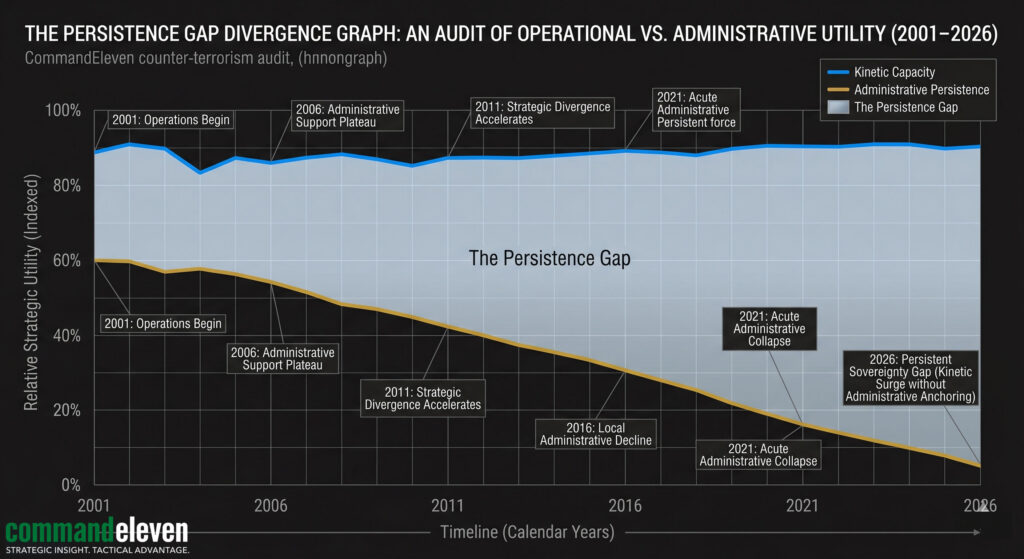
The “Persistence Gap” is the strategic deficit between the state’s kinetic capacity and its administrative durability. For 25 years, the state operated under the Kinetic Mirage – the belief that territorial clearance and the neutralization of High-Value Targets (HVTs) constituted victory. This audit confirms that while the state won the physical battlespace, it surrendered the Cognitive Frontier. The gap allowed the Madrassa Pipeline to evolve from a disparate religious network into a high-velocity asymmetric logistics hub, providing the “Logistical Oxygen” the state failed to deliver.
2001–2009: The Mirage of Infrastructure
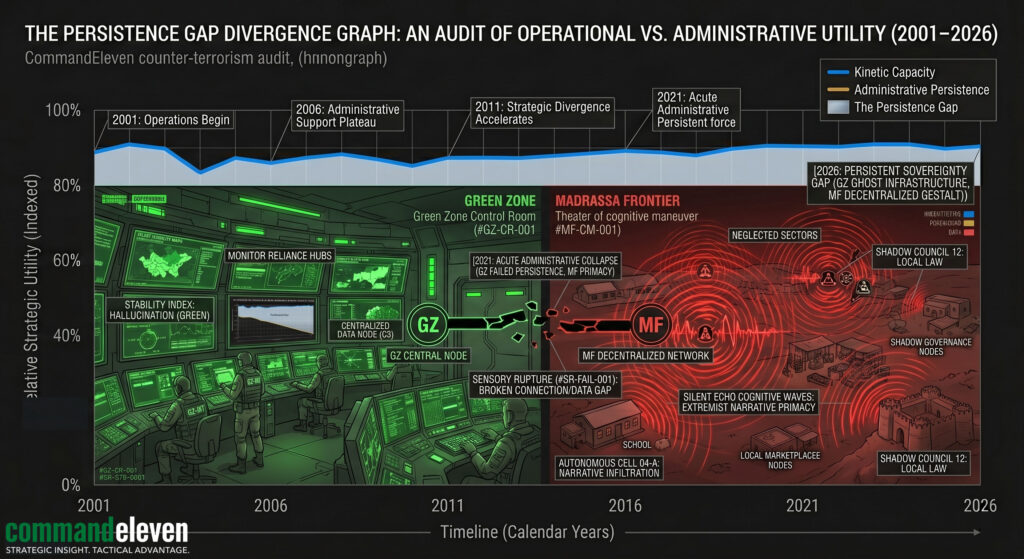
During the initial surge, the state and international partners invested billions in physical infrastructure. Thousands of schools were constructed, yet they remained hollow shells.
- The Software-Hardware Disconnect: While the state built the “hardware” (buildings), it neglected the “software” (curriculum and administrative presence). Adversaries filled these structures with extremist “Software Updates,” effectively using state-funded assets as incubators for the Silent Echo.
- Green Zone Hallucination: Centralized C2 focused on urban stability metrics while the peripheral “Madrassa Frontier” became an unmonitored laboratory for radicalization. The state mistook the lack of kinetic violence for the presence of stability.
2010–2020: The Rise of the Pipeline and Information Laundering
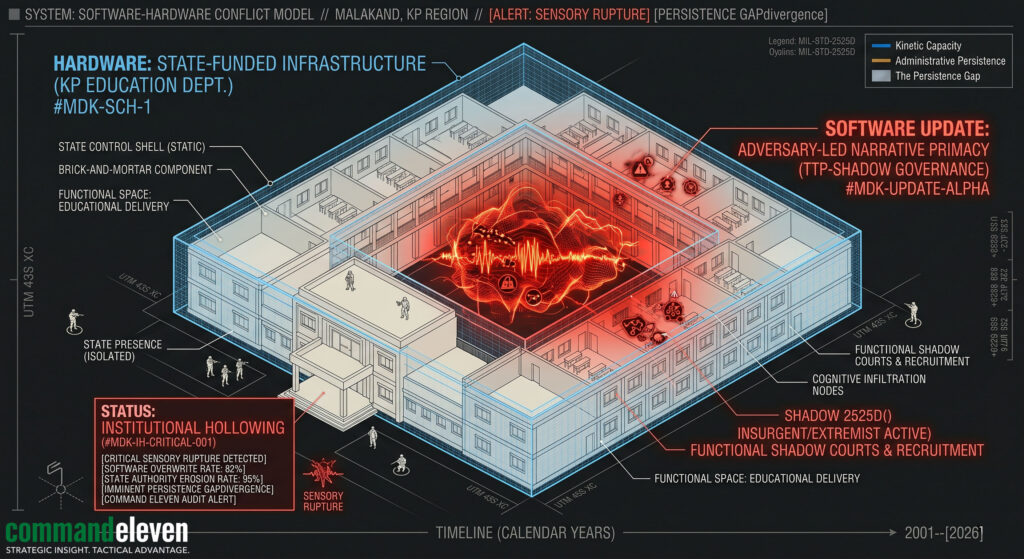
As kinetic operations pushed insurgents into the shadows, the adversary pivoted to Administrative Asymmetry.
- Sanitization Gap Evolution: The Madrassa Pipeline formalized its “Information Laundering” protocols. Kinetic directives were scrubbed and presented as benign pedagogical content, allowing the network to operate under the state’s radar.
- The Conflict Premium Surge: State responses – primarily increased physical hardening and checkpoints – inadvertently raised the Conflict Premium for local populations. This friction stalled legitimate trade, making the pipeline’s shadow economy the only viable means of survival for many provincial sectors.
- HMI Ghosting: The state’s “social sensors” were spoofed. Because the pipeline provided basic justice and welfare, local communities “ghosted” state officials, leading to a state of Institutional Hollowing where the government was physically present but functionally irrelevant.
2021–2026: The Terminal Window and the Persistence Pivot
The final five years of this audit period represent the realization of the Bamako Blueprint – the intentional induction of institutional paralysis.
- The 45-Day Terminal Window: Intelligence finally codified the threshold where narrative indoctrination becomes irreversible. For two decades, the state engaged after the window had closed, fighting “processed” human capital rather than interdicting the supply chain.
- Institutional Rupture: By 2024, several provincial sectors reached a state of rupture, where state utility was zero and the pipeline served as the de facto sovereign.
- The Pivot to Hardware Truth: The late-stage implementation of Administrative Tiles and the #72/48 Resilience Protocol marked the first successful closing of the Persistence Gap. By anchoring governance in physical utility rather than digital consensus, the state began to reclaim the cognitive battlespace.
Extracted Hardware Truths
- Buildings are not Governance: Infrastructure without a persistent administrative presence is merely a gift to the adversary.
- Kinetic Force is a Stopgap: Force can clear a space, but only Administrative Persistence can hold it.
- Utility is the Ultimate Weapon: The state’s legitimacy is a direct function of its ability to provide superior Logistical Oxygen. If the state does not fill the vacuum, the pipeline will.