Bottom Line Up Front (BLUF)
The Alabuga Special Economic Zone in Tatarstan is where the “Axis of Evil” stops being a diplomatic alignment and becomes a production line. An Iranian design is built there by North Korean labor, using Chinese carbon-fiber precursor and Chinese, Japanese and European machine tools, and the finished Russian Gerans now flow back to Iran. Russia is hardening the site underground and ringing it with air defenses, which is steadily reducing the value of strikes. CommandEleven Intelligence assesses that the leverage now lies in Alabuga’s supply dependencies, not its buildings.
Key Judgments
- [CONFIRMED] – Alabuga is Russia’s primary production center for Shahed-derived Geran attack drones. It was established under a roughly $1.75 billion 2022 licensing arrangement with Iran and has grown into a vertically integrated complex producing airframes, engines, electronics and final assemblies
- [CONFIRMED] – The eleven-nation Multilateral Sanctions Monitoring Team (MSMT) reported on September 16, 2026 that as many as 25,000 North Korean laborer’s work at the Alabuga drone factory. Most entered Russia on student visas to evade the UN ban on DPRK overseas labor, and their earnings largely go to Pyongyang, which MSMT says funds its nuclear and missile programmes
- [CONFIRMED] – Russian customs and transport documents, authenticated by the US House Select Committee on China, show Chinese state-owned Jilin Chemical Fiber Group shipped 46 tons of carbon-fiber precursor to the sanctioned Alabuga-Volokno plant under a civilian customs code. That is enough, by one expert estimate, for components of roughly 1,300 Geran airframes
- [ASSESSED] – Russia is converting Alabuga from a strikable factory into a hardened one: about 42,000 square meters of underground workshops, air-defence towers and dispersed new halls. CommandEleven Intelligence assesses this steadily lowers the return on kinetic strikes and shifts the decisive leverage to supply-chain interdiction
- [ASSESSED] – Alabuga’s output now serves two wars. Western intelligence reporting indicates Russia began supplying Geran drones to Iran in March 2026, completing a loop in which an Iranian design, improved in Russia with Chinese and North Korean inputs, returns to Iran for use against US forces
What is Alabuga, and how big has it become?
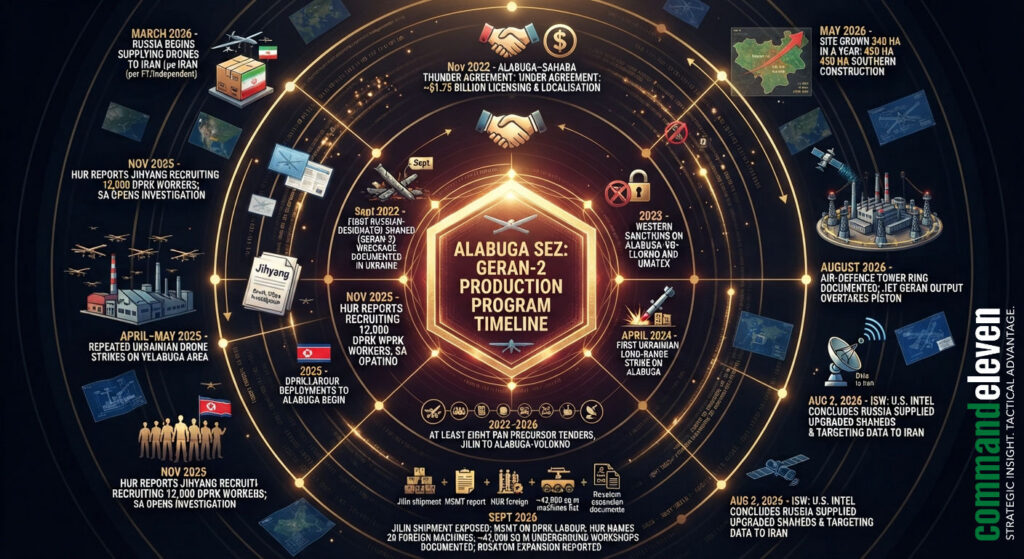
Alabuga is the largest drone production complex in Russia and, by most accounts, in Europe. It sits about 10 km from the town of Yelabuga in Tatarstan and roughly 1,200 km from the Ukrainian border. It began in 2022 as an assembly line for Iranian-supplied Shahed kits. A November 2022 agreement between JSC Alabuga and the Iranian intermediary Sahara Thunder set a goal of localizing at least 90 percent of production.
It has since become a full production ecosystem. The complex includes workshops for composite fuselages, engine manufacturing, metal casting, and electronic circuits and wiring, plus storage hangars and its own launch pad.
Growth indicators:
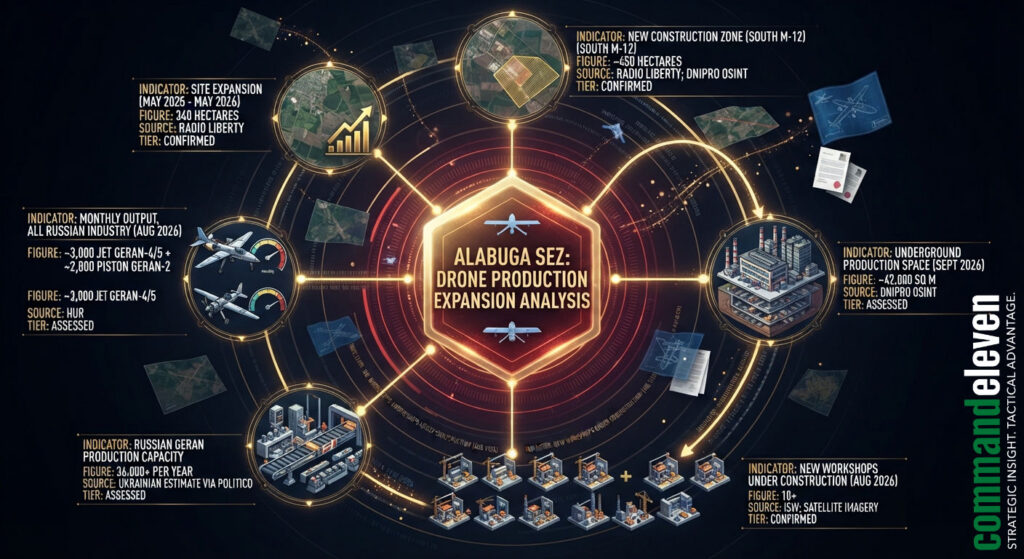
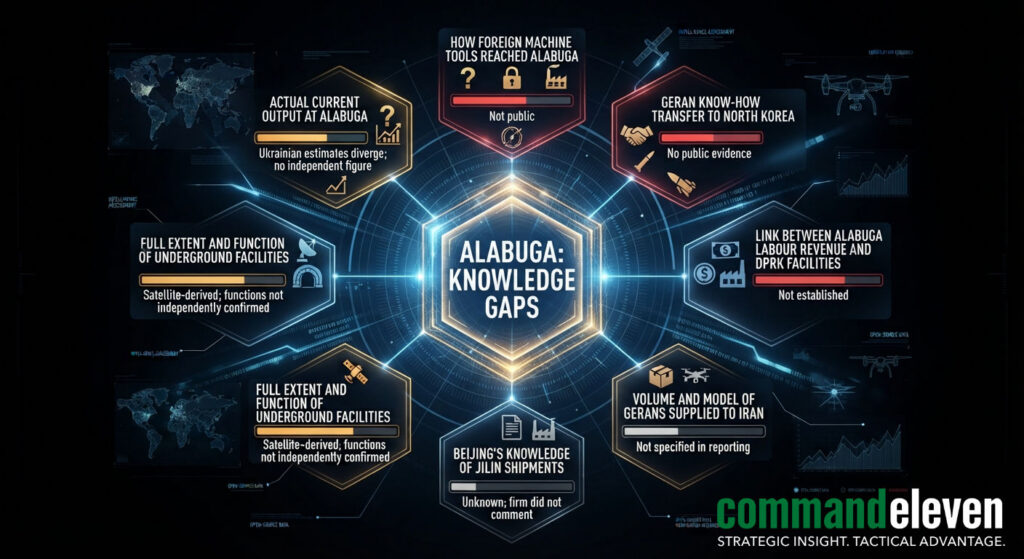
A note on the numbers – The two Ukrainian production estimates do not reconcile: roughly 5,800 per month implies about 70,000 a year, against the 36,000-plus annual capacity cited to Politico. The monthly figure likely covers all Russian Geran production, including the parallel line at Izhevsk, while the annual figure may be an earlier capacity estimate. Both come from a party to the conflict and are tiered ASSESSED. This dossier does not rely on either as a precise figure. The trend is not in dispute: output is rising, and jet-powered models now outnumber piston ones.
Who builds the drones?
A large and growing share of Alabuga’s workforce is foreign, and the largest foreign contingent by far is North Korean.
The DPRK pipeline – The MSMT, formed by eleven governments after Russia vetoed the renewal of the UN Panel of Experts in 2024, published its third report on September 16, 2026. Its findings on Alabuga:
- Scale – Russia hosted 15,000 to 30,000 North Korean workers at the end of 2025, linked to 70 to 80 DPRK companies, and as many as 25,000 were reported at the Alabuga drone factory. North Korea has promoted sending laborer’s to Alabuga’s Geran lines since 2025
- The visa mechanism – More than 98 percent of the visas Russia issued to North Koreans last year were student visas, used to dress up work as “practical training.” Russia issued over 36,400 visas to North Koreans in 2025, nearly four times the previous year, and amended domestic law to let registered “students” earn income
- The money – Average earnings are about $7,500 a year per worker, almost all confiscated by Pyongyang. MSMT estimates North Korea earned $450 million to $800 million from overseas labor in 2025 and says the funds go to its nuclear and missile programmes. North Korea rejects the findings as fabricated
- The recruiter – Ukraine’s Defence Intelligence reported in November 2025 that Russia was using the North Korean firm Jihyang Technology Trade Company to recruit 12,000 workers for Alabuga. Satellite imagery shows large housing projects built west of the factory from early 2025, consistent with that plan
- [DATA DEFICIT] – MSMT links DPRK labor revenue to the nuclear and missile programmes in general. Public sourcing does not tie Alabuga-generated revenue to a specific facility, such as Yongbyon, and this dossier makes no such link
- [ASSESSED] – Several analysts argue the more valuable return for Pyongyang is not cash but hands-on exposure to mass production of a combat-proven strike drone. CommandEleven Intelligence assesses this as plausible and significant, but no public evidence yet shows transfer of Geran production know-how to North Korea
The African recruitment pipeline – Separately, investigations in 2025 found that young women from across Africa, typically aged 18 to 22, were recruited through the “Alabuga Start” programme with promises of hospitality work or scholarships, then placed on drone assembly lines. Ugandan officials told The Wall Street Journal that more than 1,000 women had been lured to Alabuga this way, and South Africa opened an investigation in November 2025. The DPRK pipeline is larger and far more state-directed; the African one is the more exposed to diplomatic pressure.
Where do the components and machines come from?
Alabuga depends on Chinese materials and on machine tools from China, Japan and Europe. This is its most consequential vulnerability.
Carbon fiber: the Jilin shipment – Geran airframes use lightweight carbon fiber, and Alabuga-Volokno, a subsidiary of Rosatom’s composites division UMATEX, is Russia’s key producer of it. Both Alabuga-Volokno and UMATEX have been under Western sanctions since 2023.
- [CONFIRMED] – Politico and The Telegraph, working from Russian customs and transport documents, reported that Chinese state-owned Jilin Chemical Fiber Group shipped 46 tons of PAN precursor, the raw material for carbon fiber, to Alabuga-Volokno. The cargo was declared under a customs code for civilian synthetic fibers, which a former US Treasury sanctions official described as a recognized evasion tactic. The US House Select Committee on China and the Ukrainian government both confirmed the documents’ authenticity
- [CONFIRMED] – The Ukrainian Security and Cooperation Centre (USCC) identified at least eight tenders for PAN precursor shipments from Jilin Chemical Fiber Group to Alabuga-Volokno between 2022 and 2026. The relationship is sustained, not a single consignment
- [CONFIRMED] – Jilin Chemical Fiber Group is not under Western sanctions
- [ASSESSED] – Earlier trade-data analysis (Frontelligence, 2025) found Alabuga-Volokno imported about 3,000 tons of synthetic yarn worth $21.4 million from Chinese producers between March 2022 and January 2025, most of it routed through trading intermediaries
The expansion plan – Rosatom documents gathered by USCC show Alabuga-Volokno is building capacity for an additional 500 tons of aerospace-grade carbon fiber a year by 2029. David Albright of the Institute for Science and International Security estimates that could supply airframes for about 28,000 more Gerans a year, roughly a 78 percent increase on current estimated capacity. Rosatom declined to comment.
Machine tools – On September 17, 2026, Ukraine’s Defence Intelligence published 20 pieces of foreign production equipment identified at Alabuga, including lathes, milling centers, industrial robots, circuit-board component placers and soldering equipment. Among them:

The full list also includes Swiss and Iranian equipment. HUR called on manufacturers to audit end users on site and to extend controls to spare parts, software updates and servicing.
[ASSESSED] – Machine tools are a durable dependency. They need spare parts, software updates and servicing throughout their working life, which gives their original manufacturers, and the governments that regulate them, continuing leverage. How the equipment reached Alabuga, and whether any of it is still being serviced, is not public.
Why is Russia moving production underground?
Because Ukraine has repeatedly shown it can reach Alabuga, and Russia is betting on hardening rather than distance.
The strike record – Ukraine’s first long-range strike hit the zone in April 2024, when a light aircraft converted into a drone struck a workers’ dormitory. Further strikes followed, including on April 23 and 26 and May 26, 2025, and on factory buildings, a drone warehouse and a logistics terminal east of the zone.
The response – In August 2026, Spencer Faragasso of the Institute for Science and International Security identified dozens of large lattice towers built around the production facilities as a counter-drone defence. Partisan reporting from 2025 showed similar towers fitted with Pantsir air-defence systems. By September 2026, Dnipro Osint had documented about 42,000 square meters of underground workshops and five completed production halls in the southern zone, with production dispersed across the site.
- [ASSESSED] – CommandEleven Intelligence assesses the hardening is working as intended. Each step raises the cost of a strike that meaningfully reduces output. Strikes will keep imposing costs and forcing dispersal, but they are unlikely on their own to cut production decisively
- [SPECULATIVE] – The underground resistance group Black Spark claimed in June 2026 to have infiltrated the plant, taken server data and sabotaged drones. The claim has not been independently verified and is not relied on in this assessment
How does Alabuga connect Russia, Iran, China and North Korea?
Alabuga is the clearest physical proof of the convergence mapped in CommandEleven’s New Axis of Evil dossier. Each partner supplies what the others lack, and the output circulates back through the network:
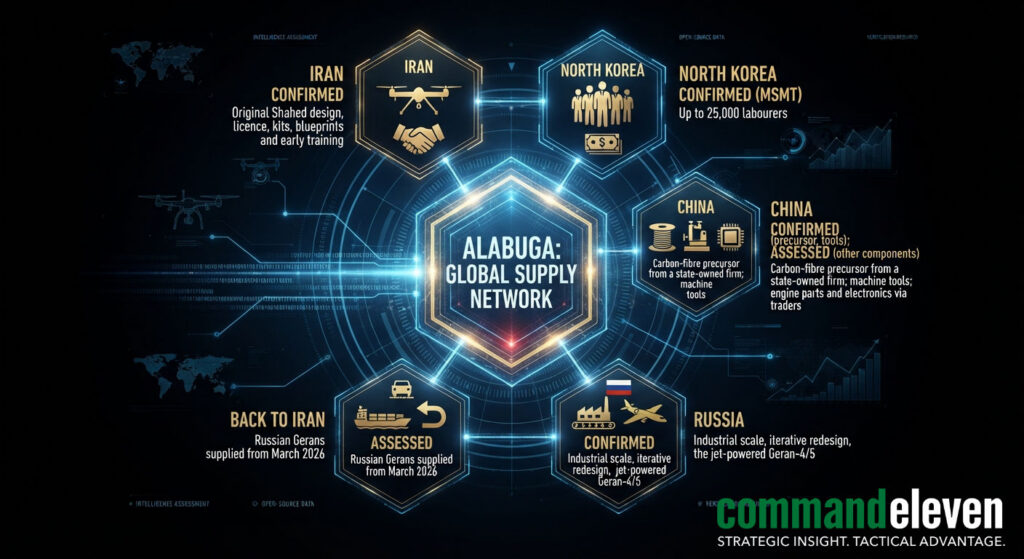
The loop closes – According to the Financial Times and The Independent, citing official sources, Russia began supplying drones to Iran in early March 2026, days after the US and Israeli strikes on Iran began. On August 2, 2026, the Institute for the Study of War reported that US intelligence had concluded Russia supplied Iran with upgraded Shahed-type drones and targeting intelligence used against US forces in the Middle East. The design Russia bought from Iran in 2022 is now returning to Iran improved.
- [ASSESSED] – The loop matters beyond Ukraine. The head of USCC warned that Alabuga-built drones are likely to become Russia’s main tool in future campaigns in Europe. That fits the hybrid-sabotage pattern documented in CommandEleven’s Leipzig’s Fallout dossier
What would actually slow Alabuga down?
CommandEleven Intelligence assesses that Alabuga’s buildings are becoming harder to hit, while its dependencies remain exposed. In order of likely leverage:
- Carbon-fiber precursor – One Chinese state firm supplies a critical input under a false customs code. Designating Jilin Chemical Fiber Group, or pressing Beijing on it, targets the material the 2029 expansion depends on.
- Machine-tool servicing – Manufacturers in Japan, Germany and Switzerland can cut off parts, software updates and service. This is slow-acting but durable leverage, and it sits largely with governments allied to Ukraine.
- The labor visa scheme – The student-visa mechanism is documented in detail. Enforcement is hard with Russia a willing host, but exposing it raises the diplomatic cost for Pyongyang and Moscow, and the African recruitment pipeline is more responsive to pressure from source countries.
- Kinetic strikes – Still valuable for imposing cost and forcing dispersal, but declining in marginal effect as hardening advances.
Timeline
What remains unknown?
What would change this assessment?
- Toward reduced output – Western designation of Jilin Chemical Fiber Group followed by a visible slowdown in Alabuga-Volokno expansion; confirmed withdrawal of machine-tool servicing; a sharp fall in DPRK worker numbers in the next MSMT report.
- Toward greater strategic weight – confirmed DPRK production of Geran-type drones at home; Geran use by Russia against European targets; expansion of Russian supply to Iran or other partners.
Frequently Asked Questions
What is the Alabuga Special Economic Zone?
An industrial zone about 10 km from Yelabuga in Tatarstan that has become Russia’s main production center for Shahed-derived Geran attack drones. It began assembling Iranian kits in 2022 and now manufactures most components on site.
How many North Koreans work at Alabuga?
The Multilateral Sanctions Monitoring Team reported in September 2026 that as many as 25,000 North Korean laborer’s work at the Alabuga drone factory. Most enter Russia on student visas to evade the UN ban on DPRK overseas labor.
How is China involved in Russia’s Geran drone production?
A Chinese state-owned company, Jilin Chemical Fiber Group, shipped 46 tons of carbon-fiber precursor to a sanctioned Alabuga plant under a civilian customs code. Chinese machine tools and traders also supply the site. Jilin Chemical Fiber Group is not under Western sanctions.
Is Russia sending Geran drones to Iran?
Western intelligence reporting indicates Russia began supplying drones to Iran in March 2026. In August 2026, ISW reported US intelligence had concluded Russia supplied upgraded Shahed-type drones and targeting data used against US forces.
Can Ukraine stop Alabuga with strikes?
Strikes impose costs, but Russia is moving production underground and ringing the site with air defences. CommandEleven assesses that supply-chain pressure, on carbon fiber, machine-tool servicing and labor, now offers more leverage than strikes alone.
Cross-Reference
This dossier connects four existing CommandEleven Intelligence pieces rather than repeating them: the Geran-4/5 jet drone white paper on the drones Alabuga now mass-produces; the New Axis of Evil dossier on China-Russia-Iran-North Korea coordination; the China series on Beijing’s grey-zone and supply-chain role; and Ukraine-Russia War Part IV, Battlefield Realities, on how drones reshaped the front. Leipzig’s Fallout covers the European hybrid-sabotage campaign Alabuga-built drones may increasingly serve.
Sourcing Base (Confidence-Tiered, with Links)
CONFIRMED, Primary/Official Record & Direct Reporting:
- Ukrainska Pravda, “Up to 25,000 North Koreans work at Russian drone plant,” Sept. 17, 2026 (MSMT report findings)
- SBS News, “Up to 100,000 North Korean Workers Dispatched Abroad,” Sept. 16, 2026 (MSMT report; student visas)
- Euronews, “Russia recruiting up to 25,000 North Koreans to assemble drones,” Sept. 24, 2026 (wages, revenue, nuclear funding). Note: Euronews describes the MSMT as a UN Security Council body; it is an eleven-nation grouping formed outside the UN.
- Kyiv Post, “Russia Employs 25,000 North Koreans in Drone Production” (visa totals)
- Meduza, “Up to 25,000 North Koreans may be making military drones in Russia,” Sept. 17, 2026
- The Insider, “Chinese state company secretly supplied Russia’s Rosatom with raw materials” (Jilin shipment; tenders; sanctions status)
- IBTimes UK, “Chinese State Firm Shipped 46 Tonnes of Material Into Russia’s Kamikaze Drone Supply Chain” (customs code; Albright estimate)
- Hromadske, “Russia plans major expansion of drone material production at Alabuga” (Politico reporting on Rosatom expansion)
- Ukrainska Pravda, “Russia expands Alabuga-Volokno plant,” Sept. 21, 2026
- United24 Media, “Ukraine Exposes 20 Foreign-Made Machines Behind Russia’s Geran Drone Production” (HUR equipment list)
- UAWire, “Ukraine identifies foreign equipment used in Russian drone production” (HUR recommendations)
- Kyiv Post, “Alabuga Expansion: Satellite Images Reveal Massive Growth,” May 2026 (340-hectare expansion; re-export to Iran)
- Military Times, “Russia and Iran deepen weapons partnership,” Sept. 15, 2026 ($1.75B deal; ISW construction data)
- CSIS, “From Shahed to Geran: How Russia Continues to Reinvent the One-Way Attack Drone“
- CSIS Beyond Parallel, “A Closer Look at the Yelabuga UAV Factory,” March 2026 (housing construction; Jihyang recruitment)
- The New Voice of Ukraine, “Russia builds large-scale defenses around Alabuga drone plant” (ISIS tower analysis)
- Militarnyi, “Western Intelligence Confirms Russian Drone Supplies to Iran” (FT/Independent reporting)
ASSESSED, Credible Secondary Reporting:
- Ukrainska Pravda, “Russians building underground workshops for Shahed drone production at Alabuga,” Sept. 19, 2026 (Dnipro Osint analysis)
- Militär Aktuell, “Russia’s massive Alabuga attack drone production complex” (strike history; underground area)
- Migflug, “Russia’s Jet-Powered Shahed Drone Surge” (HUR August 2026 production estimate)
- Army Recognition, “Russia Supplied Upgraded Shahed Kamikaze Drones to Iran” (ISW August 2 assessment)
- Defence Security Asia, “Iran Seeks Russia’s Geran-5” (Sahara Thunder agreement terms)
- Frontelligence, “Shaheds, Dollars, and Beijing,” Aug. 2025 (Chinese yarn imports; intermediaries)
- United24 Media, “Ukraine’s Drone Raids Force Moscow Into Desperate Defenses,” Aug. 2025 (2025 strike dates; Pantsir towers)
- Wikipedia, “Shahed drones” (African recruitment; WSJ and South Africa references)
Excluded from this dossier: Technical performance data, component specifications, and production-process detail beyond the organizational and strategic level, consistent with CommandEleven’s public-release standard. Unverified sabotage claims are noted but not relied on.