
EXECUTIVE SUMMARY
In November 2015, eight teams of senior officials, diplomats, and private-sector leaders sat down in Washington, DC to play a war game about food. It wasn’t fought with tanks or missiles – it was fought with weather, prices, and panic. Sponsored by the World Wildlife Fund, the Center for American Progress, Cargill, and Mars, and designed and run by CNA (formerly the Center for Naval Analyses), Food Chain Reaction asked 65 participants to govern a decade of simulated global food shocks – droughts, spiking prices, refugee flows, and fertilizer scarcity – from 2020 through 2030.
The scenario the designers built was fictional. The pressures it modeled were not: population growth, rising food prices, climate-driven weather disruption, and a tightly interconnected global food-fertilizer-energy system that snaps taut the moment one link is stressed.
A decade later, the United States is living inside a version of that scenario. Since February 2026, a war between the United States, Israel, and Iran has closed the Strait of Hormuz to normal traffic, sent diesel to a record national average above $6 per gallon, driven global urea prices toward their highest levels since 2022, and forced Washington to approve tens of billions of dollars in emergency farm relief – on top of tariff-driven aid already in place. Net farm income is falling for a fourth consecutive year. A very strong El Niño is now forecast for the 2026–27 winter, the same climate pattern the 2015 game used to trigger its worst-case round. The FAO Food Price Index hit its highest level since late 2022 in August 2026.
This paper does five things.
- it explains what Food Chain Reaction was, who ran it, and who played it
- it explains – for readers unfamiliar with the format – what a tabletop exercise actually is and why governments and corporations use them
- it lays out what the game found: the pattern of institutional paralysis followed by crisis-driven overcorrection that its designers labeled “institutional inertia.”
- it maps that decade-old finding against the food, fuel, and fertilizer shock the United States is living through right now, sector by sector – Business & Investors, Multilateral Institutions, Independent Producers, and the average American citizen
- it lays out a realistic 12–18 month outlook for American households and a three-phase policy roadmap – now, six months, nine months – for what the current administration would need to do differently than USJFCOM did in a comparable exercise twenty-four years ago: absorb the result instead of resetting the game

WHAT WAS THE EXERCISE – WHO ARRANGED AND PARTICIPATED
Food Chain Reaction – A Global Food Security Game was held November 9–10, 2015, in Washington, DC It was commissioned by four sponsoring organizations – the World Wildlife Fund, the Center for American Progress, Cargill, and Mars – who wanted a structured way to explore how governments, markets, and institutions would behave under sustained pressure on the global food system. They engaged CNA, a nonprofit research organization best known for defense and national-security analysis, to design and run it.
CNA assembled 65 participants – senior officials, diplomats, agricultural economists, climate scientists, trade specialists, and private-sector executives – and organized them into eight teams:
- Brazil
- China
- Continental Africa
- the European Union
- India
- the United States
- a Business and Investors team
- a Multilateral Institutions team representing bodies such as the World Bank, the United Nations, and international NGOs
A panel of subject-matter experts, called the Adjudication Cell, sat above the teams, judged the combined effect of every team’s decisions after each round, and updated the state of the simulated world accordingly.
The game was deliberately set a few years into the future of its design date – 2020 through 2030 – far enough out that players could reason about structural dynamics rather than refight the headlines of the day, but close enough to remain grounded in real institutions, real trade relationships, and real geography.
WHAT A TABLETOP EXERCISE IS – AND WHY IT MATTERS HERE
A tabletop exercise (TTX) is a structured, discussion-based simulation in which real decision-makers are given a scenario, organized into teams representing real-world actors, and asked to make the actual decisions those actors would face – without any of it happening in the real world.
There are no soldiers, no ships, no live money. What moves is information: a controlling body (here, the Adjudication Cell) presents an evolving situation, teams deliberate and commit to policies and actions, and the controllers then determine – using expert judgment, modeling tools, and sometimes formal simulation software – what the combined effect of everyone’s choices would be. That result becomes the next round’s starting condition.
Governments, militaries, and corporations use tabletop exercises for the same reason airlines use flight simulators: some kinds of learning are too expensive, too slow, or too dangerous to acquire by trial and error in the real world. A TTX lets an institution find out – cheaply, and without real casualties or real bankruptcies – where its assumptions break down, which relationships it has neglected, and how its own bureaucracy behaves when the pressure is on. Food Chain Reaction is a policy-and-economics TTX: no maps of troop movements, no live-fire ranges, just food stocks, prices, trade flows, and the human decisions layered on top of them. The value of the format lives or dies on one condition: that the institution running it is willing to hear an answer it didn’t expect. (CommandEleven Intelligence’s companion analysis of the US military’s 2002 Millennium Challenge war game, discussed below, is the cautionary case of what happens when that condition fails.)
WHAT FACTORS WERE BEING TESTED
CNA and the sponsors built the game around a specific set of open questions, not a predetermined conclusion. The stated objectives were to:
- Understand how governments, multilateral bodies, and private industry respond to trigger points in a food-system crisis
- Determine whether and how the global food system can be stabilized during acute disruption
- Explore both prevention and response policy tools
- Examine the trade-offs between climate change mitigation and adaptation
- Improve understanding of the roles of prices, markets, open trade, and the private sector in food security
- Improve understanding of the effects of government intervention on food markets
Four analytic threads ran through every round: agriculture and food production, economics and trade, security and diplomacy, and climate change, energy, water, and environmental impact – what the report calls the climate-energy-water-food nexus. The scenario itself was built almost entirely from exogenous shocks – weather events, not player decisions – specifically so that whatever policy responses emerged would be organic to the players’ own reasoning rather than pre-scripted by the designers.
THE RESULT OF THE EXERCISE
Across four rounds – 2020–21, 2022–24, 2025–27, and 2028–30 – the simulated world moved from mounting stress, to a full-blown crisis peak, to a period of relief, and back to renewed pressure by the end of the decade. Global food prices, expressed as a percentage of long-term averages, rose from roughly 158% at the outset to a peak of 395% during the mid-decade crisis, eased to 141% during the “relaxation” round, and climbed back to 387% by 2030 – nearly as high as the earlier peak.
The exercise’s central, most-cited finding was about institutional behavior, not commodities. In Round 1, with a crisis clearly building, teams defaulted to what the Adjudication Cell called a “business as usual” posture – aspirational statements with little committed action. It took the shock of Round 2’s full-blown crisis – record prices, record-low stocks, spreading social unrest – to break that inertia and force teams into genuinely active policy-making. Notably, when pressure eased in Round 3, teams did not relax; having learned the cost of complacency, most kept building resilience, which meant Round 4’s renewed shock landed on a far better-prepared system than Round 1’s had.
Teams also converged, largely on their own, on the conclusion that no single nation, company, or institution could manage global food security alone – driving unusual cooperation even between geopolitical rivals (China and India moved toward joint water-management talks; the US and Brazil coordinated on land-use accounting). The exercise closed with a simulated Global Summit on Climate Security and Vulnerability that, while it produced no binding agreement, sketched the outline of a standing international coordination body under the UN and G20.
The report’s own authors were candid about the exercise’s limits: it ran without budget constraints, without real electoral consequences for “voted out” leaders, and with team compositions that didn’t fully mirror the real governments and companies they represented. Even so, its authors flagged a warning that reads, in 2026, less like a hypothetical than a diagnosis: institutions tend to treat food security as a crisis-response problem rather than a standing structural one, and they relax their guard the moment the immediate pressure lifts – the same “self-licking ice cream cone” failure mode CommandEleven Intelligence has separately documented in the US military’s 2002 Millennium Challenge exercise, where an uncomfortable result was reset and sanitized rather than absorbed. Food Chain Reaction‘s finding is the gentler cousin of that same institutional pathology: not that inconvenient results get erased, but that they get *forgotten* the moment the pressure temporarily eases.
HOW THIS TRANSLATES TO THE CURRENT US ECONOMIC, GEOPOLITICAL, AND DOMESTIC LANDSCAPE
The 2015 game’s fictional Round 2 crisis – a war-adjacent shock that closes a critical maritime chokepoint, spikes fertilizer and fuel prices, and drives global food costs toward record levels – is, as of this writing, the live situation in the United States.
- The trigger – On February 28, 2026, the United States joined Israel in launching strikes on Iran. Iran responded by effectively closing the Strait of Hormuz, the channel through which roughly one-fifth of the world’s oil and, critically, close to a quarter of global ammonia and about a third of the world’s seaborne fertilizer trade normally transits. A series of ceasefires have been announced and broken repeatedly since; as of late September 2026, the Strait remains contested, Iran’s president has publicly rejected surrender, and Brent crude is trading in the $100–103/barrel range – roughly a quarter above pre-war levels.
- The input-cost shock – Global urea prices roughly doubled in the weeks after the war began, from about $400/metric ton to above $850/mt at the April 2026 peak, before easing somewhat; diammonium phosphate (DAP) rose from roughly $580/mt to $770/mt. A March 2026 Farm Bureau survey found 70% of surveyed farmers could not afford to buy all the fertilizer they needed for spring planting. Diesel – the fuel that plants, sprays, and harvests every acre of American cropland and moves nearly every truckload of food to market – hit a record national average above $6/gallon in September 2026, up from roughly $3.70 a year earlier, with some states (California) above $7.90.
- The farm-economy squeeze – USDA’s own September 2026 forecast puts fertilizer expenses up 15.3% and fuel expenses up 28.8% year over year – a forecast USDA itself notes was compiled before the latest diesel surge and likely understates the real number. Net farm income is projected at roughly $153–158 billion for 2026, a fourth straight year of decline in real terms and about 24% below the 2022 record, propped up almost entirely by a record share of government payments (nearly 29% of the bottom line). Chapter 12 farm bankruptcies rose 46% in 2025 and are projected to climb further in 2026. Congress and the administration have layered a $12 billion tariff-relief package, a further $11.1 billion Iran-war agricultural supplemental request, and a $500 million domestic fertilizer-production initiative (USDA’s “FIELDS” program) on top of each other – each one arriving to offset a cost increase created by the policy layer just below it.
- The grocery-aisle effect – Consumer food-at-home prices are up roughly 2.7% year over year as of August 2026, with the pain concentrated unevenly: beef and veal prices are forecast to rise nearly 10% for the year on the back of the smallest US cattle herd in roughly 75 years, even as egg prices have fallen sharply from 2025’s shortage-driven highs. Globally, the FAO Food Price Index hit 133.3 points in August 2026 – its highest level since the end of 2022 – driven by broad-based increases across cereals, sugar, dairy, and vegetable oils, with the report explicitly citing the Middle East conflict and Black Sea trade disruption as drivers.
- The climate multiplier arriving on schedule – NOAA’s Climate Prediction Center now assesses a greater than 90% chance of a very strong El Niño through the 2026–27 Northern Hemisphere winter – among the strongest on record. FAO and the World Food Programme have already launched a $202 million anticipatory-action appeal for 22 high-risk countries, warning that El Niño-linked drought risk runs from Pakistan and India through Southeast Asia and into parts of Africa and Latin America – almost the identical geography the 2015 game’s designers used to script their own crisis rounds. One risk-analytics firm has estimated the 2026–27 event could cut global agricultural production by 14% and $342 billion in value over the next two years. Because El Niño’s global temperature effect is typically strongest in its second year, the heaviest agricultural consequences of this event are likely to land in 2027, not 2026 – a lagged shock arriving on top of an already-stressed system, precisely as Food Chain Reaction‘s Round 4 scripted a renewed crisis after a false period of relief.
In short: the mid-2020s scenario CNA’s designers built as speculative fiction in 2015 – a geopolitical shock closing a critical chokepoint, cascading into fertilizer and fuel scarcity, compounding into a farm-income crisis, arriving just as a major climate anomaly builds – is not analogous to 2026. It is, in its structural mechanics, a close match for it.
CORE CHALLENGES AND SOLUTIONS, BY ACTOR
The 2015 game organized its participants into sectors whose real-world analogues are still the load-bearing actors in the 2026 crisis. Mapping the game’s own findings against verified 2026 developments shows both where the “solutions” playbook has already been deployed and where it is visibly falling short.
Business & Investors
- Core challenge (2015 game): The Business and Investors team pushed for information transparency, technological innovation (especially genetically modified and drought-tolerant seed), and open trade – while resisting export restrictions and distortionary short-term policy. Their central worry was that panic-driven government intervention (stockpiling, export bans) would do more damage than the underlying shock itself.
- Core challenge (2026 reality): Input-cost volatility (fertilizer, diesel, freight) rather than food-production scarcity per se. American agribusiness and food-supply-chain investors are managing a cost-side shock, not a yield-side one – US crop production is close to normal; input prices and financing costs are what have moved.
- Solutions implemented: Private capital has moved into domestic fertilizer capacity in partnership with government incentive (USDA’s $500 million FIELDS program is explicitly designed to pull in private co-investment); commodity traders and shippers have rerouted around the Strait via the Saudi East-West pipeline and other bypass capacity; agricultural lenders have tightened underwriting and increased monitoring of borrower cash reserves in response to the 46% jump in Chapter 12 bankruptcies, while largely continuing to extend credit against still-strong farmland collateral values. What the 2015 game did not anticipate, and what 2026 has revealed, is the degree to which private capital’s response is now inseparable from – and dependent on – the pace of federal relief and loan-guarantee programs; the “avoid government distortion” instinct of the game’s Business & Investors team has given way to active lobbying for federal intervention (see the Farm Bureau and Farm Aid public letters to USDA and Congress cited above).
Multilateral Institutions
- Core challenge (2015 game): Balancing internal disagreement among diverse member constituencies (the UN, World Bank, NGOs) against the need to act as a “trusted partner” capable of facilitating cooperation between rival powers, and building the case for a standing international coordination mechanism rather than an ad hoc crisis response.
- Core challenge (2026 reality): The FAO/WFP framework has done exactly what the 2015 game modeled multilateral institutions doing well – issuing early, well-quantified anticipatory-action appeals ($202 million, 22 countries) ahead of the El Niño shock rather than after it, and publishing monthly Food Price Index data that gives every downstream actor (governments, traders, aid agencies) a shared, trusted number to plan against. The WTO and World Bank have both published real-time tracking of Hormuz-linked fertilizer trade disruption, giving policymakers the kind of transparent, common operating picture the 2015 game’s teams explicitly identified as the single biggest gap in their own crisis response.
- Solutions implemented: Anticipatory financing rather than reactive relief; standardized, monthly, publicly available price indices (FAO FPI, World Bank fertilizer index) that reduce the “fog of war” pricing panic the 2015 game’s Adjudication Cell flagged as a self-reinforcing driver of its worst price spikes; targeted country-level appeals rather than a single undifferentiated global response. What remains unsolved, exactly as the 2015 game predicted, is enforcement and coordination authority – FAO and WFP can warn and fund small-scale anticipatory action, but neither they nor any other multilateral body has the mandate to compel a change in the underlying geopolitical dynamic (the Hormuz closure) driving the shock.
Independent Producers (American Farmers and Ranchers)
- Core challenge (2015 game): The India and Continental Africa teams modeled the position of price-taking, capital-constrained producers – actors with little ability to influence global prices but total exposure to them, dependent on government support programs and infrastructure investment to survive shocks they didn’t cause.
- Core challenge (2026 reality): This is now, structurally, the position of the individual American farmer or rancher. US producers do not set fertilizer or diesel prices – both are set in global markets now reflecting Hormuz-driven scarcity – and a majority (per the Farm Bureau’s own April 2026 survey) could not fully fund their spring input needs at prevailing prices. A historically small cattle herd means ranchers face a once-in-a-generation pricing environment that is simultaneously the best revenue signal in decades and the hardest rebuild cycle in decades, since expanding a herd takes years and requires the very capital (fuel, feed) that is currently most expensive.
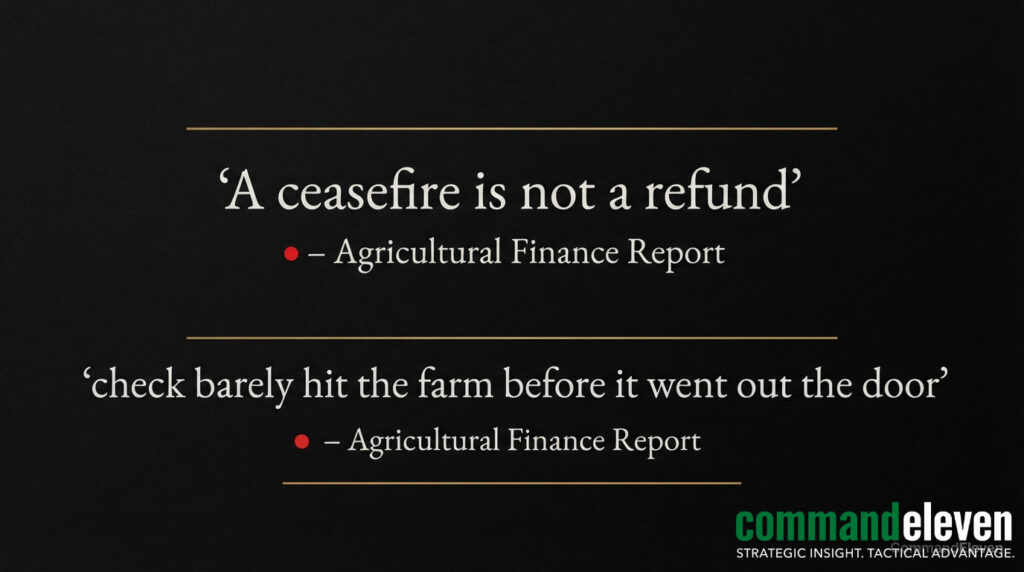
- Solutions implemented: Layered federal relief (the $12 billion tariff-bridge package, the pending $11.1 billion Iran-war agricultural supplemental, USDA’s domestic fertilizer push); temporary regulatory relief (EPA’s summer E15 waiver and diesel-emissions guideline changes announced at the White House’s March 2026 National Agriculture Day); loan-guarantee expansion through SBA/EPA partnership. The unresolved gap – flagged by farm groups themselves – is that each of these measures treats the symptom (farmers can’t afford fertilizer and diesel) rather than the underlying cause (a foreign-policy decision closed the trade route that supplies both). As one Iowa Farmers Union official put it of the tariff-relief checks: “the joke was that the check barely hit the farm before it went out the door to the fertilizer dealer.” The 2015 game’s India and Africa teams faced an analogous trap and never fully escaped it either – government payments that offset a price shock without changing the trade conditions that caused it.
The Average American Citizen
- Core challenge (2015 game): Not a formally represented team, but the game’s authors were explicit that food insecurity’s social consequences – migration, unrest, strain on relief budgets – were the real-world stakes behind every abstract policy debate the eight teams had.
- Core challenge (2026 reality): A working household is absorbing this shock on three simultaneous fronts – grocery bills (food-at-home CPI up 2.7% year over year, beef up nearly 10%), fuel costs (diesel’s ripple effect raises the delivered cost of nearly everything trucked to a store), and the broader inflationary drag from a war-linked oil-price shock feeding into the rest of the CPI basket. Unlike a farmer or an institutional investor, the average citizen has no seat at any table where fertilizer tariffs, war-risk shipping insurance, or Hormuz ceasefire terms are negotiated – the costs simply arrive at the register.
- Solutions implemented, from the citizen’s own vantage point: These are mostly informal and adaptive rather than policy-driven – trading down on protein (chicken and pork in place of beef), shifting from dining out toward at-home meals (which national grocery-price trackers show now costs roughly a third of a comparable restaurant meal), and – where available – using existing federal nutrition assistance (SNAP) as a buffer, though SNAP benefit levels were not designed to track a war-driven commodity spike and Congress has not adjusted them specifically in response to this shock. Section 7 below addresses this gap directly.
WHAT THE AMERICAN CITIZEN CAN EXPECT OVER THE NEXT 12–18 MONTHS, AND STOPGAPS TO IMPLEMENT NOW
The outlook. Based on the verified trajectory above, the most likely path over the next 12–18 months (roughly October 2026 through March/April 2028) is not a return to pre-war pricing, even in an optimistic ceasefire scenario, for three separate reasons that stack rather than offset each other:
- Diesel and fertilizer costs are sticky even after a ceasefire – Reopening the Strait does not instantly restore pre-war shipping insurance rates, refinery throughput, or fertilizer-plant output in Qatar and Iran (both of which took direct production outages, not just export disruption). Analysts at Barclays have already told clients “$65–70 a barrel is not coming back… a ceasefire is not a refund”
- The El Niño shock is a 2027 story as much as a 2026 one – Its heaviest global agricultural effects are expected to land in 2027, meaning American consumers should expect a second, largely independent wave of upward pressure on globally-traded food commodities (sugar, cereals, vegetable oils, coffee) roughly 6–12 months from now, layered on top of whatever domestic Iran-war effects have or haven’t resolved by then
- The US cattle-herd rebuild cycle runs on a multi-year biological clock, not a policy clock – Even total resolution of the Hormuz crisis will not shrink beef prices quickly; USDA’s own current forecast has beef prices rising again in 2027
The realistic expectation for a typical household, then, is: continued elevated grocery and fuel costs through at least mid-to-late 2027, with beef and other protein remaining the most persistently expensive category; a genuine chance of a second, El Niño-driven price wave in specific global commodities (sugar, coffee, vegetable oils, some cereals) arriving in 2027 independent of how the Iran war resolves; and continued volatility – rather than a clean trend in either direction – in diesel and gasoline prices tied to the on-again, off-again ceasefire and Hormuz-reopening negotiations.
Stopgaps households can implement now
- Build a food and fuel budget around volatility, not a fixed number – Treat grocery and fuel line items as a range rather than a point estimate this year; a household that budgets for the average of the last six months, not the most recent low week, will be less exposed to the next price spike
- Shift protein sourcing deliberately, not passively – With beef tracking toward a ~10% annual increase and poultry/pork essentially flat to down, a planned, partial substitution – not full elimination of beef, but fewer beef-centered dinners per week – captures most of the available savings without a lifestyle overhaul
- Front-load discretionary big-ticket food and household purchases where shelf-stable – Non-perishable staples (rice, dried goods, shelf-stable proteins, cooking oils) are exposed to the same global indices (FAO Cereal and Vegetable Oil indices both at multi-year highs) that are likely to keep climbing into 2027; buying ahead on true shelf-stable staples, within reason and without hoarding behavior that itself worsens local shortages, is a rational hedge the 2015 game’s own teams flagged as one of the few individual actions that both helps a household and does not require waiting on policy
- Check SNAP/WIC eligibility now, even if not previously needed – Given diesel and fertilizer’s delivered-cost effect on retail food prices, households near the eligibility threshold that have not previously applied should re-check; benefit levels have not been specifically adjusted for this shock, but the program remains the most immediate buffer available to a household absorbing the “average citizen” exposure
- Delay large discretionary fuel-intensive plans where feasible, or batch errands/trips, given diesel’s direct pass-through to freight and the still-elevated and volatile price of regular gasoline
- Farmers-market and direct-from-producer purchasing, where accessible, can partially bypass the diesel-driven long-haul freight markup embedded in supermarket pricing, though this is not a universally available option and should not be oversold as a systemic fix
None of these are substitutes for policy action; they are what a household can control while the structural picture below plays out.
WHAT THE ADMINISTRATION NEEDS TO IMPLEMENT – NOW, AT 6 MONTHS, AND AT 9 MONTHS
The single clearest lesson to carry over from both source documents examined in this analysis – Food Chain Reaction‘s finding that institutions relax the moment pressure eases, and the Millennium Challenge 2002 dossier’s finding that institutions resist absorbing an uncomfortable result – is that a roadmap built only around the current shock (Iran/Hormuz) will fail the moment a second, independent shock (El Niño) arrives on its own schedule in 2027. The roadmap below is built to survive that overlap.
Now (October–November 2026)
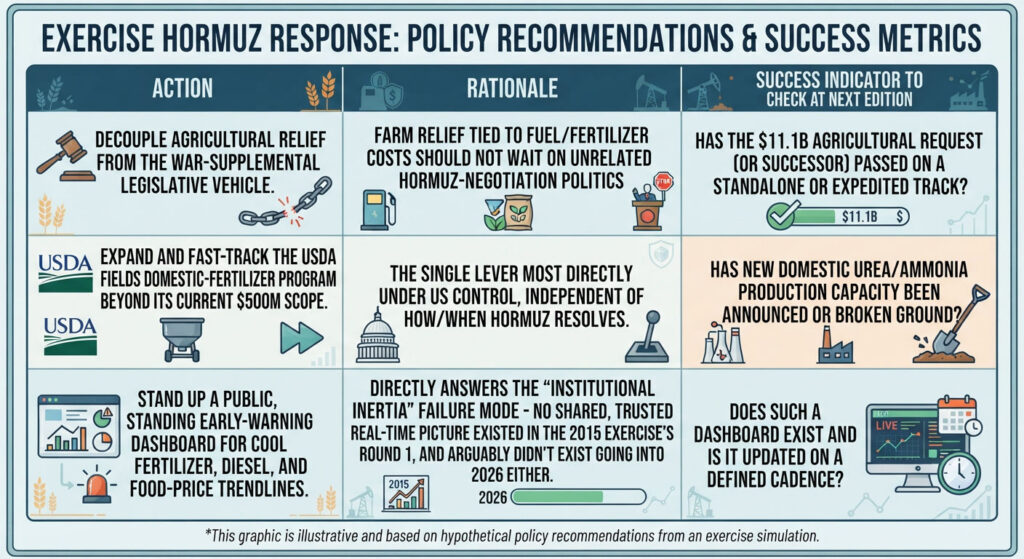
- Decouple farm relief from war-supplemental politics – The $11.1 billion agricultural request is currently bundled inside an $87.6 billion war-funding package tied to a live, unresolved conflict; farm relief tied to fuel and fertilizer costs should move on its own legislative track so producers are not left waiting on unrelated Hormuz negotiations to receive payments for damage already incurred
- Expand and fast-track the FIELDS domestic-fertilizer program beyond its current $500 million scope, with explicit milestones for new domestic urea/ammonia capacity coming online – the single lever most directly under US control, since it reduces dependence on Gulf-transiting fertilizer regardless of how or when the Hormuz situation resolves
- Formally stand up an early-warning dashboard – modeled on the FAO Food Price Index and the WTO’s Hormuz fertilizer-shipment tracker CommandEleven Intelligence cites above – that gives Congress, USDA, and the public a single, standing, non-partisan reference point for fertilizer, diesel, and food-price trend lines, rather than relying on crisis-by-crisis ad hoc reporting. This is the single most direct fix for the “institutional inertia” failure mode the 2015 exercise identified: teams didn’t act early in Round 1 because no one had a trusted, shared, real-time picture of how bad conditions actually were
At 6 months (~March–April 2027)
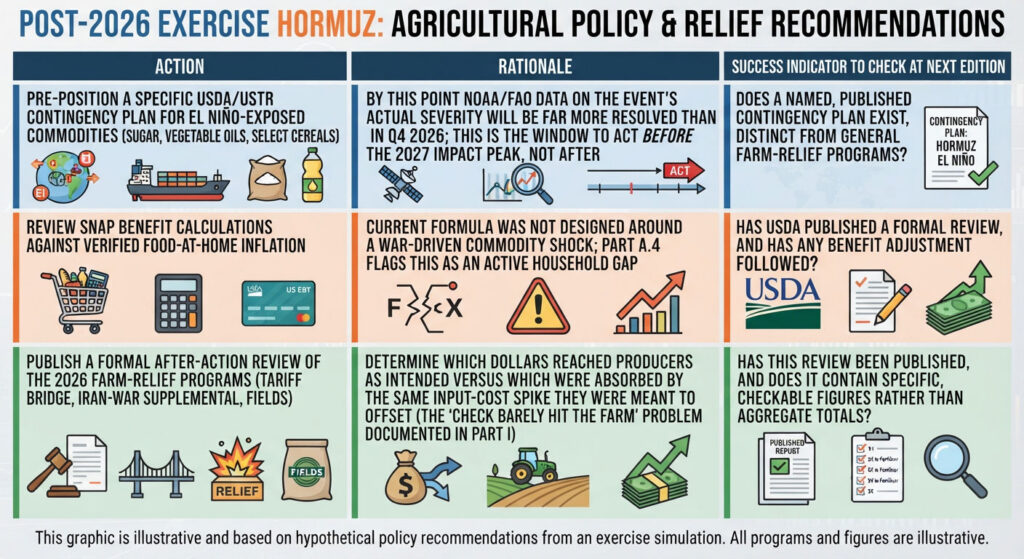
- Pre-position – do not wait to react to – the El Niño shock – By this point, NOAA and FAO/WFP data on the strengthening El Niño’s actual agricultural impact will be far more resolved than it is today. USDA and USTR should have, by this point, a specific contingency plan for the global commodities (sugar, vegetable oils, select cereals) FAO has already flagged as exposed, rather than discovering the exposure after prices move – the exact discipline the 2015 game’s teams displayed in their best-performing round (Round 3), when they used a period of relative calm to build resilience instead of relaxing.
- Review and, if warranted, adjust SNAP benefit calculations to reflect the actual, verified food-at-home inflation trajectory rather than a lagging general formula, specifically addressing the gap identified in Section 7 – that current benefit levels were not designed around a war-driven commodity shock.
- Conduct a formal, published after-action review of the farm-relief programs deployed in 2026 – the tariff bridge, the Iran-war supplemental, and FIELDS – assessing which dollars reached producers as intended versus which were absorbed by the same input-cost spike they were meant to offset. This review should be public and specific, in the spirit of what Millennium Challenge 2002 explicitly failed to do with its own inconvenient result.
At 9 months (~June–July 2027)
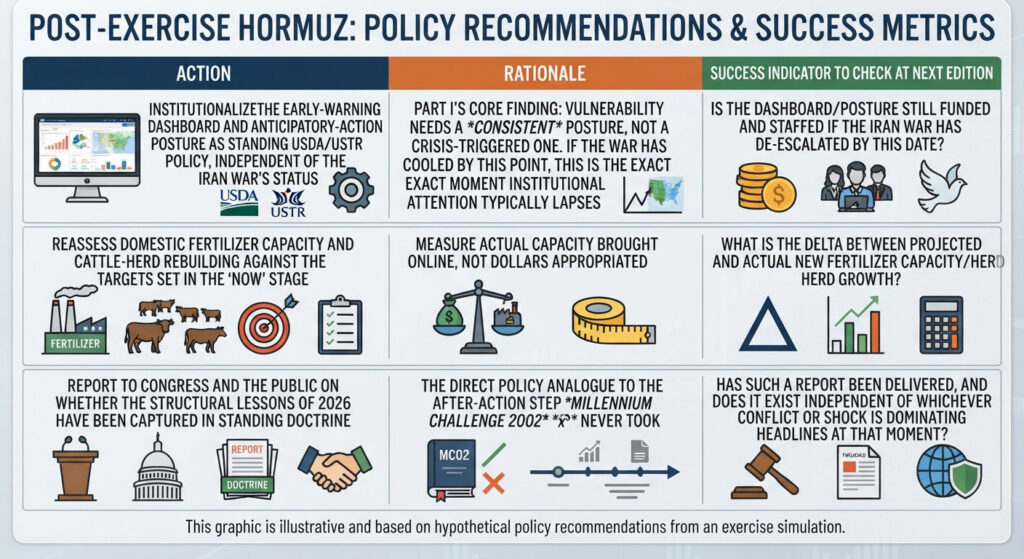
- Institutionalize the early-warning dashboard and the anticipatory-action posture as standing USDA/USTR policy, not an emergency measure tied to the Iran war specifically – The 2015 game’s core, single most repeated finding across every sector was that food-security vulnerability needs a consistent posture, not a crisis-triggered one; by this point the administration should be able to show that the systems built in response to the 2026 Iran-Hormuz shock are still funded and staffed even if that specific conflict has cooled, precisely because the El Niño-driven second wave will likely still be working through global commodity markets at this point
- Reassess domestic fertilizer and cattle-herd rebuilding progress against measurable targets set at the “Now” stage, adjusting FIELDS funding and any remaining loan-guarantee programs based on actual capacity brought online rather than dollars appropriated
- Report to Congress and the public, on the record, whether the structural lessons of this period have been captured in standing doctrine – a specific, named policy analogue to the after-action step Van Riper’s Millennium Challenge critique found totally absent in 2002. The measure of success at this stage is not that the Iran war or the El Niño event have fully resolved – they may not have – but that the institutional machinery built to manage them has outlasted the initial political urgency that created it
Sources
- CNA, “Food Chain Reaction – A Global Food Security Game” (Dec. 2015)
- USDA ERS Food Price Outlook and Farm Sector Income Forecast (Sept. 2026)
- US Bureau of Labor Statistics CPI releases (Aug. 2026)
- FAO Food Price Index (Aug. 2026)
- FAO–WFP Joint Anticipatory Action Appeal (2026)
- NOAA Climate Prediction Center ENSO Diagnostic Discussion (Sept. 2026)
- World Bank and WTO fertilizer/Hormuz trade analysis (2026)
- AAA Daily Fuel Gauge
- American Farm Bureau Federation
- Farm Aid
- CSIS
- Congressional correspondence on fertilizer/Iran war impacts
- CommandEleven Intelligence’s companion analysis of Millennium Challenge 2002