
Executive Summary
The financial architecture of global narcotics trafficking has undergone a profound structural shift. Traditional physical cash smuggling and standard banking integration have become secondary mechanisms for tier-one transnational criminal organizations. This technical paper investigates the operational mechanics of the Illicit Crypto-Clearing Architecture deployed by the Sinaloa Cartel as of May 2026. It maps the automated engineering pipelines used to convert bulk fiat currency into digital assets, analyzes the technical injection vectors used to bypass Know Your Customer (KYC) and Anti-Money Laundering (AML) software, and details the execution of Micro-Layering Protocols using decentralized finance (DeFi) protocols, privacy-enhancing coins (AECs), and chain-hopping algorithms designed to achieve absolute financial anonymity at scale.
3 Key Takeaways
- Bypassing Legitimate Forensics: Transnational syndicates deploy automated velocity-throttling and script-driven cross-chain bridges to execute horizontal transaction dispersion, creating an exponential expansion of data branches that blinds traditional blockchain forensics software.
- The Monero Cryptographic Barrier: By pairing automated atomic swaps with Anonymity-Enhanced Coins (AECs) like Monero ($XMR$), cartel financial nodes exploit protocol-level zero-knowledge encryption to permanently erase the public ledger audit trails linking initial token injections to destination accounts.
- Underground Banking Convergence: The ultimate liquidation phase relies on a mirror settlement network linked to Chinese Underground Banking Systems (CUBS), using trade-based money laundering (TBML) frameworks to bypass international wire-transfer flags and convert digital capital into clean domestic fiat currency.
Fiat-to-Crypto Ingress: The Digital Injection Vector
Before a syndicate can exploit the anonymity of decentralized ledgers, it must solve the critical engineering challenge of converting high-volume, physical street-level cash into digital assets without triggering structural banking flags.
Smurfing Automation via Over-the-Counter (OTC) Broker Networks
The cartel utilizes a highly structured, automated model of peer-to-peer (P2P) smurfing. Specialized money laundering nodes control thousands of unhosted digital wallets registered under synthetic identities or compromised credentials harvested via dark-web markets.
- The Cash-to-Digital Interface: Cash generated from retail illicit sales is distributed to localized networks of runners (smurfs). These individuals deposit small cash increments,carefully calculated to remain below regulatory reporting thresholds,into targeted commercial bank accounts linked to independent Over-the-Counter (OTC) crypto brokers.
- API-Driven Liquidation: The OTC brokers, operating with implicit or explicit complicity, utilize custom Application Programming Interfaces (APIs) linked to major digital asset exchanges. The moment the cash deposits are verified by automated scripts, the corresponding value is released in the form of high-liquidity stablecoins, primarily Tether (USDT) on the Tron ($TRX$) network, directly into cartel-controlled deposit wallets.
Exploitation of the Tron (TRX) Network
The selection of the Tron network as the primary ingress pipeline for international cartel capital is driven by specific technical efficiencies rather than ideological preference.
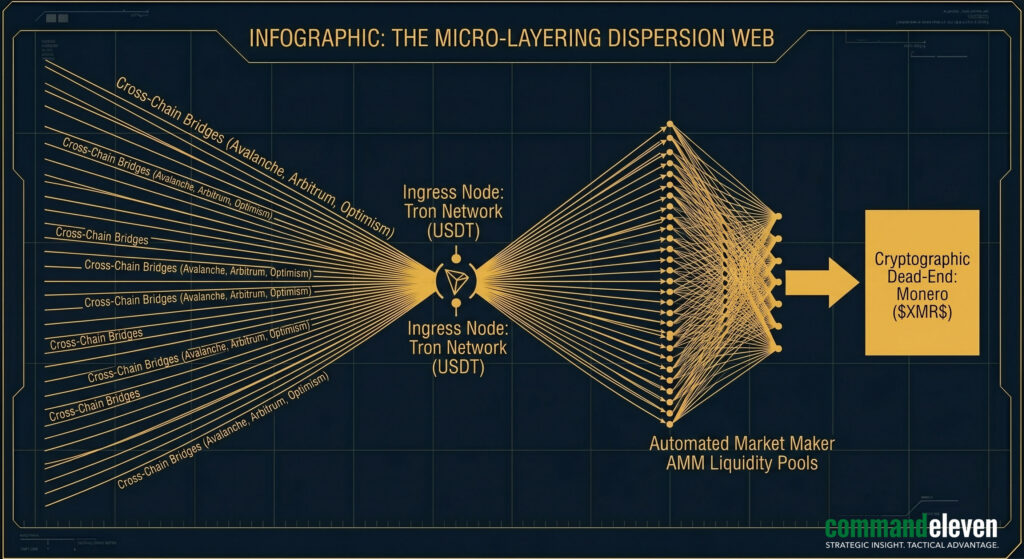
The Tron network provides high transaction processing speeds and negligible network fees compared to the Ethereum mainnet. A multi-million-dollar transaction can be executed on Tron for less than $2 in network fees, allowing the syndicate to run high-frequency, automated distribution scripts without draining profit margins through transaction gas overhead. Furthermore, the decentralized exchange (DEX) liquidity pools on Tron feature massive volume depth, enabling the cartel to swap millions in tokens instantly with minimal slippage.
Peer-to-Peer Smurfing Security Interdiction Bypass
To neutralize the tracking capabilities of automated blockchain analytics software (such as Chainalysis, Elliptic, and TRM Labs), the ingress pipeline deploys Velocity Throttling. Automated scripts ensure that no individual wallet processes more than three incoming transactions per 24-hour cycle, and the total lifetime volume of any singular address is capped at a variable threshold. Once this threshold is reached, the wallet is permanently abandoned, fracturing the deterministic transaction chain that analytics platforms rely on to build behavioral profiles.
The Micro-Layering Protocol: Mechanics of Decentralized Obfuscation
Once the fiat currency has been successfully converted into stablecoins, the cartel activates the Micro-Layering Protocol. This phase represents the core algorithmic engine of modern illicit crypto-clearing, designed to permanently sever the link between the initial token injection and the final fiat liquidation.
Automated Chain-Hopping and Cross-Chain Bridges
The fundamental vulnerability of public ledgers is their immutable audit trail. To blinding this trail, the cartel’s financial engineers utilize automated Cross-Chain Bridges.
- The Bridge Mechanism: A bridge operates by locking a specific token asset on one blockchain network (e.g., USDT on Tron) within a smart contract, and subsequently minting an equivalent asset wrapped on a destination blockchain network (e.g., Wrapped USDT on Avalanche).
- Algorithmic Fragmentation: Custom-written bots split a $1,000,000 stablecoin deposit into hundreds of micro-transactions ranging from $250 to $1,500. These transactions are routed simultaneously across dozens of independent cross-chain bridges,including Thorchain, Wormhole, and LayerZero architectures,at random time intervals.
This massive horizontal dispersion generates an exponential expansion of transaction leaves, overwhelming the graph-database tracking capacities of state-level cyber enforcement agencies.
Decentralized Exchange (DEX) Liquidity Pool Obfuscation
Upon crossing a bridge and arriving at a destination layer-2 network or alternative layer-1 chain, the micro-tokens are automatically directed to decentralized exchanges (such as Uniswap, TraderJoe, or PancakeSwap).
- The Smart Contract Swap: The automated bot interacts with localized smart contracts to execute high-frequency token swaps. USDT is swapped for native gas tokens ($ETH, $AVAX, $SOL$), which are then immediately swapped again into wrapped privacy assets or volatile meme tokens.
- Liquidity Pool Mixing: By continuously swapping assets within high-volume automated market maker (AMM) liquidity pools, the cartel’s funds are mixed with tens of thousands of legitimate retail trading transactions. This process alters the cryptographic signature of the asset’s transaction history, stripping away any “high-risk” taint associated with the original Mexican or Latin American injection points.
Smart Contract Fragmentation Automation
The entire micro-layering sequence is governed by a decentralized autonomous workflow engine. The script utilizes time-weighted average price (TWAP) execution loops to prevent market distortion while introducing intentional, random processing delays. The script can also introduce dummy transactions,intentionally sending small fractions of tokens to known, inactive dead addresses,to confuse automated tracking heuristics and generate false branches within blockchain forensics maps.
Privacy Coin Exploitation: The Monero (XMR) Dead-End
The definitive destination for the micro-layered assets is transition into the absolute cryptographic privacy layer provided by Anonymity-Enhanced Coins (AECs), primarily Monero (XMR). Once funds cross the Monero boundary, public blockchain tracking stops completely.
The Cryptographic Architecture of Absolute Anonymity
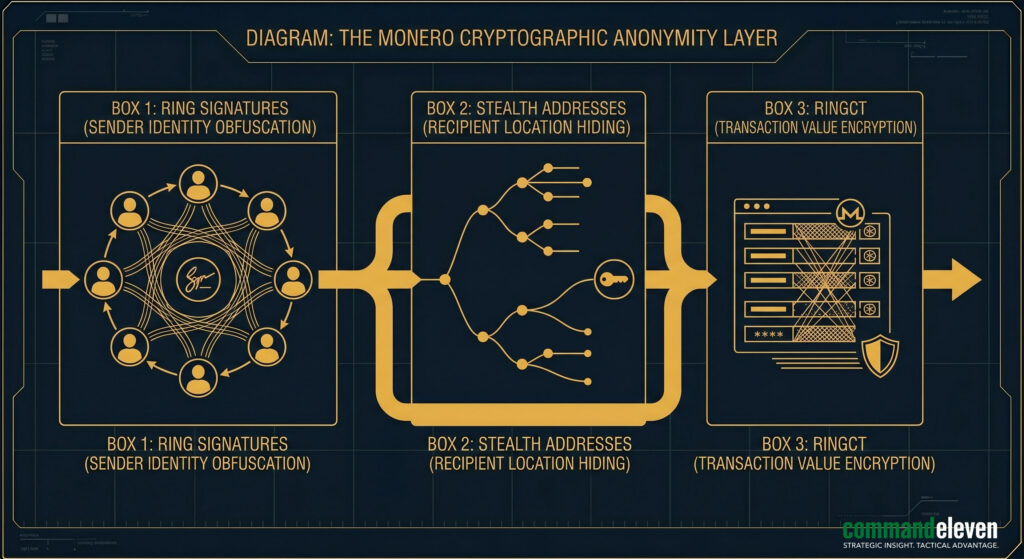
Unlike public ledgers like Bitcoin or Ethereum, where addresses and transaction balances are visible to any observer, Monero integrates three primary privacy technologies at the protocol layer
- Ring Signatures: When a transaction is executed, the sender’s cryptographic signature is grouped together with multiple historical signatures harvested from the blockchain. This creates a joint signature block where an external observer cannot mathematically determine which specific key actually signed and authorized the transaction.
- Stealth Addresses: Every transaction automatically generates a unique, one-time public key address on behalf of the recipient. This prevents the public tracking of a wallet’s cumulative balance, as no two incoming transactions can be linked to the same long-term public address.
- Ring Confidential Transactions (RingCT): This protocol encrypts the specific transaction amounts. Cryptographic checks (using zero-knowledge range proofs) validate that the sum of the transaction inputs matches the sum of the outputs to prevent token counterfeiting, without revealing the actual transaction values to the network.
Atomic Swaps and the Elimination of CEX Counterparty Risk
Historically, converting assets into Monero required the utilization of Centralized Exchanges (CEXs) that enforced strict KYC policies or were vulnerable to state asset seizures. The cartel has eliminated this vulnerability by operationalizing ASDs (Automated Atomic Swaps).
- The Trustless Exchange: An atomic swap is a pure cryptographic smart contract that allows for the direct exchange of two different cryptocurrencies operating on entirely separate blockchains (e.g., Bitcoin or Litecoin to Monero) without requiring a trusted third-party intermediary.
- Execution Mechanics: The cartel’s micro-layered assets are aggregated in decentralized environments, converted into Bitcoin or Litecoin via AMM pools, and immediately pushed through atomic swap scripts. If either party fails to complete the transaction steps within a designated time window, the smart contract automatically refunds the assets to the original wallets. This eliminates counterparty risk while ensuring that the transition into Monero occurs entirely within the dark, unregulated corners of the decentralized ecosystem.
The Blind Wallet Infrastructure
Once inside the Monero network, the funds are routed through an internal network of “Blind Wallets.” These addresses are generated on disconnected, air-gapped hardware devices operating within encrypted operating systems (such as Tails OS) via the Tor or I2P networks. Capital is shifted through multiple internal Monero transactions, resetting the ring signature loops at each step, before being cued for the final egress phase.
Egress and Fiat Liquidation: Re-Injecting Legal Capital
The final phase of the architecture requires extracting the anonymized digital capital back into the formal, physical world to fund cartel operations, purchase advanced armaments, and pay local protection networks.
The Chinese Underground Banking System (CUBS) Convergence
The most advanced egress methodology utilized by the Sinaloa Cartel involves a strategic convergence with Chinese Underground Banking Systems (CUBS) operating in North America and Western Europe.
| Step | Responsible Actor | Operational Mechanism |
| 1. Token Delivery | Cartel Financial Node | Delivers anonymized crypto (USDT/BTC via Monero exit) to CUBS cell |
| 2. Local Settlement | Wealthy Chinese National | Receives crypto assets overseas to bypass domestic capital flight limits |
| 3. Fiat Generation | Domestic CUBS Cash Pool | Releases physical local fiat cash (USD/CAD/EUR) from domestic pools |
| 4. Repatriation | Trade-Based Settle (TBML) | Liquidates local cash via industrial goods exports to Mexico |
- Capital Flight Arbitrage: Wealthy citizens inside restrictive Asian economies seek to move capital overseas, bypassing strict state capital export limits. CUBS cells facilitate this by matching the cartel’s need for local fiat currency with the Chinese national’s need for unmonitored digital assets.
- The Mirror Transaction: The cartel delivers its anonymized crypto assets directly to a CUBS wallet. In return, the CUBS network releases equivalent values of local, physical fiat cash (USD, CAD, or EUR) harvested from domestic cash pools in cities like Los Angeles, Vancouver, or Madrid, completely avoiding the formal international banking system.
Trade-Based Money Laundering (TBML) Finalization
To return the local fiat cash pools generated by CUBS back to Mexico as legitimate corporate revenue, the cartel deploys sophisticated TBML frameworks.
- Industrial Import Exploitation: Cartel front companies purchase commercial-grade industrial equipment, textiles, electronics, or chemical precursors from manufacturing firms in Asia or North America using the CUBS-cleared local cash pools.
- Sovereign Liquidation: These goods are shipped to Mexico under valid corporate import licenses. Upon arrival, the items are sold on the domestic Mexican market through legitimate retail and wholesale networks. The resulting Mexican Pesos are deposited into local corporate accounts as clean, fully auditable commercial revenue, ready to be deployed across the cartel’s primary operational portfolios.
Intelligence Assessment & Forecasting (2026–2030)
CommandEleven Intelligence assesses that the illicit crypto-clearing architecture will become increasingly autonomous, moving toward full algorithmic decentralization by 2030.
AI-Driven Liquidity Trajectory Optimization
By 2027, cartel financial networks will integrate predictive AI engines to manage the micro-layering phase. These models will monitor global blockchain transaction volumes, gas fees, and exchange tracking heuristics in real-time, dynamically shifting the trajectory of exfiltrating tokens to follow the paths of highest volume and lowest analytical visibility, outlacing human-configured blockchain forensics tracking.
The Threat of Zero-Knowledge Layer-2 Native Environments
The widespread adoption of native Zero-Knowledge (ZK) rollups and privacy-centric Layer-2 networks on top of Ethereum will eliminate the need to swap into Monero. As smart contract execution environments become private by default, syndicates will be able to run high-volume, automated money laundering dApps directly on primary smart contract chains, permanently crippling the utility of public tracking systems.
Sovereign Decentralized Havens
As international regulatory pressure forces centralized crypto exchanges to enforce strict global tracking matrices, transnational syndicates will partner with non-aligned or sanctioned sovereign states to build physical server infrastructures dedicated exclusively to hosting unregulated cross-chain bridges and atomic swap matching nodes, establishing permanent, state-protected digital clearings houses immune to Western international law enforcement seizures.