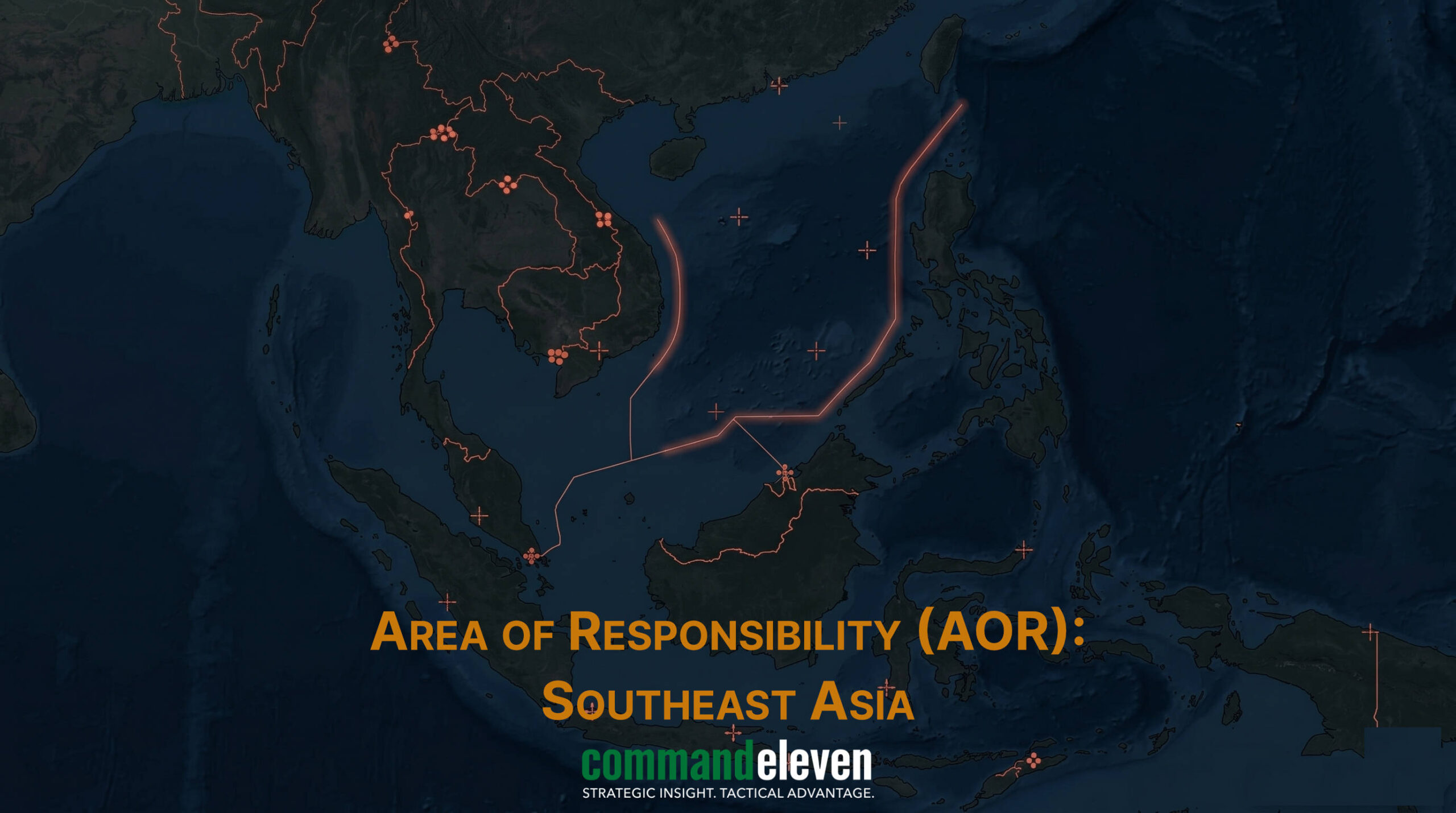
Executive Summary
The intensifying geopolitical polarization of Southeast Asia has catalyzed an aggressive, long-term cyber espionage campaign targeting the region’s digital infrastructure. Advanced Persistent Threats (APTs) operating on behalf of state intelligence services have systematically infiltrated ASEAN governmental networks, ministries of foreign affairs, and critical telecommunications infrastructure. CommandEleven Intelligence identifies a tactical shift toward edge-device exploitation and Living off the Land (LotL) mechanics, where attackers manipulate built-in administrative tools to evade signature-based detection. These operations focus on the pre-positioning of access points within operational technology (OT) and regional SCADA control loops, establishing deniable digital footholds that can be converted into kinetic kill-switches during a future regional security crisis.
3 Key Takeaways
- Exploitation of Third-Party Trust: Threat actors systematically leverage supply chain compromises through Managed Service Providers (MSPs) to cross perimeter defenses and move laterally into high-value government networks.
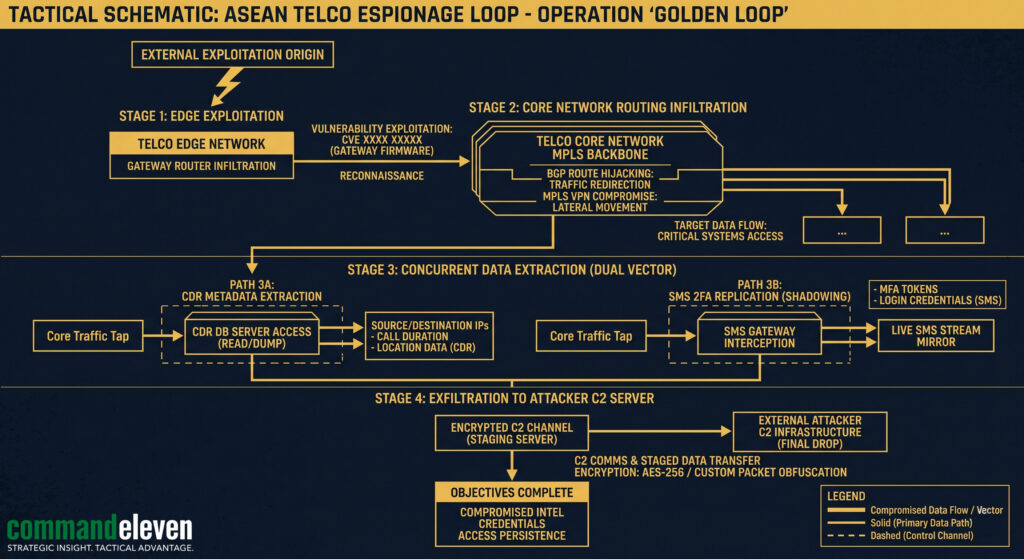
- Core Telecommunications Compromise: APT groups prioritize the structural infiltration of regional Telcos, allowing for the deep-packet extraction of call detail records (CDRs) and the duplication of SMS-based verification codes to bypass two-factor authentication.
- The Autonomy Shift: The defensive framework must adapt to the emergence of AI-driven automated exploits and deepfake-engineered social engineering, requiring the immediate implementation of hardware-based cryptographic verification and absolute IT/OT network segmentation.
Tactical Summary
The geopolitical polarization of Southeast Asia has catalyzed a sophisticated, permanent subterranean conflict within the region’s digital infrastructure. As ASEAN member states navigate the strategic rivalry between Washington and Beijing, the region’s governmental, diplomatic, and critical infrastructure networks have become primary targets for highly specialized Advanced Persistent Threats (APTs). This technical analysis investigates the operational architecture of state-sponsored cyber espionage campaigns within the ASEAN ecosystem as of May 2026. It maps the technical injection vectors, persistence mechanisms, and post-compromise exfiltration doctrines utilized by these actors, while evaluating the specific structural vulnerabilities within regional telecommunications and administrative networks that enable long-term, undetected digital exploitation.
Threat Actor Profiles and Geopolitical Targeting Vectors
Cyber espionage in the ASEAN zone is dominated by highly structured, state-sanctioned organizations operating with clear strategic collection mandates.
The Maritime Collection Specialists
APTs aligned with East Asian state architectures focus their collection efforts on ministries of foreign affairs, naval command structures, and maritime boundary commissions of South China Sea claimant states – specifically Vietnam, the Philippines, and Indonesia. The strategic intent is the extraction of diplomatic talking points, legal strategies for UNCLOS deliberations, and naval deployment schedules prior to regional summits.
The Critical Infrastructure Intruders
A distinct class of threat actors focuses on the pre-positioning of access points within regional SCADA systems, electrical transmission grids, and maritime port logistics networks. These operations bypass traditional corporate IT networks, targeting operational technology (OT) vulnerabilities to establish long-term persistence webs that can be converted into kinetic kill-switches during a regional military contingency.
Intra-ASEAN Transnational Tracking
Concurrently, localized regional intelligence services deploy commercial spyware and customized surveillance frameworks against domestic political dissidents, cross-border activist networks, and ethnic minority leadership operating across the Thailand-Myanmar and Cambodia-Vietnam borders, using cyber tools as an extension of transnational repression frameworks.
Technical Infiltration and Lateral Movement Mechanics
The sophistication of 2026-era APT operations within the ASEAN sector relies on exploiting trusted relationships and leveraging specialized, hard-to-detect malware strains.
Supply Chain Compromise via Managed Service Providers (MSPs)
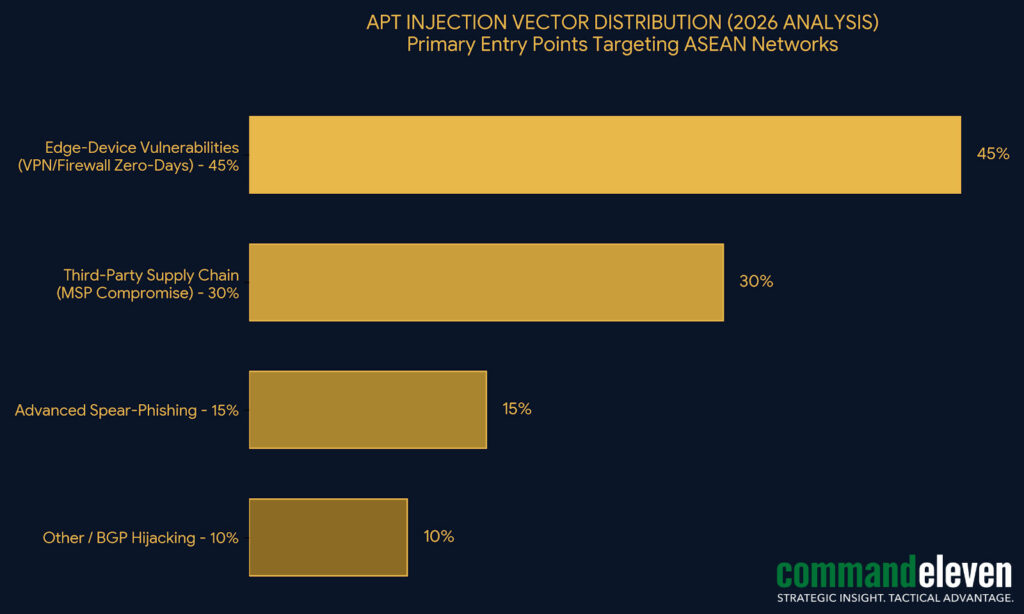
Government ministries in Southeast Asia routinely outsource network management and cloud migrations to third-party Managed Service Providers (MSPs). APT actors exploit this operational practice by compromising the less-defended networks of the MSP first. Once inside the provider’s architecture, attackers utilize legitimate administrative access tokens and remote management tools to move laterally into the primary networks of government clients, bypassing perimeter firewalls and zero-trust verification gateways.
Exploit Infrastructure and Edge-Device Vulnerabilities
Attackers heavily favor the exploitation of zero-day vulnerabilities in perimeter edge devices, such as virtual private network (VPN) gateways, firewalls, and mail servers.
By compromising an edge device, the APT establishes an unmonitored foothold at the perimeter. From this point, they deploy customized, memory-only web shells that execute entirely within the device’s Random Access Memory (RAM), avoiding the disk-level writes that would trigger traditional Endpoint Detection and Response (EDR) software alerts.
Living off the Land (LotL) and Credential Harvesting
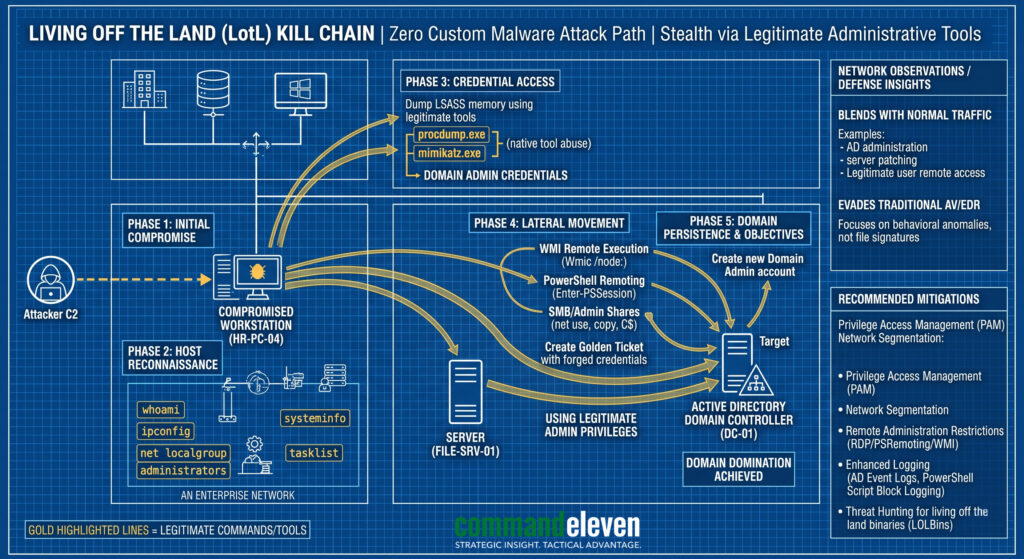
Once internal network access is secured, APT actors minimize the deployment of custom malware to avoid signature-based detection. Instead, they employ Living off the Land (LotL) techniques, utilizing native, legitimate administrative tools – such as Windows Management Instrumentation (WMI), PowerShell, and local command-line utilities – to conduct internal reconnaissance.
They harvest valid administrative credentials by dumping memory from the Local Security Authority Subsystem Service (LSASS), allowing them to navigate the network with legitimate user profiles, masking their malicious presence as standard administrative traffic.
The Telecommunications Vulnerability: Infiltration of Regional Telcos
The primary strategic objective for high-tier espionage actors in Southeast Asia is the structural compromise of regional telecommunications companies (Telcos).
Core Network Compromise and CDR Extraction
By infiltrating the core routing infrastructure of regional Telcos, APT actors gain direct access to Call Detail Record (CDR) databases. This allows for the systematic tracking of metadata – including geolocation, call duration, and device identifiers – belonging to high-value targets, such as military commanders, diplomats, and political leadership, providing a comprehensive map of human networks without requiring endpoint device compromise.
Compromise of SMS Gateways for Two-Factor Authentication (2FA) Interception
A critical technical vector involves the silent manipulation of Telco SMS gateways. When a high-value target attempts to log into an encrypted account requiring SMS-based 2FA, the compromised gateway intercepts and duplicates the verification token, routing it to the attacker’s server in real-time. This completely neutralizes standard multi-factor authentication protections across government email networks.
Rogue BGP Routing and Traffic Redirection
Advanced actors utilize Border Gateway Protocol (BGP) hijacking to briefly re-route regional internet traffic through servers under their regulatory or physical control. During these temporary redirection windows, traffic is subjected to deep-packet inspection, allowing attackers to harvest unencrypted data packets, credentials, and session tokens before returning the routing pathways to their normal configurations.
Counter-Measures and Digital Resilience Standards
The pervasive nature of cyber espionage within the ASEAN ecosystem requires a fundamental shift away from compliance-driven check-box security toward active, threat-informed defense models.
Implementation of Hardware-Based Cryptographic Verification
To counter the vulnerability of SMS-based authentication and software token theft, ASEAN government networks must mandate the transition to hardware-based cryptographic keys (e.g., FIDO2-compliant USB keys). These physical devices require direct human interaction and are immune to remote interception or duplication by compromised Telco gateways.
Network Segmentation and OT Isolation
Critical infrastructure operators must enforce absolute network segmentation between corporate IT and operational technology (OT) environments. SCADA control loops governing power plants, water treatment facilities, and port operations must be physically decoupled from internet-facing architectures, utilizing unidirectional data diodes to export telemetry data without allowing inbound digital commands.
Proactive Threat Hunting and Log Consolidation
Organizations must deploy continuous, automated threat-hunting operations that do not rely on known malware signatures. By aggregating and analyzing system logs within a centralized Security Information and Event Management (SIEM) framework, defenders can identify the subtle anomalies associated with LotL tactics – such as administrative accounts executing commands outside normal operational hours or accessing unauthorized data repositories.
Intelligence Assessment & Forecasting (2026–2030)
CommandEleven Intelligence assesses that the cyber espionage landscape within ASEAN will become increasingly complex, defined by the integration of automated execution and machine-speed data extraction.
AI-Driven Automated Infiltration Exploits
By 2028, APT actors operating in the Southeast Asian theater will deploy automated vulnerability assessment frameworks driven by specialized AI models. These systems will continuously scan regional public infrastructure networks, automatically identifying perimeter misconfigurations and deploying tailored exploit scripts within seconds of a zero-day discovery, outpacing human-driven patch management cycles.
Deepfake Infrastructure for Advanced Social Engineering
Traditional phishing mechanisms will be replaced by hyper-realistic, AI-generated synthetic media campaigns. Attackers will utilize deepfake audio and real-time video manipulation to impersonate senior government ministers or military leaders during virtual briefings or encrypted messaging sessions, tricking lower-level administrators into granting elevated system privileges or bypassing standard security protocols.
The Proliferation of Commercial Off-The-Shelf (COTS) Spyware
The democratization of offensive cyber capabilities will see a proliferation of boutique commercial spyware vendors entering the ASEAN market. Smaller regional states that lack the domestic technical capacity to build indigenous APT programs will purchase turnkey mobile exploitation frameworks from external contractors, leading to a significant increase in the volume and velocity of targeted surveillance operations across the region.