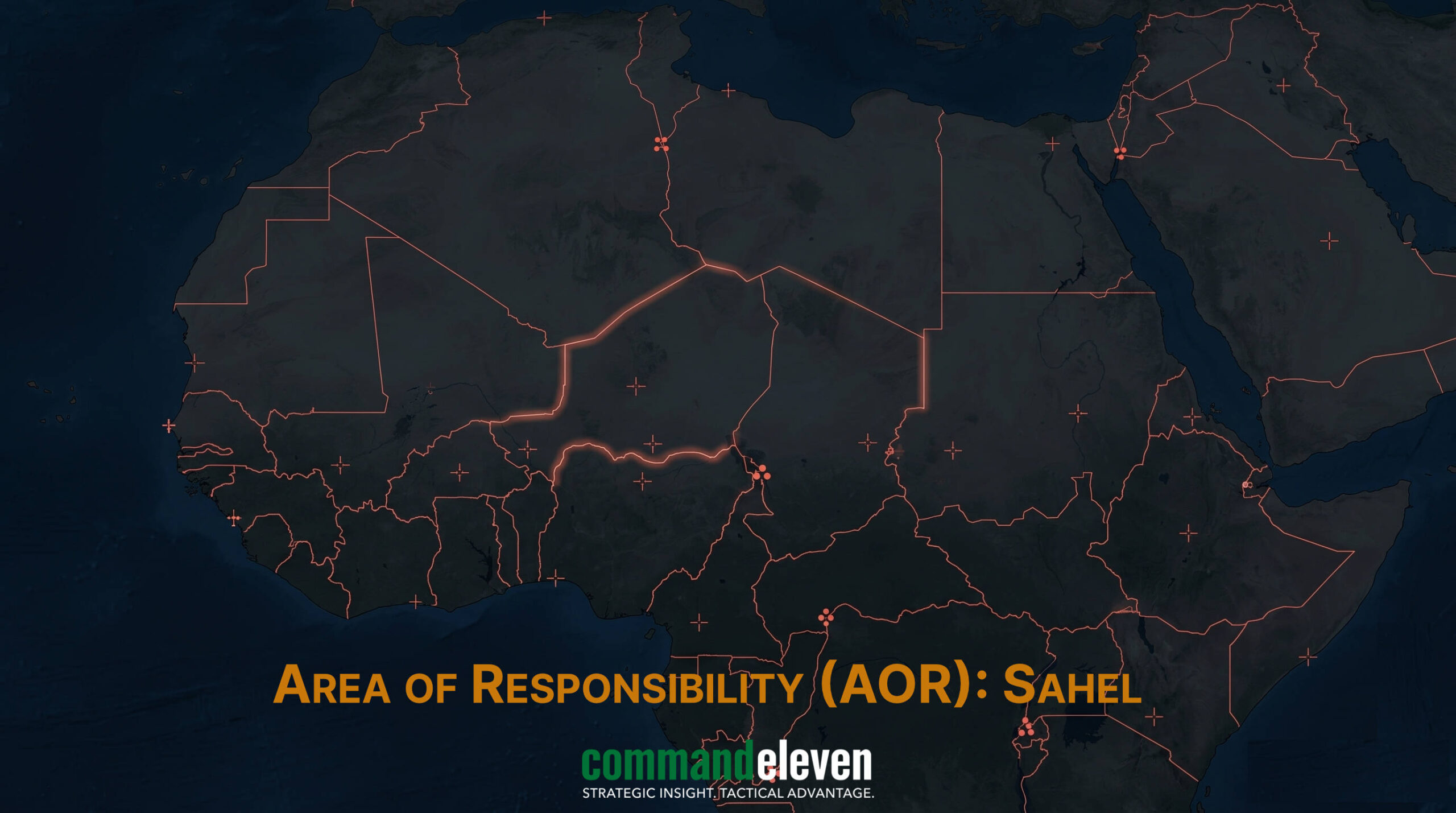
Executive Summary
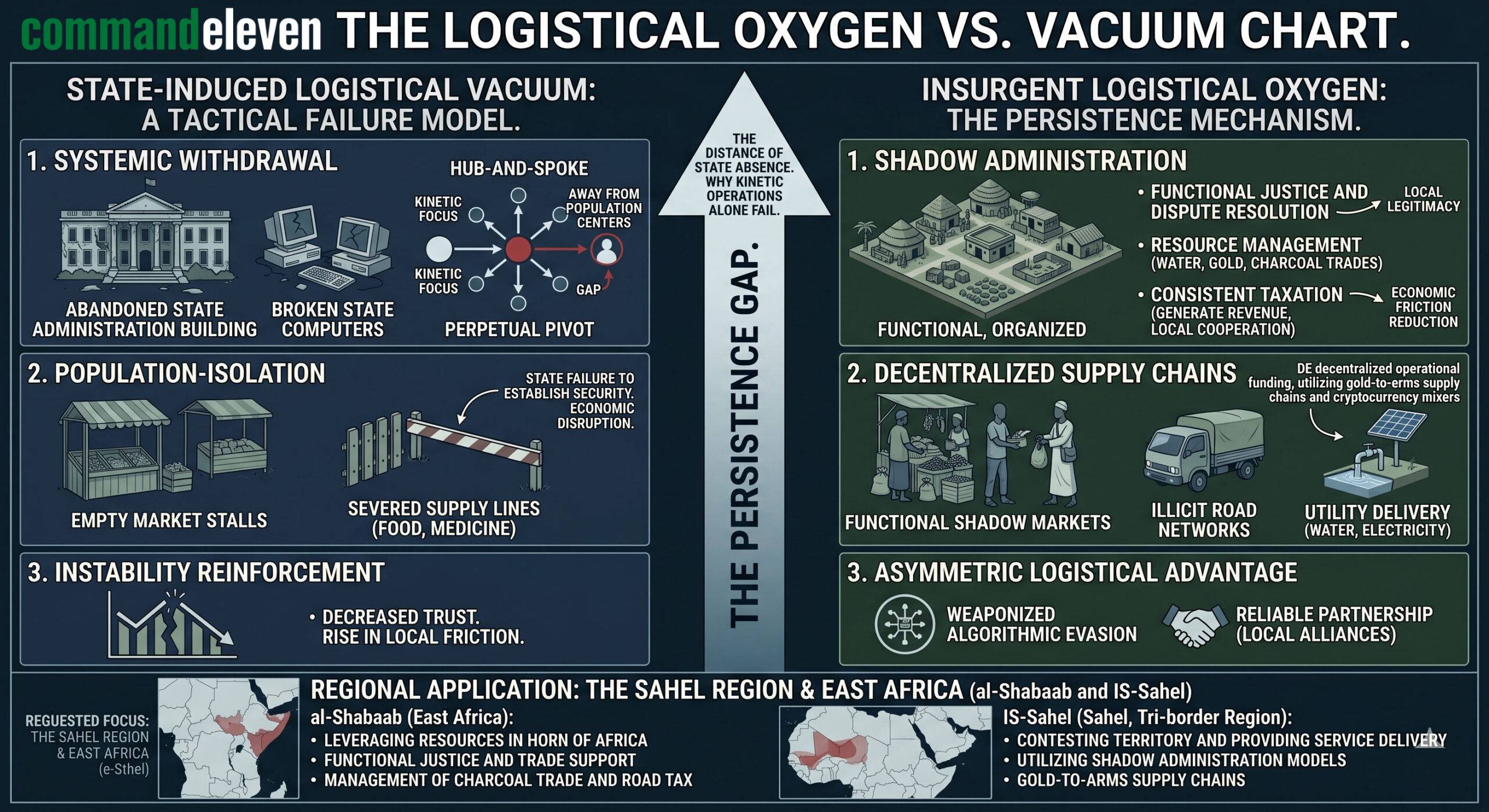
The Persistence Gap Audit (C11-2026-SA-SEA-01) deconstructs the failure of legacy “Clear-Hold-Build” models in Somalia, Mozambique, and the tri-border Sahel. Current data confirms that kinetic dominance without administrative persistence creates a strategic vacuum. Insurgents like Al-Shabaab and IS-Sahel fill this void by providing Logistical Oxygen – functional justice and resource management – at a lower Conflict Premium than the state. Sovereignty is redefined here not as a military footprint, but as a physical, persistent utility delivery. Closing this gap requires the decentralization of governance into Administrative Tiles managed by Tile Guardians who provide superior social utility.
3 Key Takeaways
- Logistical Oxygen Superiority: Insurgent nodes survive by out-performing the state in utility delivery (justice, food, fuel), rendering ideological alignment secondary to physical survival.
- The Hub-and-Spoke Vulnerability: Projected power from central hubs creates vulnerable supply “spokes” that are easily interdicted, inducing state retreat and a “Persistence Deficit.”
- Embedded Persistence: The transition to autonomous Administrative Tiles allows the state to maintain a functional presence during 48-hour digital blackouts and 72-hour kinetic sieges.
The Mirage of Territorial Clearance
In the vast, ungoverned expanses of the Sahel and the littoral corridors of East Africa, the state continues to suffer from a “Kinetic Hallucination.” Regional military coalitions, often backed by international hardware, measure success through “Territorial Clearance” – the physical removal of insurgent cadres from a specific geographic hex. However, as the 2026 Audit of the Cabo Delgado and Liptako-Gourma regions confirms, kinetic dominance without administrative persistence is a strategic void.
This is the Persistence Gap: the measurable distance between a military victory and the establishment of functional, physics-based sovereignty.
The Logistical Oxygen of Al-Shabaab and IS-Sahel
Insurgent actors like Al-Shabaab in Somalia and IS-Sahel in the tri-border region do not survive on ideology alone. They thrive by providing Logistical Oxygen where the state has induced a vacuum.
- Shadow Utility Delivery: In rural Shabelle (Somalia), Al-Shabaab manages a more efficient “Conflict Premium” than the federal administration. They provide rudimentary but consistent functional justice, tax collection, and resource management.
- The Conflict Premium: We define Conflict Premium as the economic and social friction generated by instability. When the state fails to lower the Conflict Premium – by providing security for markets and predictability for trade – the population naturally gravitates toward the insurgent node that offers the least friction, regardless of ideological alignment.
The Failure of the “Hub-and-Spoke” Model
Most counter-insurgency operations in East Africa rely on a “Hub-and-Spoke” logistical model, where military power is projected from a central urban hub into the periphery.
- The Spoke Vulnerability: Insurgents exploit the “Spoke” – the supply lines and communication links – inducing terminal Sensory Rupture through IEDs and signal interdiction.
- The Withdrawal Reflex: Once the “Clear” phase is over, the state typically withdraws to the hub, leaving the population exposed. This cycle creates a “Persistence Deficit” that the insurgent fills within 72 hours of state departure.
Implementing the Mosaic Defense in the Sahel
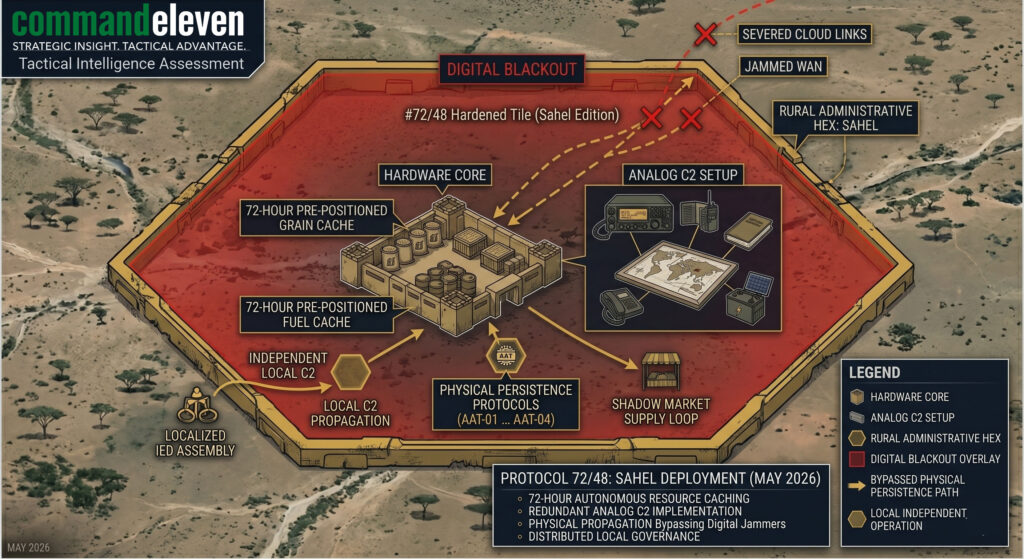
To close the Persistence Gap, regional administrations must transition from projected power to Embedded Persistence. This requires the deployment of Administrative Tiles.
- Tile Guardian Deployment: In the Sahel, sovereignty must be decentralized into autonomous hexes managed by a Tile Guardian (TG). The TG’s primary weapon is not kinetic; it is the provision of Analog Liquidity – the pre-positioning of grain, fuel, and functional justice within the Tile.
- The #72/48 Protocol: Every Tile must be hardened to survive a 72-hour kinetic siege or a 48-hour digital blackout. In East Africa, this means pre-positioned resource silos and frequency-hopping Analog C2 that bypasses the digital mirage used by IS-Sahel strike cells.
Sovereignty as a Physical Reality
Sovereignty in the Sahel and East Africa is not a flag or a digital broadcast; it is a physical, persistent reality. If the state cannot provide superior Logistical Oxygen than Al-Shabaab, it does not possess sovereignty – it only possesses a temporary military footprint. Closing the Persistence Gap requires the state to prove it is more durable, more reliable, and more physically present than the adversary’s shadow administration.